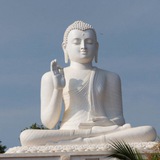
Dhammapada Verse 129
Chabbaggiya Bhikkhu Vatthu
Sabbe tasanti dandassa
sabbe bhayanti maccuno
attanam upamam katva
na haneyya na ghataye.
Verse 129: All are afraid of the stick, all fear death. Putting oneself in another's place, one should not beat or kill others.
The Story of a Group of Six Bhikkhus
While residing at the Javana monastery, the Buddha uttered Verse (129) of this book, with reference to a group of six bhikkhus (chabbaggi) who picked a quarrel with another group comprising seventeen bhikkhus.
Once seventeen bhikkhus were cleaning up a building in the Jetavana monastery-complex with the intention of occupying it, when another group comprising six bhikkhus arrived on the scene. The group of six said to the first group, "We are senior to you, so you had better give way to us; we will take this place." The group of seventeen did not give in, so the chabbaggis beat up the other group who cried out in pain. The Buddha learning about this reprimanded them and laid down the disciplinary rule forbidding bhikkhus to beat others.
Then the Buddha spoke in verse as follows:
Verse 129: All are afraid of the stick, all fear death. Putting oneself in another's place, one should not beat or kill others.
====================
Words of the Buddha channel:
https://news.1rj.ru/str/wordsofbuddha
Chabbaggiya Bhikkhu Vatthu
Sabbe tasanti dandassa
sabbe bhayanti maccuno
attanam upamam katva
na haneyya na ghataye.
Verse 129: All are afraid of the stick, all fear death. Putting oneself in another's place, one should not beat or kill others.
The Story of a Group of Six Bhikkhus
While residing at the Javana monastery, the Buddha uttered Verse (129) of this book, with reference to a group of six bhikkhus (chabbaggi) who picked a quarrel with another group comprising seventeen bhikkhus.
Once seventeen bhikkhus were cleaning up a building in the Jetavana monastery-complex with the intention of occupying it, when another group comprising six bhikkhus arrived on the scene. The group of six said to the first group, "We are senior to you, so you had better give way to us; we will take this place." The group of seventeen did not give in, so the chabbaggis beat up the other group who cried out in pain. The Buddha learning about this reprimanded them and laid down the disciplinary rule forbidding bhikkhus to beat others.
Then the Buddha spoke in verse as follows:
Verse 129: All are afraid of the stick, all fear death. Putting oneself in another's place, one should not beat or kill others.
====================
Words of the Buddha channel:
https://news.1rj.ru/str/wordsofbuddha
Telegram
Words of the Buddha
Daily teachings of Buddha Dharma
👍1💯1🏆1
Forwarded from Buddha Dharma books
Free Buddha Dharma ebook
The Path of Purification
Visuddhimagga
By Bhadantacariya Buddhaghosa
Bhante Nanamoli
One of Buddhism’s foundational texts, the Visuddhimagga is a systematic examination and condensation of Buddhist doctrine and meditation technique. The various teachings of the Buddha found throughout the Pali canon are organized in a clear, comprehensive path leading to the final goal of nibbana, the state of complete purification. Originally composed in the fifth century, this new translation provides English speakers insights into this foundational text. In the course of this treatise full and detailed instructions are given on 40 subjects of meditation aimed at concentration, an elaborate account of Buddhist Abhidhamma philosophy, and explicit denoscriptions of the stages of insight culminating in final liberation.
Free download available:
http://ftp.budaedu.org/ebooks/pdf/EN081.pdf
=============
The Path of Purification
Visuddhimagga
By Bhadantacariya Buddhaghosa
Bhante Nanamoli
One of Buddhism’s foundational texts, the Visuddhimagga is a systematic examination and condensation of Buddhist doctrine and meditation technique. The various teachings of the Buddha found throughout the Pali canon are organized in a clear, comprehensive path leading to the final goal of nibbana, the state of complete purification. Originally composed in the fifth century, this new translation provides English speakers insights into this foundational text. In the course of this treatise full and detailed instructions are given on 40 subjects of meditation aimed at concentration, an elaborate account of Buddhist Abhidhamma philosophy, and explicit denoscriptions of the stages of insight culminating in final liberation.
Free download available:
http://ftp.budaedu.org/ebooks/pdf/EN081.pdf
=============
👍1💯1🏆1
Dhammapada Verse 130
Chabbaggiya Bhikkhu Vatthu
Sabbe tasanti dandassa
sabbesam jivitam piyam
attanam upamam katva
na haneyya na ghataye.
Verse 130: All are afraid of the stick, all hold their lives dear. Putting oneself in another's place, one should not beat or kill others.
The Story of a Group of Six Bhikkhus
While residing at the Jetavana monastery, the Buddha uttered Verse (130) of this book, with reference to a group of six bhikkhus.
After coming to blows the first time, the same two groups of bhikkhus quarrelled again over the same building. As the rule prohibiting beating others had already been laid down, the group of six threatened the other group with upraised hands. The group of seventeen, who were junior to the chabbaggis, cried out in fright. The Buddha hearing about this laid down the disciplinary rule forbidding the raising of hands in threat.
Then the Buddha spoke in verse as follows:
Verse 130: All are afraid of the stick, all hold their lives dear. Putting oneself in another's place, one should not beat or kill others.
====================
Dhammapada, beloved and favorite teachings of the Buddha channel:
https://news.1rj.ru/str/dhammapadas
Chabbaggiya Bhikkhu Vatthu
Sabbe tasanti dandassa
sabbesam jivitam piyam
attanam upamam katva
na haneyya na ghataye.
Verse 130: All are afraid of the stick, all hold their lives dear. Putting oneself in another's place, one should not beat or kill others.
The Story of a Group of Six Bhikkhus
While residing at the Jetavana monastery, the Buddha uttered Verse (130) of this book, with reference to a group of six bhikkhus.
After coming to blows the first time, the same two groups of bhikkhus quarrelled again over the same building. As the rule prohibiting beating others had already been laid down, the group of six threatened the other group with upraised hands. The group of seventeen, who were junior to the chabbaggis, cried out in fright. The Buddha hearing about this laid down the disciplinary rule forbidding the raising of hands in threat.
Then the Buddha spoke in verse as follows:
Verse 130: All are afraid of the stick, all hold their lives dear. Putting oneself in another's place, one should not beat or kill others.
====================
Dhammapada, beloved and favorite teachings of the Buddha channel:
https://news.1rj.ru/str/dhammapadas
Telegram
Dhammapada - Buddha Dharma Teachings
Daily teachings of the Dhammapada, beloved and favorite teachings of the Buddha
👍2💯1🏆1
Forwarded from Buddha Dharma books
Free Buddha Dharma ebook
Gems of Buddhist Wisdom
By Ven. Sri Dhammananda, Ven. Piyadassi Thera, Ven. Narada Mahathera, Ven. U Thittila, Bhikkhu Piyananda, Phra Sasana Sobhana and more.
Compiled by Buddhist Missionary Society
This book is not intended to be read from cover to cover at one sitting. It is hoped that the reader will go through each article mindfully, but at leisure, ponder the arguments presented by each writer before proceeding to another article. The articles are also not arranged in any strict logical sequence so that they may be read in any order and not necessarily as they are presented here.
The writers represented in this book are well-known authors of scholarly treatises on Buddhism who are highly respected in academic institutions all over the world. Yet, their great humility is reflected in their ability to write on the most serious aspects of our religion in a simple and straightforward manner, devoid of any pretentious, archaic or pompous literary style. Short articles, such as those printed in this book put the sublime Teachings of the Buddha within the reach of everyone. Many of them display a charming sense of humour and wit coupled with a very down-to-earth approach to the complex problems of humanity. Through the quotations used by the writers, the lay reader can also share the thoughts of great writers, both Western and Asian like Bertrand Russell and Radhakrishnan. It is hoped that these will encourage the readers to go to the original texts to partake of the great wisdom of mankind.
Free download here:
http://ftp.budaedu.org/ebooks/pdf/EN082.pdf
=============
Gems of Buddhist Wisdom
By Ven. Sri Dhammananda, Ven. Piyadassi Thera, Ven. Narada Mahathera, Ven. U Thittila, Bhikkhu Piyananda, Phra Sasana Sobhana and more.
Compiled by Buddhist Missionary Society
This book is not intended to be read from cover to cover at one sitting. It is hoped that the reader will go through each article mindfully, but at leisure, ponder the arguments presented by each writer before proceeding to another article. The articles are also not arranged in any strict logical sequence so that they may be read in any order and not necessarily as they are presented here.
The writers represented in this book are well-known authors of scholarly treatises on Buddhism who are highly respected in academic institutions all over the world. Yet, their great humility is reflected in their ability to write on the most serious aspects of our religion in a simple and straightforward manner, devoid of any pretentious, archaic or pompous literary style. Short articles, such as those printed in this book put the sublime Teachings of the Buddha within the reach of everyone. Many of them display a charming sense of humour and wit coupled with a very down-to-earth approach to the complex problems of humanity. Through the quotations used by the writers, the lay reader can also share the thoughts of great writers, both Western and Asian like Bertrand Russell and Radhakrishnan. It is hoped that these will encourage the readers to go to the original texts to partake of the great wisdom of mankind.
Free download here:
http://ftp.budaedu.org/ebooks/pdf/EN082.pdf
=============
❤1👍1💯1🏆1
Dhammapada Verses 131 and 132
Sambahula Kumaraka Vatthu
Sukhakamani bhutani
yo dandena vihimsati
attano sukhamesano
pecca so na labhate sukham.
Sukhakamani bhutani
yo dandena na himsati
attano sukhamesano
pecca so labbate sukhatm.
Verse 131: He who seeks his own happiness by oppressing others, who also desire to have happiness, will not find happiness in his next existence.
Verse 132: He who seeks his own happiness by not oppressing others, who also desire to have happiness, will find happiness in his next existence.
The Story of Many Youths
While residing at the Jetavana monastery, the Buddha uttered Verses (131) and (132) of this book, with reference to a number of youths.
Once, the Buddha was out on an alms-round at Savatthi when he came across a number of youths beating a snake with sticks. When questioned, the youths answered that they were beating the snake because they were afraid that the snake might bite them. To them the Buddha said, "If you do not want to be harmed, you should also not harm others: if you harm others, you will not find happiness in your next existence."
Then the Buddha spoke in verse as follows:
Verse 131: He who seeks his own happiness by oppressing others, who also desire to have happiness, will not find happiness in his next existence.
Verse 132: He who seeks his own happiness by not oppressing others, who also desire to have happiness, will find happiness in his next existence.
At the end of the discourse all the youths attained Sotapatti Fruition.
====================
Buddha dharma teachings channel:
https://invite.viber.com/?g2=AQAKw1y3rv%2F6sk61PI2W4izuIiaEZj8YZujhY1tSzL%2B07s7rFnVFDAd0bAYFaMLw
Sambahula Kumaraka Vatthu
Sukhakamani bhutani
yo dandena vihimsati
attano sukhamesano
pecca so na labhate sukham.
Sukhakamani bhutani
yo dandena na himsati
attano sukhamesano
pecca so labbate sukhatm.
Verse 131: He who seeks his own happiness by oppressing others, who also desire to have happiness, will not find happiness in his next existence.
Verse 132: He who seeks his own happiness by not oppressing others, who also desire to have happiness, will find happiness in his next existence.
The Story of Many Youths
While residing at the Jetavana monastery, the Buddha uttered Verses (131) and (132) of this book, with reference to a number of youths.
Once, the Buddha was out on an alms-round at Savatthi when he came across a number of youths beating a snake with sticks. When questioned, the youths answered that they were beating the snake because they were afraid that the snake might bite them. To them the Buddha said, "If you do not want to be harmed, you should also not harm others: if you harm others, you will not find happiness in your next existence."
Then the Buddha spoke in verse as follows:
Verse 131: He who seeks his own happiness by oppressing others, who also desire to have happiness, will not find happiness in his next existence.
Verse 132: He who seeks his own happiness by not oppressing others, who also desire to have happiness, will find happiness in his next existence.
At the end of the discourse all the youths attained Sotapatti Fruition.
====================
Buddha dharma teachings channel:
https://invite.viber.com/?g2=AQAKw1y3rv%2F6sk61PI2W4izuIiaEZj8YZujhY1tSzL%2B07s7rFnVFDAd0bAYFaMLw
Viber
Buddha
Buddha dharma teachings from the suttas and commentaries from Theravada tradition
👍1💯1🏆1
Forwarded from Buddha Dharma books
Free Buddha Dharma ebook
Practical Vipassana Meditation Exercises
By Mahasi Sayadaw Gyi
When the Venerable Mahasi Sayadawgyi came down to Yangon Sasana Yeiktha, in 1949, he introduced the first batch of 25 yogis to the methodical practice of Vipassana meditation on 4th December 1945. At first, Sayadawgyi himself delivered the initiation talks of about 1½ hour to each batch of meditators. Later the talk was tape-recorded (27th July, 1951) and since then, it was played back to each batch of new yogis. This discourse was published in book form in 1954 and in the same year it was translated into English by yogi U Pe Thin under the noscript “ The Satipatthana Vipassana Meditation (A basic Buddhist Mindfulness Exercise’’).
Free download here:
http://www.mediafire.com/file/ewsxdkoq6oaa5ym/
=============
Practical Vipassana Meditation Exercises
By Mahasi Sayadaw Gyi
When the Venerable Mahasi Sayadawgyi came down to Yangon Sasana Yeiktha, in 1949, he introduced the first batch of 25 yogis to the methodical practice of Vipassana meditation on 4th December 1945. At first, Sayadawgyi himself delivered the initiation talks of about 1½ hour to each batch of meditators. Later the talk was tape-recorded (27th July, 1951) and since then, it was played back to each batch of new yogis. This discourse was published in book form in 1954 and in the same year it was translated into English by yogi U Pe Thin under the noscript “ The Satipatthana Vipassana Meditation (A basic Buddhist Mindfulness Exercise’’).
Free download here:
http://www.mediafire.com/file/ewsxdkoq6oaa5ym/
=============
👍1💯1🏆1
Dhammapada Verses 133 and 134
Kondadhanatthera Vatthu
Mavoca pharusam kanci
vutta pativadeyyu tam
dukkha hi sarambkakatha1
patidanda phuseyyu tam.
Sace neresi attanam
kamso upahato yatha
esa pattosi nibbanam
sarambho te na vijjati.
Verse 133: Do not speak harshly to anyone; those who are thus spoken to will retort. Malicious talk is indeed the cause of trouble (dukkha) and retribution will come to you.
Verse 134: If you can keep yourself calm and quiet like a broken gong which is no longer resonant, you are sure to realize Nibbana, there will be no harshness in you.
1. sarambkakatha: Malacious talk. According to the Commentary it means talk belittling others.
The Story of Thera Kondadhana
While residing at the Jetavana monastery, the Buddha uttered Verses (133) and (134) of this book, with reference to Thera Kondadhana.
Since the day Kondadhana was admitted to the Order, the image of a female was always following him. This image was seen by others, but Kondadhana himself did not see it and so did not know about it.
When he was out on an alms-round, people would offer two spoonfuls to him, saying, "This is for you, Venerable Sir, and this is for your female companion." Seeing the bhikkhu going about with a woman, people went to King Pasenadi of Kosala and reported about the bhikkhu and the woman. They said to the king, "O king! Drive out the bhikkhu, who is lacking in moral virtues, from your kingdom." So the king went to the monastery where that bhikkhu was staying and surrounded it with his men.
Hearing noises and voices, the bhikkhus came out and stood at the door, and the image also was there not far from the bhikkhu. Knowing that the king had come, the bhikkhu went into the room to wait for him. When the king entered the room, the image was not there. The king asked the bhikkhu where the woman was and he replied that he saw no woman. The king wanted to make sure and he asked the bhikkhu to leave the room for a while. The bhikkhu left the room, but when the king looked out, again he saw the woman near the bhikkhu. But when the bhikkhu came back to the room the woman was nowhere to be found. The king concluded that the woman was not real and so the bhikkhu must be innocent. He therefore invited the bhikkhu to come to the palace every day for alms-food.
When other bhikkhus heard about this, they were puzzled and said to the bhikkhu, "O bhikkhu with no morals! Now that the king, instead of driving you out of his kingdom, has invited you for alms-food, you are doomed!" The bhikkhu on his part retorted, "Only you are the ones without morals; only you are doomed because you are the ones who go about with women!"
The bhikkhus then reported the matter to the Buddha. The Buddha sent for Kodadadhana and said to him, "My son, did you see any woman with the other bhikkhus that you have talked to them thus? You have not seen any woman with them as they have seen one with you. I see that you do not realize that you have been cursed on account of an evil deed done by you in a past existence. Now listen, I shall explain to you why you have an image of a woman following you about.
"You were a deva in your last existence. During that time, there were two bhikkhus who were very much attached to each other. But you tried to create trouble between the two, by assuming the appearance of a woman and following one of the bhikkhus. For that evil deed you are now being followed by the image of a woman. So, my son, in future do not argue with other bhikkhus any more; keep silent like a gong with the rim broken off and you will realize Nibbana."
Then the Buddha spoke in verse as follows:
Kondadhanatthera Vatthu
Mavoca pharusam kanci
vutta pativadeyyu tam
dukkha hi sarambkakatha1
patidanda phuseyyu tam.
Sace neresi attanam
kamso upahato yatha
esa pattosi nibbanam
sarambho te na vijjati.
Verse 133: Do not speak harshly to anyone; those who are thus spoken to will retort. Malicious talk is indeed the cause of trouble (dukkha) and retribution will come to you.
Verse 134: If you can keep yourself calm and quiet like a broken gong which is no longer resonant, you are sure to realize Nibbana, there will be no harshness in you.
1. sarambkakatha: Malacious talk. According to the Commentary it means talk belittling others.
The Story of Thera Kondadhana
While residing at the Jetavana monastery, the Buddha uttered Verses (133) and (134) of this book, with reference to Thera Kondadhana.
Since the day Kondadhana was admitted to the Order, the image of a female was always following him. This image was seen by others, but Kondadhana himself did not see it and so did not know about it.
When he was out on an alms-round, people would offer two spoonfuls to him, saying, "This is for you, Venerable Sir, and this is for your female companion." Seeing the bhikkhu going about with a woman, people went to King Pasenadi of Kosala and reported about the bhikkhu and the woman. They said to the king, "O king! Drive out the bhikkhu, who is lacking in moral virtues, from your kingdom." So the king went to the monastery where that bhikkhu was staying and surrounded it with his men.
Hearing noises and voices, the bhikkhus came out and stood at the door, and the image also was there not far from the bhikkhu. Knowing that the king had come, the bhikkhu went into the room to wait for him. When the king entered the room, the image was not there. The king asked the bhikkhu where the woman was and he replied that he saw no woman. The king wanted to make sure and he asked the bhikkhu to leave the room for a while. The bhikkhu left the room, but when the king looked out, again he saw the woman near the bhikkhu. But when the bhikkhu came back to the room the woman was nowhere to be found. The king concluded that the woman was not real and so the bhikkhu must be innocent. He therefore invited the bhikkhu to come to the palace every day for alms-food.
When other bhikkhus heard about this, they were puzzled and said to the bhikkhu, "O bhikkhu with no morals! Now that the king, instead of driving you out of his kingdom, has invited you for alms-food, you are doomed!" The bhikkhu on his part retorted, "Only you are the ones without morals; only you are doomed because you are the ones who go about with women!"
The bhikkhus then reported the matter to the Buddha. The Buddha sent for Kodadadhana and said to him, "My son, did you see any woman with the other bhikkhus that you have talked to them thus? You have not seen any woman with them as they have seen one with you. I see that you do not realize that you have been cursed on account of an evil deed done by you in a past existence. Now listen, I shall explain to you why you have an image of a woman following you about.
"You were a deva in your last existence. During that time, there were two bhikkhus who were very much attached to each other. But you tried to create trouble between the two, by assuming the appearance of a woman and following one of the bhikkhus. For that evil deed you are now being followed by the image of a woman. So, my son, in future do not argue with other bhikkhus any more; keep silent like a gong with the rim broken off and you will realize Nibbana."
Then the Buddha spoke in verse as follows:
👍1💯1🏆1
Verse 133: Do not speak harshly to anyone; those who are thus spoken to will retort. Malicious talk is indeed the cause of trouble (dukkha) and retribution will come to you.
Verse 134: If you can keep yourself calm and quiet like a broken gong which is no longer resonant, you are sure to realize Nibbana, there will be no harshness in you.
====================
Words of the Buddha channel:
https://invite.viber.com/?g2=AQAFqzqlj7FmI061PX17rxWMAtZ%2BRuso%2FH2KmHKZSgnv7v9DD8X0bDkKnZDr9JDq
Verse 134: If you can keep yourself calm and quiet like a broken gong which is no longer resonant, you are sure to realize Nibbana, there will be no harshness in you.
====================
Words of the Buddha channel:
https://invite.viber.com/?g2=AQAFqzqlj7FmI061PX17rxWMAtZ%2BRuso%2FH2KmHKZSgnv7v9DD8X0bDkKnZDr9JDq
Viber
Words Of The Buddha
Daily teachings from Buddha Dharma
👍1💯1🏆1