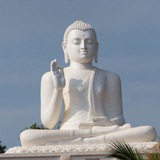
Each morning, you rededicate yourself to your path in order not to go astray. Before going to sleep at night, take a few minutes to review the day. “Did I live in the direction of my ideals today?” If you see that you took two or three steps in that direction, that is good enough. If you didn’t, say to yourself, “I’ll do better tomorrow.” Don’t compare yourself with others. Just look to yourself to see whether you are going in the direction you cherish. Take refuge in things that are solid. If you lean on something that isn’t solid, you will fall down. A few sanghas may not yet be solid, but usually taking refuge in a sangha is a wise thing to do. There are sangha members everywhere who are practicing earnestly.
“Freedom” means transcending the trap of harmful desires and being without attachments—whether to an institution, a diploma, or a certain rank. From time to time we encounter people who are free and can do whatever is needed.
“Indifference.” When we are indifferent, nothing is enjoyable, interesting, or worth striving for. We don’t experience love or understanding, and our life has no joy or meaning. We don’t even notice the beauties of nature or the laughter of children. We are unable to touch the suffering or the happiness of others. If you find yourself in a state of indifference, ask your friends for help. Even with all its suffering, life is filled with many wonders.
“Free from attachment and aversion.” The kind of love the Buddha wanted us to cultivate is not possessive or attached. All of us, young and old, have a tendency to become attached. As soon as we are born, attachment to self is already there. In wholesome love relationships, there is a certain amount of possessiveness and attachment, but if it’s excessive, both lover and beloved will suffer. If a father thinks he “owns” his son, or if a young man tries to put restrictions on his girlfriend, then love becomes a prison. This is also true in relationships between friends, teachers, students, and so on. Attachment obstructs the flow of life. And without mindfulness, attachment always becomes aversion. Both attachment and aversion lead to suffering. Look deeply to discover the nature of your love, and identify the degree of attachment, despotism, and possessiveness in your love. Then you can begin untangling the knots. The seeds of true love—lovingkindness, compassion, joy, and equanimity—are already there in our store consciousness. Through the practice of deep looking, the seeds of suffering and attachment will shrink and the positive seeds will grow. We can transform attachment and aversion and arrive at a love that is spacious and all-encompassing.
===
From No Mud, No Lotus: The Art of Transforming Suffering, by Thich Nhat Hanh.
Thich Nhat Hanh (1926–2022) was a Vietnamese Buddhist monk, author, and peace activist who was nominated for the Nobel Peace Prize by Martin Luther King Jr.
===
Ajahn Chah, Buddhist teacher of Thai forest meditation of Theravada Buddhism channel:
https://news.1rj.ru/str/ajahnchah_buddhism
===
“Freedom” means transcending the trap of harmful desires and being without attachments—whether to an institution, a diploma, or a certain rank. From time to time we encounter people who are free and can do whatever is needed.
“Indifference.” When we are indifferent, nothing is enjoyable, interesting, or worth striving for. We don’t experience love or understanding, and our life has no joy or meaning. We don’t even notice the beauties of nature or the laughter of children. We are unable to touch the suffering or the happiness of others. If you find yourself in a state of indifference, ask your friends for help. Even with all its suffering, life is filled with many wonders.
“Free from attachment and aversion.” The kind of love the Buddha wanted us to cultivate is not possessive or attached. All of us, young and old, have a tendency to become attached. As soon as we are born, attachment to self is already there. In wholesome love relationships, there is a certain amount of possessiveness and attachment, but if it’s excessive, both lover and beloved will suffer. If a father thinks he “owns” his son, or if a young man tries to put restrictions on his girlfriend, then love becomes a prison. This is also true in relationships between friends, teachers, students, and so on. Attachment obstructs the flow of life. And without mindfulness, attachment always becomes aversion. Both attachment and aversion lead to suffering. Look deeply to discover the nature of your love, and identify the degree of attachment, despotism, and possessiveness in your love. Then you can begin untangling the knots. The seeds of true love—lovingkindness, compassion, joy, and equanimity—are already there in our store consciousness. Through the practice of deep looking, the seeds of suffering and attachment will shrink and the positive seeds will grow. We can transform attachment and aversion and arrive at a love that is spacious and all-encompassing.
===
From No Mud, No Lotus: The Art of Transforming Suffering, by Thich Nhat Hanh.
Thich Nhat Hanh (1926–2022) was a Vietnamese Buddhist monk, author, and peace activist who was nominated for the Nobel Peace Prize by Martin Luther King Jr.
===
Ajahn Chah, Buddhist teacher of Thai forest meditation of Theravada Buddhism channel:
https://news.1rj.ru/str/ajahnchah_buddhism
===
Telegram
Ajahn Chah - Theravada Thailand Buddhism
Collection of teachings of Venerable Ajahn Chah, a foremost meditation and Buddhist teacher from Thailand
👏1💯1🏆1
Dhammapada Verse 165
Culakala Upasaka Vatthu
Attana hi katam pipam
attana samkilissati
attana akatam papam
attanava visujjhati
suddhi asuddhi paccattam
nanno annanam visodhaye.
Verse 165: By oneself indeed is evil done and by oneself is one defiled; by oneself is evil not done and by oneself is one purified. Purity and impurity depend entirely on oneself; no one can purify another.
The Story of Culakala Upasaka
While residing at the Jetavana monastery, the Buddha uttered Verse (165) of this book, with reference to Culakala, a lay disciple.
Culakala, a lay disciple, observed the Uposatha precepts on a certain sabbath day and spent the night at the Jetavana monastery, listening to religious discourses all through the night. Early in the morning, as he was washing his face at the pond near the monastery, some thieves dropped a bundle near him. The owners seeing him with the stolen property took him for a thief and beat him hard. Fortunately some slave girls who had come to fetch water testified that they knew him and that he was not the thief. So Culakala was let off.
When the Buddha was told about it, he said to Culakala, "You have been let off not only because the slave girls said that you were not the thief but also because you did not steal and was therefore innocent. Those who do evil go to niraya, but those who do good are reborn in the deva worlds or else realize Nibbana."
Then the Buddha spoke in verse as follows:
Verse 165: By oneself indeed is evil done and by oneself is one defiled; by oneself is evil not done and by oneself is one purified. Purity and impurity depend entirely on oneself; no one can purify another.
At the end of the discourse Culakala the lay disciple attained Sotapatti Fruition.
===
Buddha dharma teachings channel:
https://invite.viber.com/?g2=AQAKw1y3rv%2F6sk61PI2W4izuIiaEZj8YZujhY1tSzL%2B07s7rFnVFDAd0bAYFaMLw
====================
Culakala Upasaka Vatthu
Attana hi katam pipam
attana samkilissati
attana akatam papam
attanava visujjhati
suddhi asuddhi paccattam
nanno annanam visodhaye.
Verse 165: By oneself indeed is evil done and by oneself is one defiled; by oneself is evil not done and by oneself is one purified. Purity and impurity depend entirely on oneself; no one can purify another.
The Story of Culakala Upasaka
While residing at the Jetavana monastery, the Buddha uttered Verse (165) of this book, with reference to Culakala, a lay disciple.
Culakala, a lay disciple, observed the Uposatha precepts on a certain sabbath day and spent the night at the Jetavana monastery, listening to religious discourses all through the night. Early in the morning, as he was washing his face at the pond near the monastery, some thieves dropped a bundle near him. The owners seeing him with the stolen property took him for a thief and beat him hard. Fortunately some slave girls who had come to fetch water testified that they knew him and that he was not the thief. So Culakala was let off.
When the Buddha was told about it, he said to Culakala, "You have been let off not only because the slave girls said that you were not the thief but also because you did not steal and was therefore innocent. Those who do evil go to niraya, but those who do good are reborn in the deva worlds or else realize Nibbana."
Then the Buddha spoke in verse as follows:
Verse 165: By oneself indeed is evil done and by oneself is one defiled; by oneself is evil not done and by oneself is one purified. Purity and impurity depend entirely on oneself; no one can purify another.
At the end of the discourse Culakala the lay disciple attained Sotapatti Fruition.
===
Buddha dharma teachings channel:
https://invite.viber.com/?g2=AQAKw1y3rv%2F6sk61PI2W4izuIiaEZj8YZujhY1tSzL%2B07s7rFnVFDAd0bAYFaMLw
====================
Viber
Buddha
Buddha dharma teachings from the suttas and commentaries from Theravada tradition
❤3👏1🏆1
Dhammapada Verse 166
Attadatthatthera Vatthu
Attadattham1 paratthena
bahunapi na hapaye
attadatthamabhinnaya
sadatthapasuto siya.
Verse 166: For the sake of another's benefit, however great it may be, do not neglect one's own (moral) benefit. Clearly perceiving one's own benefit one should make every effort to attain it.
1. Attadattham: one's own benefit. According to the Commentary, in this context, one's own benefit means Magga, Phala and Nibbana. (N.B. The above was uttered by the Buddha in connection with Insight Meditation.)
The Story of Thera Attadattha
While residing at the Jetavana monastery, the Buddha uttered Verse (166) of this book, with reference to Thera Attadattha.
When the Buddha declared that he would realize parinibbana in four months' time, many puthujjana bhikkhus* were apprehensive and did not know what to do; so they kept close to the Buddha. Attadattha, however, did not go to the Buddha and, having resolved to attain arahatship during the lifetime of the Buddha, was striving hard in the meditation practice. Other bhikkhus, not understanding him, took him to the Buddha and said, "Venerable Sir, this bhikkhu does not seem to love and revere you as we do; he only keeps to himself." The thera then explained to them that he was striving hard to attain arahatship before the Buddha realized parinibbana and that was the only reason why he had not come to the Buddha.
The Buddha then said to the bhikkhus, "Bhikkhus, those who love and revere me should act like Attadattha. You are not paying me homage by just offering flowers, perfumes and incense and by coming to see me; you pay me homage only by practising the Dhamma I have taught you, i.e., the Lokuttara Dhamma."
Then the Buddha spoke in verse as follows:
Verse 166: For the sake of another's benefit, however great it may be, do not neglect one's own (moral) benefit. Clearly perceiving one's own benefit one should make every effort to attain it.
At the end of the discourse Thera Attadattha attained arahatship.
*Puthujjana bhikkhus: bhikkhus who have not yet attained any Magga.
End of Chapter Twelve: Self (Attavagga)
===
Words of the Buddha channel:
https://invite.viber.com/?g2=AQAFqzqlj7FmI061PX17rxWMAtZ%2BRuso%2FH2KmHKZSgnv7v9DD8X0bDkKnZDr9JDq
====================
Attadatthatthera Vatthu
Attadattham1 paratthena
bahunapi na hapaye
attadatthamabhinnaya
sadatthapasuto siya.
Verse 166: For the sake of another's benefit, however great it may be, do not neglect one's own (moral) benefit. Clearly perceiving one's own benefit one should make every effort to attain it.
1. Attadattham: one's own benefit. According to the Commentary, in this context, one's own benefit means Magga, Phala and Nibbana. (N.B. The above was uttered by the Buddha in connection with Insight Meditation.)
The Story of Thera Attadattha
While residing at the Jetavana monastery, the Buddha uttered Verse (166) of this book, with reference to Thera Attadattha.
When the Buddha declared that he would realize parinibbana in four months' time, many puthujjana bhikkhus* were apprehensive and did not know what to do; so they kept close to the Buddha. Attadattha, however, did not go to the Buddha and, having resolved to attain arahatship during the lifetime of the Buddha, was striving hard in the meditation practice. Other bhikkhus, not understanding him, took him to the Buddha and said, "Venerable Sir, this bhikkhu does not seem to love and revere you as we do; he only keeps to himself." The thera then explained to them that he was striving hard to attain arahatship before the Buddha realized parinibbana and that was the only reason why he had not come to the Buddha.
The Buddha then said to the bhikkhus, "Bhikkhus, those who love and revere me should act like Attadattha. You are not paying me homage by just offering flowers, perfumes and incense and by coming to see me; you pay me homage only by practising the Dhamma I have taught you, i.e., the Lokuttara Dhamma."
Then the Buddha spoke in verse as follows:
Verse 166: For the sake of another's benefit, however great it may be, do not neglect one's own (moral) benefit. Clearly perceiving one's own benefit one should make every effort to attain it.
At the end of the discourse Thera Attadattha attained arahatship.
*Puthujjana bhikkhus: bhikkhus who have not yet attained any Magga.
End of Chapter Twelve: Self (Attavagga)
===
Words of the Buddha channel:
https://invite.viber.com/?g2=AQAFqzqlj7FmI061PX17rxWMAtZ%2BRuso%2FH2KmHKZSgnv7v9DD8X0bDkKnZDr9JDq
====================
Viber
Words Of The Buddha
Daily teachings from Buddha Dharma
❤1💯1🏆1
Dhammapada Verse 167
Daharabhikkhu Vatthu
Hinam dhammam na seveyya
pamadena na samvase
micchaditthim na seveyya
na siya lokavaddhano.
Verse 167: Do not follow ignoble ways, do not live in negligence, do not embrace wrong views, do not be the one to prolong samsara (lit., the world).
The Story of a Young Bhikkhu
While residing at the Jetavana monastery, the Buddha uttered Verse (167) of this book, with reference to a young bhikkhu.
Once, a young bhikkhu accompanied an older bhikkhu to the house of Visakha. After taking rice gruel, the elder bhikkhu left for another place, leaving the young bhikkhu behind at the house of Visakha. The granddaughter of Visakha was filtering some water for the young bhikkhu, and when she saw her own reflection in the big water pot she smiled. Seeing her thus smiling, the young bhikkhu looked at her and he also smiled. When she saw the young bhikkhu looking at her and smiling at her, she lost her temper, and cried out angrily, "You, a shaven head! Why are you smiling at me ?" The young bhikkhu reported, "You are a shaven head yourself; your mother and your father are also shaven heads!" Thus, they quarrelled, and the young girl went weeping to her grandmother. Visakha came and said to the young bhikkhu, "Please do not get angry with my grand daughter. But, a bhikkhu does have his hair shaved, his finger nails and toe nails cut, and putting on a robe which is made up of cut pieces, he goes on alms-round with a bowl which is rimless. What this young girl said was, in a way, quite right, is it not?" The young bhikkhu replied. "It is true but why should she abuse me on that account ?" At this point, the elder bhikkhu returned; but both Visakha and the old bhikkhu failed to appease the young bhikkhu and the young girl.
Soon after this, the Buddha arrived and learned about the quarrel. The Buddha knew that time was ripe for the young bhikkhu to attain Sotapatti Fruition. Then, in order to make the young bhikkhu more responsive to his words, he seemingly sided with him and said to Visakha, "Visakha, what reason is there for your grand daughter to address my son as a shaven head just because he has his head shaven? After all, he had his head shaven to enter my Order, didn't he?"
Hearing these words, the young bhikkhu went down on his knees, paid obeisance to the Buddha, and said, "Venerable Sir! You alone understands me; neither my teacher nor the great donor of the monastery understands me." The Buddha knew that the bhikkhu was then in a receptive mood and so he said, "To smile with sensual desire is ignoble; it is not right and proper to have ignoble thoughts."
Then the Buddha spoke in verse as follows:
Verse 167: Do not follow ignoble ways, do not live in negligence, do not embrace wrong views, do not be the one to prolong samsara (lit., the world).
At the end of the discourse, the young bhikkhu attained Sotapatti Fruition.
===
Dhammapada, beloved and favorite teachings of the Buddha channel:
https://invite.viber.com/?g2=AQBLD6phsgvP%2F061YjEM3K%2BNeH1Yb372b9mtfQX2EmuBpgoLUoc99BDMfzHghrme
====================
Daharabhikkhu Vatthu
Hinam dhammam na seveyya
pamadena na samvase
micchaditthim na seveyya
na siya lokavaddhano.
Verse 167: Do not follow ignoble ways, do not live in negligence, do not embrace wrong views, do not be the one to prolong samsara (lit., the world).
The Story of a Young Bhikkhu
While residing at the Jetavana monastery, the Buddha uttered Verse (167) of this book, with reference to a young bhikkhu.
Once, a young bhikkhu accompanied an older bhikkhu to the house of Visakha. After taking rice gruel, the elder bhikkhu left for another place, leaving the young bhikkhu behind at the house of Visakha. The granddaughter of Visakha was filtering some water for the young bhikkhu, and when she saw her own reflection in the big water pot she smiled. Seeing her thus smiling, the young bhikkhu looked at her and he also smiled. When she saw the young bhikkhu looking at her and smiling at her, she lost her temper, and cried out angrily, "You, a shaven head! Why are you smiling at me ?" The young bhikkhu reported, "You are a shaven head yourself; your mother and your father are also shaven heads!" Thus, they quarrelled, and the young girl went weeping to her grandmother. Visakha came and said to the young bhikkhu, "Please do not get angry with my grand daughter. But, a bhikkhu does have his hair shaved, his finger nails and toe nails cut, and putting on a robe which is made up of cut pieces, he goes on alms-round with a bowl which is rimless. What this young girl said was, in a way, quite right, is it not?" The young bhikkhu replied. "It is true but why should she abuse me on that account ?" At this point, the elder bhikkhu returned; but both Visakha and the old bhikkhu failed to appease the young bhikkhu and the young girl.
Soon after this, the Buddha arrived and learned about the quarrel. The Buddha knew that time was ripe for the young bhikkhu to attain Sotapatti Fruition. Then, in order to make the young bhikkhu more responsive to his words, he seemingly sided with him and said to Visakha, "Visakha, what reason is there for your grand daughter to address my son as a shaven head just because he has his head shaven? After all, he had his head shaven to enter my Order, didn't he?"
Hearing these words, the young bhikkhu went down on his knees, paid obeisance to the Buddha, and said, "Venerable Sir! You alone understands me; neither my teacher nor the great donor of the monastery understands me." The Buddha knew that the bhikkhu was then in a receptive mood and so he said, "To smile with sensual desire is ignoble; it is not right and proper to have ignoble thoughts."
Then the Buddha spoke in verse as follows:
Verse 167: Do not follow ignoble ways, do not live in negligence, do not embrace wrong views, do not be the one to prolong samsara (lit., the world).
At the end of the discourse, the young bhikkhu attained Sotapatti Fruition.
===
Dhammapada, beloved and favorite teachings of the Buddha channel:
https://invite.viber.com/?g2=AQBLD6phsgvP%2F061YjEM3K%2BNeH1Yb372b9mtfQX2EmuBpgoLUoc99BDMfzHghrme
====================
Viber
Dhammapada - Buddha Dharma Teachings
Daily teachings of the Dhammapada, beloved and favorite teachings of the Buddha
👍2👏1💯1
Forwarded from Buddha Dharma books
Free Buddha Dharma ebook
Fundamentals Of Vipassana Meditation
By Mahasi Sayadaw Gyi
The Venerable Mahasi Sayadawgyi had delivered a series of lectures on “Fundamentals of Vipassana Methods” at the Fan Yin Hall of Mahasi Yeiktha during water festivals of 1959(April). These lectures had been tape recorded, transcribed into book form and published in 1961 together with a number of Dhamma Aphorisms. Up to now twenty editions have been printed and published. The English rendering of the Myanmar text was made by the translator in the name of Maung Tha Noe and the First Editions was published in 1980, followed by the Second and Third Editions in 1992 and 1996 respectively.
As the noscript of the text indicates: Mahasi Sayadawgyi explained the fundamentals of Vipassana meditation in a very clear and lucid manner. Those who are not acquainted with Vipassana meditation will find it very valuable to properly understand the fundamentals theoretically. If they wish to put into practice what they learn, this book will take them step by step as to how insight meditation is to be practised and if they follow these steps diligently they will gain various insights gradually culminating in relinquishing various mental defilements and realising Nibbana.
Free download here:
http://www.mediafire.com/file/f133oa85j9onrzt/
=============
Fundamentals Of Vipassana Meditation
By Mahasi Sayadaw Gyi
The Venerable Mahasi Sayadawgyi had delivered a series of lectures on “Fundamentals of Vipassana Methods” at the Fan Yin Hall of Mahasi Yeiktha during water festivals of 1959(April). These lectures had been tape recorded, transcribed into book form and published in 1961 together with a number of Dhamma Aphorisms. Up to now twenty editions have been printed and published. The English rendering of the Myanmar text was made by the translator in the name of Maung Tha Noe and the First Editions was published in 1980, followed by the Second and Third Editions in 1992 and 1996 respectively.
As the noscript of the text indicates: Mahasi Sayadawgyi explained the fundamentals of Vipassana meditation in a very clear and lucid manner. Those who are not acquainted with Vipassana meditation will find it very valuable to properly understand the fundamentals theoretically. If they wish to put into practice what they learn, this book will take them step by step as to how insight meditation is to be practised and if they follow these steps diligently they will gain various insights gradually culminating in relinquishing various mental defilements and realising Nibbana.
Free download here:
http://www.mediafire.com/file/f133oa85j9onrzt/
=============
🙏3❤1👍1👏1
King Milinda asks:
"What is the benefit of building stupas and paying respect to them? The Buddha has passed away, so how can such acts bring merit?"
Nagasena replies:
"Great king, even though the Buddha has passed away, his relics remain as a focus of veneration. When people build stupas or offer respect to them, they create merit. Just as the fragrance of a flower spreads with the wind, the act of reverence brings joy and spiritual benefit to the devotees."
He further explains:
"The stupa is like a great rain cloud, bringing blessings and relief to those who seek it. By honoring the stupa, one honors the Buddha, his teachings, and the Sangha, cultivating wholesome qualities and a peaceful mind."
Milindapanha, Chapter 4 (Veneration of Stupas)
"What is the benefit of building stupas and paying respect to them? The Buddha has passed away, so how can such acts bring merit?"
Nagasena replies:
"Great king, even though the Buddha has passed away, his relics remain as a focus of veneration. When people build stupas or offer respect to them, they create merit. Just as the fragrance of a flower spreads with the wind, the act of reverence brings joy and spiritual benefit to the devotees."
He further explains:
"The stupa is like a great rain cloud, bringing blessings and relief to those who seek it. By honoring the stupa, one honors the Buddha, his teachings, and the Sangha, cultivating wholesome qualities and a peaceful mind."
Milindapanha, Chapter 4 (Veneration of Stupas)
❤1🥰1