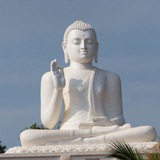
Dhammapada Verse 166
Attadatthatthera Vatthu
Attadattham1 paratthena
bahunapi na hapaye
attadatthamabhinnaya
sadatthapasuto siya.
Verse 166: For the sake of another's benefit, however great it may be, do not neglect one's own (moral) benefit. Clearly perceiving one's own benefit one should make every effort to attain it.
1. Attadattham: one's own benefit. According to the Commentary, in this context, one's own benefit means Magga, Phala and Nibbana. (N.B. The above was uttered by the Buddha in connection with Insight Meditation.)
The Story of Thera Attadattha
While residing at the Jetavana monastery, the Buddha uttered Verse (166) of this book, with reference to Thera Attadattha.
When the Buddha declared that he would realize parinibbana in four months' time, many puthujjana bhikkhus* were apprehensive and did not know what to do; so they kept close to the Buddha. Attadattha, however, did not go to the Buddha and, having resolved to attain arahatship during the lifetime of the Buddha, was striving hard in the meditation practice. Other bhikkhus, not understanding him, took him to the Buddha and said, "Venerable Sir, this bhikkhu does not seem to love and revere you as we do; he only keeps to himself." The thera then explained to them that he was striving hard to attain arahatship before the Buddha realized parinibbana and that was the only reason why he had not come to the Buddha.
The Buddha then said to the bhikkhus, "Bhikkhus, those who love and revere me should act like Attadattha. You are not paying me homage by just offering flowers, perfumes and incense and by coming to see me; you pay me homage only by practising the Dhamma I have taught you, i.e., the Lokuttara Dhamma."
Then the Buddha spoke in verse as follows:
Verse 166: For the sake of another's benefit, however great it may be, do not neglect one's own (moral) benefit. Clearly perceiving one's own benefit one should make every effort to attain it.
At the end of the discourse Thera Attadattha attained arahatship.
*Puthujjana bhikkhus: bhikkhus who have not yet attained any Magga.
End of Chapter Twelve: Self (Attavagga)
===
Words of the Buddha channel:
https://invite.viber.com/?g2=AQAFqzqlj7FmI061PX17rxWMAtZ%2BRuso%2FH2KmHKZSgnv7v9DD8X0bDkKnZDr9JDq
====================
Attadatthatthera Vatthu
Attadattham1 paratthena
bahunapi na hapaye
attadatthamabhinnaya
sadatthapasuto siya.
Verse 166: For the sake of another's benefit, however great it may be, do not neglect one's own (moral) benefit. Clearly perceiving one's own benefit one should make every effort to attain it.
1. Attadattham: one's own benefit. According to the Commentary, in this context, one's own benefit means Magga, Phala and Nibbana. (N.B. The above was uttered by the Buddha in connection with Insight Meditation.)
The Story of Thera Attadattha
While residing at the Jetavana monastery, the Buddha uttered Verse (166) of this book, with reference to Thera Attadattha.
When the Buddha declared that he would realize parinibbana in four months' time, many puthujjana bhikkhus* were apprehensive and did not know what to do; so they kept close to the Buddha. Attadattha, however, did not go to the Buddha and, having resolved to attain arahatship during the lifetime of the Buddha, was striving hard in the meditation practice. Other bhikkhus, not understanding him, took him to the Buddha and said, "Venerable Sir, this bhikkhu does not seem to love and revere you as we do; he only keeps to himself." The thera then explained to them that he was striving hard to attain arahatship before the Buddha realized parinibbana and that was the only reason why he had not come to the Buddha.
The Buddha then said to the bhikkhus, "Bhikkhus, those who love and revere me should act like Attadattha. You are not paying me homage by just offering flowers, perfumes and incense and by coming to see me; you pay me homage only by practising the Dhamma I have taught you, i.e., the Lokuttara Dhamma."
Then the Buddha spoke in verse as follows:
Verse 166: For the sake of another's benefit, however great it may be, do not neglect one's own (moral) benefit. Clearly perceiving one's own benefit one should make every effort to attain it.
At the end of the discourse Thera Attadattha attained arahatship.
*Puthujjana bhikkhus: bhikkhus who have not yet attained any Magga.
End of Chapter Twelve: Self (Attavagga)
===
Words of the Buddha channel:
https://invite.viber.com/?g2=AQAFqzqlj7FmI061PX17rxWMAtZ%2BRuso%2FH2KmHKZSgnv7v9DD8X0bDkKnZDr9JDq
====================
Viber
Words Of The Buddha
Daily teachings from Buddha Dharma
❤1💯1🏆1
Dhammapada Verse 167
Daharabhikkhu Vatthu
Hinam dhammam na seveyya
pamadena na samvase
micchaditthim na seveyya
na siya lokavaddhano.
Verse 167: Do not follow ignoble ways, do not live in negligence, do not embrace wrong views, do not be the one to prolong samsara (lit., the world).
The Story of a Young Bhikkhu
While residing at the Jetavana monastery, the Buddha uttered Verse (167) of this book, with reference to a young bhikkhu.
Once, a young bhikkhu accompanied an older bhikkhu to the house of Visakha. After taking rice gruel, the elder bhikkhu left for another place, leaving the young bhikkhu behind at the house of Visakha. The granddaughter of Visakha was filtering some water for the young bhikkhu, and when she saw her own reflection in the big water pot she smiled. Seeing her thus smiling, the young bhikkhu looked at her and he also smiled. When she saw the young bhikkhu looking at her and smiling at her, she lost her temper, and cried out angrily, "You, a shaven head! Why are you smiling at me ?" The young bhikkhu reported, "You are a shaven head yourself; your mother and your father are also shaven heads!" Thus, they quarrelled, and the young girl went weeping to her grandmother. Visakha came and said to the young bhikkhu, "Please do not get angry with my grand daughter. But, a bhikkhu does have his hair shaved, his finger nails and toe nails cut, and putting on a robe which is made up of cut pieces, he goes on alms-round with a bowl which is rimless. What this young girl said was, in a way, quite right, is it not?" The young bhikkhu replied. "It is true but why should she abuse me on that account ?" At this point, the elder bhikkhu returned; but both Visakha and the old bhikkhu failed to appease the young bhikkhu and the young girl.
Soon after this, the Buddha arrived and learned about the quarrel. The Buddha knew that time was ripe for the young bhikkhu to attain Sotapatti Fruition. Then, in order to make the young bhikkhu more responsive to his words, he seemingly sided with him and said to Visakha, "Visakha, what reason is there for your grand daughter to address my son as a shaven head just because he has his head shaven? After all, he had his head shaven to enter my Order, didn't he?"
Hearing these words, the young bhikkhu went down on his knees, paid obeisance to the Buddha, and said, "Venerable Sir! You alone understands me; neither my teacher nor the great donor of the monastery understands me." The Buddha knew that the bhikkhu was then in a receptive mood and so he said, "To smile with sensual desire is ignoble; it is not right and proper to have ignoble thoughts."
Then the Buddha spoke in verse as follows:
Verse 167: Do not follow ignoble ways, do not live in negligence, do not embrace wrong views, do not be the one to prolong samsara (lit., the world).
At the end of the discourse, the young bhikkhu attained Sotapatti Fruition.
===
Dhammapada, beloved and favorite teachings of the Buddha channel:
https://invite.viber.com/?g2=AQBLD6phsgvP%2F061YjEM3K%2BNeH1Yb372b9mtfQX2EmuBpgoLUoc99BDMfzHghrme
====================
Daharabhikkhu Vatthu
Hinam dhammam na seveyya
pamadena na samvase
micchaditthim na seveyya
na siya lokavaddhano.
Verse 167: Do not follow ignoble ways, do not live in negligence, do not embrace wrong views, do not be the one to prolong samsara (lit., the world).
The Story of a Young Bhikkhu
While residing at the Jetavana monastery, the Buddha uttered Verse (167) of this book, with reference to a young bhikkhu.
Once, a young bhikkhu accompanied an older bhikkhu to the house of Visakha. After taking rice gruel, the elder bhikkhu left for another place, leaving the young bhikkhu behind at the house of Visakha. The granddaughter of Visakha was filtering some water for the young bhikkhu, and when she saw her own reflection in the big water pot she smiled. Seeing her thus smiling, the young bhikkhu looked at her and he also smiled. When she saw the young bhikkhu looking at her and smiling at her, she lost her temper, and cried out angrily, "You, a shaven head! Why are you smiling at me ?" The young bhikkhu reported, "You are a shaven head yourself; your mother and your father are also shaven heads!" Thus, they quarrelled, and the young girl went weeping to her grandmother. Visakha came and said to the young bhikkhu, "Please do not get angry with my grand daughter. But, a bhikkhu does have his hair shaved, his finger nails and toe nails cut, and putting on a robe which is made up of cut pieces, he goes on alms-round with a bowl which is rimless. What this young girl said was, in a way, quite right, is it not?" The young bhikkhu replied. "It is true but why should she abuse me on that account ?" At this point, the elder bhikkhu returned; but both Visakha and the old bhikkhu failed to appease the young bhikkhu and the young girl.
Soon after this, the Buddha arrived and learned about the quarrel. The Buddha knew that time was ripe for the young bhikkhu to attain Sotapatti Fruition. Then, in order to make the young bhikkhu more responsive to his words, he seemingly sided with him and said to Visakha, "Visakha, what reason is there for your grand daughter to address my son as a shaven head just because he has his head shaven? After all, he had his head shaven to enter my Order, didn't he?"
Hearing these words, the young bhikkhu went down on his knees, paid obeisance to the Buddha, and said, "Venerable Sir! You alone understands me; neither my teacher nor the great donor of the monastery understands me." The Buddha knew that the bhikkhu was then in a receptive mood and so he said, "To smile with sensual desire is ignoble; it is not right and proper to have ignoble thoughts."
Then the Buddha spoke in verse as follows:
Verse 167: Do not follow ignoble ways, do not live in negligence, do not embrace wrong views, do not be the one to prolong samsara (lit., the world).
At the end of the discourse, the young bhikkhu attained Sotapatti Fruition.
===
Dhammapada, beloved and favorite teachings of the Buddha channel:
https://invite.viber.com/?g2=AQBLD6phsgvP%2F061YjEM3K%2BNeH1Yb372b9mtfQX2EmuBpgoLUoc99BDMfzHghrme
====================
Viber
Dhammapada - Buddha Dharma Teachings
Daily teachings of the Dhammapada, beloved and favorite teachings of the Buddha
👍2👏1💯1
Forwarded from Buddha Dharma books
Free Buddha Dharma ebook
Fundamentals Of Vipassana Meditation
By Mahasi Sayadaw Gyi
The Venerable Mahasi Sayadawgyi had delivered a series of lectures on “Fundamentals of Vipassana Methods” at the Fan Yin Hall of Mahasi Yeiktha during water festivals of 1959(April). These lectures had been tape recorded, transcribed into book form and published in 1961 together with a number of Dhamma Aphorisms. Up to now twenty editions have been printed and published. The English rendering of the Myanmar text was made by the translator in the name of Maung Tha Noe and the First Editions was published in 1980, followed by the Second and Third Editions in 1992 and 1996 respectively.
As the noscript of the text indicates: Mahasi Sayadawgyi explained the fundamentals of Vipassana meditation in a very clear and lucid manner. Those who are not acquainted with Vipassana meditation will find it very valuable to properly understand the fundamentals theoretically. If they wish to put into practice what they learn, this book will take them step by step as to how insight meditation is to be practised and if they follow these steps diligently they will gain various insights gradually culminating in relinquishing various mental defilements and realising Nibbana.
Free download here:
http://www.mediafire.com/file/f133oa85j9onrzt/
=============
Fundamentals Of Vipassana Meditation
By Mahasi Sayadaw Gyi
The Venerable Mahasi Sayadawgyi had delivered a series of lectures on “Fundamentals of Vipassana Methods” at the Fan Yin Hall of Mahasi Yeiktha during water festivals of 1959(April). These lectures had been tape recorded, transcribed into book form and published in 1961 together with a number of Dhamma Aphorisms. Up to now twenty editions have been printed and published. The English rendering of the Myanmar text was made by the translator in the name of Maung Tha Noe and the First Editions was published in 1980, followed by the Second and Third Editions in 1992 and 1996 respectively.
As the noscript of the text indicates: Mahasi Sayadawgyi explained the fundamentals of Vipassana meditation in a very clear and lucid manner. Those who are not acquainted with Vipassana meditation will find it very valuable to properly understand the fundamentals theoretically. If they wish to put into practice what they learn, this book will take them step by step as to how insight meditation is to be practised and if they follow these steps diligently they will gain various insights gradually culminating in relinquishing various mental defilements and realising Nibbana.
Free download here:
http://www.mediafire.com/file/f133oa85j9onrzt/
=============
🙏3❤1👍1👏1
King Milinda asks:
"What is the benefit of building stupas and paying respect to them? The Buddha has passed away, so how can such acts bring merit?"
Nagasena replies:
"Great king, even though the Buddha has passed away, his relics remain as a focus of veneration. When people build stupas or offer respect to them, they create merit. Just as the fragrance of a flower spreads with the wind, the act of reverence brings joy and spiritual benefit to the devotees."
He further explains:
"The stupa is like a great rain cloud, bringing blessings and relief to those who seek it. By honoring the stupa, one honors the Buddha, his teachings, and the Sangha, cultivating wholesome qualities and a peaceful mind."
Milindapanha, Chapter 4 (Veneration of Stupas)
"What is the benefit of building stupas and paying respect to them? The Buddha has passed away, so how can such acts bring merit?"
Nagasena replies:
"Great king, even though the Buddha has passed away, his relics remain as a focus of veneration. When people build stupas or offer respect to them, they create merit. Just as the fragrance of a flower spreads with the wind, the act of reverence brings joy and spiritual benefit to the devotees."
He further explains:
"The stupa is like a great rain cloud, bringing blessings and relief to those who seek it. By honoring the stupa, one honors the Buddha, his teachings, and the Sangha, cultivating wholesome qualities and a peaceful mind."
Milindapanha, Chapter 4 (Veneration of Stupas)
❤1🥰1
Dhammapada Verses 168 and 169
Suddhodana Vatthu
Uttitthe nappamajjeyya
dhammam sucaritam1 care
dhammacari sukham seti
asmim loke paramhi ca.
Dhammam care sucaritarm
na nam duccaritam2 care
dhammacari sukham seti
asmim loke paramhi ca.
Verse 168: Do not neglect the duty of going on alms-round; observe proper practice (in going on alms-round). One who observes proper practice lives happily both in this world and in the next.
Verse 169: Observe proper practice (in going on alms-round); do not observe improper practice. One who observes proper practice lives happily both in this world and in the next.
1. dhammam sucaritam: proper practice. The Commentary says that here proper practice means stopping for alms-food at one house after another in the course of the alms-round except where it is not proper to go (such as a courtesan's house).
2. na nam duccaritam: improper practice. Here it means not observing the above rules.
The Story of King Suddhodana
While residing at the Nigrodharama monastery, the Buddha uttered Verses (168) and (169) of this book, with reference to King Suddhodana, father of Gotama Buddha.
When the Buddha revisited Kapilavatthu for the first time he stayed at the Nigrodharama monastery. There, he expounded the Dhamma to his relatives. King Suddhodana thought that Gotama Buddha, who was his own son, would go to no other place, but would surely come to his palace for alms-food the next day; but he did not specifically invite the Buddha to come for alms-food. However, the next day, he prepared alms-food for twenty thousand bhikkhus. On that morning the Buddha went on his alms-round with a retinue of bhikkhus, as was the custom of all the Buddhas.
Yasodhara, wife of Prince Siddhattha before he renounced the world, saw the Buddha going on an alms-round, from the palace window. She informed her father-in-law, King Suddhodana, and the King went in great haste to the Buddha. The king told the Buddha that for a member of the royal Khattiya family, to go round begging for food from door to door was a disgrace. Whereupon the Buddha replied that it was the custom of all the Buddhas to go round for alms-food from house to house, and therefore it was right and proper for him to keep up the tradition.
Verse 168: Do not neglect the duty of going on alms-round; observe proper practice (in going on alms-round). One who observes proper practice lives happily both in this world and in the next.
Verse 169: Observe proper practice (in going on alms-round); do not observe improper practice. One who observes proper practice lives happily both in this world and in the next.
At the end of the discourse the father of Gotama Buddha attained Sotapatti Fruition.
===
Ajahn Chah, Buddhist teacher of Thai forest meditation of Theravada Buddhism channel:
https://news.1rj.ru/str/ajahnchah_buddhism
====================
Suddhodana Vatthu
Uttitthe nappamajjeyya
dhammam sucaritam1 care
dhammacari sukham seti
asmim loke paramhi ca.
Dhammam care sucaritarm
na nam duccaritam2 care
dhammacari sukham seti
asmim loke paramhi ca.
Verse 168: Do not neglect the duty of going on alms-round; observe proper practice (in going on alms-round). One who observes proper practice lives happily both in this world and in the next.
Verse 169: Observe proper practice (in going on alms-round); do not observe improper practice. One who observes proper practice lives happily both in this world and in the next.
1. dhammam sucaritam: proper practice. The Commentary says that here proper practice means stopping for alms-food at one house after another in the course of the alms-round except where it is not proper to go (such as a courtesan's house).
2. na nam duccaritam: improper practice. Here it means not observing the above rules.
The Story of King Suddhodana
While residing at the Nigrodharama monastery, the Buddha uttered Verses (168) and (169) of this book, with reference to King Suddhodana, father of Gotama Buddha.
When the Buddha revisited Kapilavatthu for the first time he stayed at the Nigrodharama monastery. There, he expounded the Dhamma to his relatives. King Suddhodana thought that Gotama Buddha, who was his own son, would go to no other place, but would surely come to his palace for alms-food the next day; but he did not specifically invite the Buddha to come for alms-food. However, the next day, he prepared alms-food for twenty thousand bhikkhus. On that morning the Buddha went on his alms-round with a retinue of bhikkhus, as was the custom of all the Buddhas.
Yasodhara, wife of Prince Siddhattha before he renounced the world, saw the Buddha going on an alms-round, from the palace window. She informed her father-in-law, King Suddhodana, and the King went in great haste to the Buddha. The king told the Buddha that for a member of the royal Khattiya family, to go round begging for food from door to door was a disgrace. Whereupon the Buddha replied that it was the custom of all the Buddhas to go round for alms-food from house to house, and therefore it was right and proper for him to keep up the tradition.
Verse 168: Do not neglect the duty of going on alms-round; observe proper practice (in going on alms-round). One who observes proper practice lives happily both in this world and in the next.
Verse 169: Observe proper practice (in going on alms-round); do not observe improper practice. One who observes proper practice lives happily both in this world and in the next.
At the end of the discourse the father of Gotama Buddha attained Sotapatti Fruition.
===
Ajahn Chah, Buddhist teacher of Thai forest meditation of Theravada Buddhism channel:
https://news.1rj.ru/str/ajahnchah_buddhism
====================
Telegram
Ajahn Chah - Theravada Thailand Buddhism
Collection of teachings of Venerable Ajahn Chah, a foremost meditation and Buddhist teacher from Thailand
💯1🏆1
Dhammapada Verse 170
Pancasatavipassakabhikkhu Vatthu
Yatha pubbulakam passe
yatha passe maracikam
evam lokam avekkhantam1
maccuraja na passati.
Verse 170: If a man looks at the world (i.e., the five khandhas) in the same way as one looks at a bubble or a mirage, the King of Death will not find him.
1. evam jokam avekkhantam: one who looks at the world in the same way, i.e., looks at the world as being impermanent as a bubble and as non-material as a mirage.
The Story of Five Hundred Bhikkhus
While residing at the Jetavana monastery, the Buddha uttered Verse (170) of this book, with reference to five hundred bhikkhus.
On one occasion, five hundred bhikkhus, after taking a subject of meditation from the Buddha, went into the forest to practise meditation. But they made very little progress; so they returned to the Buddha to ask for a more suitable subject of meditation. On their way to the Buddha, seeing a mirage they meditated on it. As soon as they entered the compound of the monastery, a storm broke out; as big drops of rain fell, bubbles were formed on the ground and soon disappeared. Seeing those bubbles, the bhikkhus reflected "This body of ours is perishable like the bubbles", and perceived the impermanent nature of the aggregates (khandhas).
The Buddha saw them from his perfumed chamber and sent forth the radiance and appeared in their vision.
Then the Buddha spoke in verse as follows:
Verse 170: If a man looks at the world (i.e., the five khandhas) in the same way as one looks at a bubble or a mirage, the King of Death will not find him.
At the end of the discourse, those five hundred bhikkhus attained arahatship.
===
Free Buddhism books, teachings, podcasts and videos from Theravada, Mahayana and Vajrayana traditions:
https://news.1rj.ru/str/buddha_ebooks
====================
Pancasatavipassakabhikkhu Vatthu
Yatha pubbulakam passe
yatha passe maracikam
evam lokam avekkhantam1
maccuraja na passati.
Verse 170: If a man looks at the world (i.e., the five khandhas) in the same way as one looks at a bubble or a mirage, the King of Death will not find him.
1. evam jokam avekkhantam: one who looks at the world in the same way, i.e., looks at the world as being impermanent as a bubble and as non-material as a mirage.
The Story of Five Hundred Bhikkhus
While residing at the Jetavana monastery, the Buddha uttered Verse (170) of this book, with reference to five hundred bhikkhus.
On one occasion, five hundred bhikkhus, after taking a subject of meditation from the Buddha, went into the forest to practise meditation. But they made very little progress; so they returned to the Buddha to ask for a more suitable subject of meditation. On their way to the Buddha, seeing a mirage they meditated on it. As soon as they entered the compound of the monastery, a storm broke out; as big drops of rain fell, bubbles were formed on the ground and soon disappeared. Seeing those bubbles, the bhikkhus reflected "This body of ours is perishable like the bubbles", and perceived the impermanent nature of the aggregates (khandhas).
The Buddha saw them from his perfumed chamber and sent forth the radiance and appeared in their vision.
Then the Buddha spoke in verse as follows:
Verse 170: If a man looks at the world (i.e., the five khandhas) in the same way as one looks at a bubble or a mirage, the King of Death will not find him.
At the end of the discourse, those five hundred bhikkhus attained arahatship.
===
Free Buddhism books, teachings, podcasts and videos from Theravada, Mahayana and Vajrayana traditions:
https://news.1rj.ru/str/buddha_ebooks
====================
Telegram
Buddha Dharma books
Free Buddhism books, teachings, podcasts and videos from Theravada, Mahayana and Vajrayana traditions
❤1👍1💯1