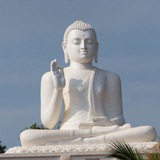
The Buddha then spoke in verse as follows:
Verse 174: Blind are the people of this world: only a few in this world see clearly (with Insight). Just as only a few birds escape from the net, so also, only a few get to the world of the devas, (and Nibbana).
At the end of the discourse, the young weaver attained Sotapatti Fruition.
Then, she continued on her way to the weaving shed. When she got there, her father was asleep on the weaver's seat. As he woke up suddenly, he accidentally pulled the shuttle, and the point of the shuttle struck the girl at her breast. She died on the spot, and her father was broken-hearted. With eyes full of tears he went to the Buddha and asked the Buddha to admit him to the Order of the bhikkhus. So, he became a bhikkhu, and not long afterwards, attained arahatship.
===
Dhammapada, beloved and favorite teachings of the Buddha channel:
https://news.1rj.ru/str/dhammapadas
====================
Verse 174: Blind are the people of this world: only a few in this world see clearly (with Insight). Just as only a few birds escape from the net, so also, only a few get to the world of the devas, (and Nibbana).
At the end of the discourse, the young weaver attained Sotapatti Fruition.
Then, she continued on her way to the weaving shed. When she got there, her father was asleep on the weaver's seat. As he woke up suddenly, he accidentally pulled the shuttle, and the point of the shuttle struck the girl at her breast. She died on the spot, and her father was broken-hearted. With eyes full of tears he went to the Buddha and asked the Buddha to admit him to the Order of the bhikkhus. So, he became a bhikkhu, and not long afterwards, attained arahatship.
===
Dhammapada, beloved and favorite teachings of the Buddha channel:
https://news.1rj.ru/str/dhammapadas
====================
Telegram
Dhammapada - Buddha Dharma Teachings
Daily teachings of the Dhammapada, beloved and favorite teachings of the Buddha
👍1💯1
Dhammapada Verse 175
Timsabhikkhu Vatthu
Hamsa diccapathe yanti
ikase yanti iddhiya
niyanti dhira lokamha
jetva maram savahinim.
Verse 175: Swans travel in the sky; those with supernormal powers travel through space; the wise having conquered Mara together with his army, go out of this world (i.e., realize Nibbana).
The Story of Thirty Bhikkhus
While residing at the Jetavana monastery, the Buddha uttered Verse (175) of this book, with reference to thirty bhikkhus.
Once, thirty bhikkhus came to pay homage to the Buddha. When they came in, the Venerable Ananda, who was then attending on the Buddha, left the room and waited outside. After some time, Thera Ananda went in, but he did not find any of the bhikkhus. So, he asked the Buddha where all those bhikkhus had gone. The Buddha then replied, "Ananda, all those bhikkhus, after hearing my discourse, had attained arahatship, and with their supernormal powers, they let travelling through space."
Then the Buddha spoke in verse as follows:
Verse 175: Swans travel in the sky; those with supernormal powers travel through space; the wise having conquered Mara together with his army, go out of this world (i.e., realize Nibbana).
===
Buddha dharma teachings channel:
https://invite.viber.com/?g2=AQAKw1y3rv%2F6sk61PI2W4izuIiaEZj8YZujhY1tSzL%2B07s7rFnVFDAd0bAYFaMLw
====================
Timsabhikkhu Vatthu
Hamsa diccapathe yanti
ikase yanti iddhiya
niyanti dhira lokamha
jetva maram savahinim.
Verse 175: Swans travel in the sky; those with supernormal powers travel through space; the wise having conquered Mara together with his army, go out of this world (i.e., realize Nibbana).
The Story of Thirty Bhikkhus
While residing at the Jetavana monastery, the Buddha uttered Verse (175) of this book, with reference to thirty bhikkhus.
Once, thirty bhikkhus came to pay homage to the Buddha. When they came in, the Venerable Ananda, who was then attending on the Buddha, left the room and waited outside. After some time, Thera Ananda went in, but he did not find any of the bhikkhus. So, he asked the Buddha where all those bhikkhus had gone. The Buddha then replied, "Ananda, all those bhikkhus, after hearing my discourse, had attained arahatship, and with their supernormal powers, they let travelling through space."
Then the Buddha spoke in verse as follows:
Verse 175: Swans travel in the sky; those with supernormal powers travel through space; the wise having conquered Mara together with his army, go out of this world (i.e., realize Nibbana).
===
Buddha dharma teachings channel:
https://invite.viber.com/?g2=AQAKw1y3rv%2F6sk61PI2W4izuIiaEZj8YZujhY1tSzL%2B07s7rFnVFDAd0bAYFaMLw
====================
Viber
Buddha
Buddha dharma teachings from the suttas and commentaries from Theravada tradition
❤1👏1💯1🏆1
Forwarded from Buddha Dharma books
Free Buddha Dharma ebook
Lokadhamma
A dhamma discourse by Mahasi Sayadaw Gyi
I have a great pleasure in writing a foreword to this third reprint of the English translation of the ‘Discourse on Lokadhamma’. The most Venerable Mahasi Sayadaw had delivered the discourse in Myanmar Language to the laities in Sasana Yeiktha on the Myanmar New Year Day (Thingyan Festival) in 1965. The English translation from the Myanmar version of the Lokadhamma was made by U Ohn Pe (Tet Toe) on 29.5.1970. The book explains vividly of the ups and downs in life every human being has to face in their life time and gives remedial measures of attitude one has to develop when one encounters them.
Free download here:
http://www.mediafire.com/file/0ofd39nt0ebhele/
=============
Lokadhamma
A dhamma discourse by Mahasi Sayadaw Gyi
I have a great pleasure in writing a foreword to this third reprint of the English translation of the ‘Discourse on Lokadhamma’. The most Venerable Mahasi Sayadaw had delivered the discourse in Myanmar Language to the laities in Sasana Yeiktha on the Myanmar New Year Day (Thingyan Festival) in 1965. The English translation from the Myanmar version of the Lokadhamma was made by U Ohn Pe (Tet Toe) on 29.5.1970. The book explains vividly of the ups and downs in life every human being has to face in their life time and gives remedial measures of attitude one has to develop when one encounters them.
Free download here:
http://www.mediafire.com/file/0ofd39nt0ebhele/
=============
👏2💯1
Peace as a Path: Five Exercises
By Thich Nhat Hanh
The late Zen master and father of Engaged Buddhism provides steps for embracing a more tranquil mindset in your meditation practice and everyday life.
Excerpted from Thich Nhat Hanh’s public talk in Toronto (June 18, 1991) and his retreat for veterans in Rhinebeck, New York (June 5–9, 1991). In 2024, on January 30th, the global Plum Village Community will be honoring Nhat Hanh’s life and legacy as he becomes the 5th Patriarch of Từ Hiếu Temple and the founder of the Plum Village Sangha.
Meditation practice aims at giving us peace and understanding. We don’t need to practice ten years or twenty years to get peace. If we practice correctly, we begin to have peace after a few seconds. As we continue to practice touching peace in us and around us, we also begin to look deeply into the nature of things and we begin to understand. This understanding has the power to liberate us from our suffering.
The seeds of peace are in and around every one of us. In our consciousness, we have all kinds of seeds: seeds of suffering, seeds of anger, seeds of jealousy, and seeds of war. But we also have seeds of peace, seeds of understanding, and seeds of joy.
When we do not lead our daily life mindfully, we only water the seeds of our unhappiness and let other people water the seeds of our anger, our hatred, and our violence. We ignore the seeds of peace and understanding and happiness buried deep under many layers of suffering, fear, and anguish. The meditation practice aims at touching the seeds of joy, the seeds of understanding, and the seeds of peace within us so that we may give them a chance to grow and that we may be nourished by them.
Suppose you practice breathing in and breathing out mindfully and bring your attention to your eyes. “Breathing in, I am aware of my eyes. Breathing out, I smile to my eyes.” You begin to have the insight that you have eyes. Most of the time, you are so possessed by your anger, your hatred, and your fear that you don’t remember that you have eyes. When people who have been blind regain the capacity to see, they feel like they are in paradise. But because you live in forgetfulness, you have lost this paradise. You need only to open your eyes in order to see the beautiful sky, the grass, the children, and to touch the seeds of peace and happiness around you.
“Breathing in, I am aware of my heart. Breathing out, I smile to my heart.” When you breathe in and out with your heart, you begin to have the insight that you have a heart. You realize that your heart has been working day and night for many years to bring you well-being. You see that you have ignored the presence of your heart and that you have been making your heart unhappy in the way you live your daily life, what you drink, what you eat, and the way you worry and get angry. When you smile to your heart, you water your heart with compassion. Now you know what to do and what not to do in order to take care of your heart. When you touch your heart with lovingkindness in this way, you touch joy and peace.
When you have a toothache, you are enlightened. You realize that not having a toothache is a wonderful thing. If you breathe in and breathe out and become aware of your non-toothache, you touch joy, you touch peace. This practice is to try to touch what is not wrong inside and outside us. Just touching [this], you get healed, and you will be able to bring this healing to our society.
1. In / Out
The first exercise on breathing that was proposed by the Buddha is the practice of touching the air, the air that we breathe. This practice is called conscious breathing. “Breathing in, I know that I am breathing in. Breathing out, I know that I’m breathing out.”
Often your body is there, but your mind is not. Your mind might be lost in the past or lost in the future, possessed by worries, anger, anxieties, fear. Since your body and mind are not together, you are not really there. When your child approaches you with a smile, you don’t see her. For you, she is not really there.
By Thich Nhat Hanh
The late Zen master and father of Engaged Buddhism provides steps for embracing a more tranquil mindset in your meditation practice and everyday life.
Excerpted from Thich Nhat Hanh’s public talk in Toronto (June 18, 1991) and his retreat for veterans in Rhinebeck, New York (June 5–9, 1991). In 2024, on January 30th, the global Plum Village Community will be honoring Nhat Hanh’s life and legacy as he becomes the 5th Patriarch of Từ Hiếu Temple and the founder of the Plum Village Sangha.
Meditation practice aims at giving us peace and understanding. We don’t need to practice ten years or twenty years to get peace. If we practice correctly, we begin to have peace after a few seconds. As we continue to practice touching peace in us and around us, we also begin to look deeply into the nature of things and we begin to understand. This understanding has the power to liberate us from our suffering.
The seeds of peace are in and around every one of us. In our consciousness, we have all kinds of seeds: seeds of suffering, seeds of anger, seeds of jealousy, and seeds of war. But we also have seeds of peace, seeds of understanding, and seeds of joy.
When we do not lead our daily life mindfully, we only water the seeds of our unhappiness and let other people water the seeds of our anger, our hatred, and our violence. We ignore the seeds of peace and understanding and happiness buried deep under many layers of suffering, fear, and anguish. The meditation practice aims at touching the seeds of joy, the seeds of understanding, and the seeds of peace within us so that we may give them a chance to grow and that we may be nourished by them.
Suppose you practice breathing in and breathing out mindfully and bring your attention to your eyes. “Breathing in, I am aware of my eyes. Breathing out, I smile to my eyes.” You begin to have the insight that you have eyes. Most of the time, you are so possessed by your anger, your hatred, and your fear that you don’t remember that you have eyes. When people who have been blind regain the capacity to see, they feel like they are in paradise. But because you live in forgetfulness, you have lost this paradise. You need only to open your eyes in order to see the beautiful sky, the grass, the children, and to touch the seeds of peace and happiness around you.
“Breathing in, I am aware of my heart. Breathing out, I smile to my heart.” When you breathe in and out with your heart, you begin to have the insight that you have a heart. You realize that your heart has been working day and night for many years to bring you well-being. You see that you have ignored the presence of your heart and that you have been making your heart unhappy in the way you live your daily life, what you drink, what you eat, and the way you worry and get angry. When you smile to your heart, you water your heart with compassion. Now you know what to do and what not to do in order to take care of your heart. When you touch your heart with lovingkindness in this way, you touch joy and peace.
When you have a toothache, you are enlightened. You realize that not having a toothache is a wonderful thing. If you breathe in and breathe out and become aware of your non-toothache, you touch joy, you touch peace. This practice is to try to touch what is not wrong inside and outside us. Just touching [this], you get healed, and you will be able to bring this healing to our society.
1. In / Out
The first exercise on breathing that was proposed by the Buddha is the practice of touching the air, the air that we breathe. This practice is called conscious breathing. “Breathing in, I know that I am breathing in. Breathing out, I know that I’m breathing out.”
Often your body is there, but your mind is not. Your mind might be lost in the past or lost in the future, possessed by worries, anger, anxieties, fear. Since your body and mind are not together, you are not really there. When your child approaches you with a smile, you don’t see her. For you, she is not really there.
Telegram
Ajahn Chah - Theravada Thailand Buddhism
Collection of teachings of Venerable Ajahn Chah, a foremost meditation and Buddhist teacher from Thailand
❤1👍1🥰1
So you are not available to your child. In order to avoid that kind of loss, you need to breathe in and breathe out. With just one breath, your mind and your body will come together. Suddenly you see your child very vividly. You know that this is your child and that she needs a hug. Then you practice hugging meditation. “Breathing in, my child is in my arms alive. Breathing out, I am so happy.”
Because our bodies and minds are not together, many of us live like dead people. When we begin to practice breathing in and out mindfully, we return to the present moment and find that we are alive.
The practice of breathing in and out can be carried out at any time; sitting on the bus, driving a car, cutting carrots, washing clothes, sitting in a meditation hall. And it is not hard work. Yet, breathing in and breathing out in a mindful way may be a very revolutionary act. We are possessed by the past, by the future, by society. We are victims of our televisions, our cars, our worries, our anger, our forgetfulness. We hardly have any liberty left in order to be ourselves and to live our lives. Breathing in and out mindfully is an act of resistance; we free ourselves from all that victimizes us, and reclaim our sovereignty as human beings.
2. Flower / Fresh
“Breathing in, I see myself as a flower. Breathing out, I feel fresh.” All of us were born as flowers. The eyes of children are very fresh, like flowers. From time to time we see a very fresh person. We like to sit close to her because she is so refreshing. With mindful breathing, you can revive your flower. Just breathe in and out and smile, and you have a flower to offer. But if you don’t know how to take care of your flower, it will become garbage.
When elements of the flower deteriorate into garbage, you have the power to transform the garbage back into flowers. This is a very deep teaching in Buddhism. The meditator can see the garbage right now in the flower. Those who don’t look deeply have to wait to find out that the flower will become garbage. But the meditator who looks deeply can also see the garbage transformed into compost, and can see flowers in the garbage.
If the flower is on her way to be the garbage, the garbage is on his way to be the flower again.
Garbage and flowers inter-are. If the flower is on her way to be the garbage, the garbage is on his way to be the flower again. That is the teaching of non-duality in Buddhism. Therefore, if you realize that there is some garbage—some suffering—in you, you will not be afraid. If you know the art of organic gardening, you will be able to transform your pain into joy and peace. This is the practice of “flower/fresh.”
So breathing in, you practice smiling with your eyes, your mouth, your hands, with all the cells in your body, and you become a fresh flower again. Breathing out, you feel the freshness emanating from you. So every time you feel irritated or tired, you know that you need to practice watering your flower. Now, because you are fresh and joyful, all of us have hope. You are serving humanity; you are serving the whole cosmos.
3. Mountain / Solid
“Breathing in, I see myself as a mountain. Breathing out, I feel solid.” This is best practiced in the sitting position because it is very stable. The stability of your body brings about the stability of your mind. From time to time we feel that we are vulnerable. We are taken over by a strong emotion like fear or anger or despair. Strong emotions can destroy us if we do not know how to handle them.
Let us visualize a tree in a storm. When we look at the top of the tree, we see little branches and leaves swaying violently in the wind. We have the impression that the tree is so fragile, that it can break at any time. But when we look down to the trunk we can see that it is firmly rooted in the soil. We know that the tree can resist the storm.
Because our bodies and minds are not together, many of us live like dead people. When we begin to practice breathing in and out mindfully, we return to the present moment and find that we are alive.
The practice of breathing in and out can be carried out at any time; sitting on the bus, driving a car, cutting carrots, washing clothes, sitting in a meditation hall. And it is not hard work. Yet, breathing in and breathing out in a mindful way may be a very revolutionary act. We are possessed by the past, by the future, by society. We are victims of our televisions, our cars, our worries, our anger, our forgetfulness. We hardly have any liberty left in order to be ourselves and to live our lives. Breathing in and out mindfully is an act of resistance; we free ourselves from all that victimizes us, and reclaim our sovereignty as human beings.
2. Flower / Fresh
“Breathing in, I see myself as a flower. Breathing out, I feel fresh.” All of us were born as flowers. The eyes of children are very fresh, like flowers. From time to time we see a very fresh person. We like to sit close to her because she is so refreshing. With mindful breathing, you can revive your flower. Just breathe in and out and smile, and you have a flower to offer. But if you don’t know how to take care of your flower, it will become garbage.
When elements of the flower deteriorate into garbage, you have the power to transform the garbage back into flowers. This is a very deep teaching in Buddhism. The meditator can see the garbage right now in the flower. Those who don’t look deeply have to wait to find out that the flower will become garbage. But the meditator who looks deeply can also see the garbage transformed into compost, and can see flowers in the garbage.
If the flower is on her way to be the garbage, the garbage is on his way to be the flower again.
Garbage and flowers inter-are. If the flower is on her way to be the garbage, the garbage is on his way to be the flower again. That is the teaching of non-duality in Buddhism. Therefore, if you realize that there is some garbage—some suffering—in you, you will not be afraid. If you know the art of organic gardening, you will be able to transform your pain into joy and peace. This is the practice of “flower/fresh.”
So breathing in, you practice smiling with your eyes, your mouth, your hands, with all the cells in your body, and you become a fresh flower again. Breathing out, you feel the freshness emanating from you. So every time you feel irritated or tired, you know that you need to practice watering your flower. Now, because you are fresh and joyful, all of us have hope. You are serving humanity; you are serving the whole cosmos.
3. Mountain / Solid
“Breathing in, I see myself as a mountain. Breathing out, I feel solid.” This is best practiced in the sitting position because it is very stable. The stability of your body brings about the stability of your mind. From time to time we feel that we are vulnerable. We are taken over by a strong emotion like fear or anger or despair. Strong emotions can destroy us if we do not know how to handle them.
Let us visualize a tree in a storm. When we look at the top of the tree, we see little branches and leaves swaying violently in the wind. We have the impression that the tree is so fragile, that it can break at any time. But when we look down to the trunk we can see that it is firmly rooted in the soil. We know that the tree can resist the storm.
👏1💯1
You are a kind of tree. Your trunk is a little below the level of your navel. The zone of emotions and thinking is at the level of your head. When you are taken hold of by a strong emotion, like despair, fear, or anger, you should try to leave the zone of the storm and go down to the level of the navel. You can embrace the trunk, breathe in and out, and become aware of the rise and fall of your abdomen.
Many people don’t know how to handle their emotions. When a strong emotion takes hold of them, they suffer intensely. Some of them cannot bear the suffering. We need to practice “mountain/solid” in order to be able to cope with these difficult moments when strong emotions take hold of us. “Breathing in, I see myself as a mountain. Breathing out, I feel solid.” After a few minutes, we realize that we are stronger than we thought. We are more than our emotions. We recover ourselves.
4. Water / Reflecting
“Breathing in, I see myself as still water. Breathing out, I reflect things as they are.” When we are agitated or possessed by a strong emotion, we cannot see things clearly. If we only listen to our irritation, our despair, our anger, we cannot listen to the voice of the truth.
The refreshing moon of the Buddha
Is traveling in the sky of utmost emptiness.
If the pond of the mind of living beings is still,
The moon will reflect itself beautifully in it.
This beautiful old poem tells us that when the lake of our mind is calm, the moon will reflect itself in the water. The truth breaks through to us if the water in our mind is calm. These are the two aspects of Buddhist meditation practice: samadhi and vipassana. Samadhi is calming, stopping: stopping forgetfulness, calming our emotions, our agitation. Vipassana is looking deeply in order to understand the true nature of things, to have the insight that can liberate us. But we can’t look deeply to get insight if we are not calm. So the practice of vipassana (insight meditation) contains the practice of samadhi and the practice of samadhi already contains the practice of vipassana.
Suppose that walking in the twilight you see a snake. You scream. But when someone brings [over] a flashlight, you discover that the snake was only a piece of rope. You did not see things clearly, because you were not calm. In our daily life, we distort many things and make a lot of mistakes just because we are not calm enough. So we need to practice “water/reflecting” in order to become calm.
5. Space / Free
“Breathing in, I see myself as space. Breathing out, I feel free.” Space is freedom. We will die slowly if we do not have enough space. Suppose someone likes to go shopping and buys a lot of things. His house is so full that he no longer has any space to move around. When he realizes how unhappy he is, he gets enlightened. He knows now that having space is very important. So he gives away all the things that he doesn’t truly need.
Inside of us we may lack space as well. We may have so many projects we want to do, so many worries, so much anger, that we deprive ourselves of space inside.
When you are a good flower arranger, you give each flower enough space. A flower needs space around her in order to radiate her beauty, her freshness. Therefore, you don’t need a lot of flowers. You need just two or three or four and you give each flower space.
We humans are like flowers. We do need space, freedom. This is the fundamental condition for our happiness. And if we deprive our beloved ones of space, they will die. Our wife, our husband, our children need space, not only outside but inside as well.
One day the Buddha was with a number of monks in the woods. They were about to have a dharma discussion when a farmer came by who was very upset. He asked the monks whether they had seen his twelve cows that had run away. He said, “Monks, I think I am going to die. I am the unhappiest person on Earth.” The Buddha said, “Gentleman, we have not seen your cows. Maybe they went in the other direction.
Many people don’t know how to handle their emotions. When a strong emotion takes hold of them, they suffer intensely. Some of them cannot bear the suffering. We need to practice “mountain/solid” in order to be able to cope with these difficult moments when strong emotions take hold of us. “Breathing in, I see myself as a mountain. Breathing out, I feel solid.” After a few minutes, we realize that we are stronger than we thought. We are more than our emotions. We recover ourselves.
4. Water / Reflecting
“Breathing in, I see myself as still water. Breathing out, I reflect things as they are.” When we are agitated or possessed by a strong emotion, we cannot see things clearly. If we only listen to our irritation, our despair, our anger, we cannot listen to the voice of the truth.
The refreshing moon of the Buddha
Is traveling in the sky of utmost emptiness.
If the pond of the mind of living beings is still,
The moon will reflect itself beautifully in it.
This beautiful old poem tells us that when the lake of our mind is calm, the moon will reflect itself in the water. The truth breaks through to us if the water in our mind is calm. These are the two aspects of Buddhist meditation practice: samadhi and vipassana. Samadhi is calming, stopping: stopping forgetfulness, calming our emotions, our agitation. Vipassana is looking deeply in order to understand the true nature of things, to have the insight that can liberate us. But we can’t look deeply to get insight if we are not calm. So the practice of vipassana (insight meditation) contains the practice of samadhi and the practice of samadhi already contains the practice of vipassana.
Suppose that walking in the twilight you see a snake. You scream. But when someone brings [over] a flashlight, you discover that the snake was only a piece of rope. You did not see things clearly, because you were not calm. In our daily life, we distort many things and make a lot of mistakes just because we are not calm enough. So we need to practice “water/reflecting” in order to become calm.
5. Space / Free
“Breathing in, I see myself as space. Breathing out, I feel free.” Space is freedom. We will die slowly if we do not have enough space. Suppose someone likes to go shopping and buys a lot of things. His house is so full that he no longer has any space to move around. When he realizes how unhappy he is, he gets enlightened. He knows now that having space is very important. So he gives away all the things that he doesn’t truly need.
Inside of us we may lack space as well. We may have so many projects we want to do, so many worries, so much anger, that we deprive ourselves of space inside.
When you are a good flower arranger, you give each flower enough space. A flower needs space around her in order to radiate her beauty, her freshness. Therefore, you don’t need a lot of flowers. You need just two or three or four and you give each flower space.
We humans are like flowers. We do need space, freedom. This is the fundamental condition for our happiness. And if we deprive our beloved ones of space, they will die. Our wife, our husband, our children need space, not only outside but inside as well.
One day the Buddha was with a number of monks in the woods. They were about to have a dharma discussion when a farmer came by who was very upset. He asked the monks whether they had seen his twelve cows that had run away. He said, “Monks, I think I am going to die. I am the unhappiest person on Earth.” The Buddha said, “Gentleman, we have not seen your cows. Maybe they went in the other direction.
👍3💯1🏆1
Go look for them there.” After the farmer left, the Buddha turned to his monks and said, “You monks are very lucky. You don’t have any cows.”
If we want to have space, we have to learn how to release our cows, the ones outside and the ones inside. So look deeply to see how many cows you have outside, how many cows you have inside, how many things you think are indispensable for your happiness. See your projects, ambitions, worries, anger. Try to release them one by one. Practice letting go.
=====
This piece was adapted from the Fall 1991 issue of Inquiring Mind (Vol. 8, No. 1). 1991–2021 by Thich Nhat Hanh.
Thich Nhat Hanh (1926–2022) was a Vietnamese Buddhist monk, author, and peace activist who was nominated for the Nobel Peace Prize by Martin Luther King Jr.
===
Ajahn Chah, Buddhist teacher of Thai forest meditation of Theravada Buddhism channel:
https://news.1rj.ru/str/ajahnchah_buddhism
===
If we want to have space, we have to learn how to release our cows, the ones outside and the ones inside. So look deeply to see how many cows you have outside, how many cows you have inside, how many things you think are indispensable for your happiness. See your projects, ambitions, worries, anger. Try to release them one by one. Practice letting go.
=====
This piece was adapted from the Fall 1991 issue of Inquiring Mind (Vol. 8, No. 1). 1991–2021 by Thich Nhat Hanh.
Thich Nhat Hanh (1926–2022) was a Vietnamese Buddhist monk, author, and peace activist who was nominated for the Nobel Peace Prize by Martin Luther King Jr.
===
Ajahn Chah, Buddhist teacher of Thai forest meditation of Theravada Buddhism channel:
https://news.1rj.ru/str/ajahnchah_buddhism
===
Telegram
Ajahn Chah - Theravada Thailand Buddhism
Collection of teachings of Venerable Ajahn Chah, a foremost meditation and Buddhist teacher from Thailand
👏1🏆1
Dhammapada Verse 176
Cincamanavika Vatthu
Ekam dhammam atitassa
musavadissa jantuno
vitinnaparalokassa
natthi papam akariyam.
Verse 176: For one who transgresses the Truth, and is given to lying, and who is unconcerned with the life hereafter, there is no evil that he dare not do.
The Story of Cincamanavika
While residing at the Jetavana monastery, the Buddha uttered Verse (176) of this book, with reference to Cincamanavika.
As the Buddha went on teaching the Dhamma, more and more people came flocking to him, and the ascetics of other faiths found their following to be dwindling. So they made a plan that would harm the reputation of the Buddha. They called the very beautiful Cincamanavika, a devoted pupil of theirs, to them and said to her, "If you have our interests in your heart, please help us and put Samana Gotama to shame." Cincamanavika agreed to comply.
That same evening, she took some flowers and went in the direction of the Jetavana monastery. When people asked her where she was going, she replied, "What is the use of you knowing where I am going?" Then she would go to the place of other ascetics near the Jetavana monastery and would come back early in the morning to make it appear as if she had spent the night at the Jetavana monastery. When asked, she would reply, "I spent the night with Samana Gotama at the Perfumed Chamber of the Jetavana monastery." After three or four months had passed, she wrapped up her stomach with some cloth to make her look pregnant. Then, after eight or nine months, she wrapped up her stomach with a round piece of thin wooden plank; she also beat up her palms and feet to make them swollen, and pretended to be feeling tired and worn out. Thus, she assumed a perfect picture of a woman in an advanced stage of pregnancy. Then, in the evening, she went to the Jetavana monastery to confront the Buddha.
The Buddha was then expounding the Dhamma to a congregation of bhikkhus and laymen. Seeing him teaching on the platform, she accused the Buddha thus: "O you big Samana! You only preach to others. I am now pregnant by you, yet you do nothing for my confinement. You only know how to enjoy your self!" The Buddha stopped preaching for a while and said to her, "Sister, only you and I know whether you are speaking the truth or not," and Cincamanavika replied, "Yes, you are right, how can others know what only you and I know?"
At that instant, Sakka, king of the devas, became aware of the trouble being brewed at the Jetavana monastery, so he sent four of his devas in the form of young rats. The four rats got under the clothes of Cincamanavika and bit off the strings that fastened the wooden plank round her stomach. As the strings broke, the wooden plank dropped, cutting off the front part of her feet. Thus, the deception of Cincamanavika was uncovered, and many from the crowd cried out in anger, "Oh you wicked woman! A liar and a cheat! How dare you accuse our noble Teacher!" Some of them spat on her and drove her out. She ran as fast as she could, and when she had gone some distance the earth cracked and fissured and she was swallowed up.
The next day, while the bhikkhus were talking about Cincamanavika, the Buddha came to them and said. "Bhikkhu;, one who is not afraid to tell lies, and who does not care what happens in the future existence, will not hesitate to do any evil."
Then the Buddha spoke in verse as follows:
Verse 176: For one who transgresses the Truth, and is given to lying, and who is unconcerned with the life hereafter, there is no evil that he dare not do.
===
Words of the Buddha channel:
https://invite.viber.com/?g2=AQAFqzqlj7FmI061PX17rxWMAtZ%2BRuso%2FH2KmHKZSgnv7v9DD8X0bDkKnZDr9JDq
====================
Cincamanavika Vatthu
Ekam dhammam atitassa
musavadissa jantuno
vitinnaparalokassa
natthi papam akariyam.
Verse 176: For one who transgresses the Truth, and is given to lying, and who is unconcerned with the life hereafter, there is no evil that he dare not do.
The Story of Cincamanavika
While residing at the Jetavana monastery, the Buddha uttered Verse (176) of this book, with reference to Cincamanavika.
As the Buddha went on teaching the Dhamma, more and more people came flocking to him, and the ascetics of other faiths found their following to be dwindling. So they made a plan that would harm the reputation of the Buddha. They called the very beautiful Cincamanavika, a devoted pupil of theirs, to them and said to her, "If you have our interests in your heart, please help us and put Samana Gotama to shame." Cincamanavika agreed to comply.
That same evening, she took some flowers and went in the direction of the Jetavana monastery. When people asked her where she was going, she replied, "What is the use of you knowing where I am going?" Then she would go to the place of other ascetics near the Jetavana monastery and would come back early in the morning to make it appear as if she had spent the night at the Jetavana monastery. When asked, she would reply, "I spent the night with Samana Gotama at the Perfumed Chamber of the Jetavana monastery." After three or four months had passed, she wrapped up her stomach with some cloth to make her look pregnant. Then, after eight or nine months, she wrapped up her stomach with a round piece of thin wooden plank; she also beat up her palms and feet to make them swollen, and pretended to be feeling tired and worn out. Thus, she assumed a perfect picture of a woman in an advanced stage of pregnancy. Then, in the evening, she went to the Jetavana monastery to confront the Buddha.
The Buddha was then expounding the Dhamma to a congregation of bhikkhus and laymen. Seeing him teaching on the platform, she accused the Buddha thus: "O you big Samana! You only preach to others. I am now pregnant by you, yet you do nothing for my confinement. You only know how to enjoy your self!" The Buddha stopped preaching for a while and said to her, "Sister, only you and I know whether you are speaking the truth or not," and Cincamanavika replied, "Yes, you are right, how can others know what only you and I know?"
At that instant, Sakka, king of the devas, became aware of the trouble being brewed at the Jetavana monastery, so he sent four of his devas in the form of young rats. The four rats got under the clothes of Cincamanavika and bit off the strings that fastened the wooden plank round her stomach. As the strings broke, the wooden plank dropped, cutting off the front part of her feet. Thus, the deception of Cincamanavika was uncovered, and many from the crowd cried out in anger, "Oh you wicked woman! A liar and a cheat! How dare you accuse our noble Teacher!" Some of them spat on her and drove her out. She ran as fast as she could, and when she had gone some distance the earth cracked and fissured and she was swallowed up.
The next day, while the bhikkhus were talking about Cincamanavika, the Buddha came to them and said. "Bhikkhu;, one who is not afraid to tell lies, and who does not care what happens in the future existence, will not hesitate to do any evil."
Then the Buddha spoke in verse as follows:
Verse 176: For one who transgresses the Truth, and is given to lying, and who is unconcerned with the life hereafter, there is no evil that he dare not do.
===
Words of the Buddha channel:
https://invite.viber.com/?g2=AQAFqzqlj7FmI061PX17rxWMAtZ%2BRuso%2FH2KmHKZSgnv7v9DD8X0bDkKnZDr9JDq
====================
Viber
Words Of The Buddha
Daily teachings from Buddha Dharma
❤1👍1👏1🏆1