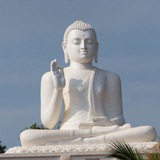
Then and there, the Buddha made him a bhikkhu.
Angulimala's mother looked for her son everywhere in the forest shouting out his name, but failing to find him she returned home. When the king and his men came to capture Angulimala, they found him at the monastery of the Buddha. Finding that Angulimala had given up his evil ways and had become a bhikkhu, the king and his men went home. During his stay at the monastery, Angulimala ardently and diligently practised meditation, and within a short time he attained arahatship.
Then, one day, while he was on an alms-round, he came to a place where some people were quarrelling among themselves. As they were throwing stones at one another, some stray stones hit Thera Angulimala on the head and he was seriously injured. Yet, he managed to come back to the Buddha, and the Buddha said to him, "My son Angulimala! You have done away with evil. Have patience. You are paying in this existence for the deeds you have done. These deeds would have made you suffer for innumerable years in niraya." Soon afterwards, Angulimala passed away peacefully; he had realized parinibbana.
Other bhikkhus asked the Buddha where Angulimala was reborn, and when the Buddha replied "My son has realized parinibbana", they could hardly believe it. So they asked him whether it was possible that a man who had killed so many people could have realized parinibbana. To this question, the Buddha replied, "Bhikkhus! Angulimala had done much evil because he did not have good friends. But later, he found good friends and through their help and good advice he had been steadfast and mindful in his practice of the dhamma. Therefore, his evil deeds have been overwhelmed by good (i e., Arahatta Magga).
Then the Buddha spoke in verse as follows:
Verse 173: He who overwhelms with good the evil that he has done lights up this world (with the light of Magga Insight), as does the moon freed from clouds.
===
Words of the Buddha channel:
https://news.1rj.ru/str/wordsofbuddha
====================
Angulimala's mother looked for her son everywhere in the forest shouting out his name, but failing to find him she returned home. When the king and his men came to capture Angulimala, they found him at the monastery of the Buddha. Finding that Angulimala had given up his evil ways and had become a bhikkhu, the king and his men went home. During his stay at the monastery, Angulimala ardently and diligently practised meditation, and within a short time he attained arahatship.
Then, one day, while he was on an alms-round, he came to a place where some people were quarrelling among themselves. As they were throwing stones at one another, some stray stones hit Thera Angulimala on the head and he was seriously injured. Yet, he managed to come back to the Buddha, and the Buddha said to him, "My son Angulimala! You have done away with evil. Have patience. You are paying in this existence for the deeds you have done. These deeds would have made you suffer for innumerable years in niraya." Soon afterwards, Angulimala passed away peacefully; he had realized parinibbana.
Other bhikkhus asked the Buddha where Angulimala was reborn, and when the Buddha replied "My son has realized parinibbana", they could hardly believe it. So they asked him whether it was possible that a man who had killed so many people could have realized parinibbana. To this question, the Buddha replied, "Bhikkhus! Angulimala had done much evil because he did not have good friends. But later, he found good friends and through their help and good advice he had been steadfast and mindful in his practice of the dhamma. Therefore, his evil deeds have been overwhelmed by good (i e., Arahatta Magga).
Then the Buddha spoke in verse as follows:
Verse 173: He who overwhelms with good the evil that he has done lights up this world (with the light of Magga Insight), as does the moon freed from clouds.
===
Words of the Buddha channel:
https://news.1rj.ru/str/wordsofbuddha
====================
Telegram
Words of the Buddha
Daily teachings of Buddha Dharma
💯1🏆1
Forwarded from Buddha Dharma books
Free Buddha Dharma ebook
Food for the Thinking Mind
By Venerable Sri K Dhammananda
As the noscript suggests, this book is not directed at readers with a particular religious affiliation but is meant for anyone who wishes to reflect on what famous thinkers throughout the ages have written about the human condition. No one can deny that despite temporary flashes of happiness, on the whole, the human condition is far from satisfactory. Human beings have always dreamed of attaining perfect happiness by transcending human problems, generally without much success. However some great thinkers, widely separated in time and space have pondered over how this human condition can be understood and how happiness can be attained. They were able to crystallise these thoughts into clear, apt sayings which sound simple at first sight, but which draw deep from the well springs of human experience. This book is a collection of these thoughts and readers are invited to share them and benefit from them. By reflection, the reader gains an understanding of his or her condition and is thus enabled to live a happier more meaningful life. Most of our problems arise from the fact that we do not understand the cause of our feelings of discontentand unsatisfactoriness.
Free download here:
https://static.sariputta.com/pdf/tipitaka/883/en110pdf.pdf
===
Food for the Thinking Mind
By Venerable Sri K Dhammananda
As the noscript suggests, this book is not directed at readers with a particular religious affiliation but is meant for anyone who wishes to reflect on what famous thinkers throughout the ages have written about the human condition. No one can deny that despite temporary flashes of happiness, on the whole, the human condition is far from satisfactory. Human beings have always dreamed of attaining perfect happiness by transcending human problems, generally without much success. However some great thinkers, widely separated in time and space have pondered over how this human condition can be understood and how happiness can be attained. They were able to crystallise these thoughts into clear, apt sayings which sound simple at first sight, but which draw deep from the well springs of human experience. This book is a collection of these thoughts and readers are invited to share them and benefit from them. By reflection, the reader gains an understanding of his or her condition and is thus enabled to live a happier more meaningful life. Most of our problems arise from the fact that we do not understand the cause of our feelings of discontentand unsatisfactoriness.
Free download here:
https://static.sariputta.com/pdf/tipitaka/883/en110pdf.pdf
===
👍1👏1💯1
Dhammapada Verse 174
Pesakaradhita Vatthu
Andhabhuto ayam loko
tanuke'ttha vipassati
sakuno jalamuttova
appo saggaya gacchati.
Verse 174: Blind are the people of this world: only a few in this world see clearly (with Insight). Just as only a few birds escape from the net, so also, only a few get to the world of the devas, (and Nibbana).
The Story of the Weaver-Girl
While residing at the monastery near Aggavala shrine in the country of Alavi, the Buddha uttered Verse (174) of this book, with reference to a young maiden, who was a weaver.
At the conclusion of an alms-giving ceremony in Alavi, the Buddha gave a discourse on the impermanence of the aggregates (khandhas). The main points the Buddha stressed on that day may be expressed as follows:
"My life is impermanent; for me, death only is permanent. I must certainly die; my life ends in death. Life is not permanent; death is permanent."
The Buddha also exhorted the audience to be always mindful and to strive to perceive the true nature of the aggregate. He also said,"As one who is armed with a stick or a spear is prepared to meet an enemy (e.g. a poisonous snake), so also, one who is ever mindful of death will face death mindfully. He would then leave this world for a good destination (sugati)." Many people did not take the above exhortation seriously, but a young girl of sixteen who was a weaver clearly understood the message. After giving the discourse, the Buddha returned to the Jetavana monastery.
After a lapse of three years, when the Buddha surveyed the world, he saw the young weaver in his vision, and knew that time was ripe for the girl to attain Sotapatti Fruition. So the Buddha came to the country of Alavi to expound the dhamma for the second time. When the girl heard that the Buddha had come again with five hundred bhikkhus, she wanted to go and listen to the discourse which would be given by the Buddha. However, her father had also asked her to wind some thread spools which he needed urgently, so she promptly wound some spools and took them to her father. On the way to her father, she stopped for a moment at the outer fringe of the audience, who had come to listen to the Buddha.
Meanwhile, the Buddha knew that the young weaver would come to listen to his discourse; he also knew that the girl would die when she got to the weaving shed. Therefore, it was very important that she should listen to the Dhamma on her way to the weaving shed and not on her return. So, when the young weaver appeared on the fringe of the audience, the Buddha looked at her. When she saw him looking at her, she dropped her basket and respectfully approached the Buddha. Then, he put four questions to her and she answered all of them. The questions and answers are as given below.
Questions Answers
(1) Where have you come from? (1) I do not know.
(2) Where are you going? (2) I do not know.
(3) Don't you know? (3) Yes, I do know.
(4) Do you know? (4) I do not know, Venerable Sir.
Hearing her answers, the audience thought that the young weaver was being very disrespectful. Then, the Buddha asked her to explain what she meant by her answers, and she explained.
"Venerable Sir! Since you know that I have come from my house, I interpreted that, by your first question, you meant to ask me from what past existence I have come here. Hence my answer, 'I do not know.' The second question means, to what future existence I would be going from here; hence my answer, 'I do not know.' The third question means whether I do not know that I would die one day; hence my answer, 'yes, I do know.' The last question means whether I know when I would die; hence my answer, 'I do not know.
The Buddha was satisfied with her explanation and he said to the audience, "Most of you might not understand clearly the meaning of the answers given by the young weaver. Those who are ignorant are in darkness, they are just like the blind."
Pesakaradhita Vatthu
Andhabhuto ayam loko
tanuke'ttha vipassati
sakuno jalamuttova
appo saggaya gacchati.
Verse 174: Blind are the people of this world: only a few in this world see clearly (with Insight). Just as only a few birds escape from the net, so also, only a few get to the world of the devas, (and Nibbana).
The Story of the Weaver-Girl
While residing at the monastery near Aggavala shrine in the country of Alavi, the Buddha uttered Verse (174) of this book, with reference to a young maiden, who was a weaver.
At the conclusion of an alms-giving ceremony in Alavi, the Buddha gave a discourse on the impermanence of the aggregates (khandhas). The main points the Buddha stressed on that day may be expressed as follows:
"My life is impermanent; for me, death only is permanent. I must certainly die; my life ends in death. Life is not permanent; death is permanent."
The Buddha also exhorted the audience to be always mindful and to strive to perceive the true nature of the aggregate. He also said,"As one who is armed with a stick or a spear is prepared to meet an enemy (e.g. a poisonous snake), so also, one who is ever mindful of death will face death mindfully. He would then leave this world for a good destination (sugati)." Many people did not take the above exhortation seriously, but a young girl of sixteen who was a weaver clearly understood the message. After giving the discourse, the Buddha returned to the Jetavana monastery.
After a lapse of three years, when the Buddha surveyed the world, he saw the young weaver in his vision, and knew that time was ripe for the girl to attain Sotapatti Fruition. So the Buddha came to the country of Alavi to expound the dhamma for the second time. When the girl heard that the Buddha had come again with five hundred bhikkhus, she wanted to go and listen to the discourse which would be given by the Buddha. However, her father had also asked her to wind some thread spools which he needed urgently, so she promptly wound some spools and took them to her father. On the way to her father, she stopped for a moment at the outer fringe of the audience, who had come to listen to the Buddha.
Meanwhile, the Buddha knew that the young weaver would come to listen to his discourse; he also knew that the girl would die when she got to the weaving shed. Therefore, it was very important that she should listen to the Dhamma on her way to the weaving shed and not on her return. So, when the young weaver appeared on the fringe of the audience, the Buddha looked at her. When she saw him looking at her, she dropped her basket and respectfully approached the Buddha. Then, he put four questions to her and she answered all of them. The questions and answers are as given below.
Questions Answers
(1) Where have you come from? (1) I do not know.
(2) Where are you going? (2) I do not know.
(3) Don't you know? (3) Yes, I do know.
(4) Do you know? (4) I do not know, Venerable Sir.
Hearing her answers, the audience thought that the young weaver was being very disrespectful. Then, the Buddha asked her to explain what she meant by her answers, and she explained.
"Venerable Sir! Since you know that I have come from my house, I interpreted that, by your first question, you meant to ask me from what past existence I have come here. Hence my answer, 'I do not know.' The second question means, to what future existence I would be going from here; hence my answer, 'I do not know.' The third question means whether I do not know that I would die one day; hence my answer, 'yes, I do know.' The last question means whether I know when I would die; hence my answer, 'I do not know.
The Buddha was satisfied with her explanation and he said to the audience, "Most of you might not understand clearly the meaning of the answers given by the young weaver. Those who are ignorant are in darkness, they are just like the blind."
Telegram
Dhammapada - Buddha Dharma Teachings
Daily teachings of the Dhammapada, beloved and favorite teachings of the Buddha
👏1
The Buddha then spoke in verse as follows:
Verse 174: Blind are the people of this world: only a few in this world see clearly (with Insight). Just as only a few birds escape from the net, so also, only a few get to the world of the devas, (and Nibbana).
At the end of the discourse, the young weaver attained Sotapatti Fruition.
Then, she continued on her way to the weaving shed. When she got there, her father was asleep on the weaver's seat. As he woke up suddenly, he accidentally pulled the shuttle, and the point of the shuttle struck the girl at her breast. She died on the spot, and her father was broken-hearted. With eyes full of tears he went to the Buddha and asked the Buddha to admit him to the Order of the bhikkhus. So, he became a bhikkhu, and not long afterwards, attained arahatship.
===
Dhammapada, beloved and favorite teachings of the Buddha channel:
https://news.1rj.ru/str/dhammapadas
====================
Verse 174: Blind are the people of this world: only a few in this world see clearly (with Insight). Just as only a few birds escape from the net, so also, only a few get to the world of the devas, (and Nibbana).
At the end of the discourse, the young weaver attained Sotapatti Fruition.
Then, she continued on her way to the weaving shed. When she got there, her father was asleep on the weaver's seat. As he woke up suddenly, he accidentally pulled the shuttle, and the point of the shuttle struck the girl at her breast. She died on the spot, and her father was broken-hearted. With eyes full of tears he went to the Buddha and asked the Buddha to admit him to the Order of the bhikkhus. So, he became a bhikkhu, and not long afterwards, attained arahatship.
===
Dhammapada, beloved and favorite teachings of the Buddha channel:
https://news.1rj.ru/str/dhammapadas
====================
Telegram
Dhammapada - Buddha Dharma Teachings
Daily teachings of the Dhammapada, beloved and favorite teachings of the Buddha
👍1💯1
Dhammapada Verse 175
Timsabhikkhu Vatthu
Hamsa diccapathe yanti
ikase yanti iddhiya
niyanti dhira lokamha
jetva maram savahinim.
Verse 175: Swans travel in the sky; those with supernormal powers travel through space; the wise having conquered Mara together with his army, go out of this world (i.e., realize Nibbana).
The Story of Thirty Bhikkhus
While residing at the Jetavana monastery, the Buddha uttered Verse (175) of this book, with reference to thirty bhikkhus.
Once, thirty bhikkhus came to pay homage to the Buddha. When they came in, the Venerable Ananda, who was then attending on the Buddha, left the room and waited outside. After some time, Thera Ananda went in, but he did not find any of the bhikkhus. So, he asked the Buddha where all those bhikkhus had gone. The Buddha then replied, "Ananda, all those bhikkhus, after hearing my discourse, had attained arahatship, and with their supernormal powers, they let travelling through space."
Then the Buddha spoke in verse as follows:
Verse 175: Swans travel in the sky; those with supernormal powers travel through space; the wise having conquered Mara together with his army, go out of this world (i.e., realize Nibbana).
===
Buddha dharma teachings channel:
https://invite.viber.com/?g2=AQAKw1y3rv%2F6sk61PI2W4izuIiaEZj8YZujhY1tSzL%2B07s7rFnVFDAd0bAYFaMLw
====================
Timsabhikkhu Vatthu
Hamsa diccapathe yanti
ikase yanti iddhiya
niyanti dhira lokamha
jetva maram savahinim.
Verse 175: Swans travel in the sky; those with supernormal powers travel through space; the wise having conquered Mara together with his army, go out of this world (i.e., realize Nibbana).
The Story of Thirty Bhikkhus
While residing at the Jetavana monastery, the Buddha uttered Verse (175) of this book, with reference to thirty bhikkhus.
Once, thirty bhikkhus came to pay homage to the Buddha. When they came in, the Venerable Ananda, who was then attending on the Buddha, left the room and waited outside. After some time, Thera Ananda went in, but he did not find any of the bhikkhus. So, he asked the Buddha where all those bhikkhus had gone. The Buddha then replied, "Ananda, all those bhikkhus, after hearing my discourse, had attained arahatship, and with their supernormal powers, they let travelling through space."
Then the Buddha spoke in verse as follows:
Verse 175: Swans travel in the sky; those with supernormal powers travel through space; the wise having conquered Mara together with his army, go out of this world (i.e., realize Nibbana).
===
Buddha dharma teachings channel:
https://invite.viber.com/?g2=AQAKw1y3rv%2F6sk61PI2W4izuIiaEZj8YZujhY1tSzL%2B07s7rFnVFDAd0bAYFaMLw
====================
Viber
Buddha
Buddha dharma teachings from the suttas and commentaries from Theravada tradition
❤1👏1💯1🏆1
Forwarded from Buddha Dharma books
Free Buddha Dharma ebook
Lokadhamma
A dhamma discourse by Mahasi Sayadaw Gyi
I have a great pleasure in writing a foreword to this third reprint of the English translation of the ‘Discourse on Lokadhamma’. The most Venerable Mahasi Sayadaw had delivered the discourse in Myanmar Language to the laities in Sasana Yeiktha on the Myanmar New Year Day (Thingyan Festival) in 1965. The English translation from the Myanmar version of the Lokadhamma was made by U Ohn Pe (Tet Toe) on 29.5.1970. The book explains vividly of the ups and downs in life every human being has to face in their life time and gives remedial measures of attitude one has to develop when one encounters them.
Free download here:
http://www.mediafire.com/file/0ofd39nt0ebhele/
=============
Lokadhamma
A dhamma discourse by Mahasi Sayadaw Gyi
I have a great pleasure in writing a foreword to this third reprint of the English translation of the ‘Discourse on Lokadhamma’. The most Venerable Mahasi Sayadaw had delivered the discourse in Myanmar Language to the laities in Sasana Yeiktha on the Myanmar New Year Day (Thingyan Festival) in 1965. The English translation from the Myanmar version of the Lokadhamma was made by U Ohn Pe (Tet Toe) on 29.5.1970. The book explains vividly of the ups and downs in life every human being has to face in their life time and gives remedial measures of attitude one has to develop when one encounters them.
Free download here:
http://www.mediafire.com/file/0ofd39nt0ebhele/
=============
👏2💯1
Peace as a Path: Five Exercises
By Thich Nhat Hanh
The late Zen master and father of Engaged Buddhism provides steps for embracing a more tranquil mindset in your meditation practice and everyday life.
Excerpted from Thich Nhat Hanh’s public talk in Toronto (June 18, 1991) and his retreat for veterans in Rhinebeck, New York (June 5–9, 1991). In 2024, on January 30th, the global Plum Village Community will be honoring Nhat Hanh’s life and legacy as he becomes the 5th Patriarch of Từ Hiếu Temple and the founder of the Plum Village Sangha.
Meditation practice aims at giving us peace and understanding. We don’t need to practice ten years or twenty years to get peace. If we practice correctly, we begin to have peace after a few seconds. As we continue to practice touching peace in us and around us, we also begin to look deeply into the nature of things and we begin to understand. This understanding has the power to liberate us from our suffering.
The seeds of peace are in and around every one of us. In our consciousness, we have all kinds of seeds: seeds of suffering, seeds of anger, seeds of jealousy, and seeds of war. But we also have seeds of peace, seeds of understanding, and seeds of joy.
When we do not lead our daily life mindfully, we only water the seeds of our unhappiness and let other people water the seeds of our anger, our hatred, and our violence. We ignore the seeds of peace and understanding and happiness buried deep under many layers of suffering, fear, and anguish. The meditation practice aims at touching the seeds of joy, the seeds of understanding, and the seeds of peace within us so that we may give them a chance to grow and that we may be nourished by them.
Suppose you practice breathing in and breathing out mindfully and bring your attention to your eyes. “Breathing in, I am aware of my eyes. Breathing out, I smile to my eyes.” You begin to have the insight that you have eyes. Most of the time, you are so possessed by your anger, your hatred, and your fear that you don’t remember that you have eyes. When people who have been blind regain the capacity to see, they feel like they are in paradise. But because you live in forgetfulness, you have lost this paradise. You need only to open your eyes in order to see the beautiful sky, the grass, the children, and to touch the seeds of peace and happiness around you.
“Breathing in, I am aware of my heart. Breathing out, I smile to my heart.” When you breathe in and out with your heart, you begin to have the insight that you have a heart. You realize that your heart has been working day and night for many years to bring you well-being. You see that you have ignored the presence of your heart and that you have been making your heart unhappy in the way you live your daily life, what you drink, what you eat, and the way you worry and get angry. When you smile to your heart, you water your heart with compassion. Now you know what to do and what not to do in order to take care of your heart. When you touch your heart with lovingkindness in this way, you touch joy and peace.
When you have a toothache, you are enlightened. You realize that not having a toothache is a wonderful thing. If you breathe in and breathe out and become aware of your non-toothache, you touch joy, you touch peace. This practice is to try to touch what is not wrong inside and outside us. Just touching [this], you get healed, and you will be able to bring this healing to our society.
1. In / Out
The first exercise on breathing that was proposed by the Buddha is the practice of touching the air, the air that we breathe. This practice is called conscious breathing. “Breathing in, I know that I am breathing in. Breathing out, I know that I’m breathing out.”
Often your body is there, but your mind is not. Your mind might be lost in the past or lost in the future, possessed by worries, anger, anxieties, fear. Since your body and mind are not together, you are not really there. When your child approaches you with a smile, you don’t see her. For you, she is not really there.
By Thich Nhat Hanh
The late Zen master and father of Engaged Buddhism provides steps for embracing a more tranquil mindset in your meditation practice and everyday life.
Excerpted from Thich Nhat Hanh’s public talk in Toronto (June 18, 1991) and his retreat for veterans in Rhinebeck, New York (June 5–9, 1991). In 2024, on January 30th, the global Plum Village Community will be honoring Nhat Hanh’s life and legacy as he becomes the 5th Patriarch of Từ Hiếu Temple and the founder of the Plum Village Sangha.
Meditation practice aims at giving us peace and understanding. We don’t need to practice ten years or twenty years to get peace. If we practice correctly, we begin to have peace after a few seconds. As we continue to practice touching peace in us and around us, we also begin to look deeply into the nature of things and we begin to understand. This understanding has the power to liberate us from our suffering.
The seeds of peace are in and around every one of us. In our consciousness, we have all kinds of seeds: seeds of suffering, seeds of anger, seeds of jealousy, and seeds of war. But we also have seeds of peace, seeds of understanding, and seeds of joy.
When we do not lead our daily life mindfully, we only water the seeds of our unhappiness and let other people water the seeds of our anger, our hatred, and our violence. We ignore the seeds of peace and understanding and happiness buried deep under many layers of suffering, fear, and anguish. The meditation practice aims at touching the seeds of joy, the seeds of understanding, and the seeds of peace within us so that we may give them a chance to grow and that we may be nourished by them.
Suppose you practice breathing in and breathing out mindfully and bring your attention to your eyes. “Breathing in, I am aware of my eyes. Breathing out, I smile to my eyes.” You begin to have the insight that you have eyes. Most of the time, you are so possessed by your anger, your hatred, and your fear that you don’t remember that you have eyes. When people who have been blind regain the capacity to see, they feel like they are in paradise. But because you live in forgetfulness, you have lost this paradise. You need only to open your eyes in order to see the beautiful sky, the grass, the children, and to touch the seeds of peace and happiness around you.
“Breathing in, I am aware of my heart. Breathing out, I smile to my heart.” When you breathe in and out with your heart, you begin to have the insight that you have a heart. You realize that your heart has been working day and night for many years to bring you well-being. You see that you have ignored the presence of your heart and that you have been making your heart unhappy in the way you live your daily life, what you drink, what you eat, and the way you worry and get angry. When you smile to your heart, you water your heart with compassion. Now you know what to do and what not to do in order to take care of your heart. When you touch your heart with lovingkindness in this way, you touch joy and peace.
When you have a toothache, you are enlightened. You realize that not having a toothache is a wonderful thing. If you breathe in and breathe out and become aware of your non-toothache, you touch joy, you touch peace. This practice is to try to touch what is not wrong inside and outside us. Just touching [this], you get healed, and you will be able to bring this healing to our society.
1. In / Out
The first exercise on breathing that was proposed by the Buddha is the practice of touching the air, the air that we breathe. This practice is called conscious breathing. “Breathing in, I know that I am breathing in. Breathing out, I know that I’m breathing out.”
Often your body is there, but your mind is not. Your mind might be lost in the past or lost in the future, possessed by worries, anger, anxieties, fear. Since your body and mind are not together, you are not really there. When your child approaches you with a smile, you don’t see her. For you, she is not really there.
Telegram
Ajahn Chah - Theravada Thailand Buddhism
Collection of teachings of Venerable Ajahn Chah, a foremost meditation and Buddhist teacher from Thailand
❤1👍1🥰1
So you are not available to your child. In order to avoid that kind of loss, you need to breathe in and breathe out. With just one breath, your mind and your body will come together. Suddenly you see your child very vividly. You know that this is your child and that she needs a hug. Then you practice hugging meditation. “Breathing in, my child is in my arms alive. Breathing out, I am so happy.”
Because our bodies and minds are not together, many of us live like dead people. When we begin to practice breathing in and out mindfully, we return to the present moment and find that we are alive.
The practice of breathing in and out can be carried out at any time; sitting on the bus, driving a car, cutting carrots, washing clothes, sitting in a meditation hall. And it is not hard work. Yet, breathing in and breathing out in a mindful way may be a very revolutionary act. We are possessed by the past, by the future, by society. We are victims of our televisions, our cars, our worries, our anger, our forgetfulness. We hardly have any liberty left in order to be ourselves and to live our lives. Breathing in and out mindfully is an act of resistance; we free ourselves from all that victimizes us, and reclaim our sovereignty as human beings.
2. Flower / Fresh
“Breathing in, I see myself as a flower. Breathing out, I feel fresh.” All of us were born as flowers. The eyes of children are very fresh, like flowers. From time to time we see a very fresh person. We like to sit close to her because she is so refreshing. With mindful breathing, you can revive your flower. Just breathe in and out and smile, and you have a flower to offer. But if you don’t know how to take care of your flower, it will become garbage.
When elements of the flower deteriorate into garbage, you have the power to transform the garbage back into flowers. This is a very deep teaching in Buddhism. The meditator can see the garbage right now in the flower. Those who don’t look deeply have to wait to find out that the flower will become garbage. But the meditator who looks deeply can also see the garbage transformed into compost, and can see flowers in the garbage.
If the flower is on her way to be the garbage, the garbage is on his way to be the flower again.
Garbage and flowers inter-are. If the flower is on her way to be the garbage, the garbage is on his way to be the flower again. That is the teaching of non-duality in Buddhism. Therefore, if you realize that there is some garbage—some suffering—in you, you will not be afraid. If you know the art of organic gardening, you will be able to transform your pain into joy and peace. This is the practice of “flower/fresh.”
So breathing in, you practice smiling with your eyes, your mouth, your hands, with all the cells in your body, and you become a fresh flower again. Breathing out, you feel the freshness emanating from you. So every time you feel irritated or tired, you know that you need to practice watering your flower. Now, because you are fresh and joyful, all of us have hope. You are serving humanity; you are serving the whole cosmos.
3. Mountain / Solid
“Breathing in, I see myself as a mountain. Breathing out, I feel solid.” This is best practiced in the sitting position because it is very stable. The stability of your body brings about the stability of your mind. From time to time we feel that we are vulnerable. We are taken over by a strong emotion like fear or anger or despair. Strong emotions can destroy us if we do not know how to handle them.
Let us visualize a tree in a storm. When we look at the top of the tree, we see little branches and leaves swaying violently in the wind. We have the impression that the tree is so fragile, that it can break at any time. But when we look down to the trunk we can see that it is firmly rooted in the soil. We know that the tree can resist the storm.
Because our bodies and minds are not together, many of us live like dead people. When we begin to practice breathing in and out mindfully, we return to the present moment and find that we are alive.
The practice of breathing in and out can be carried out at any time; sitting on the bus, driving a car, cutting carrots, washing clothes, sitting in a meditation hall. And it is not hard work. Yet, breathing in and breathing out in a mindful way may be a very revolutionary act. We are possessed by the past, by the future, by society. We are victims of our televisions, our cars, our worries, our anger, our forgetfulness. We hardly have any liberty left in order to be ourselves and to live our lives. Breathing in and out mindfully is an act of resistance; we free ourselves from all that victimizes us, and reclaim our sovereignty as human beings.
2. Flower / Fresh
“Breathing in, I see myself as a flower. Breathing out, I feel fresh.” All of us were born as flowers. The eyes of children are very fresh, like flowers. From time to time we see a very fresh person. We like to sit close to her because she is so refreshing. With mindful breathing, you can revive your flower. Just breathe in and out and smile, and you have a flower to offer. But if you don’t know how to take care of your flower, it will become garbage.
When elements of the flower deteriorate into garbage, you have the power to transform the garbage back into flowers. This is a very deep teaching in Buddhism. The meditator can see the garbage right now in the flower. Those who don’t look deeply have to wait to find out that the flower will become garbage. But the meditator who looks deeply can also see the garbage transformed into compost, and can see flowers in the garbage.
If the flower is on her way to be the garbage, the garbage is on his way to be the flower again.
Garbage and flowers inter-are. If the flower is on her way to be the garbage, the garbage is on his way to be the flower again. That is the teaching of non-duality in Buddhism. Therefore, if you realize that there is some garbage—some suffering—in you, you will not be afraid. If you know the art of organic gardening, you will be able to transform your pain into joy and peace. This is the practice of “flower/fresh.”
So breathing in, you practice smiling with your eyes, your mouth, your hands, with all the cells in your body, and you become a fresh flower again. Breathing out, you feel the freshness emanating from you. So every time you feel irritated or tired, you know that you need to practice watering your flower. Now, because you are fresh and joyful, all of us have hope. You are serving humanity; you are serving the whole cosmos.
3. Mountain / Solid
“Breathing in, I see myself as a mountain. Breathing out, I feel solid.” This is best practiced in the sitting position because it is very stable. The stability of your body brings about the stability of your mind. From time to time we feel that we are vulnerable. We are taken over by a strong emotion like fear or anger or despair. Strong emotions can destroy us if we do not know how to handle them.
Let us visualize a tree in a storm. When we look at the top of the tree, we see little branches and leaves swaying violently in the wind. We have the impression that the tree is so fragile, that it can break at any time. But when we look down to the trunk we can see that it is firmly rooted in the soil. We know that the tree can resist the storm.
👏1💯1