Forwarded from Words of the Buddha
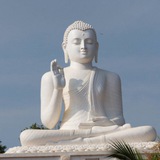
Four giant standing buddhas with different mudras facing four cardinal directions at The Shwethalyaung Temple, Bago, Myanmar.
🙏2👏1🤩1
If no-one else is found
in front or behind,
it’s extremely pleasant
to be dwelling alone in a forest grove.
Come now, I’ll go alone
to the wilderness praised by the Buddha.
It’s pleasant for a mendicant
to be dwelling alone and resolute.
When will I dwell alone,
without a companion,
in the great wood, so delightful,
my task complete, free of defilements?
This is what I want to do:
may my wish succeed!
I’ll make it happen myself,
for no-one can do another’s duty.
Fastening my armor,
I’ll enter the forest.
I won’t leave
without attaining the end of defilements.
As the cool breeze blows
with fragrant scent,
I’ll split ignorance apart,
sitting on the mountain-peak.
In a forest grove covered with blossoms,
in a cave so very cool,
I take pleasure in the Mountainfold,
happy with the happiness of freedom.
I’ve got all I wished for
like the moon on the fifteenth day.
With the utter ending of all defilements,
now there’ll be no more future lives.
Partially excerpted from Thag 10.2 Ekavihāriyattheragāthā
in front or behind,
it’s extremely pleasant
to be dwelling alone in a forest grove.
Come now, I’ll go alone
to the wilderness praised by the Buddha.
It’s pleasant for a mendicant
to be dwelling alone and resolute.
When will I dwell alone,
without a companion,
in the great wood, so delightful,
my task complete, free of defilements?
This is what I want to do:
may my wish succeed!
I’ll make it happen myself,
for no-one can do another’s duty.
Fastening my armor,
I’ll enter the forest.
I won’t leave
without attaining the end of defilements.
As the cool breeze blows
with fragrant scent,
I’ll split ignorance apart,
sitting on the mountain-peak.
In a forest grove covered with blossoms,
in a cave so very cool,
I take pleasure in the Mountainfold,
happy with the happiness of freedom.
I’ve got all I wished for
like the moon on the fifteenth day.
With the utter ending of all defilements,
now there’ll be no more future lives.
Partially excerpted from Thag 10.2 Ekavihāriyattheragāthā
❤2🥰1🕊1🤗1
Forwarded from Buddha Dharma books
Free Buddha Dharma ebook
Illustrated Buddhist tales for young and old
As interpreted by Kurunegoda Piyatissa
It is a pleasure to rewrite the Jataka stories in modern English understandable by western readers. To achieve this goal, the stories are being retold in order to convey the spirit and meaning. They are not scholarly word-for-word translations as have been done by others. The Pali Text Society published the whole text in English translation a hundred years ago. In Sri Lanka they were translated into Sinhalese in the 14th century, where they were known as Pansiya Panas Jataka.
In all Buddhist countries the Jataka tales were the major sources for developing the character of the people. They were used widely in preaching by monks and lay preachers. King Dutugemunu (2nd century B.C.), in Anuradhapura, paid for the support of preachers to teach Dharma, the teachings of the Buddha. They usually used these stories in their sermons. Even the Venerable Arahant Maha Mahinda, who introduced Dharma into Sri Lanka, used these stories to illustrate the truth of the teachings. Some were even used by the Lord Buddha in his teachings, and from him his followers learned them and passed them into popular use in society. Even earlier, the same types of stories were present in Vedic literature.
Free download here:
https://ftp.budaedu.org/ebooks/pdf/EN002.pdf
http://www.buddhanet.net/pdf_file/jtwebv1p.pdf
=============
Illustrated Buddhist tales for young and old
As interpreted by Kurunegoda Piyatissa
It is a pleasure to rewrite the Jataka stories in modern English understandable by western readers. To achieve this goal, the stories are being retold in order to convey the spirit and meaning. They are not scholarly word-for-word translations as have been done by others. The Pali Text Society published the whole text in English translation a hundred years ago. In Sri Lanka they were translated into Sinhalese in the 14th century, where they were known as Pansiya Panas Jataka.
In all Buddhist countries the Jataka tales were the major sources for developing the character of the people. They were used widely in preaching by monks and lay preachers. King Dutugemunu (2nd century B.C.), in Anuradhapura, paid for the support of preachers to teach Dharma, the teachings of the Buddha. They usually used these stories in their sermons. Even the Venerable Arahant Maha Mahinda, who introduced Dharma into Sri Lanka, used these stories to illustrate the truth of the teachings. Some were even used by the Lord Buddha in his teachings, and from him his followers learned them and passed them into popular use in society. Even earlier, the same types of stories were present in Vedic literature.
Free download here:
https://ftp.budaedu.org/ebooks/pdf/EN002.pdf
http://www.buddhanet.net/pdf_file/jtwebv1p.pdf
=============
👍2🤗1
Dhammapada Verse 200
Mara Vatthu
Susukham vata jivama
yesam no natthi kincanam1
pitibhakkha bhavissama
deva abhassara2 yatha.
Verse 200: Indeed we live very happily, without any anxiety (i.e., without greed, ill will and ignorance); like the Abhassara brahmas we shall live on delightful satisfaction (piti) as our food.
1. natthi kincanam: without any anxiety, here it means without greed, ill will and ignorance (raga, dosa and moha).
2. deva abhassara: Abhassara brahmas are the radiant brahmas of the abode of the second Rupavacara Jhana Brahmaloka.
The Story of Mara
The Buddha uttered Verse (200) of this book in a brahmin village known as Pancasala (village of five halls), with reference to Mara.
On one occasion, the Buddha saw in his vision that five hundred maidens from Pancasala village were due to attain Sotapatti Fruition. So he went to stay near that village. The five hundred maidens went to the riverside to have a bath; after the bath they returned to the village fully dressed up, because it was a festival day. About the same time, the Buddha entered Pancasila village for alms-food but none of the villagers offered him anything because they had been possessed by Mara.
On his return the Buddha met Mara, who promptly asked him whether he had received much alms-food.
The Buddha saw the hand of Mara in his failure to get any alms-food on that day and replied, "You wicked Mara! It was you who turned the villagers against me. Because they were possessed by you they did not offer any alms-food to me. Am I not right ?" Mara made no reply to that question, but he thought that it would be fun to entice the Buddha back to the village and get the villagers to insult the Buddha by making fun of him. So he suggested, "O Buddha, why don't you go back to the village again? This time, you are sure to get some food."
Just then, the five hundred village maidens arrived on the scene and paid obeisance to the Buddha. In their presence, Mara taunted the Buddha, "O Buddha, since you received no alms-food this morning, you must be feeling the pangs of hunger!" To him the Buddha replied, "O wicked Mara, even though we do not get any food, like the Abhassara brahmas who live only on the delightful satisfaction (piti) and bliss (sukha) of jhana, we shall live on the delightful satisfaction and bliss of the Dhamma."
Then the Buddha spoke in verse as follows:
Verse 200: Indeed we live very happily, without any anxiety (i.e., without greed, ill will and ignorance); like the Abhassara brahmas we shall live on delightful satisfaction (piti) as our food.
At the end of the discourse, the five hundred maidens attained Sotapatti Fruition.
===
Buddha dharma teachings channel:
https://news.1rj.ru/str/lorddivinebuddha
====================
Mara Vatthu
Susukham vata jivama
yesam no natthi kincanam1
pitibhakkha bhavissama
deva abhassara2 yatha.
Verse 200: Indeed we live very happily, without any anxiety (i.e., without greed, ill will and ignorance); like the Abhassara brahmas we shall live on delightful satisfaction (piti) as our food.
1. natthi kincanam: without any anxiety, here it means without greed, ill will and ignorance (raga, dosa and moha).
2. deva abhassara: Abhassara brahmas are the radiant brahmas of the abode of the second Rupavacara Jhana Brahmaloka.
The Story of Mara
The Buddha uttered Verse (200) of this book in a brahmin village known as Pancasala (village of five halls), with reference to Mara.
On one occasion, the Buddha saw in his vision that five hundred maidens from Pancasala village were due to attain Sotapatti Fruition. So he went to stay near that village. The five hundred maidens went to the riverside to have a bath; after the bath they returned to the village fully dressed up, because it was a festival day. About the same time, the Buddha entered Pancasila village for alms-food but none of the villagers offered him anything because they had been possessed by Mara.
On his return the Buddha met Mara, who promptly asked him whether he had received much alms-food.
The Buddha saw the hand of Mara in his failure to get any alms-food on that day and replied, "You wicked Mara! It was you who turned the villagers against me. Because they were possessed by you they did not offer any alms-food to me. Am I not right ?" Mara made no reply to that question, but he thought that it would be fun to entice the Buddha back to the village and get the villagers to insult the Buddha by making fun of him. So he suggested, "O Buddha, why don't you go back to the village again? This time, you are sure to get some food."
Just then, the five hundred village maidens arrived on the scene and paid obeisance to the Buddha. In their presence, Mara taunted the Buddha, "O Buddha, since you received no alms-food this morning, you must be feeling the pangs of hunger!" To him the Buddha replied, "O wicked Mara, even though we do not get any food, like the Abhassara brahmas who live only on the delightful satisfaction (piti) and bliss (sukha) of jhana, we shall live on the delightful satisfaction and bliss of the Dhamma."
Then the Buddha spoke in verse as follows:
Verse 200: Indeed we live very happily, without any anxiety (i.e., without greed, ill will and ignorance); like the Abhassara brahmas we shall live on delightful satisfaction (piti) as our food.
At the end of the discourse, the five hundred maidens attained Sotapatti Fruition.
===
Buddha dharma teachings channel:
https://news.1rj.ru/str/lorddivinebuddha
====================
Telegram
Buddha
Buddha dharma teachings from the suttas and commentaries
🥰1🕊1🦄1
Vision and Routine
Why you need both to strike a balance
By Ven. Bhikkhu Bodhi
All human activity can be viewed as an interplay between two contrary but equally essential factors—vision and repetitive routine. Vision is the creative element in activity, whose presence ensures that over and above the settled conditions pressing down upon us from the past we still enjoy a margin of openness to the future, a freedom to discern more meaningful ends and to discover more efficient ways to achieve them. Repetitive routine, in contrast, provides the conservative element in activity. It is the principle that accounts for the persistence of the past in the present, and it enables the successful achievements of the present to be preserved intact and faithfully transmitted to the future.
Although they pull in opposite directions—the one toward change, the other toward stability—vision and routine mesh in a variety of ways, and every course of action can be found to participate to some extent in both. For any particular action to be both meaningful and effective, the attainment of a healthy balance between the two is necessary. When one factor prevails at the expense of the other, the consequences are often undesirable. If we are bound to a repetitive cycle of work that deprives us of our freedom to inquire and understand things for ourselves, we soon stagnate, crippled by the chains of routine. If we are spurred to action by elevating ideals but lack the discipline to implement them, we may eventually find ourselves wallowing in idle dreams or exhausting our energies on frivolous pursuits. It is only when accustomed routines are infused by vision that they become springboards to discovery rather than deadening ruts. And it is only when inspired vision gives birth to a course of repeatable actions that we can bring our ideals down from the ethereal sphere of imagination to the somber realm of fact. It took a flash of genius for Michelangelo to behold the figure of David invisible in a shapeless block of stone, but it required years of training, and countless blows with hammer and chisel, to work the miracle that would leave us a masterpiece of art.
The key to development along the Buddhist path is repetitive routine guided by inspirational vision.
These reflections concerning the relationship between vision and routine are equally applicable to the practice of the Buddhist path. Like all other human activities, the treading of the way to the cessation of suffering requires that the intelligent grasp of new disclosures of truth be fused with the patient and stabilizing discipline of repetition. The factor of vision enters the path under the heading of right view—as the understanding of the undistorted truths concerning our lives and as the continued penetration of those same truths through deepening contemplation and reflection. The factor of repetition enters the path as the onerous task imposed by the practice itself: the need to undertake specific modes of training and to cultivate them diligently in the prescribed sequence until they yield their fruit. The course of spiritual growth along the Buddhist path might in fact be conceived as an alternating succession of stages in which, during one phase, the element of vision predominates, and during the next the element of routine. It is a flash of vision that opens our inner eye to the essential meaning of the dharma, gradual training that makes our insight secure, and again the urge for still more vision that propels the practice forward to its culmination in final knowledge.
Though the emphasis may alternate from phase to phase, ultimate success in the development of the path always hinges upon balancing vision with routine in such a way that each can make its optimal contribution. However, because our minds are keyed to fix upon the new and distinctive, in our practice we are prone to place a one-sided emphasis on vision at the expense of repetitive routine.
Why you need both to strike a balance
By Ven. Bhikkhu Bodhi
All human activity can be viewed as an interplay between two contrary but equally essential factors—vision and repetitive routine. Vision is the creative element in activity, whose presence ensures that over and above the settled conditions pressing down upon us from the past we still enjoy a margin of openness to the future, a freedom to discern more meaningful ends and to discover more efficient ways to achieve them. Repetitive routine, in contrast, provides the conservative element in activity. It is the principle that accounts for the persistence of the past in the present, and it enables the successful achievements of the present to be preserved intact and faithfully transmitted to the future.
Although they pull in opposite directions—the one toward change, the other toward stability—vision and routine mesh in a variety of ways, and every course of action can be found to participate to some extent in both. For any particular action to be both meaningful and effective, the attainment of a healthy balance between the two is necessary. When one factor prevails at the expense of the other, the consequences are often undesirable. If we are bound to a repetitive cycle of work that deprives us of our freedom to inquire and understand things for ourselves, we soon stagnate, crippled by the chains of routine. If we are spurred to action by elevating ideals but lack the discipline to implement them, we may eventually find ourselves wallowing in idle dreams or exhausting our energies on frivolous pursuits. It is only when accustomed routines are infused by vision that they become springboards to discovery rather than deadening ruts. And it is only when inspired vision gives birth to a course of repeatable actions that we can bring our ideals down from the ethereal sphere of imagination to the somber realm of fact. It took a flash of genius for Michelangelo to behold the figure of David invisible in a shapeless block of stone, but it required years of training, and countless blows with hammer and chisel, to work the miracle that would leave us a masterpiece of art.
The key to development along the Buddhist path is repetitive routine guided by inspirational vision.
These reflections concerning the relationship between vision and routine are equally applicable to the practice of the Buddhist path. Like all other human activities, the treading of the way to the cessation of suffering requires that the intelligent grasp of new disclosures of truth be fused with the patient and stabilizing discipline of repetition. The factor of vision enters the path under the heading of right view—as the understanding of the undistorted truths concerning our lives and as the continued penetration of those same truths through deepening contemplation and reflection. The factor of repetition enters the path as the onerous task imposed by the practice itself: the need to undertake specific modes of training and to cultivate them diligently in the prescribed sequence until they yield their fruit. The course of spiritual growth along the Buddhist path might in fact be conceived as an alternating succession of stages in which, during one phase, the element of vision predominates, and during the next the element of routine. It is a flash of vision that opens our inner eye to the essential meaning of the dharma, gradual training that makes our insight secure, and again the urge for still more vision that propels the practice forward to its culmination in final knowledge.
Though the emphasis may alternate from phase to phase, ultimate success in the development of the path always hinges upon balancing vision with routine in such a way that each can make its optimal contribution. However, because our minds are keyed to fix upon the new and distinctive, in our practice we are prone to place a one-sided emphasis on vision at the expense of repetitive routine.
Telegram
Ajahn Chah - Theravada Thailand Buddhism
Collection of teachings of Venerable Ajahn Chah, a foremost meditation and Buddhist teacher from Thailand
❤1👍1🕊1
Thus we are elated by expectations concerning the stages of the path far beyond our reach, while at the same time we tend to neglect the lower stages—dull and drab, but far more urgent and immediate—lying just beneath our feet. To adopt this attitude, however, is to forget the crucial fact that vision always operates upon a groundwork of previously established routine and must in turn give rise to new patterns of routine adequate to the attainment of its intended aim. If we are to close the gap between ideal and actuality—between the envisaged aim of striving and the lived experience of our everyday lives—it is necessary for us to pay greater heed to the task of repetition. Every wholesome thought, every pure intention, every effort to train the mind represents a potential for growth along the noble eightfold path. But to be converted from a mere potential into an active power leading to the end of suffering, the fleeting, wholesome thought formations must be repeated, fostered, and cultivated, made into enduring qualities of our being. Feeble in their individuality, when their forces are consolidated by repetition they acquire a strength that is invincible.
The key to development along the Buddhist path is repetitive routine guided by inspirational vision. It is the insight into final freedom—the peace and purity of a liberated mind—that uplifts us and impels us to overcome our limits. But it is by repetition—the methodical cultivation of wholesome practices—that we cover the distance separating us from the goal and draw ever closer to awakening.
===
An earlier version of this essay appeared in the BPS Newsletter, Buddhist Publication Society, Kandy, Sri Lanka.
Ven. Bhikkhu Bodhi lives and teaches at Chuang Yen Monastery in Carmel, New York. He is a translator of texts from the Pali canon and the cofounder of Buddhist Global Relief.
===
Ajahn Chah, Buddhist teacher of Thai forest meditation of Theravada Buddhism channel:
https://news.1rj.ru/str/ajahnchah_buddhism
===
The key to development along the Buddhist path is repetitive routine guided by inspirational vision. It is the insight into final freedom—the peace and purity of a liberated mind—that uplifts us and impels us to overcome our limits. But it is by repetition—the methodical cultivation of wholesome practices—that we cover the distance separating us from the goal and draw ever closer to awakening.
===
An earlier version of this essay appeared in the BPS Newsletter, Buddhist Publication Society, Kandy, Sri Lanka.
Ven. Bhikkhu Bodhi lives and teaches at Chuang Yen Monastery in Carmel, New York. He is a translator of texts from the Pali canon and the cofounder of Buddhist Global Relief.
===
Ajahn Chah, Buddhist teacher of Thai forest meditation of Theravada Buddhism channel:
https://news.1rj.ru/str/ajahnchah_buddhism
===
Telegram
Ajahn Chah - Theravada Thailand Buddhism
Collection of teachings of Venerable Ajahn Chah, a foremost meditation and Buddhist teacher from Thailand
💯2❤1👏1🕊1
Dhammapada Verse 201
Kosalaranno Parajaya Vatthu
Jayam veram pasavati
dukkham seti parajito
upasanto1 sukham seti
hitva jayaparajayam.
Verse 201: Conquest begets enmity; the conquered live in misery; the peaceful live happily having renounced conquest and defeat.
The Story of the Defeat of the King of Kosala
While residing at the Jetavana monastery, the Buddha uttered Verse (201) of this book, with reference to the King of Kosala who was defeated in battle by Ajatasattu, his own nephew.
In fighting against Ajatasattu, the King of Kosala was defeated three times. Ajatasattu was the son of King Bimbisara and Queen Vedehi, the sister of the King of Kosala. The King of Kosala was ashamed and very much depressed over his defeat. Thus his lamentation: "What a disgrace! I cannot even conquer this boy who still smells of mother's milk. It is better that I should die." Feeling depressed and very much ashamed, the king refused to take food, and kept to his bed. The news about the king's distress spread like wild fire and when the Buddha came to learn about it, he said, "Bhikkhus! In one who conquers, enmity and hatred increase; one who is defeated suffers pain and distress."
Then the Buddha spoke in verse as follows:
Verse 201: Conquest begets enmity; the conquered live in misery; the peaceful live happily having renounced conquest and defeat.
===
Tibetan Buddhism - Vajrayana, Tantrayana and esoteric Buddhism channel:
https://news.1rj.ru/str/tibetanbuddha
Vajrayana Tantrayana Buddhism channel:
https://news.1rj.ru/str/tantrayanabuddhism
====================
Kosalaranno Parajaya Vatthu
Jayam veram pasavati
dukkham seti parajito
upasanto1 sukham seti
hitva jayaparajayam.
Verse 201: Conquest begets enmity; the conquered live in misery; the peaceful live happily having renounced conquest and defeat.
The Story of the Defeat of the King of Kosala
While residing at the Jetavana monastery, the Buddha uttered Verse (201) of this book, with reference to the King of Kosala who was defeated in battle by Ajatasattu, his own nephew.
In fighting against Ajatasattu, the King of Kosala was defeated three times. Ajatasattu was the son of King Bimbisara and Queen Vedehi, the sister of the King of Kosala. The King of Kosala was ashamed and very much depressed over his defeat. Thus his lamentation: "What a disgrace! I cannot even conquer this boy who still smells of mother's milk. It is better that I should die." Feeling depressed and very much ashamed, the king refused to take food, and kept to his bed. The news about the king's distress spread like wild fire and when the Buddha came to learn about it, he said, "Bhikkhus! In one who conquers, enmity and hatred increase; one who is defeated suffers pain and distress."
Then the Buddha spoke in verse as follows:
Verse 201: Conquest begets enmity; the conquered live in misery; the peaceful live happily having renounced conquest and defeat.
===
Tibetan Buddhism - Vajrayana, Tantrayana and esoteric Buddhism channel:
https://news.1rj.ru/str/tibetanbuddha
Vajrayana Tantrayana Buddhism channel:
https://news.1rj.ru/str/tantrayanabuddhism
====================
Telegram
Tibetan Buddhism Vajrayana Tantrayana esoteric tradition
Buddha Dharma teachings from the esoteric Vajrayana or Tantrayana Buddhism, includes all major schools Nyingma, Kagyu, Gelug, Sakya, Jonang and Bonpo.
❤1👍1🥰1
Forwarded from Buddha Dharma books
Free Buddha Dharma ebook
A Manual of Buddhism
By Venerable Narada Mahathera
This is a fairly comprehensive book enablingthe reader to appreciate and understand certa inimportant finer aspects of Theravada Buddhism.This book would also serve as a reference, for both Teachers and Students alike, gain a good insight into the fundamentals of Buddhism.
The author, the late Venerable Narada MahaThera was a well-known Buddhist Missioner. Heis also the author of many other Buddhist Publications. We are grateful to him for his kind permission, enabling this reprint to be effected in Malaysia.
Free download available:
https://archive.org/download/a-manual-of-buddhism-narada/A%20Manual%20of%20Buddhism%20-%20Narada.pdf
=============
A Manual of Buddhism
By Venerable Narada Mahathera
This is a fairly comprehensive book enablingthe reader to appreciate and understand certa inimportant finer aspects of Theravada Buddhism.This book would also serve as a reference, for both Teachers and Students alike, gain a good insight into the fundamentals of Buddhism.
The author, the late Venerable Narada MahaThera was a well-known Buddhist Missioner. Heis also the author of many other Buddhist Publications. We are grateful to him for his kind permission, enabling this reprint to be effected in Malaysia.
Free download available:
https://archive.org/download/a-manual-of-buddhism-narada/A%20Manual%20of%20Buddhism%20-%20Narada.pdf
=============
💯2🦄1
“But Vaccha, suppose they were to ask you: ‘This fire in front of you that is quenched: in what direction did it go—east, south, west, or north?’ How would you answer?”
“It doesn’t apply, worthy Gotama. The fire depended on grass and logs as fuel. When that runs out, and no more fuel is added, the fire is reckoned to have become quenched due to lack of fuel.”
“In the same way, Vaccha, any form [feeling … perception … choices … consciousness] by which a realized one might be described has been given up, cut off at the root, made like a palm stump, obliterated, and unable to arise in the future. A realized one is freed from reckoning in terms of form [feeling … perception … choices … consciousness]. They’re deep, immeasurable, and hard to fathom, like the ocean. ‘They’re reborn’, ‘they’re not reborn’, ‘they’re both reborn and not reborn’, ‘they’re neither reborn nor not reborn’—none of these apply.
Partial excerpts from MN 72: Aggivacchasutta
“It doesn’t apply, worthy Gotama. The fire depended on grass and logs as fuel. When that runs out, and no more fuel is added, the fire is reckoned to have become quenched due to lack of fuel.”
“In the same way, Vaccha, any form [feeling … perception … choices … consciousness] by which a realized one might be described has been given up, cut off at the root, made like a palm stump, obliterated, and unable to arise in the future. A realized one is freed from reckoning in terms of form [feeling … perception … choices … consciousness]. They’re deep, immeasurable, and hard to fathom, like the ocean. ‘They’re reborn’, ‘they’re not reborn’, ‘they’re both reborn and not reborn’, ‘they’re neither reborn nor not reborn’—none of these apply.
Partial excerpts from MN 72: Aggivacchasutta
🕊1🤗1
Dhammapada Verse 202
Annatarakuladarika Vatthu
Natthi ragasamo aggi
natthi dosasamo kali
natthi khandhasama dukkha
natthi santiparam sukham.
Verse 202: There is no fire like passion; there is no evil like hatred; there is no ill like (the burden of) khandhas; there is no bliss that surpasses the Perfect Peace (i.e., Nibbana).
The Story of a Young Bride
While residing at the Jetavana monastery, the Buddha uttered Verse (202) of this book at the house of a lay-disciple, with reference to a young bride.
On the day a young woman was to be wedded to a young man, the parents of the bride invited the Buddha and eighty of his disciples for alms-food. Seeing the girl as she moved about the house, helping with the offering of alms-food, the bridegroom was very much excited, and he could hardly attend to the needs of the Buddha and the other bhikkhus. The Buddha knew exactly how the young bridegroom was feeling and also that time was ripe for both the bride and the bridegroom to attain Sotapatti Fruition.
By his supernormal power, the Buddha willed that the bride would not be visible to the bridegroom. When the young man could no longer see the young woman, he could pay full attention to the Buddha, and his love and respect for the Buddha grew stronger in him. Then the Buddha said to the young man, "O young man, there is no fire like the fire of passion; there is no evil like anger and hatred; there is no ill like the burden of the five aggregates of existence (khandhas); there is no bliss like the Perfect Peace of Nibbana."
Then the Buddha spoke in verse as follows:
Verse 202: There is no fire like passion; there is no evil like hatred; there is no ill like (the burden of) khandhas; there is no bliss that surpasses the Perfect Peace (i.e., Nibbana).
At the end of the discourse both the bride and bridegroom attained Sotapatti Fruition.
===
Words of the Buddha channel:
https://news.1rj.ru/str/wordsofbuddha
====================
Annatarakuladarika Vatthu
Natthi ragasamo aggi
natthi dosasamo kali
natthi khandhasama dukkha
natthi santiparam sukham.
Verse 202: There is no fire like passion; there is no evil like hatred; there is no ill like (the burden of) khandhas; there is no bliss that surpasses the Perfect Peace (i.e., Nibbana).
The Story of a Young Bride
While residing at the Jetavana monastery, the Buddha uttered Verse (202) of this book at the house of a lay-disciple, with reference to a young bride.
On the day a young woman was to be wedded to a young man, the parents of the bride invited the Buddha and eighty of his disciples for alms-food. Seeing the girl as she moved about the house, helping with the offering of alms-food, the bridegroom was very much excited, and he could hardly attend to the needs of the Buddha and the other bhikkhus. The Buddha knew exactly how the young bridegroom was feeling and also that time was ripe for both the bride and the bridegroom to attain Sotapatti Fruition.
By his supernormal power, the Buddha willed that the bride would not be visible to the bridegroom. When the young man could no longer see the young woman, he could pay full attention to the Buddha, and his love and respect for the Buddha grew stronger in him. Then the Buddha said to the young man, "O young man, there is no fire like the fire of passion; there is no evil like anger and hatred; there is no ill like the burden of the five aggregates of existence (khandhas); there is no bliss like the Perfect Peace of Nibbana."
Then the Buddha spoke in verse as follows:
Verse 202: There is no fire like passion; there is no evil like hatred; there is no ill like (the burden of) khandhas; there is no bliss that surpasses the Perfect Peace (i.e., Nibbana).
At the end of the discourse both the bride and bridegroom attained Sotapatti Fruition.
===
Words of the Buddha channel:
https://news.1rj.ru/str/wordsofbuddha
====================
Telegram
Words of the Buddha
Daily teachings of Buddha Dharma
👏1💯1