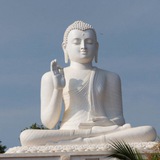
Dhammapada Verse 251
Panca Upasaka Vatthu
Natthi ragasamo aggi
natthi dosasamo gaho
natthi mohasamam jalam
natthi tanhaisama nadi1.
Verse 251: There is no fire like passion, there is no grip like ill will, there is no net like ignorance, there is no river like craving.
1. natthi tanhasama nadi: There is no river like craving. This is because although a river can be full at times, craving can never be full, ie., satiated.
The Story of Five Lay-disciples
While residing at the Jetavana monastery, the Buddha uttered Verse (251) of this book, with reference to five lay disciples.
On one occasion, five lay-disciples were present while the Buddha was expounding the Dhamma at the Jetavana monastery. One of them was asleep while sitting, the second one was drawing lines with his fingers on the ground, the third was trying to shake a tree, the fourth was looking up at the sky. The fifth was the only one who was respectfully and attentively listening to the Buddha. Thera Ananda, who was near the Buddha fanning him saw the different behaviour of the five disciples and said to the Buddha, "Venerable Sir! While you were expounding the Dhamma like big drops of rain falling from the sky, only one out of those five people were listening attentively." Then Thera Ananda described the different behaviour of the other four to the Buddha and asked why they were behaving thus.
The Buddha then explained to Thera Ananda, "Ananda, these people could not get rid of their old habits. In their past existences, the first one was a snake; as a snake usually coils itself up and goes to sleep, so also, this man goes to sleep while listening to the Dhamma. The one who was scratching the earth with his hand was an earthworm, the one who was shaking the tree was a monkey, the one who was gazing up at the sky was an astronomer and the one who was listening attentively to the Dhamma was a learned astrologer. In this connection, Ananda, you must remember that one must be attentive to be able to understand the Dhamma and that there are many people who cannot follow what was being said."
Thera Ananda then asked the Buddha, "Venerable Sir! What are the things that prevent people from being able to take in the Dhamma?" And the Buddha replied, "Ananda, passion (raga), ill will (dosa) and ignorance (moha) are the three things that prevent people from taking in the Dhamma. Passion burns one; there is no fire like passion. The world may burn up when seven suns rise in the sky, but that happens very rarely. Passion burns always and without any break."
Then the Buddha spoke in verse as follows:
Verse 251: There is no fire like passion, there is no grip like ill will, there is no net like ignorance, there is no river like craving.
At the end of the discourse the one who was listening attentively attained Sotapatti Fruition.
===
Buddha dharma teachings channel:
https://invite.viber.com/?g2=AQAKw1y3rv%2F6sk61PI2W4izuIiaEZj8YZujhY1tSzL%2B07s7rFnVFDAd0bAYFaMLw
===
Panca Upasaka Vatthu
Natthi ragasamo aggi
natthi dosasamo gaho
natthi mohasamam jalam
natthi tanhaisama nadi1.
Verse 251: There is no fire like passion, there is no grip like ill will, there is no net like ignorance, there is no river like craving.
1. natthi tanhasama nadi: There is no river like craving. This is because although a river can be full at times, craving can never be full, ie., satiated.
The Story of Five Lay-disciples
While residing at the Jetavana monastery, the Buddha uttered Verse (251) of this book, with reference to five lay disciples.
On one occasion, five lay-disciples were present while the Buddha was expounding the Dhamma at the Jetavana monastery. One of them was asleep while sitting, the second one was drawing lines with his fingers on the ground, the third was trying to shake a tree, the fourth was looking up at the sky. The fifth was the only one who was respectfully and attentively listening to the Buddha. Thera Ananda, who was near the Buddha fanning him saw the different behaviour of the five disciples and said to the Buddha, "Venerable Sir! While you were expounding the Dhamma like big drops of rain falling from the sky, only one out of those five people were listening attentively." Then Thera Ananda described the different behaviour of the other four to the Buddha and asked why they were behaving thus.
The Buddha then explained to Thera Ananda, "Ananda, these people could not get rid of their old habits. In their past existences, the first one was a snake; as a snake usually coils itself up and goes to sleep, so also, this man goes to sleep while listening to the Dhamma. The one who was scratching the earth with his hand was an earthworm, the one who was shaking the tree was a monkey, the one who was gazing up at the sky was an astronomer and the one who was listening attentively to the Dhamma was a learned astrologer. In this connection, Ananda, you must remember that one must be attentive to be able to understand the Dhamma and that there are many people who cannot follow what was being said."
Thera Ananda then asked the Buddha, "Venerable Sir! What are the things that prevent people from being able to take in the Dhamma?" And the Buddha replied, "Ananda, passion (raga), ill will (dosa) and ignorance (moha) are the three things that prevent people from taking in the Dhamma. Passion burns one; there is no fire like passion. The world may burn up when seven suns rise in the sky, but that happens very rarely. Passion burns always and without any break."
Then the Buddha spoke in verse as follows:
Verse 251: There is no fire like passion, there is no grip like ill will, there is no net like ignorance, there is no river like craving.
At the end of the discourse the one who was listening attentively attained Sotapatti Fruition.
===
Buddha dharma teachings channel:
https://invite.viber.com/?g2=AQAKw1y3rv%2F6sk61PI2W4izuIiaEZj8YZujhY1tSzL%2B07s7rFnVFDAd0bAYFaMLw
===
Viber
Buddha
Buddha dharma teachings from the suttas and commentaries from Theravada tradition
👍1🏆1
Forwarded from Words of the Buddha
Big Buddhas of Wat Pha Sorn Kaew Buddhist temple, Phetchabun, Thailand
👏1😎1
Forwarded from Buddha Dharma books
Free Buddha Dharma ebook
Keeping the Breath in Mind & Lessons in Samadhi, by Ajaan Lee Dhammadharo. (revised Dec. 15, 2018) A fundamental guidebook for breath meditation and practicing the jhānas.
Free download here:
https://www.dhammatalks.org/Archive/Writings/Ebooks/KeepingtheBreathinMind_181215.pdf
===
Keeping the Breath in Mind & Lessons in Samadhi, by Ajaan Lee Dhammadharo. (revised Dec. 15, 2018) A fundamental guidebook for breath meditation and practicing the jhānas.
Free download here:
https://www.dhammatalks.org/Archive/Writings/Ebooks/KeepingtheBreathinMind_181215.pdf
===
💯2👏1🏆1
Dhammapada Verse 252
Mendakasetthi Vatthu
Sudassam vajjamannesam
attano pana duddsam
paresam hi so vajjani
opunati yatha bhusam
attano pana chadeti
kalimva kitava satho.1
Verse 252: It is easy to see the faults of others, but difficult to see one's own. A man broadcasts the fault; of others like winnowing chaff in the wind, but hides his own faults as a crafty fowler covers himself.
1. Satho: a cheat, a gambler. According to the Commentary, it means a crafty fowler.
The Story of Mendaka the Rich Man
While residing near the town of Baddiya, the Buddha uttered Verse (252) of this book with reference to the renowned rich man Mendaka and his family.
Once, during his tour of Anga and Uttara regions, the Buddha saw in his vision that time was ripe for Mendaka, his wife, his son, his daughter-in-law, his granddaughter and his servant, to attain Sotapatti Fruition. Seeing the prospect of these six people attaining Sotapatti Fruition, the Buddha went to the town of Baddiya.
Mendaka was an extremely rich man. It was said that he found a large number of life-size golden statues of goats in his backyard. For this reason, he was known as Mendaka (a goat) the rich man. Again, it was also said that during the time of Vipassi Buddha he had donated a monastery for Vipassi Buddha and a congregation hall complete with a platform for the preacher. On completion of these buildings he made offerings of alms-food to Vipassi Buddha and the bhikkhus for four months. Then, in yet another of his past existences, when he was a rich man in Baranasi, there was a famine throughout the region. One day, they had cooked a meal just enough for the members of the family when a paccekabuddha stood at the door for alms-food. Then and there he offered all the food. But due to his great faith and generosity, the rice pot was later found to be miraculously filled up again; so also were his granaries.
Mendaka and his family, hearing that the Buddha was coming to Baddiya, went to pay homage to him. After hearing the discourse given by the Buddha, Mendaka, his wife Candapaduma, his son Danancaya, his daughter-in-law Sumanadevi, his granddaughter Visakha and the servant Punna attained Sotapatti Fruition. Mendaka then told the Buddha how on his way, some ascetics had spoken ill of the Buddha and had tried to dissuade him from coming to see him. The Buddha then said, "My disciple, it is natural for people not to see one's own faults, and to exaggerate other people's faults and failings."
Then the Buddha spoke in verse as follows:
Verse 252: It is easy to see the faults of others, but difficult to see one's own. A man broadcasts the fault; of others like winnowing chaff in the wind, but hides his own faults as a crafty fowler covers himself.
===
Words of the Buddha channel:
https://invite.viber.com/?g2=AQAFqzqlj7FmI061PX17rxWMAtZ%2BRuso%2FH2KmHKZSgnv7v9DD8X0bDkKnZDr9JDq
===
Mendakasetthi Vatthu
Sudassam vajjamannesam
attano pana duddsam
paresam hi so vajjani
opunati yatha bhusam
attano pana chadeti
kalimva kitava satho.1
Verse 252: It is easy to see the faults of others, but difficult to see one's own. A man broadcasts the fault; of others like winnowing chaff in the wind, but hides his own faults as a crafty fowler covers himself.
1. Satho: a cheat, a gambler. According to the Commentary, it means a crafty fowler.
The Story of Mendaka the Rich Man
While residing near the town of Baddiya, the Buddha uttered Verse (252) of this book with reference to the renowned rich man Mendaka and his family.
Once, during his tour of Anga and Uttara regions, the Buddha saw in his vision that time was ripe for Mendaka, his wife, his son, his daughter-in-law, his granddaughter and his servant, to attain Sotapatti Fruition. Seeing the prospect of these six people attaining Sotapatti Fruition, the Buddha went to the town of Baddiya.
Mendaka was an extremely rich man. It was said that he found a large number of life-size golden statues of goats in his backyard. For this reason, he was known as Mendaka (a goat) the rich man. Again, it was also said that during the time of Vipassi Buddha he had donated a monastery for Vipassi Buddha and a congregation hall complete with a platform for the preacher. On completion of these buildings he made offerings of alms-food to Vipassi Buddha and the bhikkhus for four months. Then, in yet another of his past existences, when he was a rich man in Baranasi, there was a famine throughout the region. One day, they had cooked a meal just enough for the members of the family when a paccekabuddha stood at the door for alms-food. Then and there he offered all the food. But due to his great faith and generosity, the rice pot was later found to be miraculously filled up again; so also were his granaries.
Mendaka and his family, hearing that the Buddha was coming to Baddiya, went to pay homage to him. After hearing the discourse given by the Buddha, Mendaka, his wife Candapaduma, his son Danancaya, his daughter-in-law Sumanadevi, his granddaughter Visakha and the servant Punna attained Sotapatti Fruition. Mendaka then told the Buddha how on his way, some ascetics had spoken ill of the Buddha and had tried to dissuade him from coming to see him. The Buddha then said, "My disciple, it is natural for people not to see one's own faults, and to exaggerate other people's faults and failings."
Then the Buddha spoke in verse as follows:
Verse 252: It is easy to see the faults of others, but difficult to see one's own. A man broadcasts the fault; of others like winnowing chaff in the wind, but hides his own faults as a crafty fowler covers himself.
===
Words of the Buddha channel:
https://invite.viber.com/?g2=AQAFqzqlj7FmI061PX17rxWMAtZ%2BRuso%2FH2KmHKZSgnv7v9DD8X0bDkKnZDr9JDq
===
Viber
Words Of The Buddha
Daily teachings from Buddha Dharma
👍1👏1💯1
Dhammapada Verse 253
Ujjhanasannitthera Vatthu
Paravajjanupassissa
niccam ujjhanasannino
asava tassa vaddhanti
ara so asavakkhaya.
Verse 253: In one who constantly sees the faults of others and is always disparaging them, moral intoxicants (asavas) increase; he is far from extinction of moral intoxicants (i.e., he is far from attainment of arahatship).
The Story of Thera Ujjhanasanni
While residing at the Jetavana monastery, the Buddha uttered Verse (253) of this book, with reference to Thera Ujjhanasanni.
Thera Ujjhanasanni was always finding fault with and speaking ill of others. Other bhikkhus reported about him to the Buddha. The Buddha replied to them, "Bhikkhus, if someone finds fault with another so as to teach him in good way; it is not an act of evil and is therefore not to be blamed. But, if someone is always finding fault with others and speaking ill of them just out of spite and malice, he will not attain concentration and mental absorption (jhana). He will not be able to understand the Dhamma, and moral (intoxicants asavas) will increase in him."
Verse 253: In one who constantly sees the faults of others and is always disparaging them, moral intoxicants (asavas) increase; he is far from extinction of moral intoxicants (i.e., he is far from attainment of arahatship).
===
Dhammapada, beloved and favorite teachings of the Buddha channel:
https://invite.viber.com/?g2=AQBLD6phsgvP%2F061YjEM3K%2BNeH1Yb372b9mtfQX2EmuBpgoLUoc99BDMfzHghrme
===
Ujjhanasannitthera Vatthu
Paravajjanupassissa
niccam ujjhanasannino
asava tassa vaddhanti
ara so asavakkhaya.
Verse 253: In one who constantly sees the faults of others and is always disparaging them, moral intoxicants (asavas) increase; he is far from extinction of moral intoxicants (i.e., he is far from attainment of arahatship).
The Story of Thera Ujjhanasanni
While residing at the Jetavana monastery, the Buddha uttered Verse (253) of this book, with reference to Thera Ujjhanasanni.
Thera Ujjhanasanni was always finding fault with and speaking ill of others. Other bhikkhus reported about him to the Buddha. The Buddha replied to them, "Bhikkhus, if someone finds fault with another so as to teach him in good way; it is not an act of evil and is therefore not to be blamed. But, if someone is always finding fault with others and speaking ill of them just out of spite and malice, he will not attain concentration and mental absorption (jhana). He will not be able to understand the Dhamma, and moral (intoxicants asavas) will increase in him."
Verse 253: In one who constantly sees the faults of others and is always disparaging them, moral intoxicants (asavas) increase; he is far from extinction of moral intoxicants (i.e., he is far from attainment of arahatship).
===
Dhammapada, beloved and favorite teachings of the Buddha channel:
https://invite.viber.com/?g2=AQBLD6phsgvP%2F061YjEM3K%2BNeH1Yb372b9mtfQX2EmuBpgoLUoc99BDMfzHghrme
===
Viber
Dhammapada - Buddha Dharma Teachings
Daily teachings of the Dhammapada, beloved and favorite teachings of the Buddha
❤1🏆1
Forwarded from Words of the Buddha
Free Buddha Dharma ebook
Facing the Future
By Bhikkhu Bodhi
In this collection of essays, Ven. Bhikkhu Bodhi uses the Buddha’s teaching as a lens through which to examine some of the confusions about social values that have engulfed us at the dawn of the new century.
The opening essay, “A Buddhist Social Ethic for the New Century,” sets the pace by drawing a contrast between the social system fostered by global capitalism and the type of social organization that might follow from a practical application of Buddhist principles.
“A Buddhist Model for Economic and Social Development” continues the argument by highlighting the economic, social, and ecological costs of industrial-growth society, sketching a more “people-friendly” alternative based on Buddhist values. “The Changing Face of Buddhism” opens with the question why, in traditional Buddhist countries, Buddhism today is losing its appeal to the young, on its way to becoming little more than a fossilized expression of ethnic culture; in attempting to answer this question be proposes some new lines of emphasis that might help to reverse this trend. In “Sangha at the Crossroads” he explores the problems that young monks face in finding a meaningful role in today’s rapidly changing world.
Free download available:
https://static.sariputta.com/pdf/tipitaka/231/facingfuture_pdf.pdf
===
Facing the Future
By Bhikkhu Bodhi
In this collection of essays, Ven. Bhikkhu Bodhi uses the Buddha’s teaching as a lens through which to examine some of the confusions about social values that have engulfed us at the dawn of the new century.
The opening essay, “A Buddhist Social Ethic for the New Century,” sets the pace by drawing a contrast between the social system fostered by global capitalism and the type of social organization that might follow from a practical application of Buddhist principles.
“A Buddhist Model for Economic and Social Development” continues the argument by highlighting the economic, social, and ecological costs of industrial-growth society, sketching a more “people-friendly” alternative based on Buddhist values. “The Changing Face of Buddhism” opens with the question why, in traditional Buddhist countries, Buddhism today is losing its appeal to the young, on its way to becoming little more than a fossilized expression of ethnic culture; in attempting to answer this question be proposes some new lines of emphasis that might help to reverse this trend. In “Sangha at the Crossroads” he explores the problems that young monks face in finding a meaningful role in today’s rapidly changing world.
Free download available:
https://static.sariputta.com/pdf/tipitaka/231/facingfuture_pdf.pdf
===
❤1👍1🥰1👏1
Slow Down, Take Your Seat
A meditation practice for relaxing into your experience and being with things as they are
By Ayya Santacitta
Times are urgent, and we need to slow down in order to decide how to respond to the many challenges we face—from environmental degradation to widespread war and violence, to name just a few. We need to make space to be with our experience as it is, to allow what is and to relax into it.
Connecting with our experience teaches us a lot about ourselves and how we meet and interpret the world. We can begin to notice our attitude towards what we encounter in any given moment by asking ourselves, How do I deal with this? What do I do with it? How do I relate to my experience? This investigation is the hallmark of the Buddha’s teaching, while experience itself is actually secondary. By looking at our lives in this way, we begin to see with increasing clarity that all phenomena are constantly changing and are therefore unable to offer us lasting satisfaction. This insight is the master key to freedom and the reason why we meditate.
First, find a posture you can sustain for half an hour or so, and as you take your seat, do so with all the beings behind you who have brought you to this moment—all the human ancestors, animal ancestors, and plant and mineral ancestors. Be aware of all of them behind you and all the future generations in front of you, and in the midst of all this, take your seat. Take your seat in order to know the path in this moment, to see yourself and the world a bit more clearly. Really honor this very deep impulse, which is in all of us. It’s a deep calling that we’ve had the good fortune to connect with and now we’re able to respond to. Just take that in—the fact that you can do this.
Begin by connecting with your body—feel your weight on the cushion, on the chair. This piece of earth, this piece of planet that we call our body is in constant exchange with the biosphere. Feel the gravity of the earth element pulling you toward the ground, offering you stability and a place to be and practice.
As you spend time with your body, be aware of the heart area as well and the emotions that you feel there. Notice what is present for you right now. If you’re not quite clear, that’s OK. Just notice the confusion or the numbness, the resistance to connect with what you’re feeling. Whatever it is, that is what’s happening, at least for now. Practice is not about changing our experience. Rather, practice increases our ability to be with what is. To accept and allow, to make space by creating a bigger container for our thoughts and feelings, to cultivate qualities that will help us work with our experience.
Next, be aware of the mind. Is it open or contracted? Is there a sense of hurry or stress? Just notice what’s there, and as you do this, be aware of your breathing. Allow your awareness to rest on the body breathing. If you notice the mind wandering off into thinking, just come back to the simplicity of the body breathing in and breathing out. With the in-breath be aware of the body and what’s happening inside you. Then relax into boundless space and silence with the out-breath. Listen to the space, listen to the silence, and allow the mind to open. Whenever you notice that the mind wants to contract around a thought, gently let go of the impulse and come back to listening. Gently lean into spaciousness and silence while allowing movement and change—giving room to it all.
If you become conscious of a feeling or some sort of response to what’s happening, just gently hold it in your heart and allow it to spread through the body—the form of your being. Let it deeply in-form you, so that through that knowing you’ll be able to sense what you need to do next. By inviting that seeing to ripple out through your body and mind, you stretch and grow and integrate a little more world and life into your being.
A meditation practice for relaxing into your experience and being with things as they are
By Ayya Santacitta
Times are urgent, and we need to slow down in order to decide how to respond to the many challenges we face—from environmental degradation to widespread war and violence, to name just a few. We need to make space to be with our experience as it is, to allow what is and to relax into it.
Connecting with our experience teaches us a lot about ourselves and how we meet and interpret the world. We can begin to notice our attitude towards what we encounter in any given moment by asking ourselves, How do I deal with this? What do I do with it? How do I relate to my experience? This investigation is the hallmark of the Buddha’s teaching, while experience itself is actually secondary. By looking at our lives in this way, we begin to see with increasing clarity that all phenomena are constantly changing and are therefore unable to offer us lasting satisfaction. This insight is the master key to freedom and the reason why we meditate.
First, find a posture you can sustain for half an hour or so, and as you take your seat, do so with all the beings behind you who have brought you to this moment—all the human ancestors, animal ancestors, and plant and mineral ancestors. Be aware of all of them behind you and all the future generations in front of you, and in the midst of all this, take your seat. Take your seat in order to know the path in this moment, to see yourself and the world a bit more clearly. Really honor this very deep impulse, which is in all of us. It’s a deep calling that we’ve had the good fortune to connect with and now we’re able to respond to. Just take that in—the fact that you can do this.
Begin by connecting with your body—feel your weight on the cushion, on the chair. This piece of earth, this piece of planet that we call our body is in constant exchange with the biosphere. Feel the gravity of the earth element pulling you toward the ground, offering you stability and a place to be and practice.
As you spend time with your body, be aware of the heart area as well and the emotions that you feel there. Notice what is present for you right now. If you’re not quite clear, that’s OK. Just notice the confusion or the numbness, the resistance to connect with what you’re feeling. Whatever it is, that is what’s happening, at least for now. Practice is not about changing our experience. Rather, practice increases our ability to be with what is. To accept and allow, to make space by creating a bigger container for our thoughts and feelings, to cultivate qualities that will help us work with our experience.
Next, be aware of the mind. Is it open or contracted? Is there a sense of hurry or stress? Just notice what’s there, and as you do this, be aware of your breathing. Allow your awareness to rest on the body breathing. If you notice the mind wandering off into thinking, just come back to the simplicity of the body breathing in and breathing out. With the in-breath be aware of the body and what’s happening inside you. Then relax into boundless space and silence with the out-breath. Listen to the space, listen to the silence, and allow the mind to open. Whenever you notice that the mind wants to contract around a thought, gently let go of the impulse and come back to listening. Gently lean into spaciousness and silence while allowing movement and change—giving room to it all.
If you become conscious of a feeling or some sort of response to what’s happening, just gently hold it in your heart and allow it to spread through the body—the form of your being. Let it deeply in-form you, so that through that knowing you’ll be able to sense what you need to do next. By inviting that seeing to ripple out through your body and mind, you stretch and grow and integrate a little more world and life into your being.
Telegram
Dhammapada - Buddha Dharma Teachings
Daily teachings of the Dhammapada, beloved and favorite teachings of the Buddha
👏1🏆1