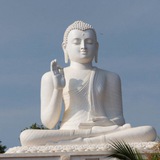
Dhammapada Verses 328, 329 and 330
Sambahulabhikkhu Vatthu
Sace labhetha nipakam sahayam
saddhim caram sadhu vihari dhiram
abhibhuyya sabbani parissayani
careyya tena' ttamano satima.
No ce labhetha nipakam sahayam
saddhim caram sadhu vihari dhiram
rajava rattham vijitam pahaya
eko care matanga' ranneva nago.
Ekassa caritam seyyo
natthi bale sahayata
eko care na ca papani kayira
appossukko matanga' ranneva nago.
Verse 328: If one finds a sagacious friend, who is a virtuous and steadfast companion, one should live with him joyfully and mindfully, overcoming all dangers.
Verse 329: If one cannot find a sagacious friend, who is a virtuous and steadfast companion, one should live alone like the king who gave up and left the country he had won, and like the elephant Matanga roaming alone in the forest.
Verse 330: It is better to live alone; there is no fellowship with a fool. So one should live alone, do no evil, and be carefree like the elephant Matanga roaming alone in the forest.
The Story of a Number of Bhikkhus
While residing in the Palileyya forest where the elephant Palileyyaka waited on him, the Buddha uttered Verses (328), (329) and (330) of this book, with reference to the bhikkhus from Kosambi.
Once, the bhikkhus of Kosambi split into two groups; one group followed the master of Vinaya and the other followed the teacher of the Dhamma. They did not listen even to the Buddha who exhorted them to make peace. So, the Buddha left them and spent the vassa all alone in the forest, where the elephant Palileyyaka waited on him.
At the end of the vassa, the Venerable Ananda went into the forest, accompanied by five hundred bhikkhus. Leaving the bhikkhus at some distance, the Venerable Ananda approached the Buddha alone. Then the Buddha told Ananda to call the other bhikkhus. All of them came, paid obeisance to the Buddha and said, "Venerable Sir! You must have had a hard time spending the vassa all alone in this forest."
To this, the Buddha replied,"Bhikkhus, do not say so; the elephant Palileyyaka had been looking after me all this time. He was, indeed, a very good friend, a true friend. If one has such a good friend one should stick to him; but if one cannot find a good friend it is better to stay alone."
Then the Buddha spoke in verse as follows:
Verse 328: If one finds a sagacious friend, who is a virtuous and steadfast companion, one should live with him joyfully and mindfully, overcoming all dangers.
Verse 329: If one cannot find a sagacious friend, who is a virtuous and steadfast companion, one should live alone like the king who gave up and left the country he had won, and like the elephant Matanga roaming alone in the forest.
Verse 330: It is better to live alone; there is no fellowship with a fool. So one should live alone, do no evil, and be carefree like the elephant Matanga roaming alone in the forest.
===
Ajahn Chah, Buddhist teacher of Thai forest meditation of Theravada Buddhism channel:
https://news.1rj.ru/str/ajahnchah_buddhism
===
Sambahulabhikkhu Vatthu
Sace labhetha nipakam sahayam
saddhim caram sadhu vihari dhiram
abhibhuyya sabbani parissayani
careyya tena' ttamano satima.
No ce labhetha nipakam sahayam
saddhim caram sadhu vihari dhiram
rajava rattham vijitam pahaya
eko care matanga' ranneva nago.
Ekassa caritam seyyo
natthi bale sahayata
eko care na ca papani kayira
appossukko matanga' ranneva nago.
Verse 328: If one finds a sagacious friend, who is a virtuous and steadfast companion, one should live with him joyfully and mindfully, overcoming all dangers.
Verse 329: If one cannot find a sagacious friend, who is a virtuous and steadfast companion, one should live alone like the king who gave up and left the country he had won, and like the elephant Matanga roaming alone in the forest.
Verse 330: It is better to live alone; there is no fellowship with a fool. So one should live alone, do no evil, and be carefree like the elephant Matanga roaming alone in the forest.
The Story of a Number of Bhikkhus
While residing in the Palileyya forest where the elephant Palileyyaka waited on him, the Buddha uttered Verses (328), (329) and (330) of this book, with reference to the bhikkhus from Kosambi.
Once, the bhikkhus of Kosambi split into two groups; one group followed the master of Vinaya and the other followed the teacher of the Dhamma. They did not listen even to the Buddha who exhorted them to make peace. So, the Buddha left them and spent the vassa all alone in the forest, where the elephant Palileyyaka waited on him.
At the end of the vassa, the Venerable Ananda went into the forest, accompanied by five hundred bhikkhus. Leaving the bhikkhus at some distance, the Venerable Ananda approached the Buddha alone. Then the Buddha told Ananda to call the other bhikkhus. All of them came, paid obeisance to the Buddha and said, "Venerable Sir! You must have had a hard time spending the vassa all alone in this forest."
To this, the Buddha replied,"Bhikkhus, do not say so; the elephant Palileyyaka had been looking after me all this time. He was, indeed, a very good friend, a true friend. If one has such a good friend one should stick to him; but if one cannot find a good friend it is better to stay alone."
Then the Buddha spoke in verse as follows:
Verse 328: If one finds a sagacious friend, who is a virtuous and steadfast companion, one should live with him joyfully and mindfully, overcoming all dangers.
Verse 329: If one cannot find a sagacious friend, who is a virtuous and steadfast companion, one should live alone like the king who gave up and left the country he had won, and like the elephant Matanga roaming alone in the forest.
Verse 330: It is better to live alone; there is no fellowship with a fool. So one should live alone, do no evil, and be carefree like the elephant Matanga roaming alone in the forest.
===
Ajahn Chah, Buddhist teacher of Thai forest meditation of Theravada Buddhism channel:
https://news.1rj.ru/str/ajahnchah_buddhism
===
Telegram
Ajahn Chah - Theravada Thailand Buddhism
Collection of teachings of Venerable Ajahn Chah, a foremost meditation and Buddhist teacher from Thailand
🥰1👏1
Forwarded from Words of the Buddha
Grand Buddha at Spring Temple, Laoshan, China, the tallest Buddha statue in the world.
🙏2🏆1
Forwarded from Ajahn Chah - Theravada Thailand Buddhism
The Venerable Sayadaw U Pandita’s last advice for attaining peace in our inner and outer worlds
By Alan Clements
Part 3 of 3
Good parenting is the basis of good dhamma and the birth of SQ? Parents have the first duty to teach the child, and after them, teachers do. For the world to be peaceful, parents are crucial, because they are a child’s first teachers. Even in Myanmar, where Buddhism flourishes, because there are so many people who are ill-equipped to be parents, the dhamma has declined. Since the days of the Mahasi Meditation Centre—because I knew that many parents were not fulfilling their responsibilities—I’ve tried to teach children about Buddhist culture both in theory and practice, so that a new generation could emerge. This was a priority and remains so.
In America, a country where science and technology flourish, education or IQ has been given great emphasis, whereas moral behavior and emotional intelligence, or EQ, have been ignored. Because our country is doing the same as America—emphasizing IQ over moral behavior—teenagers are becoming immoral. Therefore, in our dhamma courses for children I emphasize SQ, spiritual intelligence, in order to strengthen it in them. I use the term SQ in place of IQ and EQ. SQ stands for sila [ethical intelligence] and sikkha [the threefold training in higher virtue, higher mind, and higher wisdom], as well as satipatthana. All three words begin with s.
In America, there is a lot of tension, stress, and depression. SQ is the best remedy? People with good SQ are able to control these feelings. They are able to maintain their discipline. In SQ, this refers to the five precepts of not killing, lying, stealing, or misusing sexuality, and refraining from intoxicants. Further, they have compassion for others and feel gladdened by others’ good characteristics. They aren’t jealous or envious. With respect to something to be done, they have the intelligence to evaluate whether it is beneficial or not and whether it is suitable or not.
It’s been more than 50 years that I have been teaching this program to the children. In essence, the children are taught, “those things are bad and they bring bad results.” Knowing that something is wrong, one shouldn’t fail in one’s duty to avoid it. “Those things are good.” Knowing what is good, one shouldn’t fail in one’s duty to undertake them. Not neglecting to avoid what should be avoided and to do what should be done. at is called appamada, or heedfulness.
Would you say more about the application of appamada? A person’s life is like driving a car. When driving one must stay in one’s lane, right? If one starts to swerve out of one’s lane, one has to correct this and straighten out. To be able to steer is essential. This ability to steer is called yoniso manasikara (wise consideration). The same can be said of a boat: you always have to control the rudder. And in order to steer well, you must learn to control the rudder. But for the most part, people cannot control their own lives. They’re without the ability to steer. Although they have a rudder, they can’t steer.
It’s also important to keep your mind humane, to keep your mind like a human’s mind should be. You can’t just look at what benefits you. You’ve got to look at what’s good for others, too. You have to do what is good for others as much as possible, and do it with an attitude of goodwill.
What is the importance of SQ for genuine reconciliation and harmony? When there is a difference of viewpoints, SQ is important for bringing about unity. People with good SQ are automatically straightforward, they automatically go the right way.
What advice would you care to offer the people who will either visit your country or who are looking for ways to understand and possibly help the people of Burma? It’s natural for people to help each other, and this should be done without self-interest. One shouldn’t want to get something out of it, and one should help with lovingkindness and compassion.
By Alan Clements
Part 3 of 3
Good parenting is the basis of good dhamma and the birth of SQ? Parents have the first duty to teach the child, and after them, teachers do. For the world to be peaceful, parents are crucial, because they are a child’s first teachers. Even in Myanmar, where Buddhism flourishes, because there are so many people who are ill-equipped to be parents, the dhamma has declined. Since the days of the Mahasi Meditation Centre—because I knew that many parents were not fulfilling their responsibilities—I’ve tried to teach children about Buddhist culture both in theory and practice, so that a new generation could emerge. This was a priority and remains so.
In America, a country where science and technology flourish, education or IQ has been given great emphasis, whereas moral behavior and emotional intelligence, or EQ, have been ignored. Because our country is doing the same as America—emphasizing IQ over moral behavior—teenagers are becoming immoral. Therefore, in our dhamma courses for children I emphasize SQ, spiritual intelligence, in order to strengthen it in them. I use the term SQ in place of IQ and EQ. SQ stands for sila [ethical intelligence] and sikkha [the threefold training in higher virtue, higher mind, and higher wisdom], as well as satipatthana. All three words begin with s.
In America, there is a lot of tension, stress, and depression. SQ is the best remedy? People with good SQ are able to control these feelings. They are able to maintain their discipline. In SQ, this refers to the five precepts of not killing, lying, stealing, or misusing sexuality, and refraining from intoxicants. Further, they have compassion for others and feel gladdened by others’ good characteristics. They aren’t jealous or envious. With respect to something to be done, they have the intelligence to evaluate whether it is beneficial or not and whether it is suitable or not.
It’s been more than 50 years that I have been teaching this program to the children. In essence, the children are taught, “those things are bad and they bring bad results.” Knowing that something is wrong, one shouldn’t fail in one’s duty to avoid it. “Those things are good.” Knowing what is good, one shouldn’t fail in one’s duty to undertake them. Not neglecting to avoid what should be avoided and to do what should be done. at is called appamada, or heedfulness.
Would you say more about the application of appamada? A person’s life is like driving a car. When driving one must stay in one’s lane, right? If one starts to swerve out of one’s lane, one has to correct this and straighten out. To be able to steer is essential. This ability to steer is called yoniso manasikara (wise consideration). The same can be said of a boat: you always have to control the rudder. And in order to steer well, you must learn to control the rudder. But for the most part, people cannot control their own lives. They’re without the ability to steer. Although they have a rudder, they can’t steer.
It’s also important to keep your mind humane, to keep your mind like a human’s mind should be. You can’t just look at what benefits you. You’ve got to look at what’s good for others, too. You have to do what is good for others as much as possible, and do it with an attitude of goodwill.
What is the importance of SQ for genuine reconciliation and harmony? When there is a difference of viewpoints, SQ is important for bringing about unity. People with good SQ are automatically straightforward, they automatically go the right way.
What advice would you care to offer the people who will either visit your country or who are looking for ways to understand and possibly help the people of Burma? It’s natural for people to help each other, and this should be done without self-interest. One shouldn’t want to get something out of it, and one should help with lovingkindness and compassion.
Telegram
Ajahn Chah - Theravada Thailand Buddhism
Collection of teachings of Venerable Ajahn Chah, a foremost meditation and Buddhist teacher from Thailand
👍1💯1
Forwarded from Ajahn Chah - Theravada Thailand Buddhism
When you give to another, it should be done with the attitude “May the person receiving this be happy to have it.” One must not boast to the world, “My country, my people, can help.” Only when help is pure and true does it truly help. It should be help offered without lobha, without greed, without selfish interest.
Further, both the giver and the receiver, although separated by different countries, should have the attitude they are related; one should have the attitude that one is helping one’s relatives. People from other continents are related to each other although their continent is different; they’re not related as continental relatives but as world relatives.
In addition to this way of being, the Buddha taught so that people can become related by the way of dhamma, related by dhamma blood. The dhamma is that which bears the dhamma bearer, the one who knows the correct method and puts it into practice. It lifts one up so that one doesn’t go down into the four lower realms of apaya [states of deprivation, according to Buddhist cosmology], and so that one doesn’t wander a long time in samsara.
This dhamma is what the Buddha searched for and found. People who have faith in the dhamma practice it, and through this practice are able to live happily in this very life as well as become free of existential suffering. People who reach this level of developing the dhamma blood within themselves become related by dhamma blood. Between them there is mutual understanding, trust, and friendliness. Additionally, they don’t make distinctions about nationality. They don’t have this attitude that “I am this,” or “I am this or that.” We’re all the same.
For us monks, whatever foreigner comes here to practice, if he or she practices the dhamma with respect and care, they become close, a dhamma relative. Only if people become related through dhamma blood will social problems gradually become weaker and weaker until finally people can gain peace.
The people of your country have suffered greatly. They have also inspired many of us in the world to become more courageous in transforming our own sufferings and, moreover, to put ourselves in the mind and body of others, to feel, and to act compassionately. What would you like to leave us as a final statement, to your people, and to everyone in the world? If one is born a human, it’s important to be a true human being, and it’s important to have a humane mentality. And one should also search for a way to come to know what is true, to know the true dhamma, and to walk the path of dhamma. One should walk this straight path, because if one walks it one will reach a safe destination. This is what’s really important, these three things.
In this regard, in the time of the Buddha there was a deva [a celestial being] who came to see the Buddha. He said, “The beings of the world are tangled up in a tangle, both inside and outside; who is it that can untangle this tangle?”
The Buddha’s reply was very simple. With sila, or morality, as a basis, if one works to develop samadhi and panna, or concentration and wisdom, to completion, then social problems will be resolved. That’s the essence. If that thrives within society, then there will be mindful interdependence. If that happens, the world will become a happy place.
Sadhu, sadhu, sadhu. Thank you, from my heart.
Thank the Buddha; they are the Buddha’s teachings.
===
Part 1 of 3:
https://news.1rj.ru/str/dhammapadas/2069
Part 2 of 3:
https://news.1rj.ru/str/wordsofbuddha/3026
Part 3 of 3:
https://news.1rj.ru/str/ajahnchah_buddhism/893
===
Ajahn Chah, Buddhist teacher of Thai forest meditation of Theravada Buddhism channel:
https://news.1rj.ru/str/ajahnchah_buddhism
===
Further, both the giver and the receiver, although separated by different countries, should have the attitude they are related; one should have the attitude that one is helping one’s relatives. People from other continents are related to each other although their continent is different; they’re not related as continental relatives but as world relatives.
In addition to this way of being, the Buddha taught so that people can become related by the way of dhamma, related by dhamma blood. The dhamma is that which bears the dhamma bearer, the one who knows the correct method and puts it into practice. It lifts one up so that one doesn’t go down into the four lower realms of apaya [states of deprivation, according to Buddhist cosmology], and so that one doesn’t wander a long time in samsara.
This dhamma is what the Buddha searched for and found. People who have faith in the dhamma practice it, and through this practice are able to live happily in this very life as well as become free of existential suffering. People who reach this level of developing the dhamma blood within themselves become related by dhamma blood. Between them there is mutual understanding, trust, and friendliness. Additionally, they don’t make distinctions about nationality. They don’t have this attitude that “I am this,” or “I am this or that.” We’re all the same.
For us monks, whatever foreigner comes here to practice, if he or she practices the dhamma with respect and care, they become close, a dhamma relative. Only if people become related through dhamma blood will social problems gradually become weaker and weaker until finally people can gain peace.
The people of your country have suffered greatly. They have also inspired many of us in the world to become more courageous in transforming our own sufferings and, moreover, to put ourselves in the mind and body of others, to feel, and to act compassionately. What would you like to leave us as a final statement, to your people, and to everyone in the world? If one is born a human, it’s important to be a true human being, and it’s important to have a humane mentality. And one should also search for a way to come to know what is true, to know the true dhamma, and to walk the path of dhamma. One should walk this straight path, because if one walks it one will reach a safe destination. This is what’s really important, these three things.
In this regard, in the time of the Buddha there was a deva [a celestial being] who came to see the Buddha. He said, “The beings of the world are tangled up in a tangle, both inside and outside; who is it that can untangle this tangle?”
The Buddha’s reply was very simple. With sila, or morality, as a basis, if one works to develop samadhi and panna, or concentration and wisdom, to completion, then social problems will be resolved. That’s the essence. If that thrives within society, then there will be mindful interdependence. If that happens, the world will become a happy place.
Sadhu, sadhu, sadhu. Thank you, from my heart.
Thank the Buddha; they are the Buddha’s teachings.
===
Part 1 of 3:
https://news.1rj.ru/str/dhammapadas/2069
Part 2 of 3:
https://news.1rj.ru/str/wordsofbuddha/3026
Part 3 of 3:
https://news.1rj.ru/str/ajahnchah_buddhism/893
===
Ajahn Chah, Buddhist teacher of Thai forest meditation of Theravada Buddhism channel:
https://news.1rj.ru/str/ajahnchah_buddhism
===
Telegram
Ajahn Chah - Theravada Thailand Buddhism
Collection of teachings of Venerable Ajahn Chah, a foremost meditation and Buddhist teacher from Thailand
👏1🤩1
What is the power of sympathy? There are these four bases of sympathy: generosity, kind speech, doing a good turn and treating all equally. The best generosity is generosity with the Dhamma. The best kind speech is teaching the Dhamma again and again to a good and attentive listener. The best good turn is inciting, encouraging and establishing the ways of faith in the doubting, the ways of virtue in the unvirtuous, the ways of generosity in the mean, and ways of wisdom in the foolish. The best equal treatment is the equality between Stream-Winner and Stream-Winner, between Once-Returner and Once-Returner, between Non-Returner and Non-Returner, and between Noble One and Noble One. This is called the power of sympathy.
Anguttara Nikaya IV 362
Anguttara Nikaya IV 362
🥰1👏1🏆1🤗1
Forwarded from Words of the Buddha
There are fourteen kinds of personal offerings, Ananda:
1. One gives a gift to the Tathagata, accomplished and fully enlightened; this is the first kind of personal offering.
2. One gives a gift to a paccekabuddha; this is the second kind of personal offering.
3. One gives a gift to an arahant disciple of the Tathagata;
4. ... one who has entered upon the way to the realization of the fruit of arahantship; this is the fourth kind of personal offering, ... a non-returner; ... one who has entered upon the way to the realisation of the fruit of non-return; ... a once-returner; ... one who has entered upon the way to the realization of the fruit of once-return; ... a stream-enterer; ... one who has entered upon the way to the realization of the fruit of stream-entry; ... one outside [the Dispensation] who is free from lust for sensual pleasures; ... a virtuous ordinary person; ... an immoral ordinary person; ... an animal;
Source: MN 142 Dakkhinavibhanga Sutta: The Exposition of Offerings
1. One gives a gift to the Tathagata, accomplished and fully enlightened; this is the first kind of personal offering.
2. One gives a gift to a paccekabuddha; this is the second kind of personal offering.
3. One gives a gift to an arahant disciple of the Tathagata;
4. ... one who has entered upon the way to the realization of the fruit of arahantship; this is the fourth kind of personal offering, ... a non-returner; ... one who has entered upon the way to the realisation of the fruit of non-return; ... a once-returner; ... one who has entered upon the way to the realization of the fruit of once-return; ... a stream-enterer; ... one who has entered upon the way to the realization of the fruit of stream-entry; ... one outside [the Dispensation] who is free from lust for sensual pleasures; ... a virtuous ordinary person; ... an immoral ordinary person; ... an animal;
Source: MN 142 Dakkhinavibhanga Sutta: The Exposition of Offerings
👏1🤔1💯1
Forwarded from Buddha Dharma books
Free Buddhism Dharma ebook
Simple Things on Higher Truth
By Venerable Ajahn Anan Akincano
The teachings in this book have been collected from various talks given in Thai, as well as informal, late-night Dhamma discussions. They have been selected with the hope of capturing Ajahn Anan's ability to help us overcome our difficulties and grow in wholesome qualities as a result. The book itself has been laid out a way that allows us to gradually progress to the higher truths, beginning with the suffering inherent in our situation.Though it may be something hard to grasp, once recognised we can then do something about it. The next sections give us guidance in practising mindfulness and meditation. Following this are teachings on the foundation of meditation practice-virtue and kindness for others. Lastly, we meet the wisdom which reminds us that the end of suffering is actually not that far away.
Free download here:
https://ftp.budaedu.org/ebooks/pdf/EN318.pdf
===
Simple Things on Higher Truth
By Venerable Ajahn Anan Akincano
The teachings in this book have been collected from various talks given in Thai, as well as informal, late-night Dhamma discussions. They have been selected with the hope of capturing Ajahn Anan's ability to help us overcome our difficulties and grow in wholesome qualities as a result. The book itself has been laid out a way that allows us to gradually progress to the higher truths, beginning with the suffering inherent in our situation.Though it may be something hard to grasp, once recognised we can then do something about it. The next sections give us guidance in practising mindfulness and meditation. Following this are teachings on the foundation of meditation practice-virtue and kindness for others. Lastly, we meet the wisdom which reminds us that the end of suffering is actually not that far away.
Free download here:
https://ftp.budaedu.org/ebooks/pdf/EN318.pdf
===
🥰1🆒1
Dhammapada Verses 331, 332 and 333
Mara Vatthu
Atthamhi jatamhi sukha sahaya
tutthi sukha ya itaritarena
punnam sukham jivitasankhayamhi
sabbassa dukkhassa sukham pahanam.
Sukha matteyya loke
atho petteyyata sukha
sukha samannata loke
atho brahmannata sukha.
Sukham yava jara silam
sukha saddha patitthita
sukho pannaya patilabho
papanam akaranam sukham.
Verse 331: It is good to have friends when the need arises; it is good to be content with anything that is available; it is good to have merit when life is about to end; it is good to be rid of all dukkha.
Verse 332: In this world it is good to be dutiful to one's mother; also it is good to be dutiful to one's father. In this world it is good to minister unto samanas1; also it is good to minister unto brahmanas2.
Verse 333: It is good to have virtue till old age, it is good to have unshakable faith, it is good to gain wisdom, it is good to do no evil.
1. Samana: Recluses.
2. Brahmanas: here means Buddhas, paccekabuddhas or arahats. (The Commentary)
The Story of Mara
While residing in a monastery near the Himalayas. the Buddha uttered Verses (331), (332) and (333) of this book, with reference to Mara, who tried to entice him to rule as a king.
Once, while the Buddha was residing near the Himalayas, he found that many people were being ill-treated by some wicked kings. It then occurred to him whether it would be possible to prevent them from ill-treating those who should not be ill-treated and make the kings rule justly and wisely. Mara knew what the Buddha was thinking and planned to entice the Buddha to rule as a king. To him the Buddha replied, "O wicked Mara! Your teaching and my teaching are quite different. You and I cannot have any discussion. This is my teaching".
Then the Buddha spoke in verse as follows:
Verse 331: It is good to have friends when the need arises; it is good to be content with anything that is available; it is good to have merit when life is about to end; it is good to be rid of all dukkha.
Verse 332: In this world it is good to be dutiful to one's mother; also it is good to be dutiful to one's father. In this world it is good to minister unto samanas; also it is good to minister unto brahmanas.
Verse 333: It is good to have virtue till old age, it is good to have unshakable faith, it is good to gain wisdom, it is good to do no evil.
End of Chapter Twenty-Three: The Elephant
===
Free Buddhism books, teachings, podcasts and videos from Theravada, Mahayana and Vajrayana traditions:
https://news.1rj.ru/str/buddha_ebooks
===
Mara Vatthu
Atthamhi jatamhi sukha sahaya
tutthi sukha ya itaritarena
punnam sukham jivitasankhayamhi
sabbassa dukkhassa sukham pahanam.
Sukha matteyya loke
atho petteyyata sukha
sukha samannata loke
atho brahmannata sukha.
Sukham yava jara silam
sukha saddha patitthita
sukho pannaya patilabho
papanam akaranam sukham.
Verse 331: It is good to have friends when the need arises; it is good to be content with anything that is available; it is good to have merit when life is about to end; it is good to be rid of all dukkha.
Verse 332: In this world it is good to be dutiful to one's mother; also it is good to be dutiful to one's father. In this world it is good to minister unto samanas1; also it is good to minister unto brahmanas2.
Verse 333: It is good to have virtue till old age, it is good to have unshakable faith, it is good to gain wisdom, it is good to do no evil.
1. Samana: Recluses.
2. Brahmanas: here means Buddhas, paccekabuddhas or arahats. (The Commentary)
The Story of Mara
While residing in a monastery near the Himalayas. the Buddha uttered Verses (331), (332) and (333) of this book, with reference to Mara, who tried to entice him to rule as a king.
Once, while the Buddha was residing near the Himalayas, he found that many people were being ill-treated by some wicked kings. It then occurred to him whether it would be possible to prevent them from ill-treating those who should not be ill-treated and make the kings rule justly and wisely. Mara knew what the Buddha was thinking and planned to entice the Buddha to rule as a king. To him the Buddha replied, "O wicked Mara! Your teaching and my teaching are quite different. You and I cannot have any discussion. This is my teaching".
Then the Buddha spoke in verse as follows:
Verse 331: It is good to have friends when the need arises; it is good to be content with anything that is available; it is good to have merit when life is about to end; it is good to be rid of all dukkha.
Verse 332: In this world it is good to be dutiful to one's mother; also it is good to be dutiful to one's father. In this world it is good to minister unto samanas; also it is good to minister unto brahmanas.
Verse 333: It is good to have virtue till old age, it is good to have unshakable faith, it is good to gain wisdom, it is good to do no evil.
End of Chapter Twenty-Three: The Elephant
===
Free Buddhism books, teachings, podcasts and videos from Theravada, Mahayana and Vajrayana traditions:
https://news.1rj.ru/str/buddha_ebooks
===
Telegram
Buddha Dharma books
Free Buddhism books, teachings, podcasts and videos from Theravada, Mahayana and Vajrayana traditions
❤1👏1💯1
Forwarded from Words of the Buddha
Then with the passing of those seven days, the Gracious One arose from that concentration. Then the Nāga King Mucalinda, having understood that the sky was now clear without a cloud, having unravelled his coils from the Gracious One’s body, and after withdrawing his own form, and creating the appearance of a young brāhmaṇa, stood in front of the Gracious One, revering the Gracious One with raised hands.
Then the Gracious One, having understood the significance of it, on that occasion uttered this exalted utterance:
“There is happiness and detachment for the one who is satisfied,
who has heard the Dhamma, and who sees,
There is happiness for him who is free from ill-will in the world,
who is restrained towards breathing beings.
“The state of dispassion in the world is happiness,
the complete transcending of sense desires,
But for he who has removed the conceit ‘I am’—
this is indeed the highest happiness.”
Udāna 2.1
Mucalindasuttaṁ 11
Then the Gracious One, having understood the significance of it, on that occasion uttered this exalted utterance:
“There is happiness and detachment for the one who is satisfied,
who has heard the Dhamma, and who sees,
There is happiness for him who is free from ill-will in the world,
who is restrained towards breathing beings.
“The state of dispassion in the world is happiness,
the complete transcending of sense desires,
But for he who has removed the conceit ‘I am’—
this is indeed the highest happiness.”
Udāna 2.1
Mucalindasuttaṁ 11
👍1👏1🤗1
Forwarded from Words of the Buddha
Nandopanandabhujagam vibhudhammahiddhim,
Puttena therabhujagena damapayanto.
Iddhupadesa vidhina jitava Munindo,
Tam tejasa bhavatu me jayamangalani.
The gifted but perverted king of the nagas, Nandopananda by name, possessed great psychic power and was hostile. By instructing the Elder Moggallana, his spiritual son, mighty in supernatural attainments, the Sovereign Sage rendered the Naga king powerless and transformed him. Thus, through a supernormal mode of spiritual instruction intelligible to his kind, did the Master conquer the naga. By this mighty triumph may joyous victory be mine!
Jaya Mangala Gatha
Puttena therabhujagena damapayanto.
Iddhupadesa vidhina jitava Munindo,
Tam tejasa bhavatu me jayamangalani.
The gifted but perverted king of the nagas, Nandopananda by name, possessed great psychic power and was hostile. By instructing the Elder Moggallana, his spiritual son, mighty in supernatural attainments, the Sovereign Sage rendered the Naga king powerless and transformed him. Thus, through a supernormal mode of spiritual instruction intelligible to his kind, did the Master conquer the naga. By this mighty triumph may joyous victory be mine!
Jaya Mangala Gatha
🙏1🏆1
Forwarded from Buddha Dharma books
Free Buddha Dharma ebook
Straight from the Heart: Thirteen Talks on the Practice of Meditation, by Venerable Ācariya Mahā Boowa, and translated by Ṭhānissaro Bhikkhu.
The talks in this collection all deal with the practice of meditation, and particularly with the development of discernment. These talks were originally given for the benefit of a follower of Venerable Ācariya Mahā Boowa who had contracted cancer of the bone marrow and had come to practice meditation at Wat Pa Baan Taad in order to contend with the pain of the disease and the fact of her approaching death.
Free download here:
https://www.dhammatalks.org/Archive/Writings/Ebooks/StraightfromtheHeart_181215.pdf
===
Straight from the Heart: Thirteen Talks on the Practice of Meditation, by Venerable Ācariya Mahā Boowa, and translated by Ṭhānissaro Bhikkhu.
The talks in this collection all deal with the practice of meditation, and particularly with the development of discernment. These talks were originally given for the benefit of a follower of Venerable Ācariya Mahā Boowa who had contracted cancer of the bone marrow and had come to practice meditation at Wat Pa Baan Taad in order to contend with the pain of the disease and the fact of her approaching death.
Free download here:
https://www.dhammatalks.org/Archive/Writings/Ebooks/StraightfromtheHeart_181215.pdf
===
🥰1🏆1
Dhammapada Verse 344
Vibbhantabhikkhu Vatthu
Yo nibbanatho vanadhimutto
vanamutto vanameva dhavati
tam puggalametha passatha
mutto bandhanameva dhavati.
Verse 344: Having left the forest of desire (i.e., the life of a householder), he takes to the forest of the practice (i.e., the life of a bhikkhu); but when he is free from the forest of desire he rushes back to that very forest. Come, look at that man who having become free rushes back into that very bondage.
The Story of an Ex-Bhikkhu
While residing at the Veluvana monastery, the Buddha uttered Verse (344) of this book, with reference to a bhikkhu who was a pupil of the Venerable Mahakassapa.
As a pupil of the Venerable Mahakassapa, this bhikkhu had achieved the four mental absorptions (jhanas). But one day, as he went for alms-food to his uncle's house, he saw a woman and felt a great desire to have her. Then he left the Order of the bhikkhus. As a layman, he was a failure as he did not work hard. So, his uncle drove him out of the house, and subsequently he became mixed up with some thieves. All of them were caught by the authorities and were taken to the cemetery to be executed. The Venerable Mahakassapa saw his pupil as he was being led out and said to him, "My pupil, keep your mind steadfastly on a subject of meditation." As instructed, he concentrated and let himself be established in deep mental absorption. At the cemetery, while the executioners were making preparations to kill him, the ex-bhikkhu was very much composed and showed no signs of fear or anxiety. The executioners and the onlookers were awe-struck and very much impressed by the man's courage and composure and they reported about him to the king and also to the Buddha. The king gave orders to release the man. The Buddha on hearing about the matter sent his radiance and appeared to the thief as if in person.
Then the Buddha spoke to him in verse as follows:
Verse 344: Having left the forest of desire (i.e., the life of a householder), he takes to the forest of the practice (i.e., the life of a bhikkhu); but when he is free from the forest of desire he rushes back to that very forest. Come, look at that man who having become free rushes back into that very bondage.
At the end of the discourse, the thief who was steadfastly keeping his mind on the arising and perishing of the aggregates discerned the impermanent, unsatisfactory and non-self nature of all conditioned things and soon attained Sotapatti Fruition. Later, he went to the Buddha at the Jetavana monastery where he was again admitted to the Order by the Buddha and he instantly attained arahatship.
===
Buddha dharma teachings channel:
https://news.1rj.ru/str/lorddivinebuddha
===
Vibbhantabhikkhu Vatthu
Yo nibbanatho vanadhimutto
vanamutto vanameva dhavati
tam puggalametha passatha
mutto bandhanameva dhavati.
Verse 344: Having left the forest of desire (i.e., the life of a householder), he takes to the forest of the practice (i.e., the life of a bhikkhu); but when he is free from the forest of desire he rushes back to that very forest. Come, look at that man who having become free rushes back into that very bondage.
The Story of an Ex-Bhikkhu
While residing at the Veluvana monastery, the Buddha uttered Verse (344) of this book, with reference to a bhikkhu who was a pupil of the Venerable Mahakassapa.
As a pupil of the Venerable Mahakassapa, this bhikkhu had achieved the four mental absorptions (jhanas). But one day, as he went for alms-food to his uncle's house, he saw a woman and felt a great desire to have her. Then he left the Order of the bhikkhus. As a layman, he was a failure as he did not work hard. So, his uncle drove him out of the house, and subsequently he became mixed up with some thieves. All of them were caught by the authorities and were taken to the cemetery to be executed. The Venerable Mahakassapa saw his pupil as he was being led out and said to him, "My pupil, keep your mind steadfastly on a subject of meditation." As instructed, he concentrated and let himself be established in deep mental absorption. At the cemetery, while the executioners were making preparations to kill him, the ex-bhikkhu was very much composed and showed no signs of fear or anxiety. The executioners and the onlookers were awe-struck and very much impressed by the man's courage and composure and they reported about him to the king and also to the Buddha. The king gave orders to release the man. The Buddha on hearing about the matter sent his radiance and appeared to the thief as if in person.
Then the Buddha spoke to him in verse as follows:
Verse 344: Having left the forest of desire (i.e., the life of a householder), he takes to the forest of the practice (i.e., the life of a bhikkhu); but when he is free from the forest of desire he rushes back to that very forest. Come, look at that man who having become free rushes back into that very bondage.
At the end of the discourse, the thief who was steadfastly keeping his mind on the arising and perishing of the aggregates discerned the impermanent, unsatisfactory and non-self nature of all conditioned things and soon attained Sotapatti Fruition. Later, he went to the Buddha at the Jetavana monastery where he was again admitted to the Order by the Buddha and he instantly attained arahatship.
===
Buddha dharma teachings channel:
https://news.1rj.ru/str/lorddivinebuddha
===
Telegram
Buddha
Buddha dharma teachings from the suttas and commentaries
👍1👏1🤗1
Forwarded from Words of the Buddha
Mendicants, I urge you to spread a mind of love to the four royal snake families, for your own safety, security, and protection.
I love the Virūpakkhas, the Erāpathas I love, I love the Chabyāputtas, the Kaṇhāgotamakas I love.
I love the footless creatures, the two-footed I love, I love the four-footed, the many-footed I love.
May the footless not harm me! May I not be harmed by the two-footed! May the four-footed not harm me! May I not be harmed by the many-footed!
All sentient beings, all living things, all creatures, every one: may they see only nice things, may bad not come to anyone.
The Buddha is immeasurable, the teaching is immeasurable, the Saṅgha is immeasurable. But limited are crawling things,
snakes and scorpions, centipedes, spiders and lizards and mice. I’ve made this safeguard, I’ve made this protection: go away, creatures! And so I revere the Blessed One, I revere the seven perfectly awakened Buddhas.”
Anguttara Nikaya 4.67 : Ahirajasutta, The Snake King
I love the Virūpakkhas, the Erāpathas I love, I love the Chabyāputtas, the Kaṇhāgotamakas I love.
I love the footless creatures, the two-footed I love, I love the four-footed, the many-footed I love.
May the footless not harm me! May I not be harmed by the two-footed! May the four-footed not harm me! May I not be harmed by the many-footed!
All sentient beings, all living things, all creatures, every one: may they see only nice things, may bad not come to anyone.
The Buddha is immeasurable, the teaching is immeasurable, the Saṅgha is immeasurable. But limited are crawling things,
snakes and scorpions, centipedes, spiders and lizards and mice. I’ve made this safeguard, I’ve made this protection: go away, creatures! And so I revere the Blessed One, I revere the seven perfectly awakened Buddhas.”
Anguttara Nikaya 4.67 : Ahirajasutta, The Snake King
🙏1🫡1
Forwarded from Words of the Buddha
Benefits of Metta
“If, O Bhikkhus, the liberation of the mind through loving-kindness is practised, developed, made much of, made one’s vehicle and foundation, firmly established, consolidated, and thoroughly undertaken, eleven benefits are to be expected.
What eleven?
1. One sleeps in comfort;
2. One wakes in comfort;
3. One has no bad dreams;
4. One is dear to human beings;
5. One is dear to non-human beings;
6. One is protected by deities;
7. One is not harmed by fire, poison and weapon;
8. One can concentrate easily;
9. One’s facial complexion is calm and serene;
10. One dies unconfused;
11. If one does not attain anything higher, one will be reborn in the Brahma world after death.”
~ Anguttara Nikaya
Book of the Elevens
“If, O Bhikkhus, the liberation of the mind through loving-kindness is practised, developed, made much of, made one’s vehicle and foundation, firmly established, consolidated, and thoroughly undertaken, eleven benefits are to be expected.
What eleven?
1. One sleeps in comfort;
2. One wakes in comfort;
3. One has no bad dreams;
4. One is dear to human beings;
5. One is dear to non-human beings;
6. One is protected by deities;
7. One is not harmed by fire, poison and weapon;
8. One can concentrate easily;
9. One’s facial complexion is calm and serene;
10. One dies unconfused;
11. If one does not attain anything higher, one will be reborn in the Brahma world after death.”
~ Anguttara Nikaya
Book of the Elevens
❤2🥰1😍1🤗1