Forwarded from Buddha Dharma books
Free Buddha Dharma ebook
Into the Stream: A Study Guide on the First Stage of Awakening
By Thanissaro Bhikkhu
The Pali Canon recognizes four levels of Awakening, the first of which is called stream entry. This gains its name from the fact that a person who has attained this level has entered the “stream” flowing inevitably to nibbana.
He/she is guaranteed to achieve full awakening within seven lifetimes at most, and in the interim will not be reborn in any of the lower realms.
This study guide on stream entry is divided into two parts. The first deals with the practices leading to stream entry; the second, with the experience of stream entry and its results.
Free download available:
https://www.accesstoinsight.org/lib/study/into_the_stream.pdf
===
Into the Stream: A Study Guide on the First Stage of Awakening
By Thanissaro Bhikkhu
The Pali Canon recognizes four levels of Awakening, the first of which is called stream entry. This gains its name from the fact that a person who has attained this level has entered the “stream” flowing inevitably to nibbana.
He/she is guaranteed to achieve full awakening within seven lifetimes at most, and in the interim will not be reborn in any of the lower realms.
This study guide on stream entry is divided into two parts. The first deals with the practices leading to stream entry; the second, with the experience of stream entry and its results.
Free download available:
https://www.accesstoinsight.org/lib/study/into_the_stream.pdf
===
👍1😘1
Dhammapada Verse 347
Khematheri Vatthu
Ye ragaratt'nupatanti sotam
sayamkatam makkatakova jalam
etampi chetvana vajanti dhira
anapekkhino sabbadukkham pahaya.
Verse 347: Beings who are infatuated with lust, fall back into the Stream of Craving they have generated, just as a spider does in the web it has spun. The Wise, cutting off the bond of craving, walk on resolutely, leaving, all ills (dukkha) behind.
The Story of Theri Khema
While residing at the Veluvana monastery, the Buddha uttered Verse (347) of this book, with reference to Queen Khema.
Queen Khema was the chief queen of King Bimbisara. She was very beautiful and also very proud.
The king wanted her to go to the Veluvana monastery and pay homage to the Buddha. But she had heard that the Buddha always talked disparagingly about beauty and she therefore tried to avoid seeing the Buddha.
The king understood her attitude towards the Buddha; he also know how proud she was of her beauty. So the king ordered his minstrels to sing in praise of the Veluvana monastery, about its pleasant and peaceful atmosphere, etc. Hearing them, Queen Khema became interested and decided to set out for the Veluvana monastery.
When Queen Khema arrived at the monastery, the Buddha was expounding the Dhamma to an audience. By his supernormal power, the Buddha made a very beautiful young lady appear, sitting not far from him, and fanning him. When Queen Khema came to the audience hall, she alone saw the beautiful young lady. Comparing the exquisite beauty of the young lady to that of her own, Khema realised that her beauty was much inferior to that of the young lady. As she looked again intently at the young lady her beauty began to fade gradually. In the end, she saw before her eyes an old decrepit being, which again changed into a corpse, her stinking body being attacked by maggots. At that instant, Queen Khema realized the impermanence and worthlessness of beauty.
The Buddha knowing the state of her mind remarked, "O Khema! Look carefully at this decaying body which is built around a skeleton of bones and is subject to disease and decay. Look carefully at the body which is thought of so highly by the foolish. Look at the worthlessness of the beauty of this young girl." After hearing this, Queen Khema attained Sotapatti Fruition.
Then the Buddha spoke in verse as follows:
Verse 347: Beings who are infatuated with lust, fall back into the Stream of Craving they have generated, just as a spider does in the web it has spun. The Wise, cutting off the bond of craving, walk on resolutely, leaving, all ills (dukkha) behind.
At the end of the discourse Queen Khema attained arahatship and was admitted to the Order and became the Chief Female Disciple of the Buddha.
===
Words of the Buddha channel:
https://news.1rj.ru/str/wordsofbuddha
===
Khematheri Vatthu
Ye ragaratt'nupatanti sotam
sayamkatam makkatakova jalam
etampi chetvana vajanti dhira
anapekkhino sabbadukkham pahaya.
Verse 347: Beings who are infatuated with lust, fall back into the Stream of Craving they have generated, just as a spider does in the web it has spun. The Wise, cutting off the bond of craving, walk on resolutely, leaving, all ills (dukkha) behind.
The Story of Theri Khema
While residing at the Veluvana monastery, the Buddha uttered Verse (347) of this book, with reference to Queen Khema.
Queen Khema was the chief queen of King Bimbisara. She was very beautiful and also very proud.
The king wanted her to go to the Veluvana monastery and pay homage to the Buddha. But she had heard that the Buddha always talked disparagingly about beauty and she therefore tried to avoid seeing the Buddha.
The king understood her attitude towards the Buddha; he also know how proud she was of her beauty. So the king ordered his minstrels to sing in praise of the Veluvana monastery, about its pleasant and peaceful atmosphere, etc. Hearing them, Queen Khema became interested and decided to set out for the Veluvana monastery.
When Queen Khema arrived at the monastery, the Buddha was expounding the Dhamma to an audience. By his supernormal power, the Buddha made a very beautiful young lady appear, sitting not far from him, and fanning him. When Queen Khema came to the audience hall, she alone saw the beautiful young lady. Comparing the exquisite beauty of the young lady to that of her own, Khema realised that her beauty was much inferior to that of the young lady. As she looked again intently at the young lady her beauty began to fade gradually. In the end, she saw before her eyes an old decrepit being, which again changed into a corpse, her stinking body being attacked by maggots. At that instant, Queen Khema realized the impermanence and worthlessness of beauty.
The Buddha knowing the state of her mind remarked, "O Khema! Look carefully at this decaying body which is built around a skeleton of bones and is subject to disease and decay. Look carefully at the body which is thought of so highly by the foolish. Look at the worthlessness of the beauty of this young girl." After hearing this, Queen Khema attained Sotapatti Fruition.
Then the Buddha spoke in verse as follows:
Verse 347: Beings who are infatuated with lust, fall back into the Stream of Craving they have generated, just as a spider does in the web it has spun. The Wise, cutting off the bond of craving, walk on resolutely, leaving, all ills (dukkha) behind.
At the end of the discourse Queen Khema attained arahatship and was admitted to the Order and became the Chief Female Disciple of the Buddha.
===
Words of the Buddha channel:
https://news.1rj.ru/str/wordsofbuddha
===
Telegram
Words of the Buddha
Daily teachings of Buddha Dharma
🥰1👌1
Free Buddha Dharma ebook
Simply This Moment
A collection of talks about Buddhist practice
By Ajahn Brahm
Simply This Moment is a collection of talks given by Ajahn Brahm on the practice of Buddhism. Many of the talks were given to monks during the Rains Retreat at Bodhinyana. The subject topics are therefore less mundane, and more attention is given to meditation, in particular, jhana meditation. Readers will find very useful instructions and insights on the breath meditation as instructed in the Anapanasati Sutta (Mindfulness of Breathing).
Free download available:
https://static.sariputta.com/pdf/tipitaka/210/Simply-This-Moment_pdf.pdf
===
Simply This Moment
A collection of talks about Buddhist practice
By Ajahn Brahm
Simply This Moment is a collection of talks given by Ajahn Brahm on the practice of Buddhism. Many of the talks were given to monks during the Rains Retreat at Bodhinyana. The subject topics are therefore less mundane, and more attention is given to meditation, in particular, jhana meditation. Readers will find very useful instructions and insights on the breath meditation as instructed in the Anapanasati Sutta (Mindfulness of Breathing).
Free download available:
https://static.sariputta.com/pdf/tipitaka/210/Simply-This-Moment_pdf.pdf
===
🥰1👏1
Free Buddha Dharma ebook
Simply This Moment
A collection of talks about Buddhist practice
By Ajahn Brahm
Simply This Moment is a collection of talks given by Ajahn Brahm on the practice of Buddhism. Many of the talks were given to monks during the Rains Retreat at Bodhinyana. The subject topics are therefore less mundane, and more attention is given to meditation, in particular, jhana meditation. Readers will find very useful instructions and insights on the breath meditation as instructed in the Anapanasati Sutta (Mindfulness of Breathing).
Free download available:
https://static.sariputta.com/pdf/tipitaka/210/Simply-This-Moment_pdf.pdf
===
Simply This Moment
A collection of talks about Buddhist practice
By Ajahn Brahm
Simply This Moment is a collection of talks given by Ajahn Brahm on the practice of Buddhism. Many of the talks were given to monks during the Rains Retreat at Bodhinyana. The subject topics are therefore less mundane, and more attention is given to meditation, in particular, jhana meditation. Readers will find very useful instructions and insights on the breath meditation as instructed in the Anapanasati Sutta (Mindfulness of Breathing).
Free download available:
https://static.sariputta.com/pdf/tipitaka/210/Simply-This-Moment_pdf.pdf
===
👍1💯1
Free Buddha Dharma ebook
Simply This Moment
A collection of talks about Buddhist practice
By Ajahn Brahm
Free download available:
https://static.sariputta.com/pdf/tipitaka/210/Simply-This-Moment_pdf.pdf
===
Simply This Moment
A collection of talks about Buddhist practice
By Ajahn Brahm
Free download available:
https://static.sariputta.com/pdf/tipitaka/210/Simply-This-Moment_pdf.pdf
===
👌1🏆1
Dhammapada Verse 348
Uggasena Vatthu
Muncapure1munca pacchato2
majjhe3munca bhavassa paragu4
sabbattha vimuttamanaso
na punam jatijaram upehisi.
Verse 348: Give up the past, give up the future, give up the present. Having reached the end of existences, with a mind freed from all (conditioned things), you will not again undergo birth and decay.
1, 2, 3. pure, pacchato, majjhe: the reference is to attachment to the past, future and present Khandha aggregates.
4. bhavassa paragu: one who has gane to the other shore or end of existences (i.e., Nibbana); an arahat.
The Story of Uggasena
While residing at the Jetavana monastery, the Buddha uttered Verse (348) of this book, with reference to Uggasena, a rich man's son who fell in love with a dancer.
Once, a wandering theatrical troupe consisting of five hundred dancers and some acrobats came to Rajagaha and performed on the grounds of the palace of King Bimbisara for seven days. There, a young dancer who was the daughter of an acrobat sang and danced on top of a long bamboo pole. Uggasena, the young son of a rich man, fell desperately in love with this dancer and his parents could not stop him from marrying her. He married the young dancer and followed the troupe. As he was not a dancer nor an acrobat, he was not of much use to the party. So, as the party moved from place to place, he had to help carry boxes, to drive the carts, etc.
In course of time, a son was born to Uggasena and his wife, the dancer. To this child, the dancer would often sing a song which ran thus: "O you, son of the man who keeps watch over the carts; the man who carries boxes and bundles! O , you, son of the ignorant one who can do nothing!" Uggasena heard the song; he knew that his wife was referring to him and he was very much hurt and depressed. So he went to his father-in-law, the acrobat, and requested him to teach him acrobatics. After a year's training, Uggasena became a skilful acrobat.
Then, Uggasena went back to Rajagaha, and it was proclaimed that Uggasena would publicly demonstrate his skill in seven days' time. On the seventh day, a long pole was put up and Uggasena stood on top of it. At a signal given from below he somersaulted seven times on the pole. At about this time, the Buddha saw Uggasena in his vision and knew that time was ripe for Uggasena to attain arahatship. So, he entered Rajagaha and willed that the audience should turn their attention to him instead of applauding Uggasena for his acrobatic feats. When Uggasena saw that he was being neglected and ignored, he just sat on top of the pole, feeling very discontented and depressed. The Buddha then addressed Uggasena, "Uggasena, a wise man should abandon all attachment to the khandha aggregates and strive to gain liberation from the round of rebirths."
Then the Buddha spoke in verse as follows:
Verse 348: Give up the past, give up the future, give up the present. Having reached the end of existences, with a mind freed from all (conditioned things), you will not again undergo birth and decay.
At the end of the discourse Uggasena, who was still on top of the pole, attained arahatship. He came down and was soon admitted to the Order by the Buddha.
===
Dhammapada, beloved and favorite teachings of the Buddha channel:
https://news.1rj.ru/str/dhammapadas
===
Uggasena Vatthu
Muncapure1munca pacchato2
majjhe3munca bhavassa paragu4
sabbattha vimuttamanaso
na punam jatijaram upehisi.
Verse 348: Give up the past, give up the future, give up the present. Having reached the end of existences, with a mind freed from all (conditioned things), you will not again undergo birth and decay.
1, 2, 3. pure, pacchato, majjhe: the reference is to attachment to the past, future and present Khandha aggregates.
4. bhavassa paragu: one who has gane to the other shore or end of existences (i.e., Nibbana); an arahat.
The Story of Uggasena
While residing at the Jetavana monastery, the Buddha uttered Verse (348) of this book, with reference to Uggasena, a rich man's son who fell in love with a dancer.
Once, a wandering theatrical troupe consisting of five hundred dancers and some acrobats came to Rajagaha and performed on the grounds of the palace of King Bimbisara for seven days. There, a young dancer who was the daughter of an acrobat sang and danced on top of a long bamboo pole. Uggasena, the young son of a rich man, fell desperately in love with this dancer and his parents could not stop him from marrying her. He married the young dancer and followed the troupe. As he was not a dancer nor an acrobat, he was not of much use to the party. So, as the party moved from place to place, he had to help carry boxes, to drive the carts, etc.
In course of time, a son was born to Uggasena and his wife, the dancer. To this child, the dancer would often sing a song which ran thus: "O you, son of the man who keeps watch over the carts; the man who carries boxes and bundles! O , you, son of the ignorant one who can do nothing!" Uggasena heard the song; he knew that his wife was referring to him and he was very much hurt and depressed. So he went to his father-in-law, the acrobat, and requested him to teach him acrobatics. After a year's training, Uggasena became a skilful acrobat.
Then, Uggasena went back to Rajagaha, and it was proclaimed that Uggasena would publicly demonstrate his skill in seven days' time. On the seventh day, a long pole was put up and Uggasena stood on top of it. At a signal given from below he somersaulted seven times on the pole. At about this time, the Buddha saw Uggasena in his vision and knew that time was ripe for Uggasena to attain arahatship. So, he entered Rajagaha and willed that the audience should turn their attention to him instead of applauding Uggasena for his acrobatic feats. When Uggasena saw that he was being neglected and ignored, he just sat on top of the pole, feeling very discontented and depressed. The Buddha then addressed Uggasena, "Uggasena, a wise man should abandon all attachment to the khandha aggregates and strive to gain liberation from the round of rebirths."
Then the Buddha spoke in verse as follows:
Verse 348: Give up the past, give up the future, give up the present. Having reached the end of existences, with a mind freed from all (conditioned things), you will not again undergo birth and decay.
At the end of the discourse Uggasena, who was still on top of the pole, attained arahatship. He came down and was soon admitted to the Order by the Buddha.
===
Dhammapada, beloved and favorite teachings of the Buddha channel:
https://news.1rj.ru/str/dhammapadas
===
Telegram
Dhammapada - Buddha Dharma Teachings
Daily teachings of the Dhammapada, beloved and favorite teachings of the Buddha
👏1🙏1🏆1
Forwarded from Words of the Buddha
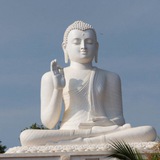
Big Buddhas of Wat Pha Sorn Kaew Buddhist temple, Phetchabun, Thailand
👍1👏1🤩1😍1😎1
Dhammapada Verses 349 and 350
Culadhanuggaha Pandita Vatthu
Vitakkamathitassa jantuno
tibbaragassa subbhanupassino
bhiyyo tanha pavaddhati
esa kho dalham karoti bandhanam.
Vitakkupasame ca yo rato
asubham bhavayate sada sato
esa kho byanti kahiti
esa cheechati marabandhanam.
Verse 349: In a man who is disturbed by (sensual) thoughts, whose passions are strong, and who keeps seeing objects as being pleasant, craving grows more and more. Indeed, he makes his bondage strong.
Verse 350: A man who takes delight in calming (sensual) thoughts, who is ever mindful, and meditates on the impurity (of the body, etc.) will certainly get rid (of craving); this man will cut the bond of Mara.
The Story of Culadhanuggaha, the Skilful Archer
While residing at the Jetavana monastery, the Buddha uttered Verses (349) and (350) of this book, with reference to a young bhikkhu, who was a skilful archer in one of his previous existences.
Once a young bhikkhu took his alms-food in one of the shelters specially built for bhikkhus in town. After his meal he felt like drinking water. So he went to a house and asked for some drinking water, and a young woman came out to give him some water. As soon as this young woman saw the young bhikkhu she fell in love with him. Wishing to entice him, she invited the young bhikkhu to come to her house whenever he felt thirsty. After some time, she invited him to her house for alms-food. On that day, she told him that they had everything they could wish for in the house, but that there was no male to look after their affairs, etc. Hearing those words, the young bhikkhu took the hint and he soon found himself to be more and more attached to the young, attractive woman. He became very much dissatisfied with his life as a bhikkhu and was getting thin. Other bhikkhus reported about him to the Buddha.
The Buddha called the young bhikkhu to his presence and said to him, "My son, listen to me. This young woman will be your undoing just as she had been to you in a previous existence. In one of your previous existences you were a very skilful archer and she was your wife. On one occasion, while the two of you were travelling, you came upon a gang of highwaymen. She fell in love with the gang leader. So, while you and the gang leader were engaged in fighting and you called out to her to give you the sword, she gave the sword to the robber who promptly killed you. Thus, she was the cause of your death. Now, too, she will be the cause of your ruin if you go after her and leave my Order for her sake."
Then the Buddha spoke in verse as follows:
Verse 349: In a man who is disturbed by (sensual) thoughts, whose passions are strong, and who keeps seeing objects as being pleasant, craving grows more and more. Indeed, he makes his bondage strong.
Verse 350: A man who takes delight in calming (sensual) thoughts, who is ever mindful, and meditates on the impurity (of the body, etc.) will certainly get rid (of craving); this man will cut the bond of Mara.
At the end of the discourse, the young bhikkhu attained Sotapatti Fruition.
===
Buddha dharma teachings channel:
https://invite.viber.com/?g2=AQAKw1y3rv%2F6sk61PI2W4izuIiaEZj8YZujhY1tSzL%2B07s7rFnVFDAd0bAYFaMLw
===
Culadhanuggaha Pandita Vatthu
Vitakkamathitassa jantuno
tibbaragassa subbhanupassino
bhiyyo tanha pavaddhati
esa kho dalham karoti bandhanam.
Vitakkupasame ca yo rato
asubham bhavayate sada sato
esa kho byanti kahiti
esa cheechati marabandhanam.
Verse 349: In a man who is disturbed by (sensual) thoughts, whose passions are strong, and who keeps seeing objects as being pleasant, craving grows more and more. Indeed, he makes his bondage strong.
Verse 350: A man who takes delight in calming (sensual) thoughts, who is ever mindful, and meditates on the impurity (of the body, etc.) will certainly get rid (of craving); this man will cut the bond of Mara.
The Story of Culadhanuggaha, the Skilful Archer
While residing at the Jetavana monastery, the Buddha uttered Verses (349) and (350) of this book, with reference to a young bhikkhu, who was a skilful archer in one of his previous existences.
Once a young bhikkhu took his alms-food in one of the shelters specially built for bhikkhus in town. After his meal he felt like drinking water. So he went to a house and asked for some drinking water, and a young woman came out to give him some water. As soon as this young woman saw the young bhikkhu she fell in love with him. Wishing to entice him, she invited the young bhikkhu to come to her house whenever he felt thirsty. After some time, she invited him to her house for alms-food. On that day, she told him that they had everything they could wish for in the house, but that there was no male to look after their affairs, etc. Hearing those words, the young bhikkhu took the hint and he soon found himself to be more and more attached to the young, attractive woman. He became very much dissatisfied with his life as a bhikkhu and was getting thin. Other bhikkhus reported about him to the Buddha.
The Buddha called the young bhikkhu to his presence and said to him, "My son, listen to me. This young woman will be your undoing just as she had been to you in a previous existence. In one of your previous existences you were a very skilful archer and she was your wife. On one occasion, while the two of you were travelling, you came upon a gang of highwaymen. She fell in love with the gang leader. So, while you and the gang leader were engaged in fighting and you called out to her to give you the sword, she gave the sword to the robber who promptly killed you. Thus, she was the cause of your death. Now, too, she will be the cause of your ruin if you go after her and leave my Order for her sake."
Then the Buddha spoke in verse as follows:
Verse 349: In a man who is disturbed by (sensual) thoughts, whose passions are strong, and who keeps seeing objects as being pleasant, craving grows more and more. Indeed, he makes his bondage strong.
Verse 350: A man who takes delight in calming (sensual) thoughts, who is ever mindful, and meditates on the impurity (of the body, etc.) will certainly get rid (of craving); this man will cut the bond of Mara.
At the end of the discourse, the young bhikkhu attained Sotapatti Fruition.
===
Buddha dharma teachings channel:
https://invite.viber.com/?g2=AQAKw1y3rv%2F6sk61PI2W4izuIiaEZj8YZujhY1tSzL%2B07s7rFnVFDAd0bAYFaMLw
===
Viber
Buddha
Buddha dharma teachings from the suttas and commentaries from Theravada tradition
Free Buddha Dharma ebook
Dhamma In Practice
-- A Collection Of Works
By Phra Nirodharansigambhira pannacariya of Hin Mark Peng Monastery, Thailand
Free download here:
https://ftp.budaedu.org/ebooks/pdf/EN340.pdf
===
Dhamma In Practice
-- A Collection Of Works
By Phra Nirodharansigambhira pannacariya of Hin Mark Peng Monastery, Thailand
Free download here:
https://ftp.budaedu.org/ebooks/pdf/EN340.pdf
===
👍1💯1
Free Buddha Dharma ebook
Dhamma In Practice
-- A Collection Of Works
By Phra Nirodharansigambhira pannacariya of Hin Mark Peng Monastery, Thailand
The book here presented is meant to serve as a guide for those who aspire for mind-development. Written in the light of what actually takes place in the course of that development, it might in places sound unfamiliar to some. It was in view of a number of aspirants that this attempt was made. Most of those aspirants, despite their sincere faith and devotion, are not so well-informed, but they are fervently earnest in the practice of Kammatthana (Insight Meditation). Because of this drawback they often do not know how to come to terms with what they have to encounter in their development process. Thus they cannot decide for themselves how well, or how far, they have progressed, and as a result are known to have fallen back or been deluded in some cases.This is a deplorable situation showing that the practical aspect of Dhamma cannot be determined entirely by the intellectual, academical aspect.
Free download here:
https://ftp.budaedu.org/ebooks/pdf/EN340.pdf
===
Dhamma In Practice
-- A Collection Of Works
By Phra Nirodharansigambhira pannacariya of Hin Mark Peng Monastery, Thailand
The book here presented is meant to serve as a guide for those who aspire for mind-development. Written in the light of what actually takes place in the course of that development, it might in places sound unfamiliar to some. It was in view of a number of aspirants that this attempt was made. Most of those aspirants, despite their sincere faith and devotion, are not so well-informed, but they are fervently earnest in the practice of Kammatthana (Insight Meditation). Because of this drawback they often do not know how to come to terms with what they have to encounter in their development process. Thus they cannot decide for themselves how well, or how far, they have progressed, and as a result are known to have fallen back or been deluded in some cases.This is a deplorable situation showing that the practical aspect of Dhamma cannot be determined entirely by the intellectual, academical aspect.
Free download here:
https://ftp.budaedu.org/ebooks/pdf/EN340.pdf
===
👌1🏆1