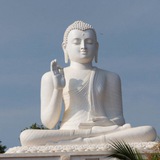
Anapanasati Mindfulness With Breathing
By Buddhadasa Bhikkhu
Part 1 of 2:
Today we will summarize all of the inquiries into Anapanasati covered by these lectures. We will summarize the sixteen steps in terms of their essential characters, their value or benefits, and the means of realizing those benefits. Please commit yourselves to listening carefully. Then you will be able to make use of those benefits in their fullest sense.
Do not forget that we are talking about nature, about four aspects of nature and the law of nature manifest in them: kaya, vedana, citta, and Dhamma. Nature pure and simple. So please understand the word "dhamma-jati." It is both the law of nature and follows the law of nature; nature and its law can never be separated. As living creatures, our duty is to understand and use nature for our highest benefit. Although we cannot control it, we can use it to our advantage when we act correctly according to its law. We know these four natures for just this benefit, for the benefit of our very own lives however long they may last.
KAYA: COOLING EMOTIONS
The first subject in the practice of mindfulness with breathing is the kaya, the body or bodies. We all understand its importance in life without needing explanations. The body is the foundation for the mind. We require a kaya which is ready to maintain and support itself and the mind in ways beneficial for life. Further, we need to understand how to control kaya according to our needs through regulating the breath. There are many advantages in knowing how to regulate the breath. By doing so we can change our moods and emotions. For example, when we are angry, we can let go of that anger quickly by breathing long. By breathing long the anger will disappear. When we are worried and unable to think straight, we breathe longer and longer to force that worry away. Or if we want to change from one train of thought to another, we can do so by breathing long in order to wipe out the unwanted thoughts or emotions and replace them with something more orderly and normal. Then we will be able to think what needs to be thought. So there is more to kaya than just the flesh body, it carries over to the citta, also.
The breath alone is well worth knowing, even if only in terms of health. We will have good health if we know how to breathe properly. Thus, the body and the various things associated with the body such as, the breath, the emotions, and health are considered to be one most important subject. I hope that all of you are able to get the fullest advantage from this stage of Anapanasati.
VEDANA: STOPPING THE SPINNING
The feelings are the second item. If you are not aware of these things you will think they are unimportant. In reality, they are of the highest importance to human beings in that they spin people around at will. Further, they spin the whole world around. Whatever feelings we desire - and everyone craves them we are incited to all kinds of behavior accordingly. Everyone is chasing after pleasant feelings and running away from unpleasant feelings. This is how the vedana can keep the whole world spinning. The feelings in people are the cause of all the new, strange inventions and creations which humanity has produced. Art, culture, and technology were discovered and produced for the sake of feelings, which have such great power to force us to follow them. Vedana causes desire. Want is born out of feeling and follows feeling. Then, we act according to our desires. Thereby, all the many things happen. Even our search for money is a response to vedana, whether from sensuality and sex, or merely from the ordinary feeling of being at ease.
Please get to know the things that dominate humanity. Vedana have tremendous power and influence over us. If we cannot control feelings, we must rise and fall at their whim, which is dukkha. And we will act out of vedana which are trapped in ignorance (avijja) and are incorrect. The same is true for animals. They too are directed and compelled by feelings.
By Buddhadasa Bhikkhu
Part 1 of 2:
Today we will summarize all of the inquiries into Anapanasati covered by these lectures. We will summarize the sixteen steps in terms of their essential characters, their value or benefits, and the means of realizing those benefits. Please commit yourselves to listening carefully. Then you will be able to make use of those benefits in their fullest sense.
Do not forget that we are talking about nature, about four aspects of nature and the law of nature manifest in them: kaya, vedana, citta, and Dhamma. Nature pure and simple. So please understand the word "dhamma-jati." It is both the law of nature and follows the law of nature; nature and its law can never be separated. As living creatures, our duty is to understand and use nature for our highest benefit. Although we cannot control it, we can use it to our advantage when we act correctly according to its law. We know these four natures for just this benefit, for the benefit of our very own lives however long they may last.
KAYA: COOLING EMOTIONS
The first subject in the practice of mindfulness with breathing is the kaya, the body or bodies. We all understand its importance in life without needing explanations. The body is the foundation for the mind. We require a kaya which is ready to maintain and support itself and the mind in ways beneficial for life. Further, we need to understand how to control kaya according to our needs through regulating the breath. There are many advantages in knowing how to regulate the breath. By doing so we can change our moods and emotions. For example, when we are angry, we can let go of that anger quickly by breathing long. By breathing long the anger will disappear. When we are worried and unable to think straight, we breathe longer and longer to force that worry away. Or if we want to change from one train of thought to another, we can do so by breathing long in order to wipe out the unwanted thoughts or emotions and replace them with something more orderly and normal. Then we will be able to think what needs to be thought. So there is more to kaya than just the flesh body, it carries over to the citta, also.
The breath alone is well worth knowing, even if only in terms of health. We will have good health if we know how to breathe properly. Thus, the body and the various things associated with the body such as, the breath, the emotions, and health are considered to be one most important subject. I hope that all of you are able to get the fullest advantage from this stage of Anapanasati.
VEDANA: STOPPING THE SPINNING
The feelings are the second item. If you are not aware of these things you will think they are unimportant. In reality, they are of the highest importance to human beings in that they spin people around at will. Further, they spin the whole world around. Whatever feelings we desire - and everyone craves them we are incited to all kinds of behavior accordingly. Everyone is chasing after pleasant feelings and running away from unpleasant feelings. This is how the vedana can keep the whole world spinning. The feelings in people are the cause of all the new, strange inventions and creations which humanity has produced. Art, culture, and technology were discovered and produced for the sake of feelings, which have such great power to force us to follow them. Vedana causes desire. Want is born out of feeling and follows feeling. Then, we act according to our desires. Thereby, all the many things happen. Even our search for money is a response to vedana, whether from sensuality and sex, or merely from the ordinary feeling of being at ease.
Please get to know the things that dominate humanity. Vedana have tremendous power and influence over us. If we cannot control feelings, we must rise and fall at their whim, which is dukkha. And we will act out of vedana which are trapped in ignorance (avijja) and are incorrect. The same is true for animals. They too are directed and compelled by feelings.
Telegram
Words of the Buddha
Daily teachings of Buddha Dharma
❤2👍1👏1
All activities are merely search- ing, hunting, and chasing after the desired vedana. People, as well, search and hunt for the feelings they want.
Even in coming here to Suan Mokkh, all of you are hoping to find something that will produce the vedana which please you. Is it not true that you came here in order to get some pleasant feelings, such as, from the peace and quiet of a monastery or the joy of meditation; or, that you are trying to get away from some of the agitation, conflict, sorrow, and suffering in the world? These vedana cause all kinds of activity and search; they compel every kind of effort and endeavor. In effect, they are the masters, the dictators, of our lives in the most profound way. When we can control them, they do not do us any harm. When we are unable to control them, we become slaves. What a pitiful state it is to be a slave to vedana!
There are two kinds of vedana: foolish feeling conditioned by ignorance (avijja) and clever feeling conditioned by vijja (correct knowledge). If we are foolish at the moment of phassa (sensory contact), we have foolish feeling. If we are clever and knowledgable at phassa, we have wise feeling. Foolish feeling leads to ignorant desire, which we call tanha (craving). Wise feeling leads to correct desire, to wanting what we ought to want, to wise want. We should be careful to make sure that vedana is always wise feeling. Foolish feeling causes tanha, or craving, which in turn drags us along behind foolish tanha, as well as after intelligent wants. Craving can turn wise wants and needs into stupid desires. Foolish tanha leads us around the world, around and around who knows how many times, and still we put up with it. Sometimes we even want to go to the moon! As long as craving remains, there will be no end to it all: endless comings and goings, endless inventions and concoctions, endless desires for the luxurious life. Consequently, the benefits of controlling the vedana are enormous. Do not allow them to stir up foolish desires and wants. Let us be interested in the vedana with this perspective.
===
Part 1 of 2:
https://news.1rj.ru/str/dhammapadas/2276
Part 2 of 2:
https://news.1rj.ru/str/wordsofbuddha/3298
===
Words of the Buddha channel:
https://news.1rj.ru/str/wordsofbuddha
===
Even in coming here to Suan Mokkh, all of you are hoping to find something that will produce the vedana which please you. Is it not true that you came here in order to get some pleasant feelings, such as, from the peace and quiet of a monastery or the joy of meditation; or, that you are trying to get away from some of the agitation, conflict, sorrow, and suffering in the world? These vedana cause all kinds of activity and search; they compel every kind of effort and endeavor. In effect, they are the masters, the dictators, of our lives in the most profound way. When we can control them, they do not do us any harm. When we are unable to control them, we become slaves. What a pitiful state it is to be a slave to vedana!
There are two kinds of vedana: foolish feeling conditioned by ignorance (avijja) and clever feeling conditioned by vijja (correct knowledge). If we are foolish at the moment of phassa (sensory contact), we have foolish feeling. If we are clever and knowledgable at phassa, we have wise feeling. Foolish feeling leads to ignorant desire, which we call tanha (craving). Wise feeling leads to correct desire, to wanting what we ought to want, to wise want. We should be careful to make sure that vedana is always wise feeling. Foolish feeling causes tanha, or craving, which in turn drags us along behind foolish tanha, as well as after intelligent wants. Craving can turn wise wants and needs into stupid desires. Foolish tanha leads us around the world, around and around who knows how many times, and still we put up with it. Sometimes we even want to go to the moon! As long as craving remains, there will be no end to it all: endless comings and goings, endless inventions and concoctions, endless desires for the luxurious life. Consequently, the benefits of controlling the vedana are enormous. Do not allow them to stir up foolish desires and wants. Let us be interested in the vedana with this perspective.
===
Part 1 of 2:
https://news.1rj.ru/str/dhammapadas/2276
Part 2 of 2:
https://news.1rj.ru/str/wordsofbuddha/3298
===
Words of the Buddha channel:
https://news.1rj.ru/str/wordsofbuddha
===
Telegram
Words of the Buddha
Daily teachings of Buddha Dharma
❤1💯1🤗1
Dhammapada Verse 386
Annatarabrahmana Vatthu
Jhayim viraja' masinam
katakicca' manasavam
uttamattha' manuppattam
tamaham brumi brahmanam.
Verse 386: Him I call a brahmana, who dwells in seclusion practising Tranquility and Insight Meditation and is free from taints (of moral defilements); who has performed his duties, and is free from moral intoxicants (asavas) and has reached the highest goal (arahatship).
The Story of a Certain Brahmin
While residing at the Jetavana monastery, the Buddha uttered Verse (386) of this book, with reference to a brahmin.
One day, a brahmin thought to himself, "Gotama Buddha calls his disciples 'brahmana'. I also am a brahmin by caste. Shouldn't I also be called a brahmana?" So thinking, he went to the Buddha and posed this question. To him the Buddha replied, "I do not call one a brahmana simply because of his caste; I only call him a brahmana, who has attained arahatship."
Then the Buddha spoke in verse as follows:
Verse 386: Him I call a brahmana, who dwells in seclusion practising Tranquility and Insight Meditation and is free from taints (of moral defilements); who has performed his duties, and is free from moral intoxicants (asavas) and has reached the highest goal (arahatship).
At the end of the discourse the brahmin attained Sotapatti Fruition.
===
Ajahn Chah, Buddhist teacher of Thai forest meditation of Theravada Buddhism channel:
https://news.1rj.ru/str/ajahnchah_buddhism
===
Annatarabrahmana Vatthu
Jhayim viraja' masinam
katakicca' manasavam
uttamattha' manuppattam
tamaham brumi brahmanam.
Verse 386: Him I call a brahmana, who dwells in seclusion practising Tranquility and Insight Meditation and is free from taints (of moral defilements); who has performed his duties, and is free from moral intoxicants (asavas) and has reached the highest goal (arahatship).
The Story of a Certain Brahmin
While residing at the Jetavana monastery, the Buddha uttered Verse (386) of this book, with reference to a brahmin.
One day, a brahmin thought to himself, "Gotama Buddha calls his disciples 'brahmana'. I also am a brahmin by caste. Shouldn't I also be called a brahmana?" So thinking, he went to the Buddha and posed this question. To him the Buddha replied, "I do not call one a brahmana simply because of his caste; I only call him a brahmana, who has attained arahatship."
Then the Buddha spoke in verse as follows:
Verse 386: Him I call a brahmana, who dwells in seclusion practising Tranquility and Insight Meditation and is free from taints (of moral defilements); who has performed his duties, and is free from moral intoxicants (asavas) and has reached the highest goal (arahatship).
At the end of the discourse the brahmin attained Sotapatti Fruition.
===
Ajahn Chah, Buddhist teacher of Thai forest meditation of Theravada Buddhism channel:
https://news.1rj.ru/str/ajahnchah_buddhism
===
Telegram
Ajahn Chah - Theravada Thailand Buddhism
Collection of teachings of Venerable Ajahn Chah, a foremost meditation and Buddhist teacher from Thailand
❤2🙏1🏆1
Forwarded from Words of the Buddha
Bhikkhus, there are these five defilements of gold, defiled by which gold is not malleable, wieldy, and luminous, but brittle and not properly fit for work. What five? Iron, copper, tin, lead, and silver. But when gold is freed from these five defilements, it is malleable, wieldy, and luminous, pliant and properly fit for work. Then whatever kind of ornament one wishes to make from it—whether a bracelet, earrings, a necklace, or a golden garland—one can achieve one’s purpose.
“So too, bhikkhus, there are these five defilements of the mind, defiled by which the mind is not malleable, wieldy, and luminous, but brittle and not properly concentrated for the destruction of the taints. What five? Sensual desire, ill will, dullness and drowsiness, restlessness and remorse, and doubt. But when the mind is freed from these five defilements, it becomes malleable, wieldy, and luminous, pliant and properly concentrated for the destruction of the taints.
Partially excerpted from AN 5.23 Upakkilesasutta : Defilements
“So too, bhikkhus, there are these five defilements of the mind, defiled by which the mind is not malleable, wieldy, and luminous, but brittle and not properly concentrated for the destruction of the taints. What five? Sensual desire, ill will, dullness and drowsiness, restlessness and remorse, and doubt. But when the mind is freed from these five defilements, it becomes malleable, wieldy, and luminous, pliant and properly concentrated for the destruction of the taints.
Partially excerpted from AN 5.23 Upakkilesasutta : Defilements
❤3👏1🙏1
Forwarded from Buddha
Free Buddha Dharma ebook
The Debate of King Milinda
By Bhikkhu Pesala
The Milinda Panha is, with good reason, a famous work of Buddhist literature, probably compiled in the first century B.C. It presents Buddhist doctrine in a very attractive and memorable form as a dialogue between a Bactrian Greek king, Milinda, who plays the ‘Devil’s Advocate’ and a Buddhist sage, Nàgasena. The topics covered include most of those questions commonly asked by Westerners such as “If there is no soul, what is it that is reborn?” and “If there is no soul, who is talking to you now?”
This abridgement provides a concise presentation of this masterpiece of Buddhist literature. The introduction outlines the historical background against which the dialogues took place, indicating the meeting of two great cultures, that of ancient Greece and the Buddhism of the Indus valley, which was a legacy of the great Emperor Asoka.
Free download available:
https://static.sariputta.com/pdf/tipitaka/741/milindapdf.pdf
===
The Debate of King Milinda
By Bhikkhu Pesala
The Milinda Panha is, with good reason, a famous work of Buddhist literature, probably compiled in the first century B.C. It presents Buddhist doctrine in a very attractive and memorable form as a dialogue between a Bactrian Greek king, Milinda, who plays the ‘Devil’s Advocate’ and a Buddhist sage, Nàgasena. The topics covered include most of those questions commonly asked by Westerners such as “If there is no soul, what is it that is reborn?” and “If there is no soul, who is talking to you now?”
This abridgement provides a concise presentation of this masterpiece of Buddhist literature. The introduction outlines the historical background against which the dialogues took place, indicating the meeting of two great cultures, that of ancient Greece and the Buddhism of the Indus valley, which was a legacy of the great Emperor Asoka.
Free download available:
https://static.sariputta.com/pdf/tipitaka/741/milindapdf.pdf
===
👏1🏆1
Forwarded from Words of the Buddha
Anapanasati Mindfulness With Breathing
By Buddhadasa Bhikkhu
Part 2 of 2:
CITTA: WORKING CORRECTLY
Now we come to the citta. You probably knew by yourselves and have been aware for some time of its importance. If not, then our studies here have shown you how significant the citta (mind- heart) is. On the other hand, it is much the same as the kaya and vedana. If the citta is standing or existing in the wrong way problems will arise, dukkha will occur.
At a minimum, there are three things we must understand about the mind. Depending on the function which it is performing, we can call it by three different names. When it thinks we call it "citta." For being aware, feeling, experiencing, and knowing we say "mano." The basic function of being conscious at the sense doors in order to see, hear, smell, taste, touch, and cognize is called "vinnana." We focus on the function the mind performs and then name it accordingly: for thinking we name it citta, for knowing we name it mano, and for the basic sensory consciousness we name it vinnana.
When the citta performs correctly there are good results but it must be under control for it to work correctly. If we cannot control it, it will not be correct. When it it is not correct the whole thing goes to the dogs; nothing will be left in the world. We can say that the world exists because we have citta. If we did not have citta, it would be as if there was no world. If we can keep the mind under control and dwelling in correctness, we will receive the fruit of calmness, quiet, and peace. Understanding the citta enough to keep it under control is the most excellent knowledge for us human be- ings to discover and have. You ought to be especially interested in this.
DHAMMA: TWO BASIC FACTS
Lastly, we come to Dhamma- or Truth. In all things, both those that are us and those that are involved with us, there is Truth that we must know. If we do not know such Truth, or understand it incorrectly, our involvement with things, with life, will be incorrect. This will cause problems and will lead to dukkha. The whole of such knowledge can be summarized within two subjects: compounded things (sankhara, concoctions) which have causes and conditions; and their opposite, the non-compounded thing. You might study these subjects through the metaphysical terms "phenomenal" and "noumenal." Noumenal is the opposite of phenomenal in principle, they are a pair. If something is phenomenal, it is a compounded thing and must exhibit the truth of impermanence (aniccam). If a thing is noumenal, it is a non-compounded thing and it is not aniccam. Rather, it is niccam (permanent). Therefore, we study the aniccam of all things until we know the Truth of impermanence well. Then we do not attach to anything. The mind which is not attached to anything proceeds to realize that thing which is permanent (niccam), beyond impermanence, namely, the noumenon nibbana. That we understand these two realities - the conditioned and the unconditioned - is of the utmost importance. It is the most important principle of all. The practice of the Dhamma tetrad of Anapanasati leads to knowing these two facts.
That is the essence of our study into these four areas, and the knowledges and benefits such study brings. This is the essence of Anapanasati.
THE FOUR COMRADE DHAMMAS
There are further benefits, however, from practicing Anapanasati. We also will get what I like to call the "Four Comrade Dhammas," I came up with this name myself in order to discuss them more easily. The four comrade dhammas are sati, panna, sampajanna, and samadhi. You will recall from the first lecture that while we live within this world the four comrade dhammas will enable us to subdue all threats. With them we can get rid of dukkha. Whether inside or outside the monastery, we must use these four comrades to live. First, we have sati (reflective awareness mindfulness). When a sense object makes contact, sati is there and brings panna (wisdom) to the experience.
By Buddhadasa Bhikkhu
Part 2 of 2:
CITTA: WORKING CORRECTLY
Now we come to the citta. You probably knew by yourselves and have been aware for some time of its importance. If not, then our studies here have shown you how significant the citta (mind- heart) is. On the other hand, it is much the same as the kaya and vedana. If the citta is standing or existing in the wrong way problems will arise, dukkha will occur.
At a minimum, there are three things we must understand about the mind. Depending on the function which it is performing, we can call it by three different names. When it thinks we call it "citta." For being aware, feeling, experiencing, and knowing we say "mano." The basic function of being conscious at the sense doors in order to see, hear, smell, taste, touch, and cognize is called "vinnana." We focus on the function the mind performs and then name it accordingly: for thinking we name it citta, for knowing we name it mano, and for the basic sensory consciousness we name it vinnana.
When the citta performs correctly there are good results but it must be under control for it to work correctly. If we cannot control it, it will not be correct. When it it is not correct the whole thing goes to the dogs; nothing will be left in the world. We can say that the world exists because we have citta. If we did not have citta, it would be as if there was no world. If we can keep the mind under control and dwelling in correctness, we will receive the fruit of calmness, quiet, and peace. Understanding the citta enough to keep it under control is the most excellent knowledge for us human be- ings to discover and have. You ought to be especially interested in this.
DHAMMA: TWO BASIC FACTS
Lastly, we come to Dhamma- or Truth. In all things, both those that are us and those that are involved with us, there is Truth that we must know. If we do not know such Truth, or understand it incorrectly, our involvement with things, with life, will be incorrect. This will cause problems and will lead to dukkha. The whole of such knowledge can be summarized within two subjects: compounded things (sankhara, concoctions) which have causes and conditions; and their opposite, the non-compounded thing. You might study these subjects through the metaphysical terms "phenomenal" and "noumenal." Noumenal is the opposite of phenomenal in principle, they are a pair. If something is phenomenal, it is a compounded thing and must exhibit the truth of impermanence (aniccam). If a thing is noumenal, it is a non-compounded thing and it is not aniccam. Rather, it is niccam (permanent). Therefore, we study the aniccam of all things until we know the Truth of impermanence well. Then we do not attach to anything. The mind which is not attached to anything proceeds to realize that thing which is permanent (niccam), beyond impermanence, namely, the noumenon nibbana. That we understand these two realities - the conditioned and the unconditioned - is of the utmost importance. It is the most important principle of all. The practice of the Dhamma tetrad of Anapanasati leads to knowing these two facts.
That is the essence of our study into these four areas, and the knowledges and benefits such study brings. This is the essence of Anapanasati.
THE FOUR COMRADE DHAMMAS
There are further benefits, however, from practicing Anapanasati. We also will get what I like to call the "Four Comrade Dhammas," I came up with this name myself in order to discuss them more easily. The four comrade dhammas are sati, panna, sampajanna, and samadhi. You will recall from the first lecture that while we live within this world the four comrade dhammas will enable us to subdue all threats. With them we can get rid of dukkha. Whether inside or outside the monastery, we must use these four comrades to live. First, we have sati (reflective awareness mindfulness). When a sense object makes contact, sati is there and brings panna (wisdom) to the experience.
Telegram
Dhammapada - Buddha Dharma Teachings
Daily teachings of the Dhammapada, beloved and favorite teachings of the Buddha
❤1👏1
Forwarded from Words of the Buddha
Once it arrives, panna transforms into sampajanna (wisdom-in-action), the specific application of wisdom required by the situation. Then, samadhi's power and strength are added to sampajanna. With them we are able to conquer every kind of object that comes in through the eyes, ears, nose, tongue, body, and mind. The four comrade dhammas are unsurpassed guardians. They watch over and protect us just like God. If we practice Anapanasati we will acquire the four comrade dhammas.
===
Part 1 of 2:
https://news.1rj.ru/str/dhammapadas/2276
Part 2 of 2:
https://news.1rj.ru/str/wordsofbuddha/3298
===
Dhammapada, beloved and favorite teachings of the Buddha channel:
https://news.1rj.ru/str/dhammapadas
===
===
Part 1 of 2:
https://news.1rj.ru/str/dhammapadas/2276
Part 2 of 2:
https://news.1rj.ru/str/wordsofbuddha/3298
===
Dhammapada, beloved and favorite teachings of the Buddha channel:
https://news.1rj.ru/str/dhammapadas
===
Telegram
Dhammapada - Buddha Dharma Teachings
Daily teachings of the Dhammapada, beloved and favorite teachings of the Buddha
👍1🥰1
Dhammapada Verse 387
Anandatthera Vatthu
Diva tapati adicco
ratti mabhati candima
sannaddho khattiyo tapati
jhayi tapati brahmano
atha sabbamahorattim
buddho tapati tejasa.
Verse 387: By day shines the sun; by night shines the moon; in regalia shines the king; in meditation shines the arahat; but the Buddha in his glory shines at all times, by day and by night.
The Story of Thera Ananda
While residing at the Pubbarama monastery, the Buddha uttered Verse (387) of this book, with reference to the Venerable Ananda.
It was the full moon day of the seventh month (Assayuja) when King Pasenadi of Kosala came to visit the Buddha. The king was then resplendent in his full royal regalia. At that time, Thera Kaludayi was also present in the same room sitting at the edge of the congregation. He was in deep mental absorption (jhana), his body bright and golden. In the sky, the Venerable Ananda noticed that the sun was setting and the moon was just coming out, both the sun and the moon radiating rays of light.
The Venerable Ananda looked at the shining splendour of the king, of the thera, and of the sun and the moon. Finally, the Venerable Ananda looked at the Buddha and he suddenly perceived that the light that was then radiating from the Buddha far surpassed the light shining from the others. Seeing the Buddha in his glory and splendour, the Venerable Ananda immediately approached the Buddha and burst forth, "O Venerable Sir! The light that shines forth from your noble body far surpasses the light from the king, the light from the thera, the light from the sun and the light from the moon."
To him the Buddha spoke in verse as follows:
Verse 387: By day shines the sun; by night shines the moon; in regalia shines the king; in meditation shines the arahat; but the Buddha in his glory shines at all times, by day and by night.
===
Free Buddhism books, teachings, podcasts and videos from Theravada, Mahayana and Vajrayana traditions:
https://news.1rj.ru/str/buddha_ebooks
===
Anandatthera Vatthu
Diva tapati adicco
ratti mabhati candima
sannaddho khattiyo tapati
jhayi tapati brahmano
atha sabbamahorattim
buddho tapati tejasa.
Verse 387: By day shines the sun; by night shines the moon; in regalia shines the king; in meditation shines the arahat; but the Buddha in his glory shines at all times, by day and by night.
The Story of Thera Ananda
While residing at the Pubbarama monastery, the Buddha uttered Verse (387) of this book, with reference to the Venerable Ananda.
It was the full moon day of the seventh month (Assayuja) when King Pasenadi of Kosala came to visit the Buddha. The king was then resplendent in his full royal regalia. At that time, Thera Kaludayi was also present in the same room sitting at the edge of the congregation. He was in deep mental absorption (jhana), his body bright and golden. In the sky, the Venerable Ananda noticed that the sun was setting and the moon was just coming out, both the sun and the moon radiating rays of light.
The Venerable Ananda looked at the shining splendour of the king, of the thera, and of the sun and the moon. Finally, the Venerable Ananda looked at the Buddha and he suddenly perceived that the light that was then radiating from the Buddha far surpassed the light shining from the others. Seeing the Buddha in his glory and splendour, the Venerable Ananda immediately approached the Buddha and burst forth, "O Venerable Sir! The light that shines forth from your noble body far surpasses the light from the king, the light from the thera, the light from the sun and the light from the moon."
To him the Buddha spoke in verse as follows:
Verse 387: By day shines the sun; by night shines the moon; in regalia shines the king; in meditation shines the arahat; but the Buddha in his glory shines at all times, by day and by night.
===
Free Buddhism books, teachings, podcasts and videos from Theravada, Mahayana and Vajrayana traditions:
https://news.1rj.ru/str/buddha_ebooks
===
Telegram
Buddha Dharma books
Free Buddhism books, teachings, podcasts and videos from Theravada, Mahayana and Vajrayana traditions
👍2❤1🔥1🆒1
Forwarded from Words of the Buddha
Shwedagon Zedi Daw, The Shwedagon Golden Dagon Pagoda, Yangon, Myanmar.
👍3🤩1😍1
Forwarded from Ajahn Chah - Theravada Thailand Buddhism
Free Buddha Dharma ebook
Not for Sure: Two Dhamma Talks
By Ajahn Chah, translated from the Thai by Thanissaro Bhikkhu
Two Dhamma talks by Ajahn Chah "Supposition and Release" and "Still Flowing Water".
Free download available:
https://www.accesstoinsight.org/lib/thai/chah/not_for_sure.pdf
===
Not for Sure: Two Dhamma Talks
By Ajahn Chah, translated from the Thai by Thanissaro Bhikkhu
Two Dhamma talks by Ajahn Chah "Supposition and Release" and "Still Flowing Water".
Free download available:
https://www.accesstoinsight.org/lib/thai/chah/not_for_sure.pdf
===
👍1🏆1
Dhammapada Verse 388
Annatarabrahmana Pabbajita Vatthu
Bahitapapoti brahmano
samacariya1 "samano" ti vuccati
pabbajayamattano malam
tasma "pabbajito2" ti vuccati.
Verse 388: Because he has discarded evil he is called a 'brahmana'; because he lives calmly he is called a 'samana'; and because he gets rid of his impurities he is called a 'pabbajita'.
1. samacariya: lit., living calmly, i.e., practising for eradication of moral defilements.
2. pabbajita: one who leaves the household life for the homeless life of a recluse; in Buddhism it means one who has given up the impurities of the household life to become a bhikkhu.
The Story of a Brahmin Recluse
While residing at the Jetavana monastery, the Buddha uttered Verse (388) of this book, with reference to a brahmin ascetic.
Once there was a brahmin ascetic in Savatthi. One day, it occurred to him that the Buddha called his disciples pabbajita bhikkhus and since he also was a recluse, he should also be called a pabbajita. So he went to the Buddha and posed the question why he should not be called a pabbajita. The Buddha's answer to him was this: "Just because one is a recluse one does not automatically become a pabbajita; a pabbajita must have other qualifications also."
Then the Buddha spoke in verse as follows:
Verse 388: Because he has discarded evil he is called a 'brahmana'; because he lives calmly he is called a 'samana'; and because he gets rid of his impurities he is called a 'pabbajita'.
At the end of the discourse the brahmin attained Sotapatti Fruition.
===
Buddha dharma teachings channel:
https://news.1rj.ru/str/lorddivinebuddha
===
Annatarabrahmana Pabbajita Vatthu
Bahitapapoti brahmano
samacariya1 "samano" ti vuccati
pabbajayamattano malam
tasma "pabbajito2" ti vuccati.
Verse 388: Because he has discarded evil he is called a 'brahmana'; because he lives calmly he is called a 'samana'; and because he gets rid of his impurities he is called a 'pabbajita'.
1. samacariya: lit., living calmly, i.e., practising for eradication of moral defilements.
2. pabbajita: one who leaves the household life for the homeless life of a recluse; in Buddhism it means one who has given up the impurities of the household life to become a bhikkhu.
The Story of a Brahmin Recluse
While residing at the Jetavana monastery, the Buddha uttered Verse (388) of this book, with reference to a brahmin ascetic.
Once there was a brahmin ascetic in Savatthi. One day, it occurred to him that the Buddha called his disciples pabbajita bhikkhus and since he also was a recluse, he should also be called a pabbajita. So he went to the Buddha and posed the question why he should not be called a pabbajita. The Buddha's answer to him was this: "Just because one is a recluse one does not automatically become a pabbajita; a pabbajita must have other qualifications also."
Then the Buddha spoke in verse as follows:
Verse 388: Because he has discarded evil he is called a 'brahmana'; because he lives calmly he is called a 'samana'; and because he gets rid of his impurities he is called a 'pabbajita'.
At the end of the discourse the brahmin attained Sotapatti Fruition.
===
Buddha dharma teachings channel:
https://news.1rj.ru/str/lorddivinebuddha
===
Telegram
Buddha
Buddha dharma teachings from the suttas and commentaries
❤1👍1