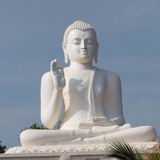
The Buddha was satisfied with the explanation given by the Venerable Sariputta and said to the other bhikkhus, "Bhikkhus! The Venerable Sariputta was not worshipping the various directions; he was only paying obeisance to his teacher and benefactor, through whom he had attained the Deathless. It is quite right and proper for him to pay homage to such a teacher."
Then the Buddha spoke in verse as follows:
Verse 392: If from somebody one should learn the Teaching of the Buddha, he should respectfully pay homage to that teacher, as a brahmin worships the sacrificial fire.
===
Dhammapada, beloved and favorite teachings of the Buddha channel:
https://news.1rj.ru/str/dhammapadas
===
Then the Buddha spoke in verse as follows:
Verse 392: If from somebody one should learn the Teaching of the Buddha, he should respectfully pay homage to that teacher, as a brahmin worships the sacrificial fire.
===
Dhammapada, beloved and favorite teachings of the Buddha channel:
https://news.1rj.ru/str/dhammapadas
===
Telegram
Dhammapada - Buddha Dharma Teachings
Daily teachings of the Dhammapada, beloved and favorite teachings of the Buddha
👏1💯1
Forwarded from Buddha Dharma books
Free Buddha Dharma ebook
Basic Themes: Four Treatises on Buddhist Practice, by Phra Ajaan Lee Dhammadharo
Uniquely among the ajaans in the Thai Wilderness tradition Ajaan Lee composed systematic treatises on the practice. These are valuable documents, giving a wilderness perspective on basic Dhamma topics.
Free download here:
https://www.dhammatalks.org/Archive/Writings/Ebooks/BasicThemes_181215.pdf
===
Basic Themes: Four Treatises on Buddhist Practice, by Phra Ajaan Lee Dhammadharo
Uniquely among the ajaans in the Thai Wilderness tradition Ajaan Lee composed systematic treatises on the practice. These are valuable documents, giving a wilderness perspective on basic Dhamma topics.
Free download here:
https://www.dhammatalks.org/Archive/Writings/Ebooks/BasicThemes_181215.pdf
===
💯2👍1🥰1
Dhammapada Verse 393
Jatilabrahmana Vatthu
Na jatahi na gottena
na jacca hoti brahmano
yamhi saccanca1 dhammo2 ca
so suci so ca brahmano.
Verse 393: Not by wearing matted hair, nor by lineage, nor by caste, does one become a brahmana; only he who realizes the Truth and the Dhamma is pure; he is a brahmana.
1. sacca: the Four Noble Truths.
2. dhamma : the nine Transcendentals, viz., the four Maggas, the four Phalas and Nibbana.
The Story of Jatila, the Brahmin
While residing at the Jetavana monastery, the Buddha uttered Verse (393) of this book, with reference to Jatila, a brahmin ascetic who wore matted hair.
Once, a brahmin ascetic thought to himself that the Buddha called his disciples 'brahmanas' and that he being a brahmin by birth should also be called a 'brahmana'. Thinking thus, he went to see the Buddha and put forward his view. But the Buddha rejected his view and said, "O brahmin, I do not call one a brahmana because he keeps his hair matted or simply because of his birth; I call one a brahmana only if he fully comprehends the Four Noble Truths."
Then the Buddha spoke in verse as follows:
Verse 393: Not by wearing matted hair, nor by lineage, nor by caste, does one become a brahmana; only he who realizes the Truth and the Dhamma is pure; he is a brahmana.
===
Buddha dharma teachings channel:
https://invite.viber.com/?g2=AQAKw1y3rv%2F6sk61PI2W4izuIiaEZj8YZujhY1tSzL%2B07s7rFnVFDAd0bAYFaMLw
===
Jatilabrahmana Vatthu
Na jatahi na gottena
na jacca hoti brahmano
yamhi saccanca1 dhammo2 ca
so suci so ca brahmano.
Verse 393: Not by wearing matted hair, nor by lineage, nor by caste, does one become a brahmana; only he who realizes the Truth and the Dhamma is pure; he is a brahmana.
1. sacca: the Four Noble Truths.
2. dhamma : the nine Transcendentals, viz., the four Maggas, the four Phalas and Nibbana.
The Story of Jatila, the Brahmin
While residing at the Jetavana monastery, the Buddha uttered Verse (393) of this book, with reference to Jatila, a brahmin ascetic who wore matted hair.
Once, a brahmin ascetic thought to himself that the Buddha called his disciples 'brahmanas' and that he being a brahmin by birth should also be called a 'brahmana'. Thinking thus, he went to see the Buddha and put forward his view. But the Buddha rejected his view and said, "O brahmin, I do not call one a brahmana because he keeps his hair matted or simply because of his birth; I call one a brahmana only if he fully comprehends the Four Noble Truths."
Then the Buddha spoke in verse as follows:
Verse 393: Not by wearing matted hair, nor by lineage, nor by caste, does one become a brahmana; only he who realizes the Truth and the Dhamma is pure; he is a brahmana.
===
Buddha dharma teachings channel:
https://invite.viber.com/?g2=AQAKw1y3rv%2F6sk61PI2W4izuIiaEZj8YZujhY1tSzL%2B07s7rFnVFDAd0bAYFaMLw
===
Viber
Buddha
Buddha dharma teachings from the suttas and commentaries from Theravada tradition
❤1👏1
Free Buddha Dharma ebook
The Not-self Strategy
By Thanissaro Bhikkhu
Free download here:
https://www.accesstoinsight.org/lib/authors/thanissaro/notselfstrategy.pdf
===
The Not-self Strategy
By Thanissaro Bhikkhu
Free download here:
https://www.accesstoinsight.org/lib/authors/thanissaro/notselfstrategy.pdf
===
🥰1🙏1
Free Buddha Dharma ebook
The Not-self Strategy
By Thanissaro Bhikkhu
As the Buddha once said, the teaching he most frequently gave to his students was this: All fabrications are inconstant; all phenomena are not-self (anatta) (MN 35). Many people have interpreted this second statement as meaning that there is no self. Others, however, have noticed statements in the Pali Canon—our earliest extant record of the Buddha’s teachings—that refer to the idea of self in a positive manner, as when the Buddha stated that the self is its own mainstay (Dhp 160) or when he encouraged a group of young men—who were searching for a woman who had stolen their belongings—to search for the self instead (Mv.I.14.4). From these statements, these readers conclude that the statement, “All phenomena are not-self,” is meant to clear away attachment to a false view of self so that an experience of the true self can be attained.
Free download here:
https://www.accesstoinsight.org/lib/authors/thanissaro/notselfstrategy.pdf
===
The Not-self Strategy
By Thanissaro Bhikkhu
As the Buddha once said, the teaching he most frequently gave to his students was this: All fabrications are inconstant; all phenomena are not-self (anatta) (MN 35). Many people have interpreted this second statement as meaning that there is no self. Others, however, have noticed statements in the Pali Canon—our earliest extant record of the Buddha’s teachings—that refer to the idea of self in a positive manner, as when the Buddha stated that the self is its own mainstay (Dhp 160) or when he encouraged a group of young men—who were searching for a woman who had stolen their belongings—to search for the self instead (Mv.I.14.4). From these statements, these readers conclude that the statement, “All phenomena are not-self,” is meant to clear away attachment to a false view of self so that an experience of the true self can be attained.
Free download here:
https://www.accesstoinsight.org/lib/authors/thanissaro/notselfstrategy.pdf
===
❤1👍1🏆1
Forwarded from Words of the Buddha
Wat Ek Phnom, Angkorian temple at Sangkae River, Battambang City, Cambodia.
👍1🤩1🆒1
Cultivate Tranquility, Harvest Insight
The classical Theravada model of meditation employs the practices of shamatha and vipassana, both. Ajahn Brahmavamso explains the path of tranquility and insight.
By Ajahn Brahmavamso
Part 1 of 3
In America, Theravada Buddhist meditation is often flatly identified with the practice of vipassana, even to the extent that those who practice within this tradition speak of themselves as vipassana meditators. However, the Pali suttas, the ancient records of the Buddha’s discourses, do not treat vipassana as an autonomous system of meditation but as a member of two paired meditative skills called shamatha and vipassana, tranquility and insight. Far from being opposed, in the suttas tranquility and insight are held to be complementary aspects of mental cultivation which, to yield the proper fruits of the Buddhist path, must eventually be yoked and harmonized.
According to their aptitude and disposition, meditators will develop these two qualities in different temporal sequences. One important source (Anguttara Nikaya, The Fours, sutta 170) states that some develop tranquility first and insight afterwards; others develop insight first and tranquility afterwards; and still others develop tranquility and insight in close conjunction. While most teachers of Theravada meditation in the West have leaned towards the second of these models, in the Buddha’s own discourses it is the first that predominates, and this model also forms the scaffolding for the classical Pali meditation manuals such as the Visuddhimagga (“The Path of Purification”).
Ajahn Brahmavamso, abbot of Bodhinyana Monastery in Western Australia, teaches meditation in accordance with this ancient paradigm. Like many other meditation teachers, he takes mindfulness of breathing as his primary subject of meditation, but he emphasizes the development of breath meditation in a particular way designed to induce states of deep concentration culminating in the jhanas, the exalted stages of mental unification. In this model, the meditator first pursues the development of a powerful, peaceful, focused mind by means of tranquility meditation. Once this is achieved, one then applies this mind to investigate the true characteristics of phenomena. This is the cultivation of vipassana, also called the higher wisdom of insight into phenomena, which brings direct personal insight into the impermanence, unsatisfactoriness, and selfless nature of all conditioned things. —Bhikkhu Bodhi
It is a law of nature that without effort one does not make progress. Whether one is a layperson or a monk, without effort one gets nowhere, in meditation or anything else.
Effort alone, though, is not sufficient. The effort needs to be skillful. This means directing your energy just at the right places and sustaining it there until its task is completed. Skillful effort neither hinders nor disturbs you; instead it produces the peace of deep meditation.
In order to know where your effort should be directed, you must have a clear understanding of the goal of meditation. The goal is the silence, stillness and clarity of mind. If you can understand that goal, then the place to apply your effort and the means to achieve the goal become very clear.
Skillful effort is directed at letting go, at developing a mind that inclines to abandoning. One of the many simple but profound statements of the Lord Buddha is that “a meditator whose mind inclines to abandoning easily achieves samadhi.” Such a meditator gains these states of inner bliss almost automatically. What the Lord Buddha was saying was that the major cause for attaining deep meditation, for reaching these powerful states, is the willingness to abandon, to let go, and to renounce.
1. Abiding in the Present Moment
In the way that I teach meditation, I like to begin with the very simple stage of giving up the baggage of past and future and abiding in the present moment. You may think that this is too basic, that it is an easy thing to do.
The classical Theravada model of meditation employs the practices of shamatha and vipassana, both. Ajahn Brahmavamso explains the path of tranquility and insight.
By Ajahn Brahmavamso
Part 1 of 3
In America, Theravada Buddhist meditation is often flatly identified with the practice of vipassana, even to the extent that those who practice within this tradition speak of themselves as vipassana meditators. However, the Pali suttas, the ancient records of the Buddha’s discourses, do not treat vipassana as an autonomous system of meditation but as a member of two paired meditative skills called shamatha and vipassana, tranquility and insight. Far from being opposed, in the suttas tranquility and insight are held to be complementary aspects of mental cultivation which, to yield the proper fruits of the Buddhist path, must eventually be yoked and harmonized.
According to their aptitude and disposition, meditators will develop these two qualities in different temporal sequences. One important source (Anguttara Nikaya, The Fours, sutta 170) states that some develop tranquility first and insight afterwards; others develop insight first and tranquility afterwards; and still others develop tranquility and insight in close conjunction. While most teachers of Theravada meditation in the West have leaned towards the second of these models, in the Buddha’s own discourses it is the first that predominates, and this model also forms the scaffolding for the classical Pali meditation manuals such as the Visuddhimagga (“The Path of Purification”).
Ajahn Brahmavamso, abbot of Bodhinyana Monastery in Western Australia, teaches meditation in accordance with this ancient paradigm. Like many other meditation teachers, he takes mindfulness of breathing as his primary subject of meditation, but he emphasizes the development of breath meditation in a particular way designed to induce states of deep concentration culminating in the jhanas, the exalted stages of mental unification. In this model, the meditator first pursues the development of a powerful, peaceful, focused mind by means of tranquility meditation. Once this is achieved, one then applies this mind to investigate the true characteristics of phenomena. This is the cultivation of vipassana, also called the higher wisdom of insight into phenomena, which brings direct personal insight into the impermanence, unsatisfactoriness, and selfless nature of all conditioned things. —Bhikkhu Bodhi
It is a law of nature that without effort one does not make progress. Whether one is a layperson or a monk, without effort one gets nowhere, in meditation or anything else.
Effort alone, though, is not sufficient. The effort needs to be skillful. This means directing your energy just at the right places and sustaining it there until its task is completed. Skillful effort neither hinders nor disturbs you; instead it produces the peace of deep meditation.
In order to know where your effort should be directed, you must have a clear understanding of the goal of meditation. The goal is the silence, stillness and clarity of mind. If you can understand that goal, then the place to apply your effort and the means to achieve the goal become very clear.
Skillful effort is directed at letting go, at developing a mind that inclines to abandoning. One of the many simple but profound statements of the Lord Buddha is that “a meditator whose mind inclines to abandoning easily achieves samadhi.” Such a meditator gains these states of inner bliss almost automatically. What the Lord Buddha was saying was that the major cause for attaining deep meditation, for reaching these powerful states, is the willingness to abandon, to let go, and to renounce.
1. Abiding in the Present Moment
In the way that I teach meditation, I like to begin with the very simple stage of giving up the baggage of past and future and abiding in the present moment. You may think that this is too basic, that it is an easy thing to do.
Telegram
Buddha
Buddha dharma teachings from the suttas and commentaries
👍1🤩1🙏1
However, if you give it your full effort, not going ahead until you have properly reached the first goal of sustained attention on the present moment, then you will find later on that you have established a very strong foundation on which to build the higher stages of meditation.
Abandoning the past means not thinking about your work, your family, your commitments, your responsibilities, your history, the good or bad times you had as a child and so on. You abandon all past experiences by showing no interest in them at all. You let go of every part of your history, even the memory of what happened to you just a moment ago!
In this way, you carry no burden from the past into the present. You do not allow the past to reverberate in your mind. During the time that you meditate you become someone who has no history. In this way, everyone becomes equal, just a meditator. It becomes unimportant how many years you have been meditating, whether you are an old hand or a beginner. You free yourself of these concerns, perceptions and thoughts that limit you and that stop you from developing the peace born of letting go.
As for the future—anticipations, fears, plans and expectations—let all of that go too. The Lord Buddha once said about the future, “Whatever you think it will be, it will always be something different!” The future is known to the wise as uncertain, unknown and unpredictable. It is often complete stupidity to anticipate the future, and always a great waste of your time to think of the future in meditation.
So in this stage of meditation keep your attention right in the present moment, to the point where you don’t even know what day it is or what time it is: Morning? Afternoon? Don’t know! All you know is what moment it is—right now! In this way you arrive at this beautiful monastic timescale where you are just meditating in the moment, not aware of how many minutes have gone by or how many remain, not even remembering what day it is.
The reality of now is magnificent and awesome. When you have abandoned all past and all future, it is as if you have come alive. You are here; you are mindful. This is the first stage of the meditation, this mindfulness sustained only in the present. Reaching here, you have done a great deal. You have let go of the first burden that stops deep meditation. So put forth a lot of effort to reach this first stage until it is strong, firm and well-established.
2. Silent Awareness of the Present Moment
The first stage is attained when the meditator abides comfortably in the present moment for long, unbroken periods of time. But having achieved so much, one should go further, into the even more beautiful and truthful silence of the mind.
It is helpful here to clarify the difference between silent awareness of the present moment and thinking about it. It is through our inner commentary that we sometimes think we know the world. Actually, that inner speech does not know the world at all! It is inner speech that weaves the delusions that cause suffering. It is inner speech that causes us to be angry at those we make our enemies, and to have dangerous attachments to those we make our loved ones. Inner speech causes all of life’s problems. It constructs fear and guilt. It creates anxiety and depression. It builds these illusions as surely as the skillful commentator on TV manipulates an audience to create anger or tears. So if you seek for truth, you should value silent awareness, considering it more important, when meditating, than any thought whatsoever.
The high value that one gives to one’s thoughts is the major obstacle to silent awareness. Carefully removing the importance one gives to one’s thinking and thus realizing the value and truthfulness of silent awareness is the insight that makes the second stage—silent awareness of the present moment—possible.
Abandoning the past means not thinking about your work, your family, your commitments, your responsibilities, your history, the good or bad times you had as a child and so on. You abandon all past experiences by showing no interest in them at all. You let go of every part of your history, even the memory of what happened to you just a moment ago!
In this way, you carry no burden from the past into the present. You do not allow the past to reverberate in your mind. During the time that you meditate you become someone who has no history. In this way, everyone becomes equal, just a meditator. It becomes unimportant how many years you have been meditating, whether you are an old hand or a beginner. You free yourself of these concerns, perceptions and thoughts that limit you and that stop you from developing the peace born of letting go.
As for the future—anticipations, fears, plans and expectations—let all of that go too. The Lord Buddha once said about the future, “Whatever you think it will be, it will always be something different!” The future is known to the wise as uncertain, unknown and unpredictable. It is often complete stupidity to anticipate the future, and always a great waste of your time to think of the future in meditation.
So in this stage of meditation keep your attention right in the present moment, to the point where you don’t even know what day it is or what time it is: Morning? Afternoon? Don’t know! All you know is what moment it is—right now! In this way you arrive at this beautiful monastic timescale where you are just meditating in the moment, not aware of how many minutes have gone by or how many remain, not even remembering what day it is.
The reality of now is magnificent and awesome. When you have abandoned all past and all future, it is as if you have come alive. You are here; you are mindful. This is the first stage of the meditation, this mindfulness sustained only in the present. Reaching here, you have done a great deal. You have let go of the first burden that stops deep meditation. So put forth a lot of effort to reach this first stage until it is strong, firm and well-established.
2. Silent Awareness of the Present Moment
The first stage is attained when the meditator abides comfortably in the present moment for long, unbroken periods of time. But having achieved so much, one should go further, into the even more beautiful and truthful silence of the mind.
It is helpful here to clarify the difference between silent awareness of the present moment and thinking about it. It is through our inner commentary that we sometimes think we know the world. Actually, that inner speech does not know the world at all! It is inner speech that weaves the delusions that cause suffering. It is inner speech that causes us to be angry at those we make our enemies, and to have dangerous attachments to those we make our loved ones. Inner speech causes all of life’s problems. It constructs fear and guilt. It creates anxiety and depression. It builds these illusions as surely as the skillful commentator on TV manipulates an audience to create anger or tears. So if you seek for truth, you should value silent awareness, considering it more important, when meditating, than any thought whatsoever.
The high value that one gives to one’s thoughts is the major obstacle to silent awareness. Carefully removing the importance one gives to one’s thinking and thus realizing the value and truthfulness of silent awareness is the insight that makes the second stage—silent awareness of the present moment—possible.
👌1🏆1
One of the ways of overcoming inner commentary is to develop such refined present-moment awareness, watching every moment so closely, that you simply do not have the time to comment about what just happened. A thought is often an opinion on what has just happened. For example, “That was good”, “That was gross”, “What was that?” All of these comments are on experiences that have just passed by. When you are noting, making a comment about an experience that has just passed, then you are not paying attention to the experience that has just arrived. You are dealing with old visitors and neglecting the new visitors coming now!
Another useful method of developing silent awareness is to recognize the space between thoughts, between periods of inner chatter. If you closely attend with sharp mindfulness, when one thought ends and before another thought begins—THERE! That is silent awareness! It may be only momentary at first, but as you recognize that fleeting silence you become accustomed to it, and as you become accustomed to it, the silence lasts longer. Once you have found it at last, you begin to enjoy the silence, and that is why it grows. But remember, silence is shy. If silence hears you talking about her, she vanishes immediately!
It would be marvelous if each one of us could abandon inner speech and abide in silent awareness of the present moment long enough to realize how delightful it is. Silence is so much more productive of wisdom and clarity than thinking. When you realize how much more enjoyable and valuable it is to be silent within, then silence becomes more attractive and important to you. Inner silence becomes what the mind inclines towards. The mind seeks out silence constantly, to the point where it only thinks if it really has to, only if there is some point to it. Since at this stage you have realized that most of your thinking is really pointless anyway, that it gets you nowhere, only giving you many headaches, you gladly and easily spend much time in inner quiet.
===
Buddha dharma teachings channel:
https://news.1rj.ru/str/lorddivinebuddha
===
Another useful method of developing silent awareness is to recognize the space between thoughts, between periods of inner chatter. If you closely attend with sharp mindfulness, when one thought ends and before another thought begins—THERE! That is silent awareness! It may be only momentary at first, but as you recognize that fleeting silence you become accustomed to it, and as you become accustomed to it, the silence lasts longer. Once you have found it at last, you begin to enjoy the silence, and that is why it grows. But remember, silence is shy. If silence hears you talking about her, she vanishes immediately!
It would be marvelous if each one of us could abandon inner speech and abide in silent awareness of the present moment long enough to realize how delightful it is. Silence is so much more productive of wisdom and clarity than thinking. When you realize how much more enjoyable and valuable it is to be silent within, then silence becomes more attractive and important to you. Inner silence becomes what the mind inclines towards. The mind seeks out silence constantly, to the point where it only thinks if it really has to, only if there is some point to it. Since at this stage you have realized that most of your thinking is really pointless anyway, that it gets you nowhere, only giving you many headaches, you gladly and easily spend much time in inner quiet.
===
Buddha dharma teachings channel:
https://news.1rj.ru/str/lorddivinebuddha
===
Telegram
Buddha
Buddha dharma teachings from the suttas and commentaries
❤1👍1💯1
This was said by the Lord, said by the Arahant, so I heard:
“Bhikkhus, there are these three eyes. What three? The fleshly eye, the divine eye, and the wisdom eye. These, bhikkhus, are the three eyes.”
This is the meaning of what the Lord said. So in regard to this it was said:
The fleshly eye, the divine eye,
And the unsurpassed wisdom eye—
These three eyes were described
By the Buddha, supreme among men.
The arising of the fleshly eye
Is the path to the divine eye,
But the unsurpassed wisdom eye
Is that from which knowledge arises.
By obtaining such an eye
One is released from all suffering.
This too is the meaning of what was said by the Lord, so I heard.
Iti 61 Cakkhusutta: Eyes
“Bhikkhus, there are these three eyes. What three? The fleshly eye, the divine eye, and the wisdom eye. These, bhikkhus, are the three eyes.”
This is the meaning of what the Lord said. So in regard to this it was said:
The fleshly eye, the divine eye,
And the unsurpassed wisdom eye—
These three eyes were described
By the Buddha, supreme among men.
The arising of the fleshly eye
Is the path to the divine eye,
But the unsurpassed wisdom eye
Is that from which knowledge arises.
By obtaining such an eye
One is released from all suffering.
This too is the meaning of what was said by the Lord, so I heard.
Iti 61 Cakkhusutta: Eyes
👏1🤩1🙏1💯1
Forwarded from Words of the Buddha
Big Amitabha Buddha Lingshan Da Fo, Wuxi, Jiangsu, China. One of the largest statue in the world.
❤1👏1
Forwarded from Words of the Buddha
Cultivate Tranquility, Harvest Insight
The classical Theravada model of meditation employs the practices of shamatha and vipassana, both. Ajahn Brahmavamso explains the path of tranquility and insight.
By Ajahn Brahmavamso
Part 2 of 3
3. Sustained Attention on the Breath
If you want to go further, then instead of being silently aware of whatever comes into the mind, you choose silent present-moment awareness of just one thing. That one thing can be the experience of breathing, the idea of loving-kindness (metta), a colored circle visualized in the mind (kasina) or several other, less-common focal points for awareness. Here I will describe silent present-moment awareness of the breath.
Choosing to fix one’s attention on one thing is letting go of diversity and moving to its opposite, unity. As the mind begins to unify, sustaining attention on just one thing, the experience of peace, bliss and power increases significantly. Here you discover that the diversity of consciousness—like having six telephones on your desk ringing at the same time—is such a burden. Letting go of this diversity—only permitting one telephone, a private line at that, on your desk—is such a relief that it generates bliss. Understanding that diversity is a burden is crucial to being able to settle on the breath.
If you have developed silent awareness of the present moment carefully for long periods of time, you will find it quite easy to turn that awareness onto the breath and follow that breath from moment to moment without interruption. This is because the two major obstacles have already been subdued—the mind’s tendency to go off into the past and future, and inner speech. This is why I teach the two preliminary stages of present-moment awareness and silent awareness of the present moment as a solid preparation for deeper meditation on the breath.
When you know the breath is going in, or the breath is going out, for, say, one hundred breaths in a row, not missing one, then you have achieved what I call the third stage of this meditation, sustained attention on the breath. This again is more peaceful and joyful than the previous stage.
4. Full Sustained Attention on the Breath
The fourth stage occurs when one’s attention expands to take in every single moment of the breath. You know the in-breath at the very first moment, when the first sensation of in-breathing arises. Then you observe those sensations gradually developing through the whole course of one in-breath, not missing even a moment of the in-breath. When that in-breath finishes, you know that moment, you see in your mind that last movement of the in-breath. You then see the next moment as a pause between breaths, and then many more pauses until the out-breath begins. You see the first moment of the out-breath and each subsequent sensation as the out-breath evolves, until the out-breath disappears when its function is complete. All this is done in silence and just in the present moment.
You experience every part of each in-breath and out-breath, continuously, for many hundred breaths in a row. This is why this stage is called full sustained attention on the breath. You cannot reach this stage through force, through holding or gripping. You can only attain this degree of stillness by letting go of everything in the entire universe, except for this momentary experience of breath happening silently now.
“You” don’t reach this stage; the mind reaches this stage. The mind does the work itself. The mind recognizes this stage to be a very peaceful and pleasant abiding, just being alone with the breath. This is where the “doer,” the major part of one’s ego, starts to disappear.
You will find that progress happens effortlessly at this stage of the meditation. You just have to get out of the way, let go and watch it all happen. The mind will automatically incline, if only you let it, towards this very simple, peaceful and delicious unity of being alone with one thing, just being with the breath in each and every moment.
The classical Theravada model of meditation employs the practices of shamatha and vipassana, both. Ajahn Brahmavamso explains the path of tranquility and insight.
By Ajahn Brahmavamso
Part 2 of 3
3. Sustained Attention on the Breath
If you want to go further, then instead of being silently aware of whatever comes into the mind, you choose silent present-moment awareness of just one thing. That one thing can be the experience of breathing, the idea of loving-kindness (metta), a colored circle visualized in the mind (kasina) or several other, less-common focal points for awareness. Here I will describe silent present-moment awareness of the breath.
Choosing to fix one’s attention on one thing is letting go of diversity and moving to its opposite, unity. As the mind begins to unify, sustaining attention on just one thing, the experience of peace, bliss and power increases significantly. Here you discover that the diversity of consciousness—like having six telephones on your desk ringing at the same time—is such a burden. Letting go of this diversity—only permitting one telephone, a private line at that, on your desk—is such a relief that it generates bliss. Understanding that diversity is a burden is crucial to being able to settle on the breath.
If you have developed silent awareness of the present moment carefully for long periods of time, you will find it quite easy to turn that awareness onto the breath and follow that breath from moment to moment without interruption. This is because the two major obstacles have already been subdued—the mind’s tendency to go off into the past and future, and inner speech. This is why I teach the two preliminary stages of present-moment awareness and silent awareness of the present moment as a solid preparation for deeper meditation on the breath.
When you know the breath is going in, or the breath is going out, for, say, one hundred breaths in a row, not missing one, then you have achieved what I call the third stage of this meditation, sustained attention on the breath. This again is more peaceful and joyful than the previous stage.
4. Full Sustained Attention on the Breath
The fourth stage occurs when one’s attention expands to take in every single moment of the breath. You know the in-breath at the very first moment, when the first sensation of in-breathing arises. Then you observe those sensations gradually developing through the whole course of one in-breath, not missing even a moment of the in-breath. When that in-breath finishes, you know that moment, you see in your mind that last movement of the in-breath. You then see the next moment as a pause between breaths, and then many more pauses until the out-breath begins. You see the first moment of the out-breath and each subsequent sensation as the out-breath evolves, until the out-breath disappears when its function is complete. All this is done in silence and just in the present moment.
You experience every part of each in-breath and out-breath, continuously, for many hundred breaths in a row. This is why this stage is called full sustained attention on the breath. You cannot reach this stage through force, through holding or gripping. You can only attain this degree of stillness by letting go of everything in the entire universe, except for this momentary experience of breath happening silently now.
“You” don’t reach this stage; the mind reaches this stage. The mind does the work itself. The mind recognizes this stage to be a very peaceful and pleasant abiding, just being alone with the breath. This is where the “doer,” the major part of one’s ego, starts to disappear.
You will find that progress happens effortlessly at this stage of the meditation. You just have to get out of the way, let go and watch it all happen. The mind will automatically incline, if only you let it, towards this very simple, peaceful and delicious unity of being alone with one thing, just being with the breath in each and every moment.
Telegram
Dhammapada - Buddha Dharma Teachings
Daily teachings of the Dhammapada, beloved and favorite teachings of the Buddha
❤2🙏1
Forwarded from Words of the Buddha
This is the unity of mind, the unity in the moment, the unity in stillness.
This fourth stage is what I call the “springboard” of meditation, because from here one can dive into the blissful states. When one simply maintains this unity of consciousness, by not interfering, the breath will begin to disappear. The breath appears to fade away as the mind focuses instead on what is at the center of the experience of breath, which is awesome peace, freedom and bliss.
5. The Beautiful Breath
The fifth stage is called full sustained attention on the beautiful breath. Often, this stage flows on naturally, seamlessly, from the previous stage. As one’s full attention rests easily and continuously on the experience of breath, with nothing interrupting the even flow of awareness, the breath calms down. It changes from a coarse, ordinary breath, to a very smooth and peaceful “beautiful breath.” The mind recognizes this beautiful breath and delights in it. The mind experiences a deepening of contentment. It is happy just to be there watching this beautiful breath. The mind does not need to be forced. It stays with the beautiful breath by itself. “You” don’t do anything. If you try to do something at this stage, you disturb the whole process, the beauty is lost and, like landing on a snake’s head in the game of snakes and ladders, you go back many squares. The “doer” has to disappear from this stage of the meditation, with just the “knower” passively observing.
Now the breath will disappear—not when “you” want it to but when there is enough calm, leaving only “the beautiful.” A simile from English literature might help. In Lewis Carroll’s Alice in Wonderland, Alice and the White Queen saw a vision of a smiling Cheshire cat appear in the sky. As they watched, first the cat’s tail disappeared, then its paws, followed by the rest of its legs. Soon the Cheshire cat’s torso vanished, leaving only the cat’s head, still with a smile. Then the head started to fade into nothing, from the ears and whiskers inwards, and soon the smiling cat’s head had completely disappeared—except for the smile, which still remained in the sky! This was a smile without any lips to do the smiling, but a visible smile nevertheless. This is an accurate analogy for the process of letting go that happens at this point in meditation. The cat with a smile on her face stands for the beautiful breath. The cat disappearing represents the breath disappearing, and the disembodied smile still visible in the sky stands for the pure mental object “beauty,” clearly visible in the mind.
===
Part 1 of 3:
https://news.1rj.ru/str/dhammapadas/2331
Part 2 of 3:
https://news.1rj.ru/str/wordsofbuddha/3368
===
Dhammapada, beloved and favorite teachings of the Buddha channel:
https://news.1rj.ru/str/dhammapadas
===
This fourth stage is what I call the “springboard” of meditation, because from here one can dive into the blissful states. When one simply maintains this unity of consciousness, by not interfering, the breath will begin to disappear. The breath appears to fade away as the mind focuses instead on what is at the center of the experience of breath, which is awesome peace, freedom and bliss.
5. The Beautiful Breath
The fifth stage is called full sustained attention on the beautiful breath. Often, this stage flows on naturally, seamlessly, from the previous stage. As one’s full attention rests easily and continuously on the experience of breath, with nothing interrupting the even flow of awareness, the breath calms down. It changes from a coarse, ordinary breath, to a very smooth and peaceful “beautiful breath.” The mind recognizes this beautiful breath and delights in it. The mind experiences a deepening of contentment. It is happy just to be there watching this beautiful breath. The mind does not need to be forced. It stays with the beautiful breath by itself. “You” don’t do anything. If you try to do something at this stage, you disturb the whole process, the beauty is lost and, like landing on a snake’s head in the game of snakes and ladders, you go back many squares. The “doer” has to disappear from this stage of the meditation, with just the “knower” passively observing.
Now the breath will disappear—not when “you” want it to but when there is enough calm, leaving only “the beautiful.” A simile from English literature might help. In Lewis Carroll’s Alice in Wonderland, Alice and the White Queen saw a vision of a smiling Cheshire cat appear in the sky. As they watched, first the cat’s tail disappeared, then its paws, followed by the rest of its legs. Soon the Cheshire cat’s torso vanished, leaving only the cat’s head, still with a smile. Then the head started to fade into nothing, from the ears and whiskers inwards, and soon the smiling cat’s head had completely disappeared—except for the smile, which still remained in the sky! This was a smile without any lips to do the smiling, but a visible smile nevertheless. This is an accurate analogy for the process of letting go that happens at this point in meditation. The cat with a smile on her face stands for the beautiful breath. The cat disappearing represents the breath disappearing, and the disembodied smile still visible in the sky stands for the pure mental object “beauty,” clearly visible in the mind.
===
Part 1 of 3:
https://news.1rj.ru/str/dhammapadas/2331
Part 2 of 3:
https://news.1rj.ru/str/wordsofbuddha/3368
===
Dhammapada, beloved and favorite teachings of the Buddha channel:
https://news.1rj.ru/str/dhammapadas
===
Telegram
Dhammapada - Buddha Dharma Teachings
Daily teachings of the Dhammapada, beloved and favorite teachings of the Buddha
❤1👍1🤗1