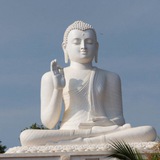
Dhammapada Verse 401
Uppalavanna Theri Vatthu
Vari pokkharapatteva
araggeriva sasapo
yo na limpati kamesu
tamaham brumi brahmanam.
Verse 401: Him I call a brahmana, who does not cling to sensual pleasures, just as water does not cling to a lotus leaf, or the mustard seed to the tip of an awl.
The Story of Theri Uppalavanna*
While residing at the Jetavana monastery, the Buddha uttered Verse (401) of this book, with reference to Theri Uppalavanna.
Once, some bhikkhus were talking about the arahat Theri Uppalavanna being molested by the young Nanda who was then swallowed up by the earth. In this connection, they asked the Buddha whether arahats do not enjoy sensual pleasures as they have the same physical make-up like any other people. To them the Buddha replied, "Bhikkhus! Arahats do not enjoy sensual pleasures; they do not indulge in sensual pleasures, for they do not cling to objects of sense and to sensual pleasures, just as water does not cling to the lotus leaf or the mustard seed to the tip of an awl."
Then the Buddha spoke in verse as follows:
Verse 401: Him I call a brahmana, who does not cling to sensual pleasures, just as water does not cling to a lotus leaf, or the mustard seed to the tip of an awl.
===
Dhammapada, beloved and favorite teachings of the Buddha channel:
https://news.1rj.ru/str/dhammapadas
===
Uppalavanna Theri Vatthu
Vari pokkharapatteva
araggeriva sasapo
yo na limpati kamesu
tamaham brumi brahmanam.
Verse 401: Him I call a brahmana, who does not cling to sensual pleasures, just as water does not cling to a lotus leaf, or the mustard seed to the tip of an awl.
The Story of Theri Uppalavanna*
While residing at the Jetavana monastery, the Buddha uttered Verse (401) of this book, with reference to Theri Uppalavanna.
Once, some bhikkhus were talking about the arahat Theri Uppalavanna being molested by the young Nanda who was then swallowed up by the earth. In this connection, they asked the Buddha whether arahats do not enjoy sensual pleasures as they have the same physical make-up like any other people. To them the Buddha replied, "Bhikkhus! Arahats do not enjoy sensual pleasures; they do not indulge in sensual pleasures, for they do not cling to objects of sense and to sensual pleasures, just as water does not cling to the lotus leaf or the mustard seed to the tip of an awl."
Then the Buddha spoke in verse as follows:
Verse 401: Him I call a brahmana, who does not cling to sensual pleasures, just as water does not cling to a lotus leaf, or the mustard seed to the tip of an awl.
===
Dhammapada, beloved and favorite teachings of the Buddha channel:
https://news.1rj.ru/str/dhammapadas
===
Telegram
Dhammapada - Buddha Dharma Teachings
Daily teachings of the Dhammapada, beloved and favorite teachings of the Buddha
👏1🏆1
Dhammapada Verse 402
Annatarabrahmana Vatthu
Yo dukkhassa pajanati
idheva khayamattano
pannabharam visamyuttam
tamaham brumi brahmanam.
Verse 402: Him I call a brahmana, who even in this existence realizes the end of dukkha (i.e., Nibbana), who has laid down the burden (of the khandhas) and who is free from moral defilements.
The Story of a Certain Brahmin
While residing at the Jetavana monastery, the Buddha uttered Verse (402) of this book, with reference to a certain brahmin, whose slave became an arahat.
Once, there was a young slave of a brahmin. One day, fleeing from the house of his master he joined the Order of the bhikkhus, and in due course, he attained arahatship. On one occasion, while he went on an alms-round with the Buddha, his former master, the brahmin, saw him and grabbed him firmly by the robe. When the Buddha asked what the matter was, the brahmin explained that the young bhikkhu was his slave at one time. To him the Buddha said, "This bhikkhu has laid down the burden (of the khandhas)." The brahmin took that to mean that his slave had become an arahat. So to make sure, he asked the Buddha whether it was true that the young bhikkhu had become an arahat, and the Buddha confirmed his statement.
Then the Buddha spoke in verse as follows:
Verse 402: Him I call a brahmana, who even in this existence realizes the end of dukkha (i.e., Nibbana), who has laid down the burden (of the khandhas) and who is free from moral defilements.
At the end of the discourse the brahmin attained Sotapatti Fruition.
===
Buddha dharma teachings channel:
https://invite.viber.com/?g2=AQAKw1y3rv%2F6sk61PI2W4izuIiaEZj8YZujhY1tSzL%2B07s7rFnVFDAd0bAYFaMLw
===
Annatarabrahmana Vatthu
Yo dukkhassa pajanati
idheva khayamattano
pannabharam visamyuttam
tamaham brumi brahmanam.
Verse 402: Him I call a brahmana, who even in this existence realizes the end of dukkha (i.e., Nibbana), who has laid down the burden (of the khandhas) and who is free from moral defilements.
The Story of a Certain Brahmin
While residing at the Jetavana monastery, the Buddha uttered Verse (402) of this book, with reference to a certain brahmin, whose slave became an arahat.
Once, there was a young slave of a brahmin. One day, fleeing from the house of his master he joined the Order of the bhikkhus, and in due course, he attained arahatship. On one occasion, while he went on an alms-round with the Buddha, his former master, the brahmin, saw him and grabbed him firmly by the robe. When the Buddha asked what the matter was, the brahmin explained that the young bhikkhu was his slave at one time. To him the Buddha said, "This bhikkhu has laid down the burden (of the khandhas)." The brahmin took that to mean that his slave had become an arahat. So to make sure, he asked the Buddha whether it was true that the young bhikkhu had become an arahat, and the Buddha confirmed his statement.
Then the Buddha spoke in verse as follows:
Verse 402: Him I call a brahmana, who even in this existence realizes the end of dukkha (i.e., Nibbana), who has laid down the burden (of the khandhas) and who is free from moral defilements.
At the end of the discourse the brahmin attained Sotapatti Fruition.
===
Buddha dharma teachings channel:
https://invite.viber.com/?g2=AQAKw1y3rv%2F6sk61PI2W4izuIiaEZj8YZujhY1tSzL%2B07s7rFnVFDAd0bAYFaMLw
===
Viber
Buddha
Buddha dharma teachings from the suttas and commentaries from Theravada tradition
❤1👏1
Forwarded from Words of the Buddha
Free Buddha Dharma ebook
The Natural Cure for Spiritual Disease
A Guide into Buddhist Science
By Buddhadasa Bhikkhu
Buddha-Dhamma is as vast as the universe and as concise as a moment’s flash of insight. Many sentient beings have gotten lost between the two, unable to resolve through direct personal experience the many teachings available today. Fundamental perspectives are required for us to begin sorting out the multiplicity of experiences and concepts. Here, we offer a clear, direct, and practical guide into the essentials of Buddhism, that is, the Dhamma.
While many Buddhists take Dhamma to be “the Buddha’s teaching,” it really means “Natural Truth” or “Natural Law.” Of course, this is what the Buddha taught and demonstrated, but we must be careful to distinguish the teaching from the Truth itself. Thus, to understand Buddhism one must begin with the Dhamma.
This guide examines the three inter-related aspects of Dhamma and pinpoints the key elements in each.
Although Dhamma is One, we interact with it in three basic ways: study (pariyatti-dhamma), practice (patipatti-dhamma), and realization (pativedha-dhamma). Dhamma study is finding the right perspective on our human predicament and what we must do about it. Dhamma practice is developing and correctly applying the basic tools needed for spiritual survival. Dhamma realization is the benefits that occur naturally with correct practice.
Each aspect can be approached in many ways. Here, Buddhadasa Bhikkhu approaches each in a direct and practical way.
Free download available:
https://static.sariputta.com/pdf/tipitaka/236/nat_cure_pdf.pdf
===
The Natural Cure for Spiritual Disease
A Guide into Buddhist Science
By Buddhadasa Bhikkhu
Buddha-Dhamma is as vast as the universe and as concise as a moment’s flash of insight. Many sentient beings have gotten lost between the two, unable to resolve through direct personal experience the many teachings available today. Fundamental perspectives are required for us to begin sorting out the multiplicity of experiences and concepts. Here, we offer a clear, direct, and practical guide into the essentials of Buddhism, that is, the Dhamma.
While many Buddhists take Dhamma to be “the Buddha’s teaching,” it really means “Natural Truth” or “Natural Law.” Of course, this is what the Buddha taught and demonstrated, but we must be careful to distinguish the teaching from the Truth itself. Thus, to understand Buddhism one must begin with the Dhamma.
This guide examines the three inter-related aspects of Dhamma and pinpoints the key elements in each.
Although Dhamma is One, we interact with it in three basic ways: study (pariyatti-dhamma), practice (patipatti-dhamma), and realization (pativedha-dhamma). Dhamma study is finding the right perspective on our human predicament and what we must do about it. Dhamma practice is developing and correctly applying the basic tools needed for spiritual survival. Dhamma realization is the benefits that occur naturally with correct practice.
Each aspect can be approached in many ways. Here, Buddhadasa Bhikkhu approaches each in a direct and practical way.
Free download available:
https://static.sariputta.com/pdf/tipitaka/236/nat_cure_pdf.pdf
===
👍1👏1💯1
Nāḷāgiriṁ gaja-varaṁ atimattabhūtaṁ
Dāvaggi-cakkam-asanīva sudāruṇantaṁ
Mett’ambuseka-vidhinā jitavā munindo
Tan-tejasā bhavatu te (or me) jaya-maṅgalāni.
Nāḷāgiri, the excellent elephant, when maddened, was very horrific,
like a forest fire, a flaming discus, a lightning bolt.
The Lord of Sages defeated him by sprinkling the water of goodwill:
By the majesty of this, may you have the highest victory blessing.
Jaya Mangala Gatha
Dāvaggi-cakkam-asanīva sudāruṇantaṁ
Mett’ambuseka-vidhinā jitavā munindo
Tan-tejasā bhavatu te (or me) jaya-maṅgalāni.
Nāḷāgiri, the excellent elephant, when maddened, was very horrific,
like a forest fire, a flaming discus, a lightning bolt.
The Lord of Sages defeated him by sprinkling the water of goodwill:
By the majesty of this, may you have the highest victory blessing.
Jaya Mangala Gatha
❤2🙏1👌1🏆1
Dhammapada Verse 403
Khemabhikkhuni Vatthu
Gambhirapannam medhavim
maggamaggassa kovidam1
uttamattha manuppattam
tamaham brumi brahmanam.
Verse 403: Him I call a brahmana, who is wise and is profound in his knowledge, who knows the right way from the wrong way, and who has attained the highest goal (i.e., arahatship).
1. maggamaggassa kovidam: skilful in differentiating the right way from the wrong way, i.e., knowledge of what does and what does not lead to the realization of Nibbana.
The Story of Theri Khema*
While residing at the Gijjhakuta hill, the Buddha uttered Verse (403) of this book, with reference to Theri Khema.
One night, Sakka, king of the devas, came with his followers to pay homage to the Buddha. While they were with the Buddha, Theri Khema, by her supernormal power, also came through the sky to pay homage to the Buddha. But because Sakka and his company were there with the Buddha, she just paid obeisance to the Buddha, and soon left him. Sakka asked the Buddha who that bhikkhuni was and the Buddha replied, "She is one of my pre-eminent disciples; she is known as Theri Khema. She is matchless amongst the bhikkhunis in wisdom and she knows how to differentiate the right way from the wrong way."
Then the Buddha spoke in verse as follows:
Verse 403: Him I call a brahmana, who is wise and is profound in his knowledge, who knows the right way from the wrong way, and who has attained the highest goal (i.e., arahatship).
===
Words of the Buddha channel:
https://invite.viber.com/?g2=AQAFqzqlj7FmI061PX17rxWMAtZ%2BRuso%2FH2KmHKZSgnv7v9DD8X0bDkKnZDr9JDq
===
Khemabhikkhuni Vatthu
Gambhirapannam medhavim
maggamaggassa kovidam1
uttamattha manuppattam
tamaham brumi brahmanam.
Verse 403: Him I call a brahmana, who is wise and is profound in his knowledge, who knows the right way from the wrong way, and who has attained the highest goal (i.e., arahatship).
1. maggamaggassa kovidam: skilful in differentiating the right way from the wrong way, i.e., knowledge of what does and what does not lead to the realization of Nibbana.
The Story of Theri Khema*
While residing at the Gijjhakuta hill, the Buddha uttered Verse (403) of this book, with reference to Theri Khema.
One night, Sakka, king of the devas, came with his followers to pay homage to the Buddha. While they were with the Buddha, Theri Khema, by her supernormal power, also came through the sky to pay homage to the Buddha. But because Sakka and his company were there with the Buddha, she just paid obeisance to the Buddha, and soon left him. Sakka asked the Buddha who that bhikkhuni was and the Buddha replied, "She is one of my pre-eminent disciples; she is known as Theri Khema. She is matchless amongst the bhikkhunis in wisdom and she knows how to differentiate the right way from the wrong way."
Then the Buddha spoke in verse as follows:
Verse 403: Him I call a brahmana, who is wise and is profound in his knowledge, who knows the right way from the wrong way, and who has attained the highest goal (i.e., arahatship).
===
Words of the Buddha channel:
https://invite.viber.com/?g2=AQAFqzqlj7FmI061PX17rxWMAtZ%2BRuso%2FH2KmHKZSgnv7v9DD8X0bDkKnZDr9JDq
===
Viber
Words Of The Buddha
Daily teachings from Buddha Dharma
👍1🏆1
Forwarded from Words of the Buddha
“Having ventured out from my day’s abiding
at Vulture’s Peak Mountain,
I saw an elephant going in and out
the river by the shore.
A man took a pole with a hook,
and said to him: ‘give me your foot.’
The elephant held out his foot,
and the man mounted him.
Once I saw the untamed tamed,
brought under human control,
from there I sought one-pointedness of mind—
This is why I went to the forest."
Thig 3.4 Dantikātherīgāthā: Verses of the Elder Dantikā
at Vulture’s Peak Mountain,
I saw an elephant going in and out
the river by the shore.
A man took a pole with a hook,
and said to him: ‘give me your foot.’
The elephant held out his foot,
and the man mounted him.
Once I saw the untamed tamed,
brought under human control,
from there I sought one-pointedness of mind—
This is why I went to the forest."
Thig 3.4 Dantikātherīgāthā: Verses of the Elder Dantikā
🔥1🙏1🕊1😇1
Forwarded from Buddha Dharma books
Free Buddha Dharma ebook
Kamma And The End Of Kamma
By Ajahn Sucitto
This book evolved out of some talks I had given in the space of a few years, mostly at Cittaviveka Monastery. In these talks, I had been exploring the relevance of the Buddha's teachings on kamma to the practice of meditation. At first glance the two topics may not seem that closely related: kamma is a teaching on behaviour, and meditation is apparently about doing nothing, isn't it? Or we might have the idea that: 'Kamma is all about who I was in a previous life, what I'm stuck with now, and what I'll get reborn as. Kamma is about being somebody, whilst meditation is about not being anybody.' Not so. I hope that the ensuing texts, which have evolved from talks into essays, help make it clear that the principles of kamma link 'external' behaviour to the 'internal' practice of meditation. And that meditation is one kind of kamma - the kamma that leads to the end of kamma. In fact 'kamma and the end of kamma' is a useful summary of what the Buddha had to offer as a path to wellbeing and to Awakening.
Free download available:
https://ftp.budaedu.org/ebooks/pdf/EN360.pdf
===
Kamma And The End Of Kamma
By Ajahn Sucitto
This book evolved out of some talks I had given in the space of a few years, mostly at Cittaviveka Monastery. In these talks, I had been exploring the relevance of the Buddha's teachings on kamma to the practice of meditation. At first glance the two topics may not seem that closely related: kamma is a teaching on behaviour, and meditation is apparently about doing nothing, isn't it? Or we might have the idea that: 'Kamma is all about who I was in a previous life, what I'm stuck with now, and what I'll get reborn as. Kamma is about being somebody, whilst meditation is about not being anybody.' Not so. I hope that the ensuing texts, which have evolved from talks into essays, help make it clear that the principles of kamma link 'external' behaviour to the 'internal' practice of meditation. And that meditation is one kind of kamma - the kamma that leads to the end of kamma. In fact 'kamma and the end of kamma' is a useful summary of what the Buddha had to offer as a path to wellbeing and to Awakening.
Free download available:
https://ftp.budaedu.org/ebooks/pdf/EN360.pdf
===
👍1🏆1
Forwarded from Buddha
Realization
A late Forest Tradition teacher on the insights that come from seeing things as separate
By Phra Ajaan Fuang Jotiko, translated from Thai by Thanissaro Bhikkhu
Part 1 of 2
The following excerpt was taken from a tape-recorded talk given to one of Ajaan Fuang’s students who had reached an impasse in her meditation.
Once the mind is firmly established in the breath, you then try to separate the mind from its object—from the breath itself. Focus on this: The breath is an element, part of the wind element. Awareness of the breath is something else. So you’ve got two things that have come together. Now, when you can separate them—through realizing the breath’s true nature as an element—the mind can stand on its own. After all, the breath isn’t you, and you aren’t the breath. When you can separate things in this way, the mind gains power. It’s set loose from the breath and is wise to the breath’s every aspect. When mindfulness is full, it’s wise to all the aspects of the breath and can separate itself from them.
Now, if it so happens that your mind is strong and your mindfulness sharp while you’re doing this, that’s when insight occurs. The knowledge will arise in that moment, letting you know that you’ve really let go. If your mindfulness is still weak, though, you won’t be able to let go. Only when your mindfulness is really resilient will you have mindfulness and insight arising together.
This is something you have to keep contemplating whenever you have the chance. When you can separate the mind from its objects, it’ll be freed from all its burdens. So focus your attention right down, in the area of the heart. Keep it focused there, and then observe the breath and what it is that’s aware of the breath. Be as observant as you can, and eventually you’ll see that they separate from each other. When they’ve separated, that gives you the chance to investigate further inside. And once you’ve investigated this one element, you’ll find that what you learn applies to everything else.
When you investigate the breath, you’ll find that it’s not a being, not a person—so what is there to latch on to? You can’t latch on to it as your self, for it simply goes its own way. When you look at the breath, you’ll see that it doesn’t have a body—no head, no legs, no hands, no feet, nothing at all. When you see this, you let go of it, in line with the way it really is.
The texts say, ‘Cago patinissaggo mutti analayo’: You move out of the breath. You remove your concerns for it. You don’t make it your home any longer—because it’s not yours. You let it go in line with its original nature. You give it back. Whatever it’s got, you give it back to nature. All of the elements—earth, water, wind, fire, and space—you give back to nature. You let them return to what they originally were. When you examine all five of these things, you’ll see that they’re not a being, not a person, not ‘us,’ not ‘them.’ You let them all return to their original nature in every way.
The breath isn’t you, and you aren’t the breath. When you can separate things in this way, the mind gains power.
This then brings us to the mind, what it is that’s aware of these five elements. What is it going to stay with now? Turn your powers of observation on this knowing element that is now standing on its own, with nothing else left. Examine it to see what’s what, and that’s when another level of insight will arise.
If you want to gain the insight that will let go of all things in line with their original nature, there has to be a special realization that arises in the act of letting go. If there isn’t this realization, your letting go is simply an ordinary, everyday label or perception. It’s mundane discernment. But when this special realization arises in the act of letting go—the instant you let go, the result comes right back at you, verifying, certifying what’s happened for what it really is: You know. You’ve let go. You then experience the purity within you.
A late Forest Tradition teacher on the insights that come from seeing things as separate
By Phra Ajaan Fuang Jotiko, translated from Thai by Thanissaro Bhikkhu
Part 1 of 2
The following excerpt was taken from a tape-recorded talk given to one of Ajaan Fuang’s students who had reached an impasse in her meditation.
Once the mind is firmly established in the breath, you then try to separate the mind from its object—from the breath itself. Focus on this: The breath is an element, part of the wind element. Awareness of the breath is something else. So you’ve got two things that have come together. Now, when you can separate them—through realizing the breath’s true nature as an element—the mind can stand on its own. After all, the breath isn’t you, and you aren’t the breath. When you can separate things in this way, the mind gains power. It’s set loose from the breath and is wise to the breath’s every aspect. When mindfulness is full, it’s wise to all the aspects of the breath and can separate itself from them.
Now, if it so happens that your mind is strong and your mindfulness sharp while you’re doing this, that’s when insight occurs. The knowledge will arise in that moment, letting you know that you’ve really let go. If your mindfulness is still weak, though, you won’t be able to let go. Only when your mindfulness is really resilient will you have mindfulness and insight arising together.
This is something you have to keep contemplating whenever you have the chance. When you can separate the mind from its objects, it’ll be freed from all its burdens. So focus your attention right down, in the area of the heart. Keep it focused there, and then observe the breath and what it is that’s aware of the breath. Be as observant as you can, and eventually you’ll see that they separate from each other. When they’ve separated, that gives you the chance to investigate further inside. And once you’ve investigated this one element, you’ll find that what you learn applies to everything else.
When you investigate the breath, you’ll find that it’s not a being, not a person—so what is there to latch on to? You can’t latch on to it as your self, for it simply goes its own way. When you look at the breath, you’ll see that it doesn’t have a body—no head, no legs, no hands, no feet, nothing at all. When you see this, you let go of it, in line with the way it really is.
The texts say, ‘Cago patinissaggo mutti analayo’: You move out of the breath. You remove your concerns for it. You don’t make it your home any longer—because it’s not yours. You let it go in line with its original nature. You give it back. Whatever it’s got, you give it back to nature. All of the elements—earth, water, wind, fire, and space—you give back to nature. You let them return to what they originally were. When you examine all five of these things, you’ll see that they’re not a being, not a person, not ‘us,’ not ‘them.’ You let them all return to their original nature in every way.
The breath isn’t you, and you aren’t the breath. When you can separate things in this way, the mind gains power.
This then brings us to the mind, what it is that’s aware of these five elements. What is it going to stay with now? Turn your powers of observation on this knowing element that is now standing on its own, with nothing else left. Examine it to see what’s what, and that’s when another level of insight will arise.
If you want to gain the insight that will let go of all things in line with their original nature, there has to be a special realization that arises in the act of letting go. If there isn’t this realization, your letting go is simply an ordinary, everyday label or perception. It’s mundane discernment. But when this special realization arises in the act of letting go—the instant you let go, the result comes right back at you, verifying, certifying what’s happened for what it really is: You know. You’ve let go. You then experience the purity within you.
Telegram
Buddha
Buddha dharma teachings from the suttas and commentaries
❤1👏1😍1