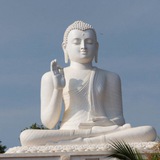
Nāḷāgiriṁ gaja-varaṁ atimattabhūtaṁ
Dāvaggi-cakkam-asanīva sudāruṇantaṁ
Mett’ambuseka-vidhinā jitavā munindo
Tan-tejasā bhavatu te (or me) jaya-maṅgalāni.
Nāḷāgiri, the excellent elephant, when maddened, was very horrific,
like a forest fire, a flaming discus, a lightning bolt.
The Lord of Sages defeated him by sprinkling the water of goodwill:
By the majesty of this, may you have the highest victory blessing.
Jaya Mangala Gatha
Dāvaggi-cakkam-asanīva sudāruṇantaṁ
Mett’ambuseka-vidhinā jitavā munindo
Tan-tejasā bhavatu te (or me) jaya-maṅgalāni.
Nāḷāgiri, the excellent elephant, when maddened, was very horrific,
like a forest fire, a flaming discus, a lightning bolt.
The Lord of Sages defeated him by sprinkling the water of goodwill:
By the majesty of this, may you have the highest victory blessing.
Jaya Mangala Gatha
❤2🙏1👌1🏆1
Dhammapada Verse 403
Khemabhikkhuni Vatthu
Gambhirapannam medhavim
maggamaggassa kovidam1
uttamattha manuppattam
tamaham brumi brahmanam.
Verse 403: Him I call a brahmana, who is wise and is profound in his knowledge, who knows the right way from the wrong way, and who has attained the highest goal (i.e., arahatship).
1. maggamaggassa kovidam: skilful in differentiating the right way from the wrong way, i.e., knowledge of what does and what does not lead to the realization of Nibbana.
The Story of Theri Khema*
While residing at the Gijjhakuta hill, the Buddha uttered Verse (403) of this book, with reference to Theri Khema.
One night, Sakka, king of the devas, came with his followers to pay homage to the Buddha. While they were with the Buddha, Theri Khema, by her supernormal power, also came through the sky to pay homage to the Buddha. But because Sakka and his company were there with the Buddha, she just paid obeisance to the Buddha, and soon left him. Sakka asked the Buddha who that bhikkhuni was and the Buddha replied, "She is one of my pre-eminent disciples; she is known as Theri Khema. She is matchless amongst the bhikkhunis in wisdom and she knows how to differentiate the right way from the wrong way."
Then the Buddha spoke in verse as follows:
Verse 403: Him I call a brahmana, who is wise and is profound in his knowledge, who knows the right way from the wrong way, and who has attained the highest goal (i.e., arahatship).
===
Words of the Buddha channel:
https://invite.viber.com/?g2=AQAFqzqlj7FmI061PX17rxWMAtZ%2BRuso%2FH2KmHKZSgnv7v9DD8X0bDkKnZDr9JDq
===
Khemabhikkhuni Vatthu
Gambhirapannam medhavim
maggamaggassa kovidam1
uttamattha manuppattam
tamaham brumi brahmanam.
Verse 403: Him I call a brahmana, who is wise and is profound in his knowledge, who knows the right way from the wrong way, and who has attained the highest goal (i.e., arahatship).
1. maggamaggassa kovidam: skilful in differentiating the right way from the wrong way, i.e., knowledge of what does and what does not lead to the realization of Nibbana.
The Story of Theri Khema*
While residing at the Gijjhakuta hill, the Buddha uttered Verse (403) of this book, with reference to Theri Khema.
One night, Sakka, king of the devas, came with his followers to pay homage to the Buddha. While they were with the Buddha, Theri Khema, by her supernormal power, also came through the sky to pay homage to the Buddha. But because Sakka and his company were there with the Buddha, she just paid obeisance to the Buddha, and soon left him. Sakka asked the Buddha who that bhikkhuni was and the Buddha replied, "She is one of my pre-eminent disciples; she is known as Theri Khema. She is matchless amongst the bhikkhunis in wisdom and she knows how to differentiate the right way from the wrong way."
Then the Buddha spoke in verse as follows:
Verse 403: Him I call a brahmana, who is wise and is profound in his knowledge, who knows the right way from the wrong way, and who has attained the highest goal (i.e., arahatship).
===
Words of the Buddha channel:
https://invite.viber.com/?g2=AQAFqzqlj7FmI061PX17rxWMAtZ%2BRuso%2FH2KmHKZSgnv7v9DD8X0bDkKnZDr9JDq
===
Viber
Words Of The Buddha
Daily teachings from Buddha Dharma
👍1🏆1
Forwarded from Words of the Buddha
“Having ventured out from my day’s abiding
at Vulture’s Peak Mountain,
I saw an elephant going in and out
the river by the shore.
A man took a pole with a hook,
and said to him: ‘give me your foot.’
The elephant held out his foot,
and the man mounted him.
Once I saw the untamed tamed,
brought under human control,
from there I sought one-pointedness of mind—
This is why I went to the forest."
Thig 3.4 Dantikātherīgāthā: Verses of the Elder Dantikā
at Vulture’s Peak Mountain,
I saw an elephant going in and out
the river by the shore.
A man took a pole with a hook,
and said to him: ‘give me your foot.’
The elephant held out his foot,
and the man mounted him.
Once I saw the untamed tamed,
brought under human control,
from there I sought one-pointedness of mind—
This is why I went to the forest."
Thig 3.4 Dantikātherīgāthā: Verses of the Elder Dantikā
🔥1🙏1🕊1😇1
Forwarded from Buddha Dharma books
Free Buddha Dharma ebook
Kamma And The End Of Kamma
By Ajahn Sucitto
This book evolved out of some talks I had given in the space of a few years, mostly at Cittaviveka Monastery. In these talks, I had been exploring the relevance of the Buddha's teachings on kamma to the practice of meditation. At first glance the two topics may not seem that closely related: kamma is a teaching on behaviour, and meditation is apparently about doing nothing, isn't it? Or we might have the idea that: 'Kamma is all about who I was in a previous life, what I'm stuck with now, and what I'll get reborn as. Kamma is about being somebody, whilst meditation is about not being anybody.' Not so. I hope that the ensuing texts, which have evolved from talks into essays, help make it clear that the principles of kamma link 'external' behaviour to the 'internal' practice of meditation. And that meditation is one kind of kamma - the kamma that leads to the end of kamma. In fact 'kamma and the end of kamma' is a useful summary of what the Buddha had to offer as a path to wellbeing and to Awakening.
Free download available:
https://ftp.budaedu.org/ebooks/pdf/EN360.pdf
===
Kamma And The End Of Kamma
By Ajahn Sucitto
This book evolved out of some talks I had given in the space of a few years, mostly at Cittaviveka Monastery. In these talks, I had been exploring the relevance of the Buddha's teachings on kamma to the practice of meditation. At first glance the two topics may not seem that closely related: kamma is a teaching on behaviour, and meditation is apparently about doing nothing, isn't it? Or we might have the idea that: 'Kamma is all about who I was in a previous life, what I'm stuck with now, and what I'll get reborn as. Kamma is about being somebody, whilst meditation is about not being anybody.' Not so. I hope that the ensuing texts, which have evolved from talks into essays, help make it clear that the principles of kamma link 'external' behaviour to the 'internal' practice of meditation. And that meditation is one kind of kamma - the kamma that leads to the end of kamma. In fact 'kamma and the end of kamma' is a useful summary of what the Buddha had to offer as a path to wellbeing and to Awakening.
Free download available:
https://ftp.budaedu.org/ebooks/pdf/EN360.pdf
===
👍1🏆1
Forwarded from Buddha
Realization
A late Forest Tradition teacher on the insights that come from seeing things as separate
By Phra Ajaan Fuang Jotiko, translated from Thai by Thanissaro Bhikkhu
Part 1 of 2
The following excerpt was taken from a tape-recorded talk given to one of Ajaan Fuang’s students who had reached an impasse in her meditation.
Once the mind is firmly established in the breath, you then try to separate the mind from its object—from the breath itself. Focus on this: The breath is an element, part of the wind element. Awareness of the breath is something else. So you’ve got two things that have come together. Now, when you can separate them—through realizing the breath’s true nature as an element—the mind can stand on its own. After all, the breath isn’t you, and you aren’t the breath. When you can separate things in this way, the mind gains power. It’s set loose from the breath and is wise to the breath’s every aspect. When mindfulness is full, it’s wise to all the aspects of the breath and can separate itself from them.
Now, if it so happens that your mind is strong and your mindfulness sharp while you’re doing this, that’s when insight occurs. The knowledge will arise in that moment, letting you know that you’ve really let go. If your mindfulness is still weak, though, you won’t be able to let go. Only when your mindfulness is really resilient will you have mindfulness and insight arising together.
This is something you have to keep contemplating whenever you have the chance. When you can separate the mind from its objects, it’ll be freed from all its burdens. So focus your attention right down, in the area of the heart. Keep it focused there, and then observe the breath and what it is that’s aware of the breath. Be as observant as you can, and eventually you’ll see that they separate from each other. When they’ve separated, that gives you the chance to investigate further inside. And once you’ve investigated this one element, you’ll find that what you learn applies to everything else.
When you investigate the breath, you’ll find that it’s not a being, not a person—so what is there to latch on to? You can’t latch on to it as your self, for it simply goes its own way. When you look at the breath, you’ll see that it doesn’t have a body—no head, no legs, no hands, no feet, nothing at all. When you see this, you let go of it, in line with the way it really is.
The texts say, ‘Cago patinissaggo mutti analayo’: You move out of the breath. You remove your concerns for it. You don’t make it your home any longer—because it’s not yours. You let it go in line with its original nature. You give it back. Whatever it’s got, you give it back to nature. All of the elements—earth, water, wind, fire, and space—you give back to nature. You let them return to what they originally were. When you examine all five of these things, you’ll see that they’re not a being, not a person, not ‘us,’ not ‘them.’ You let them all return to their original nature in every way.
The breath isn’t you, and you aren’t the breath. When you can separate things in this way, the mind gains power.
This then brings us to the mind, what it is that’s aware of these five elements. What is it going to stay with now? Turn your powers of observation on this knowing element that is now standing on its own, with nothing else left. Examine it to see what’s what, and that’s when another level of insight will arise.
If you want to gain the insight that will let go of all things in line with their original nature, there has to be a special realization that arises in the act of letting go. If there isn’t this realization, your letting go is simply an ordinary, everyday label or perception. It’s mundane discernment. But when this special realization arises in the act of letting go—the instant you let go, the result comes right back at you, verifying, certifying what’s happened for what it really is: You know. You’ve let go. You then experience the purity within you.
A late Forest Tradition teacher on the insights that come from seeing things as separate
By Phra Ajaan Fuang Jotiko, translated from Thai by Thanissaro Bhikkhu
Part 1 of 2
The following excerpt was taken from a tape-recorded talk given to one of Ajaan Fuang’s students who had reached an impasse in her meditation.
Once the mind is firmly established in the breath, you then try to separate the mind from its object—from the breath itself. Focus on this: The breath is an element, part of the wind element. Awareness of the breath is something else. So you’ve got two things that have come together. Now, when you can separate them—through realizing the breath’s true nature as an element—the mind can stand on its own. After all, the breath isn’t you, and you aren’t the breath. When you can separate things in this way, the mind gains power. It’s set loose from the breath and is wise to the breath’s every aspect. When mindfulness is full, it’s wise to all the aspects of the breath and can separate itself from them.
Now, if it so happens that your mind is strong and your mindfulness sharp while you’re doing this, that’s when insight occurs. The knowledge will arise in that moment, letting you know that you’ve really let go. If your mindfulness is still weak, though, you won’t be able to let go. Only when your mindfulness is really resilient will you have mindfulness and insight arising together.
This is something you have to keep contemplating whenever you have the chance. When you can separate the mind from its objects, it’ll be freed from all its burdens. So focus your attention right down, in the area of the heart. Keep it focused there, and then observe the breath and what it is that’s aware of the breath. Be as observant as you can, and eventually you’ll see that they separate from each other. When they’ve separated, that gives you the chance to investigate further inside. And once you’ve investigated this one element, you’ll find that what you learn applies to everything else.
When you investigate the breath, you’ll find that it’s not a being, not a person—so what is there to latch on to? You can’t latch on to it as your self, for it simply goes its own way. When you look at the breath, you’ll see that it doesn’t have a body—no head, no legs, no hands, no feet, nothing at all. When you see this, you let go of it, in line with the way it really is.
The texts say, ‘Cago patinissaggo mutti analayo’: You move out of the breath. You remove your concerns for it. You don’t make it your home any longer—because it’s not yours. You let it go in line with its original nature. You give it back. Whatever it’s got, you give it back to nature. All of the elements—earth, water, wind, fire, and space—you give back to nature. You let them return to what they originally were. When you examine all five of these things, you’ll see that they’re not a being, not a person, not ‘us,’ not ‘them.’ You let them all return to their original nature in every way.
The breath isn’t you, and you aren’t the breath. When you can separate things in this way, the mind gains power.
This then brings us to the mind, what it is that’s aware of these five elements. What is it going to stay with now? Turn your powers of observation on this knowing element that is now standing on its own, with nothing else left. Examine it to see what’s what, and that’s when another level of insight will arise.
If you want to gain the insight that will let go of all things in line with their original nature, there has to be a special realization that arises in the act of letting go. If there isn’t this realization, your letting go is simply an ordinary, everyday label or perception. It’s mundane discernment. But when this special realization arises in the act of letting go—the instant you let go, the result comes right back at you, verifying, certifying what’s happened for what it really is: You know. You’ve let go. You then experience the purity within you.
Telegram
Buddha
Buddha dharma teachings from the suttas and commentaries
❤1👏1😍1
Forwarded from Buddha
This is called transcendent discernment. When the realization arises within you, verifying what you’ve seen and what you’ve done, that’s called transcendent discernment. As long as this realization doesn’t arise, your discernment is still mundane. So you keep working at your investigation into things until all the conditions are ripe. Then when they’re ripe, there’s nothing more you have to do, for transcendent discernment penetrates things completely the very instant it arises. It’s not like mundane discernment at all.
The path we follow, then, is to be observant, to investigate things. Keep making a focused investigation until you reach the strategic point. When the mind reaches that point, it lets go on its own. What happens is that it reaches a point of fullness—the dhamma within it is full—and it lets go. Once it lets go, the results will appear immediately.
So keep on practicing. There’s nothing to be afraid of. You’ll have to reap results, there’s no doubt about it. You reap results all along the way. Like right now, while you’re sitting in meditation here. You know that the breath and the mind are comfortable with each other. That’s a result of the practice. Even though you haven’t yet reached the end of the path, you’re still gaining a sense of comfort and ease in your meditation. The mind is at peace with the in-and-out breath. As long as the mind and breath can’t separate from each other, they have to help each other along. The mind helps the breath, and the breath helps the mind until they can get fully acquainted. Once the mind gets fully acquainted, it can let go. When it knows, it lets go. As long as it doesn’t really know, it won’t really let go.
What this means is that you have to associate with the breath, spend time with it, and gradually come to know it. As the mind gets more and more acquainted, it will be able to unravel its attachments to body, feelings, perceptions, thought constructs, and consciousness. Its identity views—seeing these things as the self—will fall away. This is the way to freedom. The moment this transcendent discernment arises, you’ll be free. You’ll be able to disentangle yourself from all the conventional truths of the world that say ‘person,’ ‘self,’ ‘man,’ ‘woman,’ ‘us,’ ‘them,’ and so on.
But as long as you can’t yet let go, you still have to depend on these things. They’re your resting spots but not your refuge. You simply lean on each other, and help each other along, so that you can make progress on your way. You can’t abandon these things, for they’re the path of your practice. As long as you stick with the practice, you won’t fall back. But as soon as you let up on the practice, you’ll start backsliding immediately. You’ll fall prey to doubts, wondering whether or not the dhamma is true.
===
Buddha dharma teachings channel:
https://news.1rj.ru/str/lorddivinebuddha
===
The path we follow, then, is to be observant, to investigate things. Keep making a focused investigation until you reach the strategic point. When the mind reaches that point, it lets go on its own. What happens is that it reaches a point of fullness—the dhamma within it is full—and it lets go. Once it lets go, the results will appear immediately.
So keep on practicing. There’s nothing to be afraid of. You’ll have to reap results, there’s no doubt about it. You reap results all along the way. Like right now, while you’re sitting in meditation here. You know that the breath and the mind are comfortable with each other. That’s a result of the practice. Even though you haven’t yet reached the end of the path, you’re still gaining a sense of comfort and ease in your meditation. The mind is at peace with the in-and-out breath. As long as the mind and breath can’t separate from each other, they have to help each other along. The mind helps the breath, and the breath helps the mind until they can get fully acquainted. Once the mind gets fully acquainted, it can let go. When it knows, it lets go. As long as it doesn’t really know, it won’t really let go.
What this means is that you have to associate with the breath, spend time with it, and gradually come to know it. As the mind gets more and more acquainted, it will be able to unravel its attachments to body, feelings, perceptions, thought constructs, and consciousness. Its identity views—seeing these things as the self—will fall away. This is the way to freedom. The moment this transcendent discernment arises, you’ll be free. You’ll be able to disentangle yourself from all the conventional truths of the world that say ‘person,’ ‘self,’ ‘man,’ ‘woman,’ ‘us,’ ‘them,’ and so on.
But as long as you can’t yet let go, you still have to depend on these things. They’re your resting spots but not your refuge. You simply lean on each other, and help each other along, so that you can make progress on your way. You can’t abandon these things, for they’re the path of your practice. As long as you stick with the practice, you won’t fall back. But as soon as you let up on the practice, you’ll start backsliding immediately. You’ll fall prey to doubts, wondering whether or not the dhamma is true.
===
Buddha dharma teachings channel:
https://news.1rj.ru/str/lorddivinebuddha
===
Telegram
Buddha
Buddha dharma teachings from the suttas and commentaries
👍2🕊1
Dhammapada Verse 404
Pabbharavasitissatthera Vatthu
Asamsattham gahatthehi
anagarehi cubhayam
anokasari mappiccham
tamaham brumi brahmanam.
Verse 404: Him I call a brahmana, who associates not with the householder or with the homeless one, or with both, who is free from sensual desire and has few wants.
The Story of Thera Tissa
While residing at the Jetavana monastery, the Buddha uttered Verse (404) of this book with reference to Thera Tissa.
Thera Tissa, after taking a subject of meditation from the Buddha, went to a mountain side. There, he found a cave which suited him and he decided to spend the three months of the rainy season (vassa) in that cave. So he stayed in the cave and went to the village for alms-food every morning. In the village, there was a certain elderly woman who regularly offered him alms-food. In the cave, there also lived the guardian spirit of the cave. As the thera was one whose practice of morality was pure, the cave-spirit dared not live in the same cave with the noble thera; at the same time, he did not have the courage to ask the thera to leave the place. So he thought of a plan that would enable him to find fault with the thera and thus cause him to leave the cave.
The cave-spirit possessed the son of the elderly woman from the house where the thera usually went for his alms-food. He caused the boy to behave in a very peculiar way, turning his head backwards, and rolling his wide open eyes. His mother got alarmed and was in tears. The cave-spirit, who possessed the boy, then said "Let your teacher, the thera, wash his feet with water and pour that water on the head of your son." The next day when the thera came to her house for alms-food, she did as she was advised by the cave-spirit and the boy was left in peace. The cave-spirit went back to the cave and waited at the entrance for the return of the thera. When the thera returned from his alms-round, the cave-spirit revealed himself and said, "I am the spirit guarding this cave. O you physician, do not enter this cave." The thera knew that he had lived a clean life from the day he had become a thera, so he replied that he did not remember practising medicine. Then the cave-spirit accused him that in that very morning he had cured a young boy possessed by an ogre at the house of the elderly woman. But the thera reflected that it was not, in fact, practising medicine and he realized that even the cave spirit could find no other fault with him. That gave him a delightful satisfaction (piti) with himself, and abandoning piti and concentrating hard on Insight Meditation he attained arahatship then and there, while still standing at the entrance to the cave.
As the thera had now become an arahat, he advised the cave-spirit to leave the cave. The thera continued to stay there till the end of the vassa, and then he returned to the Buddha. When he told the other bhikkhus about his encounter with the cave-spirit, they asked him whether he did not get angry with the cave-spirit when he was forbidden to enter the cave. The thera answered in the negative but they did not believe him. So they went to the Buddha and said, "Thera Tissa claims himself to be an arahat ; he is not speaking the truth." To them the Buddha replied, "Bhikkhus, my son Tissa was speaking the truth when he said he did not get angry. He has indeed become an arahat he is no longer attached to anyone; he has no occasion to get angry with anyone nor any need to associate with others."
Then the Buddha spoke in verse as follows:
Verse 404: Him I call a brahmana, who associates not with the householder or with the homeless one, or with both, who is free from sensual desire and has few wants.
===
Dhammapada, beloved and favorite teachings of the Buddha channel:
https://invite.viber.com/?g2=AQBLD6phsgvP%2F061YjEM3K%2BNeH1Yb372b9mtfQX2EmuBpgoLUoc99BDMfzHghrme
===
Pabbharavasitissatthera Vatthu
Asamsattham gahatthehi
anagarehi cubhayam
anokasari mappiccham
tamaham brumi brahmanam.
Verse 404: Him I call a brahmana, who associates not with the householder or with the homeless one, or with both, who is free from sensual desire and has few wants.
The Story of Thera Tissa
While residing at the Jetavana monastery, the Buddha uttered Verse (404) of this book with reference to Thera Tissa.
Thera Tissa, after taking a subject of meditation from the Buddha, went to a mountain side. There, he found a cave which suited him and he decided to spend the three months of the rainy season (vassa) in that cave. So he stayed in the cave and went to the village for alms-food every morning. In the village, there was a certain elderly woman who regularly offered him alms-food. In the cave, there also lived the guardian spirit of the cave. As the thera was one whose practice of morality was pure, the cave-spirit dared not live in the same cave with the noble thera; at the same time, he did not have the courage to ask the thera to leave the place. So he thought of a plan that would enable him to find fault with the thera and thus cause him to leave the cave.
The cave-spirit possessed the son of the elderly woman from the house where the thera usually went for his alms-food. He caused the boy to behave in a very peculiar way, turning his head backwards, and rolling his wide open eyes. His mother got alarmed and was in tears. The cave-spirit, who possessed the boy, then said "Let your teacher, the thera, wash his feet with water and pour that water on the head of your son." The next day when the thera came to her house for alms-food, she did as she was advised by the cave-spirit and the boy was left in peace. The cave-spirit went back to the cave and waited at the entrance for the return of the thera. When the thera returned from his alms-round, the cave-spirit revealed himself and said, "I am the spirit guarding this cave. O you physician, do not enter this cave." The thera knew that he had lived a clean life from the day he had become a thera, so he replied that he did not remember practising medicine. Then the cave-spirit accused him that in that very morning he had cured a young boy possessed by an ogre at the house of the elderly woman. But the thera reflected that it was not, in fact, practising medicine and he realized that even the cave spirit could find no other fault with him. That gave him a delightful satisfaction (piti) with himself, and abandoning piti and concentrating hard on Insight Meditation he attained arahatship then and there, while still standing at the entrance to the cave.
As the thera had now become an arahat, he advised the cave-spirit to leave the cave. The thera continued to stay there till the end of the vassa, and then he returned to the Buddha. When he told the other bhikkhus about his encounter with the cave-spirit, they asked him whether he did not get angry with the cave-spirit when he was forbidden to enter the cave. The thera answered in the negative but they did not believe him. So they went to the Buddha and said, "Thera Tissa claims himself to be an arahat ; he is not speaking the truth." To them the Buddha replied, "Bhikkhus, my son Tissa was speaking the truth when he said he did not get angry. He has indeed become an arahat he is no longer attached to anyone; he has no occasion to get angry with anyone nor any need to associate with others."
Then the Buddha spoke in verse as follows:
Verse 404: Him I call a brahmana, who associates not with the householder or with the homeless one, or with both, who is free from sensual desire and has few wants.
===
Dhammapada, beloved and favorite teachings of the Buddha channel:
https://invite.viber.com/?g2=AQBLD6phsgvP%2F061YjEM3K%2BNeH1Yb372b9mtfQX2EmuBpgoLUoc99BDMfzHghrme
===
Viber
Dhammapada - Buddha Dharma Teachings
Daily teachings of the Dhammapada, beloved and favorite teachings of the Buddha
🥰1🙏1
Forwarded from Words of the Buddha
Realization
A late Forest Tradition teacher on the insights that come from seeing things as separate
By Phra Ajaan Fuang Jotiko, translated from Thai by Thanissaro Bhikkhu
Part 2 of 2
You have to keep being observant of the mind: awareness itself. It’s not the case that the mind isn’t aware, you know. Its basic nature is awareness. Just look at it. It’s aware of everything—aware, but it can’t yet let go of its perceptions, of the conventions it holds to be true. So you have to focus your investigation on in. Focus on in until the mind and its objects separate from each other. Simply keep at it. If you’re persistent like this, without letup, your doubts will gradually fade away and eventually you’ll reach your true refuge within you, the basic awareness called buddha that sees clearly through everything. This is the Buddha, dhamma, and sangha appearing within you as your ultimate refuge.
This is when you’ll know what’s actually within, what’s actually without, what’s actually a resting spot, and what’s really your refuge. You’ll be able to distinguish these things.
Things outside are simply resting spots. Like the body: It’s a resting spot. For the brief moment that the elements of earth, water, wind, and fire stay balanced together, you can rest with the body. But as for your true refuge, you’ve already seen it. It’s this basic awareness itself, within the mind. Your awareness of the breath is a refuge on one level. When it separates from the breath, it’s a refuge on another level. And as for your true refuge—buddha—that’s the awareness that lies further within. Once you realize this, that’s all there is. It’s sovereign in and of itself. It knows clearly and truly, all around. That’s the true refuge within you.
As for things outside, they’re just temporary supports, things you can depend on for a little while, like a crutch. As long as there’s the breath to keep them alive, you make use of them. When there’s no more breath, that’s the end of the problem. The physical elements separate and no longer depend on each other, so the mind returns to its own true refuge. And where is that? Just where is that buddha awareness? When we’ve trained the mind to be its own refuge, there will be no sorrow at that moment in the meditating heart.
The Buddha’s own search was for this refuge. He taught all of his disciples to take refuge in themselves, for we can depend on others only for a little while. Other people merely show us the way. But if you want what’s really true and good in life, you have to depend on yourself—teach yourself, train yourself, depend on yourself in every way. Your sufferings come eventually from you. Your happiness, eventually from you. It’s like eating: If you don’t eat, how are you going to get full? If you leave it up to other people to eat, there’s no way you’re going to get full. If you want to be full, you yourself have to eat. It’s the same with the practice.
You can’t let yourself latch on to things outside you. Things outside are inconstant. Impermanent. Undependable. They change with every in-and-out breath. This holds not only for you but for everyone. If you don’t part from one another while you’re still alive, you part when you die. You part from things with every in-and-out breath. You can’t base the meaning of your life on these things—and you don’t have to. You can simply tell yourself that this is the way things are all over the world. The world offers nothing lasting. We don’t want things to be that way, but that’s the way they are. They don’t lie under anyone’s control at all. This is true not only with things outside but also with things within you. You want the body to stay alive, you don’t want it to die, but it’s going to die. You don’t want it to change, but it changes, constantly.
This is why you have to get your mind in shape so that it can take refuge in itself, in line with the principles of the skill the Buddha taught. And you don’t have to feel doubts about the practice, for all the qualities you need to develop in the practice are already present within you.
A late Forest Tradition teacher on the insights that come from seeing things as separate
By Phra Ajaan Fuang Jotiko, translated from Thai by Thanissaro Bhikkhu
Part 2 of 2
You have to keep being observant of the mind: awareness itself. It’s not the case that the mind isn’t aware, you know. Its basic nature is awareness. Just look at it. It’s aware of everything—aware, but it can’t yet let go of its perceptions, of the conventions it holds to be true. So you have to focus your investigation on in. Focus on in until the mind and its objects separate from each other. Simply keep at it. If you’re persistent like this, without letup, your doubts will gradually fade away and eventually you’ll reach your true refuge within you, the basic awareness called buddha that sees clearly through everything. This is the Buddha, dhamma, and sangha appearing within you as your ultimate refuge.
This is when you’ll know what’s actually within, what’s actually without, what’s actually a resting spot, and what’s really your refuge. You’ll be able to distinguish these things.
Things outside are simply resting spots. Like the body: It’s a resting spot. For the brief moment that the elements of earth, water, wind, and fire stay balanced together, you can rest with the body. But as for your true refuge, you’ve already seen it. It’s this basic awareness itself, within the mind. Your awareness of the breath is a refuge on one level. When it separates from the breath, it’s a refuge on another level. And as for your true refuge—buddha—that’s the awareness that lies further within. Once you realize this, that’s all there is. It’s sovereign in and of itself. It knows clearly and truly, all around. That’s the true refuge within you.
As for things outside, they’re just temporary supports, things you can depend on for a little while, like a crutch. As long as there’s the breath to keep them alive, you make use of them. When there’s no more breath, that’s the end of the problem. The physical elements separate and no longer depend on each other, so the mind returns to its own true refuge. And where is that? Just where is that buddha awareness? When we’ve trained the mind to be its own refuge, there will be no sorrow at that moment in the meditating heart.
The Buddha’s own search was for this refuge. He taught all of his disciples to take refuge in themselves, for we can depend on others only for a little while. Other people merely show us the way. But if you want what’s really true and good in life, you have to depend on yourself—teach yourself, train yourself, depend on yourself in every way. Your sufferings come eventually from you. Your happiness, eventually from you. It’s like eating: If you don’t eat, how are you going to get full? If you leave it up to other people to eat, there’s no way you’re going to get full. If you want to be full, you yourself have to eat. It’s the same with the practice.
You can’t let yourself latch on to things outside you. Things outside are inconstant. Impermanent. Undependable. They change with every in-and-out breath. This holds not only for you but for everyone. If you don’t part from one another while you’re still alive, you part when you die. You part from things with every in-and-out breath. You can’t base the meaning of your life on these things—and you don’t have to. You can simply tell yourself that this is the way things are all over the world. The world offers nothing lasting. We don’t want things to be that way, but that’s the way they are. They don’t lie under anyone’s control at all. This is true not only with things outside but also with things within you. You want the body to stay alive, you don’t want it to die, but it’s going to die. You don’t want it to change, but it changes, constantly.
This is why you have to get your mind in shape so that it can take refuge in itself, in line with the principles of the skill the Buddha taught. And you don’t have to feel doubts about the practice, for all the qualities you need to develop in the practice are already present within you.
Telegram
Words of the Buddha
Daily teachings of Buddha Dharma
❤1🫡1
Forwarded from Words of the Buddha
All forms of good and evil are present within you. You already know which path is the good one, which path is the shoddy one, so all you have to do is train your heart to hold on to the good path. Stop and take a look at yourself right now: Are you on the right path? Whatever is wrong, don’t latch on to it. Let go of it. Past, future, whatever, let go of it, leaving only the present. Keep the mind open and at ease in the present at all times, and then start investigating.
You already know that things outside aren’t you or yours, but inside you there are many levels you have to examine. Even the mind isn’t really yours. There are still inconstant and stressful things inside it. Sometimes it wants to do this, sometimes to do that, it’s not really yours. So don’t get too attached to it.
Everything that arises, the Buddha said, is inconstant and not self. Even the understandings that arise in the mind aren’t constant.
Thought constructs are the big issue. Sometimes they form good thoughts, sometimes evil thoughts, even though you know better. You don’t want to think those things, and yet they keep appearing in the mind, in spite of your intentions. So you have to regard them as not being yours. Examine them. There’s nothing dependable about them. They don’t last. They’re impersonal events, so let them go in line with their own nature.
And what is there that’s lasting, solid, dependable, and true? Keep looking on in. Focus your mindfulness on the breath, and ask yourself right there. Eventually you’ll come to see what’s what within you. Whenever you have any doubts or problems in the practice, focus down on the breath and ask the mind right there, and understanding will arise, to loosen up your wrong views and help you past your impasse.
But even this understanding is inconstant, stressful, and not-self. Sabbe dhamma anatta: Everything that arises, the Buddha said, is inconstant and not self. Even the understandings that arise in the mind aren’t constant. Sometimes they arise, sometimes they don’t. So don’t get too attached to them. When they arise, take note of them, and then let them follow their own course. Let your views be right views: i.e., just right, not going overboard. If you go overboard with them, you latch on tight to them, and then they turn wrong on you, for you’ve lost sight of what you’re doing.
What this all boils down to is that the more mindfulness in your practice, the better. As your mindfulness gets more and more mature, more and more complete, it turns into something transcendent. The transcendent discernment we mentioned above arises from the power of your mindfulness as it becomes more and more complete.
You already know that things outside aren’t you or yours, but inside you there are many levels you have to examine. Even the mind isn’t really yours. There are still inconstant and stressful things inside it. Sometimes it wants to do this, sometimes to do that, it’s not really yours. So don’t get too attached to it.
Everything that arises, the Buddha said, is inconstant and not self. Even the understandings that arise in the mind aren’t constant.
Thought constructs are the big issue. Sometimes they form good thoughts, sometimes evil thoughts, even though you know better. You don’t want to think those things, and yet they keep appearing in the mind, in spite of your intentions. So you have to regard them as not being yours. Examine them. There’s nothing dependable about them. They don’t last. They’re impersonal events, so let them go in line with their own nature.
And what is there that’s lasting, solid, dependable, and true? Keep looking on in. Focus your mindfulness on the breath, and ask yourself right there. Eventually you’ll come to see what’s what within you. Whenever you have any doubts or problems in the practice, focus down on the breath and ask the mind right there, and understanding will arise, to loosen up your wrong views and help you past your impasse.
But even this understanding is inconstant, stressful, and not-self. Sabbe dhamma anatta: Everything that arises, the Buddha said, is inconstant and not self. Even the understandings that arise in the mind aren’t constant. Sometimes they arise, sometimes they don’t. So don’t get too attached to them. When they arise, take note of them, and then let them follow their own course. Let your views be right views: i.e., just right, not going overboard. If you go overboard with them, you latch on tight to them, and then they turn wrong on you, for you’ve lost sight of what you’re doing.
What this all boils down to is that the more mindfulness in your practice, the better. As your mindfulness gets more and more mature, more and more complete, it turns into something transcendent. The transcendent discernment we mentioned above arises from the power of your mindfulness as it becomes more and more complete.
🥰1🤝1
Forwarded from Words of the Buddha
So keep training your mindfulness until it’s Great Mindfulness. Try to keep it constant, persistent, and focused, until you see all things for what they are. That’s how you’ll advance in the Buddha’s teachings.
The article was excerpted and adapted from Awareness Itself by Phra Ajaan Fuang Jotiko, translated from Thai by Thanissaro Bhikkhu.
===
Phra Ajaan Fuang Jotiko was a Thai Buddhist monk and abbot in the Thai Forest Tradition of Theravada Buddhism. Ajaan Fuang was a student of Ajaan Lee at Wat Asokaram, a monastery near Bangkok. After Ajaan Lee's death in 1961, Ajaan Fuang continued at Wat Asokaram where he was expected to become abbot. However, in 1965 Ajaan Fuang left to pursue greater solitude which he felt would improve his meditation practice. Around 1971, Ajaan Fuang moved to Wat Thamma Sathit in Rayong Province, where he lived as abbot until his death in 1986. Ajaan Fuang's students included American monk Thanissaro Bhikkhu, who studied with him for ten years.
Thanissaro Bhikkhu is an American Theravada Buddhist monk trained in the Thai Forest Tradition. He currently serves as abbot of the Metta Forest Monastery in San Diego County, California and is a frequent contributor to Tricycle. His latest book is Good Heart, Good Mind: The Practice of the Ten Perfections. Thanissaro Bhikkhu’s talks, writings, and translations are all freely available at his website:
www.dhammatalks.org
===
Part 1 of 2:
https://news.1rj.ru/str/lorddivinebuddha/2836
Part 2 of 2:
https://news.1rj.ru/str/wordsofbuddha/3472
===
Words of the Buddha channel:
https://news.1rj.ru/str/wordsofbuddha
===
The article was excerpted and adapted from Awareness Itself by Phra Ajaan Fuang Jotiko, translated from Thai by Thanissaro Bhikkhu.
===
Phra Ajaan Fuang Jotiko was a Thai Buddhist monk and abbot in the Thai Forest Tradition of Theravada Buddhism. Ajaan Fuang was a student of Ajaan Lee at Wat Asokaram, a monastery near Bangkok. After Ajaan Lee's death in 1961, Ajaan Fuang continued at Wat Asokaram where he was expected to become abbot. However, in 1965 Ajaan Fuang left to pursue greater solitude which he felt would improve his meditation practice. Around 1971, Ajaan Fuang moved to Wat Thamma Sathit in Rayong Province, where he lived as abbot until his death in 1986. Ajaan Fuang's students included American monk Thanissaro Bhikkhu, who studied with him for ten years.
Thanissaro Bhikkhu is an American Theravada Buddhist monk trained in the Thai Forest Tradition. He currently serves as abbot of the Metta Forest Monastery in San Diego County, California and is a frequent contributor to Tricycle. His latest book is Good Heart, Good Mind: The Practice of the Ten Perfections. Thanissaro Bhikkhu’s talks, writings, and translations are all freely available at his website:
www.dhammatalks.org
===
Part 1 of 2:
https://news.1rj.ru/str/lorddivinebuddha/2836
Part 2 of 2:
https://news.1rj.ru/str/wordsofbuddha/3472
===
Words of the Buddha channel:
https://news.1rj.ru/str/wordsofbuddha
===
🤩1🏆1