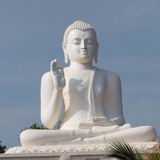
Dhammapada Verse 406
Samaneranam Vatthu
Aviruddham viruddhesu
attadandesu nibbutam
sadanesu anadanam
tamaham brumi brahmanam.
Verse 406: Him I call a brahmana, who is not hostile to those who are hostile, who is peaceful (i.e., has laid aside the use of force) to those with weapons, and who is without attachment to objects of attachment.
The Story of Four Samaneras
While residing at the Jetavana monastery, the Buddha uttered Verse (406) of this book, with reference to four samaneras who were arahats.
Once, the wife of a brahmin sent her husband the brahmin to the Jetavana monastery to invite four bhikkhus to an alms-meal at their house. She told him to specifically request for senior bhikkhus who were also true brahmanas. But four seven year old arahat samaneras, viz., Samkicca, Pandita, Sopaka and Revata were sent along with him. When his wife saw the young samaneras she was very much dissatisfied and blamed the brahmin for bringing such young samaneras who were even younger than her grandson. She was, in fact, furious with her husband, and so she sent him back to the monastery to get older bhikkhus. In the meantime she refused to give the young samaneras the higher seats reserved for the bhikkhus; they were given lower seats and she did not offer them alms-food.
When the brahmin arrived at the monastery, he met the Venerable Sariputta and invited him to his house. When the Venerable Sariputta arrived at the house of the brahmin, he saw the four young arahat samaneras and asked them if they had been offered alms-food yet. On learning that the arahat samaneras had not been given alms-food yet and also that food had been prepared only for four persons the Venerable Sariputta returned to the monastery without accepting alms-food from the house of the brahmin. So his wife sent the brahmin back again to the monastery to get another senior bhikkhu. This time, the Venerable Maha Moggallana came along with the brahmin, but he also returned to the monastery without accepting alms-food when he learned that the young samaneras had not been offered alms-food and also that food had been prepared only for four persons.
By this time, the samaneras were feeling hungry. Sakka, king of the devas, seeing the state of things took the form of an old brahmin and came to the house. The brahmin and his wife paid respect to the old brahmin and offered him a seat of honour, but Sakka just sat on the ground and paid respect to the four samaneras. Then he revealed that he was Sakka. Seeing that Sakka himself was paying respect to the young samaneras, the brahmin couple offered alms-food to all the five. After the meal, Sakka and the samaneras manifested their supernormal power by going right up into the sky through the roof. Sakka went back to his celestial abode, the samaneras returned to the monastery.
When other bhikkhus asked the samaneras whether they did not get angry when the brahmin couple refused to offer alms-food to them, they answered in the negative. The bhikkhus not believing them reported to the Buddha that the four young samaneras were falsely claiming to be arahats. To them the Buddha said, "Bhikkhus, arahats bear no ill will towards those who are hostile to them."
Then the Buddha spoke in verse as follows:
Verse 406: Him I call a brahmana, who is not hostile to those who are hostile, who is peaceful (i.e., has laid aside the use of force) to those with weapons, and who is without attachment to objects of attachment.
===
Free Buddhism books, teachings, podcasts and videos from Theravada, Mahayana and Vajrayana traditions:
https://news.1rj.ru/str/buddha_ebooks
===
Samaneranam Vatthu
Aviruddham viruddhesu
attadandesu nibbutam
sadanesu anadanam
tamaham brumi brahmanam.
Verse 406: Him I call a brahmana, who is not hostile to those who are hostile, who is peaceful (i.e., has laid aside the use of force) to those with weapons, and who is without attachment to objects of attachment.
The Story of Four Samaneras
While residing at the Jetavana monastery, the Buddha uttered Verse (406) of this book, with reference to four samaneras who were arahats.
Once, the wife of a brahmin sent her husband the brahmin to the Jetavana monastery to invite four bhikkhus to an alms-meal at their house. She told him to specifically request for senior bhikkhus who were also true brahmanas. But four seven year old arahat samaneras, viz., Samkicca, Pandita, Sopaka and Revata were sent along with him. When his wife saw the young samaneras she was very much dissatisfied and blamed the brahmin for bringing such young samaneras who were even younger than her grandson. She was, in fact, furious with her husband, and so she sent him back to the monastery to get older bhikkhus. In the meantime she refused to give the young samaneras the higher seats reserved for the bhikkhus; they were given lower seats and she did not offer them alms-food.
When the brahmin arrived at the monastery, he met the Venerable Sariputta and invited him to his house. When the Venerable Sariputta arrived at the house of the brahmin, he saw the four young arahat samaneras and asked them if they had been offered alms-food yet. On learning that the arahat samaneras had not been given alms-food yet and also that food had been prepared only for four persons the Venerable Sariputta returned to the monastery without accepting alms-food from the house of the brahmin. So his wife sent the brahmin back again to the monastery to get another senior bhikkhu. This time, the Venerable Maha Moggallana came along with the brahmin, but he also returned to the monastery without accepting alms-food when he learned that the young samaneras had not been offered alms-food and also that food had been prepared only for four persons.
By this time, the samaneras were feeling hungry. Sakka, king of the devas, seeing the state of things took the form of an old brahmin and came to the house. The brahmin and his wife paid respect to the old brahmin and offered him a seat of honour, but Sakka just sat on the ground and paid respect to the four samaneras. Then he revealed that he was Sakka. Seeing that Sakka himself was paying respect to the young samaneras, the brahmin couple offered alms-food to all the five. After the meal, Sakka and the samaneras manifested their supernormal power by going right up into the sky through the roof. Sakka went back to his celestial abode, the samaneras returned to the monastery.
When other bhikkhus asked the samaneras whether they did not get angry when the brahmin couple refused to offer alms-food to them, they answered in the negative. The bhikkhus not believing them reported to the Buddha that the four young samaneras were falsely claiming to be arahats. To them the Buddha said, "Bhikkhus, arahats bear no ill will towards those who are hostile to them."
Then the Buddha spoke in verse as follows:
Verse 406: Him I call a brahmana, who is not hostile to those who are hostile, who is peaceful (i.e., has laid aside the use of force) to those with weapons, and who is without attachment to objects of attachment.
===
Free Buddhism books, teachings, podcasts and videos from Theravada, Mahayana and Vajrayana traditions:
https://news.1rj.ru/str/buddha_ebooks
===
Telegram
Buddha Dharma books
Free Buddhism books, teachings, podcasts and videos from Theravada, Mahayana and Vajrayana traditions
❤1👍1🏆1
Forwarded from Words of the Buddha
Hsinbyume Myatheindan Pagoda, Sagaing, Mandalay, Myanmar.
❤1👍1🥰1😍1
Forwarded from Words of the Buddha
Free Buddha Dharma ebook
Paradox of Becoming
By Thanissaro Bhikkhu
The Buddha had a word for this experience of an identity inhabiting a world defined around a specific desire. He called it bhava, which is related to the verb bhavati, to “be,” or to “become.” He was especially interested in bhava as process—how it comes about, and how it can be ended. So “becoming” is probably a better English rendering for the term than “being” or “existence,” especially as it follows on doing, rather than existing as a prior metaphysical absolute or ground. In other words, it’s not the source from which we come; it’s something produced by the activity of our minds.
Free download here:
https://www.accesstoinsight.org/lib/authors/thanissaro/paradoxofbecoming.pdf
===
Paradox of Becoming
By Thanissaro Bhikkhu
The Buddha had a word for this experience of an identity inhabiting a world defined around a specific desire. He called it bhava, which is related to the verb bhavati, to “be,” or to “become.” He was especially interested in bhava as process—how it comes about, and how it can be ended. So “becoming” is probably a better English rendering for the term than “being” or “existence,” especially as it follows on doing, rather than existing as a prior metaphysical absolute or ground. In other words, it’s not the source from which we come; it’s something produced by the activity of our minds.
Free download here:
https://www.accesstoinsight.org/lib/authors/thanissaro/paradoxofbecoming.pdf
===
👍1🥰1🙏1
Dhammapada Verse 407
Mahapanthakatthera Vatthu
Yassa rago ca doso ca
mano makkho ca patito
sasaporiva aragga
tamaham brumi brahmanam.
Verse 407: Him I call a brahmana, from whom passion, ill will, pride and detraction have fallen off like a mustard seed from the tip of an awl.
The Story of Thera Mahapanthaka
While residing at the Veluvana monastery, the Buddha uttered Verse (407) of this book, with reference to Thera Mahapanthaka, elder brother of Culapanthaka*.
Thera Mahapanthaka was already an arahat when his younger brother Culapanthaka joined the Order. Culapanthaka was born a dullard because he had made fun of a very dull bhikkhu in one of his past existences. Culapanthaka could not even memorize one verse in four months' time. Mahapanthaka was disappointed with his younger brother and asked him to leave the monastery as he was not worthy of the Order.
It was in this connection that, on one occasion, the bhikkhus asked the Buddha why Mahapanthaka, even though he was an arahat, turned his younger brother Culapanthaka out of the monastery. They also added "Do the arahats still lose their temper? Do they still have moral defilements like ill will in them?" To them the Buddha replied, "Bhikkhus! Arahats have no moral defilements like passion and ill will in them. My son Mahapanthaka acted as he did with a view to benefiting his brother and not out of ill will."
Then the Buddha spoke in verse as follows:
Verse 407: Him I call a brahmana, from whom passion, ill will, pride and detraction have fallen off like a mustard seed from the tip of an awl.
===
Buddha dharma teachings channel:
https://news.1rj.ru/str/lorddivinebuddha
===
Mahapanthakatthera Vatthu
Yassa rago ca doso ca
mano makkho ca patito
sasaporiva aragga
tamaham brumi brahmanam.
Verse 407: Him I call a brahmana, from whom passion, ill will, pride and detraction have fallen off like a mustard seed from the tip of an awl.
The Story of Thera Mahapanthaka
While residing at the Veluvana monastery, the Buddha uttered Verse (407) of this book, with reference to Thera Mahapanthaka, elder brother of Culapanthaka*.
Thera Mahapanthaka was already an arahat when his younger brother Culapanthaka joined the Order. Culapanthaka was born a dullard because he had made fun of a very dull bhikkhu in one of his past existences. Culapanthaka could not even memorize one verse in four months' time. Mahapanthaka was disappointed with his younger brother and asked him to leave the monastery as he was not worthy of the Order.
It was in this connection that, on one occasion, the bhikkhus asked the Buddha why Mahapanthaka, even though he was an arahat, turned his younger brother Culapanthaka out of the monastery. They also added "Do the arahats still lose their temper? Do they still have moral defilements like ill will in them?" To them the Buddha replied, "Bhikkhus! Arahats have no moral defilements like passion and ill will in them. My son Mahapanthaka acted as he did with a view to benefiting his brother and not out of ill will."
Then the Buddha spoke in verse as follows:
Verse 407: Him I call a brahmana, from whom passion, ill will, pride and detraction have fallen off like a mustard seed from the tip of an awl.
===
Buddha dharma teachings channel:
https://news.1rj.ru/str/lorddivinebuddha
===
Telegram
Buddha
Buddha dharma teachings from the suttas and commentaries
❤1🥰1
Forwarded from Words of the Buddha
The Desire for Awakening
While you’ll eventually need to abandon your sense of “I” as you approach the final stages of the path, you won’t arrive there unless you first put that “I” to good use.
By Thanissaro Bhikkhu
Part 1 of 3
Adapted from a talk given to a group of Buddhist students in Singapore as part of a series devoted to the topic of determination, held for the three months of vassa.
When the Buddha lists the various forms of suffering under the first noble truth, one of them is “not getting what is wanted.” If you read just that much, and you remember that the Buddha also said that craving is the cause of suffering, you might think that the cure for that form of suffering is simply not to want anything: When you don’t want anything, you won’t be disappointed when you don’t get anything. You won’t suffer.
It’s from this line of reasoning that people have drawn the conclusion that if the key to the goal of not suffering is not to want anything, then the path there should also involve not wanting anything either. From that, it follows that a path of not wanting would have to be a path of not doing, and to be truly not doing anything, you can’t assume that you’re doing the path—or that there’s even anyone there to do the path to begin with. The path simply unfolds as you get your “self” out of the way.
But if you read the Buddha’s explanation of what he means by “not getting what is wanted,” and if you view that explanation in light of his own quest for awakening, you realize that the path to ending that form of suffering is more subtle and strategic. It involves wanting and doing, and you have to take responsibility for making sure it gets done.
He explains “not getting what is wanted” like this:
“And what is the stress of not getting what is wanted? In beings subject to birth, the wish arises, ‘O, may we not be subject to birth, and may birth not come to us.’ But this is not to be achieved by wishing. This is the stress of not getting what is wanted. In beings subject to aging … illness … death … sorrow, lamentation, pain, distress, & despair, the wish arises, ‘O, may we not be subject to aging … illness… death … sorrow, lamentation, pain, distress, & despair, and may aging … illness … death … sorrow, lamentation, pain, distress, & despair not come to us.’ But this is not to be achieved by wishing. This is the stress of not getting what is wanted.” – DN 22
This explanation complicates the picture because the desire not to be subject to birth, aging, illness, death, and all the rest was precisely the desire that motivated the Bodhisatta—the Buddha-to-be—in his search for awakening.
“I, too, monks, before my self-awakening, when I was still just an unawakened Bodhisatta … the thought occurred to me, ‘Why do I, being subject myself to birth, seek what is likewise subject to birth? Being subject myself to aging … illness … death … sorrow … defilement, why do I seek what is likewise subject to aging … illness … death … sorrow … defilement? What if I, being subject myself to birth, seeing the drawbacks of birth, were to seek the unborn, unexcelled rest from the yoke: unbinding? What if I, being subject myself to aging … illness … death … sorrow … defilement, seeing the drawbacks of aging … illness… death … sorrow… defilement, were to seek the aging-less, illness-less, deathless, sorrow-less, undefiled, unexcelled rest from the yoke: unbinding?’ ” – MN 26
The desire that motivated him to search for awakening differed from the more generic desire to put an end to aging, etc., in that he recognized that the ending of the more everyday forms of not getting what you want—such as freedom from sorrow, lamentation, and despair—required something radical: total freedom from birth and death. That, in turn, would require a dedicated search. He called that search the noble search, in contrast to the ignoble search that looked for happiness in things subject to birth, aging, illness, and death, such as relationships and possessions (MN 26).
While you’ll eventually need to abandon your sense of “I” as you approach the final stages of the path, you won’t arrive there unless you first put that “I” to good use.
By Thanissaro Bhikkhu
Part 1 of 3
Adapted from a talk given to a group of Buddhist students in Singapore as part of a series devoted to the topic of determination, held for the three months of vassa.
When the Buddha lists the various forms of suffering under the first noble truth, one of them is “not getting what is wanted.” If you read just that much, and you remember that the Buddha also said that craving is the cause of suffering, you might think that the cure for that form of suffering is simply not to want anything: When you don’t want anything, you won’t be disappointed when you don’t get anything. You won’t suffer.
It’s from this line of reasoning that people have drawn the conclusion that if the key to the goal of not suffering is not to want anything, then the path there should also involve not wanting anything either. From that, it follows that a path of not wanting would have to be a path of not doing, and to be truly not doing anything, you can’t assume that you’re doing the path—or that there’s even anyone there to do the path to begin with. The path simply unfolds as you get your “self” out of the way.
But if you read the Buddha’s explanation of what he means by “not getting what is wanted,” and if you view that explanation in light of his own quest for awakening, you realize that the path to ending that form of suffering is more subtle and strategic. It involves wanting and doing, and you have to take responsibility for making sure it gets done.
He explains “not getting what is wanted” like this:
“And what is the stress of not getting what is wanted? In beings subject to birth, the wish arises, ‘O, may we not be subject to birth, and may birth not come to us.’ But this is not to be achieved by wishing. This is the stress of not getting what is wanted. In beings subject to aging … illness … death … sorrow, lamentation, pain, distress, & despair, the wish arises, ‘O, may we not be subject to aging … illness… death … sorrow, lamentation, pain, distress, & despair, and may aging … illness … death … sorrow, lamentation, pain, distress, & despair not come to us.’ But this is not to be achieved by wishing. This is the stress of not getting what is wanted.” – DN 22
This explanation complicates the picture because the desire not to be subject to birth, aging, illness, death, and all the rest was precisely the desire that motivated the Bodhisatta—the Buddha-to-be—in his search for awakening.
“I, too, monks, before my self-awakening, when I was still just an unawakened Bodhisatta … the thought occurred to me, ‘Why do I, being subject myself to birth, seek what is likewise subject to birth? Being subject myself to aging … illness … death … sorrow … defilement, why do I seek what is likewise subject to aging … illness … death … sorrow … defilement? What if I, being subject myself to birth, seeing the drawbacks of birth, were to seek the unborn, unexcelled rest from the yoke: unbinding? What if I, being subject myself to aging … illness … death … sorrow … defilement, seeing the drawbacks of aging … illness… death … sorrow… defilement, were to seek the aging-less, illness-less, deathless, sorrow-less, undefiled, unexcelled rest from the yoke: unbinding?’ ” – MN 26
The desire that motivated him to search for awakening differed from the more generic desire to put an end to aging, etc., in that he recognized that the ending of the more everyday forms of not getting what you want—such as freedom from sorrow, lamentation, and despair—required something radical: total freedom from birth and death. That, in turn, would require a dedicated search. He called that search the noble search, in contrast to the ignoble search that looked for happiness in things subject to birth, aging, illness, and death, such as relationships and possessions (MN 26).
Telegram
Words of the Buddha
Daily teachings of Buddha Dharma
❤1🆒1
Forwarded from Words of the Buddha
Now, it wasn’t the case that his desire to go beyond birth, etc., was limited to just the beginning of his path. His continued desire to find the deathless explains why he wasn’t satisfied with the first two knowledges on the night of his awakening: knowing his previous lives and knowing how beings throughout the cosmos die and are reborn in line with their actions. Only when he found the deathless through the third knowledge—knowing that he had mastered the duties of the four noble truths—did he end his search.
“Then, monks, being subject myself to birth, seeing the drawbacks of birth, seeking the unborn, unexcelled rest from the yoke, unbinding, I reached the unborn, unexcelled rest from the yoke: unbinding. Being subject myself to aging … illness … death … sorrow … defilement, seeing the drawbacks of aging … illness … death… sorrow … defilement, seeking the aging-less, illness-less, deathless, sorrow-less, undefiled, unexcelled rest from the yoke, unbinding, I reached the aging-less, illness-less, deathless, sorrow-less, undefiled, unexcelled rest from the yoke: unbinding. Knowledge & vision arose in me: ‘Unprovoked is my release. This is the last birth. There is now no further becoming.’ ” – MN 26
He then taught his students to give rise to the same desire for the deathless and—rather than simply wishing for the deathless, or abandoning that desire and resting content with things subject to death—to focus their desires on the path to the deathless and to follow through with it until they had reached the goal.
===
Words of the Buddha channel:
https://news.1rj.ru/str/wordsofbuddha
===
“Then, monks, being subject myself to birth, seeing the drawbacks of birth, seeking the unborn, unexcelled rest from the yoke, unbinding, I reached the unborn, unexcelled rest from the yoke: unbinding. Being subject myself to aging … illness … death … sorrow … defilement, seeing the drawbacks of aging … illness … death… sorrow … defilement, seeking the aging-less, illness-less, deathless, sorrow-less, undefiled, unexcelled rest from the yoke, unbinding, I reached the aging-less, illness-less, deathless, sorrow-less, undefiled, unexcelled rest from the yoke: unbinding. Knowledge & vision arose in me: ‘Unprovoked is my release. This is the last birth. There is now no further becoming.’ ” – MN 26
He then taught his students to give rise to the same desire for the deathless and—rather than simply wishing for the deathless, or abandoning that desire and resting content with things subject to death—to focus their desires on the path to the deathless and to follow through with it until they had reached the goal.
===
Words of the Buddha channel:
https://news.1rj.ru/str/wordsofbuddha
===
Telegram
Words of the Buddha
Daily teachings of Buddha Dharma
👍1🏆1
Forwarded from Buddha Dharma books
Free Buddha Dharma ebook
A Handbook for the Relief of Suffering : Three Essays by Ajaan Lee Dhammadharo
Free download available:
https://www.dhammatalks.org/Archive/Writings/Ebooks/HandbookRoS_230113.pdf
===
A Handbook for the Relief of Suffering : Three Essays by Ajaan Lee Dhammadharo
Free download available:
https://www.dhammatalks.org/Archive/Writings/Ebooks/HandbookRoS_230113.pdf
===
❤1🕊1
Forwarded from Buddha Dharma books
Free Buddha Dharma ebook
A Handbook for the Relief of Suffering : Three Essays by Ajaan Lee Dhammadharo
A Handbook for the Relief of Suffering consists of three short essays that were meant to be given to hospital patients as food for thought for them to ponder while undergoing treatment.
Free download available:
https://www.dhammatalks.org/Archive/Writings/Ebooks/HandbookRoS_230113.pdf
===
A Handbook for the Relief of Suffering : Three Essays by Ajaan Lee Dhammadharo
A Handbook for the Relief of Suffering consists of three short essays that were meant to be given to hospital patients as food for thought for them to ponder while undergoing treatment.
Free download available:
https://www.dhammatalks.org/Archive/Writings/Ebooks/HandbookRoS_230113.pdf
===
👍1💯1
Then Ugga the government chief minister went up to the Buddha, bowed, sat down to one side, and said to him, “It’s incredible, sir, it’s amazing! Migāra of Rohaṇa is so rich, so very wealthy.”
“But Ugga, how rich is he?”
“He has a hundred thousand gold coins, not to mention the silver coins!”
“Well, Ugga, that is wealth, I can’t deny it. But fire, water, rulers, thieves, and unloved heirs all take a share of that wealth. There are these seven kinds of wealth that they can’t take a share of. What seven? The wealth of faith, ethics, conscience, prudence, learning, generosity, and wisdom. There are these seven kinds of wealth that fire, water, rulers, thieves, and unloved heirs can’t take a share of.
Faith and ethical conduct are kinds of wealth, as are conscience and prudence, learning and generosity, and wisdom is the seventh kind of wealth.
Partial excerpts from AN 7.7: Uggasutta
“But Ugga, how rich is he?”
“He has a hundred thousand gold coins, not to mention the silver coins!”
“Well, Ugga, that is wealth, I can’t deny it. But fire, water, rulers, thieves, and unloved heirs all take a share of that wealth. There are these seven kinds of wealth that they can’t take a share of. What seven? The wealth of faith, ethics, conscience, prudence, learning, generosity, and wisdom. There are these seven kinds of wealth that fire, water, rulers, thieves, and unloved heirs can’t take a share of.
Faith and ethical conduct are kinds of wealth, as are conscience and prudence, learning and generosity, and wisdom is the seventh kind of wealth.
Partial excerpts from AN 7.7: Uggasutta
🥰1🙏1😇1
Forwarded from Words of the Buddha
Buddha protected by Serpent dragon Naga King Muccalinda as told in Muccalinda Sutta.
❤1👍1🆒1
The Desire for Awakening
While you’ll eventually need to abandon your sense of “I” as you approach the final stages of the path, you won’t arrive there unless you first put that “I” to good use.
By Thanissaro Bhikkhu
Part 2 of 3
This is why the Buddha noted that one of the secrets to his awakening was “discontent with skillful qualities” (AN 2:5). As he described his quest for awakening, when he followed a path of practice and found that it didn’t lead all the way to the deathless, he abandoned it “in search of what is skillful” (MN 36). He kept trying to raise the level of his skill until it yielded the results he wanted. Only when he reached the deathless was he content.
He illustrated this principle with an analogy: If a person has need of the heartwood of a tree, he shouldn’t content himself with the leaves and twigs, the bark, or the sapwood. He has to keep searching until he finds the heartwood that will serve his purposes (MN 29).
So the desire for the deathless is not the problem. The problem is in wanting to attain the deathless simply through wishing it to be so. This is why the Buddha taught that the duty with regard to suffering is not to abandon the desire for the deathless but to comprehend it. When you comprehend the problem, you’ll comprehend the solution, and you can focus your desires there.
When you comprehend the problem, you’ll comprehend the solution, and you can focus your desires there.
The Buddha makes this point in more abstract terms in an interesting variant on dependent co-arising, his list of the causes that lead to suffering and stress. Most versions of the list end with suffering, but one version takes suffering as the jumping-off point for a series of factors beginning with conviction: When you comprehend the suffering of not getting what you want and can actually pinpoint the problem, that’s your motivation for placing conviction in the Buddha’s path and desiring to follow it. When you do, you give rise to joy, to the rapture, pleasure, and calm of concentration, and to the discernment that inspires dispassion, leading to total release (SN 12:23). When you focus your desires on following the right path of action, you’ll get what you want.
Ven. Ananda used an analogy to illustrate the role of desire on the path and in attaining the goal.
Once, when he was staying in a park, a brahman came and asked him what the goal of his practice was. Ananda replied that the goal was to abandon desire.
The brahman then asked whether there was a path of practice leading to the abandoning of desire, and Ananda replied that there was. He then described the path in terms of a teaching called the four bases of power: mental power endowed with concentration based on one of four things—desire, persistence, intent, and analysis—along with the fabrications of exertion, or right effort.
The brahman then replied that the path would have to be an endless path, because there’s no way you could abandon desire by means of desire.
Ananda responded with his analogy: Before the brahman came to the park, didn’t he have a desire to come? Didn’t he make an effort to act on that desire? And when he arrived, wasn’t that desire, along with the effort, allayed?
The brahman admitted that that was the case.
In the same way, Ananda continued, when a person has attained total awakening, whatever desire he or she had for awakening, whatever effort he or she made for awakening, is allayed (SN 51:15).
What he implies here is that you need desire to get on the path and stick with it to the end. And as he also implies, it’s not the case that, in the higher stages of the path, you attain the goal by abandoning the desire to get there. You abandon the desire because you’ve arrived.
Now, the path and the goal are two different things. The goal is unfabricated, which means that it doesn’t depend on any conditions. It’s not something you do. The path, though, is fabricated. It doesn’t cause the unfabricated, but the act of following the path can take you there.
While you’ll eventually need to abandon your sense of “I” as you approach the final stages of the path, you won’t arrive there unless you first put that “I” to good use.
By Thanissaro Bhikkhu
Part 2 of 3
This is why the Buddha noted that one of the secrets to his awakening was “discontent with skillful qualities” (AN 2:5). As he described his quest for awakening, when he followed a path of practice and found that it didn’t lead all the way to the deathless, he abandoned it “in search of what is skillful” (MN 36). He kept trying to raise the level of his skill until it yielded the results he wanted. Only when he reached the deathless was he content.
He illustrated this principle with an analogy: If a person has need of the heartwood of a tree, he shouldn’t content himself with the leaves and twigs, the bark, or the sapwood. He has to keep searching until he finds the heartwood that will serve his purposes (MN 29).
So the desire for the deathless is not the problem. The problem is in wanting to attain the deathless simply through wishing it to be so. This is why the Buddha taught that the duty with regard to suffering is not to abandon the desire for the deathless but to comprehend it. When you comprehend the problem, you’ll comprehend the solution, and you can focus your desires there.
When you comprehend the problem, you’ll comprehend the solution, and you can focus your desires there.
The Buddha makes this point in more abstract terms in an interesting variant on dependent co-arising, his list of the causes that lead to suffering and stress. Most versions of the list end with suffering, but one version takes suffering as the jumping-off point for a series of factors beginning with conviction: When you comprehend the suffering of not getting what you want and can actually pinpoint the problem, that’s your motivation for placing conviction in the Buddha’s path and desiring to follow it. When you do, you give rise to joy, to the rapture, pleasure, and calm of concentration, and to the discernment that inspires dispassion, leading to total release (SN 12:23). When you focus your desires on following the right path of action, you’ll get what you want.
Ven. Ananda used an analogy to illustrate the role of desire on the path and in attaining the goal.
Once, when he was staying in a park, a brahman came and asked him what the goal of his practice was. Ananda replied that the goal was to abandon desire.
The brahman then asked whether there was a path of practice leading to the abandoning of desire, and Ananda replied that there was. He then described the path in terms of a teaching called the four bases of power: mental power endowed with concentration based on one of four things—desire, persistence, intent, and analysis—along with the fabrications of exertion, or right effort.
The brahman then replied that the path would have to be an endless path, because there’s no way you could abandon desire by means of desire.
Ananda responded with his analogy: Before the brahman came to the park, didn’t he have a desire to come? Didn’t he make an effort to act on that desire? And when he arrived, wasn’t that desire, along with the effort, allayed?
The brahman admitted that that was the case.
In the same way, Ananda continued, when a person has attained total awakening, whatever desire he or she had for awakening, whatever effort he or she made for awakening, is allayed (SN 51:15).
What he implies here is that you need desire to get on the path and stick with it to the end. And as he also implies, it’s not the case that, in the higher stages of the path, you attain the goal by abandoning the desire to get there. You abandon the desire because you’ve arrived.
Now, the path and the goal are two different things. The goal is unfabricated, which means that it doesn’t depend on any conditions. It’s not something you do. The path, though, is fabricated. It doesn’t cause the unfabricated, but the act of following the path can take you there.
Telegram
Dhammapada - Buddha Dharma Teachings
Daily teachings of the Dhammapada, beloved and favorite teachings of the Buddha
❤1💯1
And it is a path of doing. The important thing is that you do it right. You can’t clone awakening by abandoning all efforts in imitation of what you’ve read about the goal. We can illustrate this point with another of the Buddha’s analogies. Suppose you want milk from a cow. If you try to get it by twisting the cow’s horn, you won’t get any milk no matter how much you want it. But if you pull the udder, you’ll get the milk (MN 126).
It’s not the case that, in the higher stages of the path, you attain the goal by abandoning the desire to get there. You abandon the desire because you’ve arrived.
All too many people try getting milk by twisting the horn, and then, when they don’t get any, they stop twisting the horn. They notice that not twisting the horn is more peaceful than twisting it, so they decide that peace is to be found, not by doing anything to the cow but by embracing your innate cow awareness. They even suggest that that’s what the Buddha meant by “milk.”
Now, cow awareness may bring you peace and relief after years of twisting the horn, but it still leaves you thirsty because it’s no way to get any milk. It would be a shame to content yourself with being thirsty, because the milk is still potentially available. What you have to realize is that you originally took the wrong approach, and that you’ll have to make the effort to find the right approach. Even though the act of pulling the udder is very different from the act of drinking milk, and it’s not as peaceful as simply being aware of the cow, still, when you pull the udder, you’ll get the milk. You can end your thirst. That’s why it’s the right approach.
===
Part 1 of 3:
https://news.1rj.ru/str/wordsofbuddha/3499
Part 2 of 3:
https://news.1rj.ru/str/dhammapadas/2455
Part 3 of 3:
https://news.1rj.ru/str/lorddivinebuddha/2877
===
Dhammapada, beloved and favorite teachings of the Buddha channel:
https://news.1rj.ru/str/dhammapadas
===
It’s not the case that, in the higher stages of the path, you attain the goal by abandoning the desire to get there. You abandon the desire because you’ve arrived.
All too many people try getting milk by twisting the horn, and then, when they don’t get any, they stop twisting the horn. They notice that not twisting the horn is more peaceful than twisting it, so they decide that peace is to be found, not by doing anything to the cow but by embracing your innate cow awareness. They even suggest that that’s what the Buddha meant by “milk.”
Now, cow awareness may bring you peace and relief after years of twisting the horn, but it still leaves you thirsty because it’s no way to get any milk. It would be a shame to content yourself with being thirsty, because the milk is still potentially available. What you have to realize is that you originally took the wrong approach, and that you’ll have to make the effort to find the right approach. Even though the act of pulling the udder is very different from the act of drinking milk, and it’s not as peaceful as simply being aware of the cow, still, when you pull the udder, you’ll get the milk. You can end your thirst. That’s why it’s the right approach.
===
Part 1 of 3:
https://news.1rj.ru/str/wordsofbuddha/3499
Part 2 of 3:
https://news.1rj.ru/str/dhammapadas/2455
Part 3 of 3:
https://news.1rj.ru/str/lorddivinebuddha/2877
===
Dhammapada, beloved and favorite teachings of the Buddha channel:
https://news.1rj.ru/str/dhammapadas
===
Telegram
Words of the Buddha
The Desire for Awakening
While you’ll eventually need to abandon your sense of “I” as you approach the final stages of the path, you won’t arrive there unless you first put that “I” to good use.
By Thanissaro Bhikkhu
Part 1 of 3
Adapted from a talk given…
While you’ll eventually need to abandon your sense of “I” as you approach the final stages of the path, you won’t arrive there unless you first put that “I” to good use.
By Thanissaro Bhikkhu
Part 1 of 3
Adapted from a talk given…
👏1🙏1