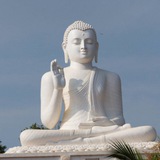
Forwarded from Words of the Buddha
Heedfulness Is Auspicious Thanissaro
A teaching and personal reflection on the goodness of merit
By Thanissaro Bhikkhu
Part 1 of 2
In Thailand, they have a series of exams for the monks and a corresponding set of exams for laypeople. For the laypeople, they have a special text on the ceremonies for making merit. It divides merit-making ceremonies into two types: auspicious and inauspicious. Auspicious ones have to do with house blessings and other positive events in life; inauspicious ones have to do with death: funeral services or services for making merit for someone who passed away in years past.
The idea that those ceremonies are inauspicious is not a Buddhist one, it’s brahmanical. After all, the Buddha said one of the highest blessings is heedfulness in terms of mental qualities, and when you go to a funeral it forces you to think heedfully—especially when it’s someone close to you. It reminds you that you’re subject to death, too, and that you have to prepare if you want to die well.
This morning we got the news that Kridkanok Taabloka, someone I knew well from Thailand, had passed away. She was a very admirable person, very even in her moods.
Years back, when I was giving a talk as a part of a retreat, I got to the topic of generosity, focusing on right and wrong attitudes to have toward generosity, and I wanted to give an example of an attitude that was really right. I thought of the time we built the chedi, the spired monument to the Buddha, in Wat Dhammasathit. Nok had been involved in the project from very early on.
At that point, she was still a new student of Ajaan Fuang’s. One of her good friends had invited her to come meditate a little bit with Ajaan Fuang in Bangkok. Soon after she started, the construction of the chedi began. It became obvious very quickly that we weren’t going to be able to hire anybody to build it. The workers we tried hiring all ran away when they saw how difficult the work was.
So, many of Ajaan Fuang’s students in Bangkok got together and said, “Okay, we’ll volunteer. We’ll do the work ourselves.” Nok came along with them, every weekend. The group would gather after work on Friday evening at one woman’s house in Bangkok. She would provide them with dinner, and then they’d get in a truck—one of those pickups equipped with bench-seats in the back. They’d drive out to the monastery, arriving usually around ten, eleven o’clock at night, sometimes midnight. In some cases, they’d get right to work because there was going to be a cement-pouring on Saturday night.
They would work and rest, work and rest, pretty much around the clock, until the cement-pouring. Then, on Sunday they’d do a little extra work, spend the night at Wat Dhammasathit, get up at 3 a.m., drive into Bangkok, and go straight to work. They kept this up month after month for a year and a half until the chedi was done. They were all very dedicated, and she was one of the regulars.
In later years, we would talk about this and laugh. We were young at that time: We could do things like that. Now that we were getting older, there was no way we could do that. Of course, now she’s gone on to another lifetime, we don’t know where, but at least she has that fund of the goodness she did when she was able to. This is something that we should all take to heart: Whatever goodness we’re capable of doing we should do now, when we have the opportunity, because the opportunity won’t always be there.
Some people like to put things off. But what are you waiting for? When you get older, things get harder. When you’re young, you can do things that stretch you and you don’t break. So stretch yourself now in doing something really good.
Nok was one of those people, when I would go back to Thailand, with whom I’d sit around and reminisce about how the chedi was built. There was a really strong sense of family feeling around the people who worked together on the project: people coming from all kinds of backgrounds, including a Western monk.
A teaching and personal reflection on the goodness of merit
By Thanissaro Bhikkhu
Part 1 of 2
In Thailand, they have a series of exams for the monks and a corresponding set of exams for laypeople. For the laypeople, they have a special text on the ceremonies for making merit. It divides merit-making ceremonies into two types: auspicious and inauspicious. Auspicious ones have to do with house blessings and other positive events in life; inauspicious ones have to do with death: funeral services or services for making merit for someone who passed away in years past.
The idea that those ceremonies are inauspicious is not a Buddhist one, it’s brahmanical. After all, the Buddha said one of the highest blessings is heedfulness in terms of mental qualities, and when you go to a funeral it forces you to think heedfully—especially when it’s someone close to you. It reminds you that you’re subject to death, too, and that you have to prepare if you want to die well.
This morning we got the news that Kridkanok Taabloka, someone I knew well from Thailand, had passed away. She was a very admirable person, very even in her moods.
Years back, when I was giving a talk as a part of a retreat, I got to the topic of generosity, focusing on right and wrong attitudes to have toward generosity, and I wanted to give an example of an attitude that was really right. I thought of the time we built the chedi, the spired monument to the Buddha, in Wat Dhammasathit. Nok had been involved in the project from very early on.
At that point, she was still a new student of Ajaan Fuang’s. One of her good friends had invited her to come meditate a little bit with Ajaan Fuang in Bangkok. Soon after she started, the construction of the chedi began. It became obvious very quickly that we weren’t going to be able to hire anybody to build it. The workers we tried hiring all ran away when they saw how difficult the work was.
So, many of Ajaan Fuang’s students in Bangkok got together and said, “Okay, we’ll volunteer. We’ll do the work ourselves.” Nok came along with them, every weekend. The group would gather after work on Friday evening at one woman’s house in Bangkok. She would provide them with dinner, and then they’d get in a truck—one of those pickups equipped with bench-seats in the back. They’d drive out to the monastery, arriving usually around ten, eleven o’clock at night, sometimes midnight. In some cases, they’d get right to work because there was going to be a cement-pouring on Saturday night.
They would work and rest, work and rest, pretty much around the clock, until the cement-pouring. Then, on Sunday they’d do a little extra work, spend the night at Wat Dhammasathit, get up at 3 a.m., drive into Bangkok, and go straight to work. They kept this up month after month for a year and a half until the chedi was done. They were all very dedicated, and she was one of the regulars.
In later years, we would talk about this and laugh. We were young at that time: We could do things like that. Now that we were getting older, there was no way we could do that. Of course, now she’s gone on to another lifetime, we don’t know where, but at least she has that fund of the goodness she did when she was able to. This is something that we should all take to heart: Whatever goodness we’re capable of doing we should do now, when we have the opportunity, because the opportunity won’t always be there.
Some people like to put things off. But what are you waiting for? When you get older, things get harder. When you’re young, you can do things that stretch you and you don’t break. So stretch yourself now in doing something really good.
Nok was one of those people, when I would go back to Thailand, with whom I’d sit around and reminisce about how the chedi was built. There was a really strong sense of family feeling around the people who worked together on the project: people coming from all kinds of backgrounds, including a Western monk.
Telegram
Words of the Buddha
Daily teachings of Buddha Dharma
😍2💯1🤗1
Forwarded from Words of the Buddha
We felt we were all part of the same family because we were working together on something good.
Now there’s one less person who can remember. This is one of the things that strikes you as life moves on and the years add up: how little is left of the earlier years, and how, with the passage of time, fewer and fewer people are around to actually tell from their own experience what exactly happened.
Whatever goodness we’re capable of doing we should do now, when we have the opportunity, because the opportunity won’t always be there.
I went back to Wat Dhammasathit a couple of years back, and they arranged for a young monk to greet me and take me around. We started talking, and he asked me questions: about Ajaan Fuang, about the construction of the chedi and the other buildings there. I told him what I had remembered. At the end, he said that all this was very different from what he’d learned from others.
===
Words of the Buddha channel:
https://news.1rj.ru/str/wordsofbuddha
===
Now there’s one less person who can remember. This is one of the things that strikes you as life moves on and the years add up: how little is left of the earlier years, and how, with the passage of time, fewer and fewer people are around to actually tell from their own experience what exactly happened.
Whatever goodness we’re capable of doing we should do now, when we have the opportunity, because the opportunity won’t always be there.
I went back to Wat Dhammasathit a couple of years back, and they arranged for a young monk to greet me and take me around. We started talking, and he asked me questions: about Ajaan Fuang, about the construction of the chedi and the other buildings there. I told him what I had remembered. At the end, he said that all this was very different from what he’d learned from others.
===
Words of the Buddha channel:
https://news.1rj.ru/str/wordsofbuddha
===
Telegram
Words of the Buddha
Daily teachings of Buddha Dharma
👏1🙏1
Furthermore, I have explained to my disciples a practice that they use to develop the ten universal dimensions of meditation.
Someone perceives the meditation on universal (= kasina) earth above, below, across, undivided and limitless.
They perceive the meditation on universal water … the meditation on universal fire … the meditation on universal air … the meditation on universal blue … the meditation on universal yellow … the meditation on universal red … the meditation on universal white … the meditation on universal space … the meditation on universal consciousness above, below, across, undivided and limitless.
And many of my disciples meditate on that having attained perfection and consummation of insight.
MN 77 : Mahāsakuludāyisutta
Someone perceives the meditation on universal (= kasina) earth above, below, across, undivided and limitless.
They perceive the meditation on universal water … the meditation on universal fire … the meditation on universal air … the meditation on universal blue … the meditation on universal yellow … the meditation on universal red … the meditation on universal white … the meditation on universal space … the meditation on universal consciousness above, below, across, undivided and limitless.
And many of my disciples meditate on that having attained perfection and consummation of insight.
MN 77 : Mahāsakuludāyisutta
🕊1💯1
Forwarded from Buddha
Heedfulness Is Auspicious Thanissaro
A teaching and personal reflection on the goodness of merit
By Thanissaro Bhikkhu
Part 2 of 2
So, things pass away, memories get blurred and forgotten, and there’s nothing left except for the goodness you do. Of course, the badness you do can also follow you. But you want to hold on just to the goodness, because we all have something bad in our background: either things we did that were not so good, or things that other people did to us. As the Buddha says, you don’t want to focus on those things; you want to do something better so that you have something better to focus on.
Of course, the building of the chedi was, as Ajaan Fuang used to say, “heavy merit”, whereas meditation is light merit. Light merit you can take with you wherever you go. Heavy merit leaves good memories, yet those memories can get obscured. But if you have the skills of meditation, they can help you when you most need them.
So that’s what you want to take, that’s what you want to develop—and of those skills, thoughts of universal goodwill, compassion, empathetic joy, and equanimity are especially important. As you encounter memories of things you did that were not skillful, or things that other people did to you that were not skillful, the Buddha has you think, in both cases, in larger terms.
Regarding things that other people did to you: The Buddha would give the example of the bandits with a two-handled saw, trying to saw you into pieces. He said that even in a case like that, you should not have ill-will for them; you should have goodwill instead and, starting with them, extend goodwill to the entire cosmos. This is for several reasons: One is that having ill-will will pull you down. And two, if you can develop a larger sense of the whole universe as your object of thought, it pulls you out of the particularities of your own suffering.
This framing puts things into context: You’re not the only one dying. You’re not the only one in the universe being mistreated. And when you think of the larger context, of course, you think of the Buddha’s second knowledge on the night of his awakening, when he saw beings passing away and being reborn in line with their actions. You realize that those poor bandits are setting themselves up for a bad fall. You can actually have compassion for them as you step back from the immediate experience.
This also goes for cases where you’ve done something wrong. You learn from the Buddha that killing, stealing, illicit sex, lying, and taking intoxicants are all unskillful. You think back, and you may have done unskillful things like that in your life. As he said, the proper response to those thoughts is not to get wound up in remorse. It’s simply to recognize, okay, that was a mistake. You resolve not to repeat the mistake, and then you develop thoughts of goodwill again for everyone, thoughts of compassion, empathetic joy, and equanimity for all the beings in the universe.
This is partly to reinforce your determination not to repeat the mistake, and also to pull you out of that narrative. Your unskilful action just becomes one more instance of all the stupid things that all beings have done over the centuries. When you think about the amount of suffering that’s gone on, it pulls you out of the particulars of your narrative. From that perspective, you can have some compassion for yourself and for all other beings.
And remember, in the Buddha’s case when he had that second knowledge, it then led to coming back into the present moment not in terms of the narratives, but in terms of what mental actions in the present moment are the ones that drive beings to keep on doing these things again and again.
So it’s advisable that you learn how to develop this larger perspective and then to think: “Where does this apply to me right now? And what can I do to get out?”
A teaching and personal reflection on the goodness of merit
By Thanissaro Bhikkhu
Part 2 of 2
So, things pass away, memories get blurred and forgotten, and there’s nothing left except for the goodness you do. Of course, the badness you do can also follow you. But you want to hold on just to the goodness, because we all have something bad in our background: either things we did that were not so good, or things that other people did to us. As the Buddha says, you don’t want to focus on those things; you want to do something better so that you have something better to focus on.
Of course, the building of the chedi was, as Ajaan Fuang used to say, “heavy merit”, whereas meditation is light merit. Light merit you can take with you wherever you go. Heavy merit leaves good memories, yet those memories can get obscured. But if you have the skills of meditation, they can help you when you most need them.
So that’s what you want to take, that’s what you want to develop—and of those skills, thoughts of universal goodwill, compassion, empathetic joy, and equanimity are especially important. As you encounter memories of things you did that were not skillful, or things that other people did to you that were not skillful, the Buddha has you think, in both cases, in larger terms.
Regarding things that other people did to you: The Buddha would give the example of the bandits with a two-handled saw, trying to saw you into pieces. He said that even in a case like that, you should not have ill-will for them; you should have goodwill instead and, starting with them, extend goodwill to the entire cosmos. This is for several reasons: One is that having ill-will will pull you down. And two, if you can develop a larger sense of the whole universe as your object of thought, it pulls you out of the particularities of your own suffering.
This framing puts things into context: You’re not the only one dying. You’re not the only one in the universe being mistreated. And when you think of the larger context, of course, you think of the Buddha’s second knowledge on the night of his awakening, when he saw beings passing away and being reborn in line with their actions. You realize that those poor bandits are setting themselves up for a bad fall. You can actually have compassion for them as you step back from the immediate experience.
This also goes for cases where you’ve done something wrong. You learn from the Buddha that killing, stealing, illicit sex, lying, and taking intoxicants are all unskillful. You think back, and you may have done unskillful things like that in your life. As he said, the proper response to those thoughts is not to get wound up in remorse. It’s simply to recognize, okay, that was a mistake. You resolve not to repeat the mistake, and then you develop thoughts of goodwill again for everyone, thoughts of compassion, empathetic joy, and equanimity for all the beings in the universe.
This is partly to reinforce your determination not to repeat the mistake, and also to pull you out of that narrative. Your unskilful action just becomes one more instance of all the stupid things that all beings have done over the centuries. When you think about the amount of suffering that’s gone on, it pulls you out of the particulars of your narrative. From that perspective, you can have some compassion for yourself and for all other beings.
And remember, in the Buddha’s case when he had that second knowledge, it then led to coming back into the present moment not in terms of the narratives, but in terms of what mental actions in the present moment are the ones that drive beings to keep on doing these things again and again.
So it’s advisable that you learn how to develop this larger perspective and then to think: “Where does this apply to me right now? And what can I do to get out?”
Telegram
Buddha
Buddha dharma teachings from the suttas and commentaries
💯1🤗1
Forwarded from Buddha
It was in this context that the Buddha discovered the four noble truths. He realized that the problem was the craving in the mind that led to all these actions that cause suffering, but also that that craving could be ended through the factors of the noble eightfold path. So he carried out his duties with regard to those four noble truths and was able to reach the cessation of suffering.
That larger perspective is helpful in many ways: It gets you out of the particulars of your narrative and gives you the ability to see where, exactly, is the problem. When the Buddha had that vision of beings dying and being reborn, he saw that it was in line with their actions. Their actions were determined by their intentions, and their intentions were shaped by their views, which is why he taught the verse that stands in the beginning of the Dhammapada: The mind is the forerunner of all things. Everything you’re going to experience comes out of the mind.
So if you’re really heedful, you’ll focus on training the mind to develop these skills. Then as aging, illness, and death come, you won’t do anything foolish. Before they come, you realize: You’ve got the opportunity to do some good, both inside and out.
When I talked to Nok shortly before she died, that’s what I reminded her of. She said she had been meditating, and I told her, “Well, this is what you’ve got to do from now on, nothing but meditate.” She said she knew that. So I encouraged her even further.
She’s an example of someone who did good things for the people around her and also made sure that she had some skills to take with her, as she faced the difficulties that we’re all bound to meet in life.
So in this way, making merit for someone who’s passed away can be an auspicious experience. If we learn how to look at our own lives, we realize what needs to be done: We’ve got to be heedful to do whatever good we can while we have the power to do it, because that goodness will give us support.
As the Buddha said, the goodness we’ve done is like relatives: When we get to the other side, that goodness will meet us and greet us, in the same way that relatives will welcome us after we’ve been parted for a long time.
Adapted from a talk given on June 10, 2021, which originally appeared on
www.dhammatalks.org
===
Part 1 of 2:
https://news.1rj.ru/str/wordsofbuddha/4131
Part 2 of 2:
https://news.1rj.ru/str/lorddivinebuddha/3387
===
Buddha dharma teachings channel:
https://news.1rj.ru/str/lorddivinebuddha
===
That larger perspective is helpful in many ways: It gets you out of the particulars of your narrative and gives you the ability to see where, exactly, is the problem. When the Buddha had that vision of beings dying and being reborn, he saw that it was in line with their actions. Their actions were determined by their intentions, and their intentions were shaped by their views, which is why he taught the verse that stands in the beginning of the Dhammapada: The mind is the forerunner of all things. Everything you’re going to experience comes out of the mind.
So if you’re really heedful, you’ll focus on training the mind to develop these skills. Then as aging, illness, and death come, you won’t do anything foolish. Before they come, you realize: You’ve got the opportunity to do some good, both inside and out.
When I talked to Nok shortly before she died, that’s what I reminded her of. She said she had been meditating, and I told her, “Well, this is what you’ve got to do from now on, nothing but meditate.” She said she knew that. So I encouraged her even further.
She’s an example of someone who did good things for the people around her and also made sure that she had some skills to take with her, as she faced the difficulties that we’re all bound to meet in life.
So in this way, making merit for someone who’s passed away can be an auspicious experience. If we learn how to look at our own lives, we realize what needs to be done: We’ve got to be heedful to do whatever good we can while we have the power to do it, because that goodness will give us support.
As the Buddha said, the goodness we’ve done is like relatives: When we get to the other side, that goodness will meet us and greet us, in the same way that relatives will welcome us after we’ve been parted for a long time.
Adapted from a talk given on June 10, 2021, which originally appeared on
www.dhammatalks.org
===
Part 1 of 2:
https://news.1rj.ru/str/wordsofbuddha/4131
Part 2 of 2:
https://news.1rj.ru/str/lorddivinebuddha/3387
===
Buddha dharma teachings channel:
https://news.1rj.ru/str/lorddivinebuddha
===
Telegram
Buddha
Buddha dharma teachings from the suttas and commentaries
🙏1😘1
4. Yo balo maññati balyam
paudito va'pi tena so
Balo ca pauditamana
sa ve balo'ti vuccati. 63.
WISE IS HE WHO ACKNOWLEDGES HIS FOOLISHNESS
4. The fool who knows that he is a fool is for that very reason a wise man; the fool who thinks that he is wise is called a fool indeed. 63.
Story
Two persons went to hear the Dhamma. One attained the first stage of Sainthood, the other stole some money. On returning home the latter taunted the former as a fool not to have availed himself of the opportunity to steal something as he had done. When the matter was reported to the Buddha He explained the difference between a fool and a wise man.
===
Buddha dharma teachings channel:
https://news.1rj.ru/str/lorddivinebuddha
===
paudito va'pi tena so
Balo ca pauditamana
sa ve balo'ti vuccati. 63.
WISE IS HE WHO ACKNOWLEDGES HIS FOOLISHNESS
4. The fool who knows that he is a fool is for that very reason a wise man; the fool who thinks that he is wise is called a fool indeed. 63.
Story
Two persons went to hear the Dhamma. One attained the first stage of Sainthood, the other stole some money. On returning home the latter taunted the former as a fool not to have availed himself of the opportunity to steal something as he had done. When the matter was reported to the Buddha He explained the difference between a fool and a wise man.
===
Buddha dharma teachings channel:
https://news.1rj.ru/str/lorddivinebuddha
===
Telegram
Buddha
Buddha dharma teachings from the suttas and commentaries
💯1🆒1
Forwarded from Buddha Dharma books
Free Buddha Dharma ebook
Sri Pada, A Guide to Buddhism’s Most Sacred Mountain
By Bhante Shravasti Dhammika
Free download available:
https://budblooms.org/sri-pada/
===
Sri Pada, A Guide to Buddhism’s Most Sacred Mountain
By Bhante Shravasti Dhammika
Free download available:
https://budblooms.org/sri-pada/
===
😍1🏆1
Forwarded from Buddha Dharma books
Free Buddha Dharma ebook
Sri Pada, A Guide to Buddhism’s Most Sacred Mountain
By Bhante Shravasti Dhammika
Mount Sinai was considered sacred at a much earlier date, Mt. Fuji surpasses it in beauty and height, and Mt. Kilash evokes a far greater sense of mystery. Nevertheless, no other mountain has been revered by so many people, from such a variety of religions, for so many centuries as Sri Pada has. In Sanskrit literature Sri Pada is called variously Mount Lanka, Ratnagiri (Mountain of Gems), Malayagiri or Mount Rohana. This last name, like its Arab and Persian equivalent, Al Rohoun, is derived from the name of the south western district of Sri Lanka where Sri Pada is situated. In several Tamil works it is known as Svargarohanam (The Ascent to Heaven) while the Portuguese called it Pico de Adam and the English Adam’s Peak. In the Mahavamsa, the great chronicle of Sri Lanka written in the 5th century CE, it is called Samantakuta (Samanta’s Abode) while in modern Sinhalese it is often called Samanelakhanda (Saman’s Mountain).
Free download available:
https://budblooms.org/sri-pada/
===
Sri Pada, A Guide to Buddhism’s Most Sacred Mountain
By Bhante Shravasti Dhammika
Mount Sinai was considered sacred at a much earlier date, Mt. Fuji surpasses it in beauty and height, and Mt. Kilash evokes a far greater sense of mystery. Nevertheless, no other mountain has been revered by so many people, from such a variety of religions, for so many centuries as Sri Pada has. In Sanskrit literature Sri Pada is called variously Mount Lanka, Ratnagiri (Mountain of Gems), Malayagiri or Mount Rohana. This last name, like its Arab and Persian equivalent, Al Rohoun, is derived from the name of the south western district of Sri Lanka where Sri Pada is situated. In several Tamil works it is known as Svargarohanam (The Ascent to Heaven) while the Portuguese called it Pico de Adam and the English Adam’s Peak. In the Mahavamsa, the great chronicle of Sri Lanka written in the 5th century CE, it is called Samantakuta (Samanta’s Abode) while in modern Sinhalese it is often called Samanelakhanda (Saman’s Mountain).
Free download available:
https://budblooms.org/sri-pada/
===
❤2🤗1🆒1
“Mendicants, in some past lives the Realized One was reborn as a human being. ... Due to performing those deeds he was reborn in a heavenly realm. When he came back to this place he obtained this mark: he is golden colored; his skin shines like lustrous gold.
On this it is said:
“Fixated on good will, he gave gifts. In an earlier life he poured forth cloth fine and soft to touch, like a god pouring rain on this broad earth.
So doing he passed from here to heaven, where he enjoyed the fruits of deeds well done. Here he wins a figure shining like honey-yellow gold, like Indra, the finest of gods.
If that man stays in the house, not wishing to go forth, he conquers and rules this vast, broad earth. He obtains abundant excellent cloth, so fine and soft to touch.
He receives robes, cloth, and the finest garments. if he chooses the life gone forth. For he still partakes of past deed’s fruit; what’s been done is never lost.”
Partial excerpts from DN 30 : Pathikavagga
On this it is said:
“Fixated on good will, he gave gifts. In an earlier life he poured forth cloth fine and soft to touch, like a god pouring rain on this broad earth.
So doing he passed from here to heaven, where he enjoyed the fruits of deeds well done. Here he wins a figure shining like honey-yellow gold, like Indra, the finest of gods.
If that man stays in the house, not wishing to go forth, he conquers and rules this vast, broad earth. He obtains abundant excellent cloth, so fine and soft to touch.
He receives robes, cloth, and the finest garments. if he chooses the life gone forth. For he still partakes of past deed’s fruit; what’s been done is never lost.”
Partial excerpts from DN 30 : Pathikavagga
❤1🤩1🏆1
5. Yavajavam'pi ce balo
pauditam payirupasati
Na so dhammam vijanati
dabbi suparasam yatha. 64.
A FOOL CANNOT APPRECIATE THE VALUE OF THE DHAMMA
5. Though a fool, through all his life, associates with a wise man, he no more understands the Dhamma than a spoon (tastes) the flavour of soup. 64.
Story
Mistaking the Venerable Udayi who used to sit in the seat of Dhamma, for a skilled exponent of the Dhamma, the monks questioned him about the teaching. Discovering his ignorance, they reported the matter to the Buddha, who then explained the attitude of a fool towards the Dhamma.
===
Words of the Buddha channel:
https://news.1rj.ru/str/wordsofbuddha
===
pauditam payirupasati
Na so dhammam vijanati
dabbi suparasam yatha. 64.
A FOOL CANNOT APPRECIATE THE VALUE OF THE DHAMMA
5. Though a fool, through all his life, associates with a wise man, he no more understands the Dhamma than a spoon (tastes) the flavour of soup. 64.
Story
Mistaking the Venerable Udayi who used to sit in the seat of Dhamma, for a skilled exponent of the Dhamma, the monks questioned him about the teaching. Discovering his ignorance, they reported the matter to the Buddha, who then explained the attitude of a fool towards the Dhamma.
===
Words of the Buddha channel:
https://news.1rj.ru/str/wordsofbuddha
===
Telegram
Words of the Buddha
Daily teachings of Buddha Dharma
❤1👍1💯1
Forwarded from Buddha Dharma books
Free Buddha Dharma ebook
Who Will Feed the Mice
By Ajahn Amaro
Ajahn Amaro's accounts about his mother in relation to his spiritual path.
Free download here:
https://drive.google.com/file/d/1x-9Ug5K9kKl-k-nhBTtvPNEBPgoLnPOS/view?usp=drive_link
===
Who Will Feed the Mice
By Ajahn Amaro
Ajahn Amaro's accounts about his mother in relation to his spiritual path.
Free download here:
https://drive.google.com/file/d/1x-9Ug5K9kKl-k-nhBTtvPNEBPgoLnPOS/view?usp=drive_link
===
❤2😍1
Forwarded from Buddha Dharma books
Free Buddha Dharma ebook
Who Will Feed the Mice
By Ajahn Amaro
Ajahn Amaro's accounts about his mother in relation to his spiritual path.
Free download here:
https://drive.google.com/file/d/1x-9Ug5K9kKl-k-nhBTtvPNEBPgoLnPOS/view?usp=drive_link
===
Who Will Feed the Mice
By Ajahn Amaro
Ajahn Amaro's accounts about his mother in relation to his spiritual path.
Free download here:
https://drive.google.com/file/d/1x-9Ug5K9kKl-k-nhBTtvPNEBPgoLnPOS/view?usp=drive_link
===
🥰1😘1
6. Muhuttam api ce viññu
pauditam payirupasati
Khippam dhammam vijanati
jivha suparasam yatha. 65.
THE WISE CAN APPRECIATE THE VALUE OF THE DHAMMA
6. Though an intelligent person, associates with a wise man for only a moment, he quickly understands the Dhamma as the tongue (tastes) the flavour of soup. 65.
Story
Thirty youths listened to the Dhamma and instantly attained Arahantship. The Buddha commented on their quick realization owing to their high intelligence.
===
Dhammapada, beloved and favorite teachings of the Buddha channel:
https://news.1rj.ru/str/dhammapadas
===
pauditam payirupasati
Khippam dhammam vijanati
jivha suparasam yatha. 65.
THE WISE CAN APPRECIATE THE VALUE OF THE DHAMMA
6. Though an intelligent person, associates with a wise man for only a moment, he quickly understands the Dhamma as the tongue (tastes) the flavour of soup. 65.
Story
Thirty youths listened to the Dhamma and instantly attained Arahantship. The Buddha commented on their quick realization owing to their high intelligence.
===
Dhammapada, beloved and favorite teachings of the Buddha channel:
https://news.1rj.ru/str/dhammapadas
===
Telegram
Dhammapada - Buddha Dharma Teachings
Daily teachings of the Dhammapada, beloved and favorite teachings of the Buddha
👍1🆒1