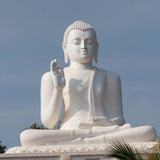
Forwarded from Buddha
So I have heard. At one time the Buddha was staying near Sāvatthī in Jeta’s Grove, Anāthapiṇḍika’s monastery. The Buddha said this:
“There are 32 marks of a great man. A great man who possesses these has only two possible destinies, no other. If he stays at home he becomes a king, a wheel-turning monarch, a just and principled king. [...] He has the following seven treasures: the wheel, the elephant, the horse, the jewel, the woman, the householder, and the commander as the seventh treasure. He has over a thousand sons who are valiant and heroic, crushing the armies of his enemies. After conquering this land girt by sea, he reigns by principle, without rod or sword. But if he goes forth from the lay life to homelessness, he becomes a perfected one, a fully awakened Buddha, who draws back the veil from the world.
And what are the 32 marks?
He is golden colored; his skin shines like lustrous gold.
Partial excerpts from DN 30 : Lakkhanasutta : Marks of a Great Man
“There are 32 marks of a great man. A great man who possesses these has only two possible destinies, no other. If he stays at home he becomes a king, a wheel-turning monarch, a just and principled king. [...] He has the following seven treasures: the wheel, the elephant, the horse, the jewel, the woman, the householder, and the commander as the seventh treasure. He has over a thousand sons who are valiant and heroic, crushing the armies of his enemies. After conquering this land girt by sea, he reigns by principle, without rod or sword. But if he goes forth from the lay life to homelessness, he becomes a perfected one, a fully awakened Buddha, who draws back the veil from the world.
And what are the 32 marks?
He is golden colored; his skin shines like lustrous gold.
Partial excerpts from DN 30 : Lakkhanasutta : Marks of a Great Man
👏1🏆1
Forwarded from Buddha
Free Buddhism ebook
The Only Way for the Realization of Nibbana
By Pa-Auk Tawya Sayadaw
The only way, bhikkhus, is this path, for beings' purification, for sorrow and lamentation's overcoming, for pain and displeasure's disappearance, for the true way's attainment, for Nibbāna's realization: that is, the four foundations of mindfulness(cattāro sati∙paṭṭhānā).
'Mahā∙Sati∙Paṭṭhāna∙Suttaṃ' ('The Great Mindfulness-Foundation Sutta')
In The Only Way for the Realization of Nibbāna, the Most Venerable Sayadaw gives a brief summary of the practice necessary for such realization, namely samatha and vipassanā. He bases his discussion on the first section of the ‘Mahā∙Sati∙Paṭṭhāṇa Sutta’, the in&out-breath section of ‘The Great Mindfulness-Foundation Sutta’.
Free download here:
https://drive.google.com/open?id=0B7p0UB1QfBmvS3ZaSzdEOE1Vdnc
===
The Only Way for the Realization of Nibbana
By Pa-Auk Tawya Sayadaw
The only way, bhikkhus, is this path, for beings' purification, for sorrow and lamentation's overcoming, for pain and displeasure's disappearance, for the true way's attainment, for Nibbāna's realization: that is, the four foundations of mindfulness(cattāro sati∙paṭṭhānā).
'Mahā∙Sati∙Paṭṭhāna∙Suttaṃ' ('The Great Mindfulness-Foundation Sutta')
In The Only Way for the Realization of Nibbāna, the Most Venerable Sayadaw gives a brief summary of the practice necessary for such realization, namely samatha and vipassanā. He bases his discussion on the first section of the ‘Mahā∙Sati∙Paṭṭhāṇa Sutta’, the in&out-breath section of ‘The Great Mindfulness-Foundation Sutta’.
Free download here:
https://drive.google.com/open?id=0B7p0UB1QfBmvS3ZaSzdEOE1Vdnc
===
❤1🆒1
Forwarded from Buddha
Free Buddhism ebook
The Only Way for the Realization of Nibbana
By Pa-Auk Tawya Sayadaw
The only way, bhikkhus, is this path, for beings' purification, for sorrow and lamentation's overcoming, for pain and displeasure's disappearance, for the true way's attainment, for Nibbāna's realization: that is, the four foundations of mindfulness(cattāro sati∙paṭṭhānā).
'Mahā∙Sati∙Paṭṭhāna∙Suttaṃ' ('The Great Mindfulness-Foundation Sutta')
In The Only Way for the Realization of Nibbāna, the Most Venerable Sayadaw gives a brief summary of the practice necessary for such realization, namely samatha and vipassanā. He bases his discussion on the first section of the ‘Mahā∙Sati∙Paṭṭhāṇa Sutta’, the in&out-breath section of ‘The Great Mindfulness-Foundation Sutta’.
Free download here:
https://drive.google.com/open?id=0B7p0UB1QfBmvS3ZaSzdEOE1Vdnc
===
The Only Way for the Realization of Nibbana
By Pa-Auk Tawya Sayadaw
The only way, bhikkhus, is this path, for beings' purification, for sorrow and lamentation's overcoming, for pain and displeasure's disappearance, for the true way's attainment, for Nibbāna's realization: that is, the four foundations of mindfulness(cattāro sati∙paṭṭhānā).
'Mahā∙Sati∙Paṭṭhāna∙Suttaṃ' ('The Great Mindfulness-Foundation Sutta')
In The Only Way for the Realization of Nibbāna, the Most Venerable Sayadaw gives a brief summary of the practice necessary for such realization, namely samatha and vipassanā. He bases his discussion on the first section of the ‘Mahā∙Sati∙Paṭṭhāṇa Sutta’, the in&out-breath section of ‘The Great Mindfulness-Foundation Sutta’.
Free download here:
https://drive.google.com/open?id=0B7p0UB1QfBmvS3ZaSzdEOE1Vdnc
===
👌1😘1
All Heavens Bite
The late Thai reformist monk Buddhadasa Bhikkhu (1906–1993) on the sufferings inherent in even the highest of heavens.
By Buddhadasa Bhikkhu
In every cycle of dependent co-arising, there is existence and birth. Every time this flow takes us in, there is existence and birth. Physical birth out of our mother’s womb is not the problem; we need not make problems with being born physically. The problems do not start until there is spiritual birth. Because of ignorance and through clinging an ego-me is born. In the dhamma way of speaking, we include suffering with birth. The two are inseparable. As soon as ego-me is born, there is some form of distress or suffering. Birth is stressful, painful, and troublesome. Of course, we mean spiritual not physical birth.
Whether the cycle of dependent co-arising is dependent on eyes, ears, nose, tongue, body, or the mind-door, each cycle will include becoming and birth. Once there is birth, there is the big fat ego playing this role or that. That ego is heavy and suffers. Whatever the form of existence, and whatever sense experience it is based on, there appears the birth of this “I am,” the ego, playing its act, getting into trouble. This is something that requires special attention because we have been overlooking this for all of our lives. We have not been paying any attention to existence and to this birth of ego-me. This habit continues to churn along with almost everyone ignoring it. The time has now come to start paying attention to it, to understand it, and to find a way to get away from this endless spinning around in circles of dukkha.
An easy way to understand this is to reflect in terms of heaven or paradise (sagga). There is heaven even here in this world, in this life; and there is heaven in other worlds, wherever those may be. Let us consider the heavens of this world first. Whenever sexuality or sensuality is fulfilled and satisfied, that is paradise, a sexual or sensual heaven, a delicious kind of sensual existence. When we are thoroughly, perfectly happy with material things, that too is heaven, a kind of formish existence. When we are fulfilled and happy due to honor, fame, power, influence, and other immaterial things, that is a formless existence kind of heaven. Each of these heavens can be found here in this life.
If, however, we speak more traditionally and take the conservative, orthodox view based on the commentaries written long after the Buddha, the heavens are other worlds (paraloka). The heavenly worlds filled with sensual pleasures are sensual existence. The higher worlds full of joys based in fine material things, such as form-based samādhi, are heavens of formish existence. The highest levels of paradise come from developing samādhi until one is born as a Brahma god. In this scheme, sensuality is rather lower, form is superior, and formless is the highest. Yet, even the heavens of other worlds are still suffering because they are still existence.
The heavens of this world are dukkha. The heavens of other worlds that we cannot see but have heard about are suffering. Every heaven is stressful and burdensome. On the other hand, the arahants, the Worthy Ones, are beyond all worlds and have transcended the various heavens. One must be beyond the heavens of sensual existence, formish existence, and formless existence to be an arahant, the highest kind of person. It is necessary to be above heaven in all its meanings in order to be totally free, liberated from dukkha.
Every heaven is stressful and burdensome.
Let us come back to the heavens of this world; they’re easier to understand, more relevant, and can be seen clearly. Take a look at your friends, especially those who are young. Their heavens here are often in sexuality. They will invest anything, spend all their money, to fulfill their sexual joys. So they dwell mainly in such sensual existence. Even this heaven of theirs bites them. Because of it they undergo all sorts of difficulties, expenses, conflicts, competitions, and jealousy.
The late Thai reformist monk Buddhadasa Bhikkhu (1906–1993) on the sufferings inherent in even the highest of heavens.
By Buddhadasa Bhikkhu
In every cycle of dependent co-arising, there is existence and birth. Every time this flow takes us in, there is existence and birth. Physical birth out of our mother’s womb is not the problem; we need not make problems with being born physically. The problems do not start until there is spiritual birth. Because of ignorance and through clinging an ego-me is born. In the dhamma way of speaking, we include suffering with birth. The two are inseparable. As soon as ego-me is born, there is some form of distress or suffering. Birth is stressful, painful, and troublesome. Of course, we mean spiritual not physical birth.
Whether the cycle of dependent co-arising is dependent on eyes, ears, nose, tongue, body, or the mind-door, each cycle will include becoming and birth. Once there is birth, there is the big fat ego playing this role or that. That ego is heavy and suffers. Whatever the form of existence, and whatever sense experience it is based on, there appears the birth of this “I am,” the ego, playing its act, getting into trouble. This is something that requires special attention because we have been overlooking this for all of our lives. We have not been paying any attention to existence and to this birth of ego-me. This habit continues to churn along with almost everyone ignoring it. The time has now come to start paying attention to it, to understand it, and to find a way to get away from this endless spinning around in circles of dukkha.
An easy way to understand this is to reflect in terms of heaven or paradise (sagga). There is heaven even here in this world, in this life; and there is heaven in other worlds, wherever those may be. Let us consider the heavens of this world first. Whenever sexuality or sensuality is fulfilled and satisfied, that is paradise, a sexual or sensual heaven, a delicious kind of sensual existence. When we are thoroughly, perfectly happy with material things, that too is heaven, a kind of formish existence. When we are fulfilled and happy due to honor, fame, power, influence, and other immaterial things, that is a formless existence kind of heaven. Each of these heavens can be found here in this life.
If, however, we speak more traditionally and take the conservative, orthodox view based on the commentaries written long after the Buddha, the heavens are other worlds (paraloka). The heavenly worlds filled with sensual pleasures are sensual existence. The higher worlds full of joys based in fine material things, such as form-based samādhi, are heavens of formish existence. The highest levels of paradise come from developing samādhi until one is born as a Brahma god. In this scheme, sensuality is rather lower, form is superior, and formless is the highest. Yet, even the heavens of other worlds are still suffering because they are still existence.
The heavens of this world are dukkha. The heavens of other worlds that we cannot see but have heard about are suffering. Every heaven is stressful and burdensome. On the other hand, the arahants, the Worthy Ones, are beyond all worlds and have transcended the various heavens. One must be beyond the heavens of sensual existence, formish existence, and formless existence to be an arahant, the highest kind of person. It is necessary to be above heaven in all its meanings in order to be totally free, liberated from dukkha.
Every heaven is stressful and burdensome.
Let us come back to the heavens of this world; they’re easier to understand, more relevant, and can be seen clearly. Take a look at your friends, especially those who are young. Their heavens here are often in sexuality. They will invest anything, spend all their money, to fulfill their sexual joys. So they dwell mainly in such sensual existence. Even this heaven of theirs bites them. Because of it they undergo all sorts of difficulties, expenses, conflicts, competitions, and jealousy.
Telegram
Dhammapada - Buddha Dharma Teachings
Daily teachings of the Dhammapada, beloved and favorite teachings of the Buddha
👌1💯1
Sexual heavens, so common in this world, consume many of our friends.
Once their sexual searches lead to consummation in marriage, a higher or more refined level of heaven is found. With marriage there are children, a home, possessions, and wealth. These are heavens of formish existence. No matter how difficult it is to maintain these heavens, no matter how much people have, they cling to these heavens and suffer, unless there is sufficient dhamma understanding. Most people do not have enough dhamma, so these heavens bite their owners. The heavens of formish existence gnaw and devour; they even drive some people mad.
Climbing higher, people find the heavens of purely mental matters. Enjoying and delighting in great fame and prestigious awards such as Nobel Prizes are heavens of formless existence. These chew and chomp. Seduced into clinging to these exalted pleasures their hearts are heavy with jealousy and possessiveness, with fighting to preserve their existences. So the formless paradises also bite their owner. Whatever kind of heaven it may be— sexual, formish, or formless—each and every kind of existence turns and bites. Observe the existences of life around us and you will understand existence well. There is not any kind of existence that is free of suffering.
The existences connected with sex and sensuality have the usual problems, difficulties, jealousies, and conflicts with which you are familiar. The existences connected with simple materiality—with form, money, jewels, and possessions—have the problems and stress of the hard work and struggle to obtain, protect, and increase them. The existences connected with things having no form—matters like power, prestige, honor, reputation, virtue, and vice—all have their problems and difficulties. They all involve a lot of effort, concern, worry, and time. One can see that all three kinds of existence are fraught with trouble, cause problems, and bring distress.
There is not any kind of existence that is free of suffering.
Please take your study to the level that sees how every level of heaven and every kind of existence contains the devouring reactions known as defilements (kilesas). Each level has its corresponding defilement and all of them wound. There are things that bite, that inflict aches and pain, on every level of heaven and in every kind of existence. One cannot escape pain even in the highest heaven.
Under the Bodhi Tree: Buddha’s Original Vision of Dependent Co-arising by Ajahn Buddhadasa.
===
Buddhadasa Bhikkhu (1906–1993) was a famous and influential Thai Buddhist philosopher and the founder of Suan Mokkh, the first modern forest monastery in Thailand.
===
Dhammapada, beloved and favorite teachings of the Buddha channel:
https://news.1rj.ru/str/dhammapadas
===
Once their sexual searches lead to consummation in marriage, a higher or more refined level of heaven is found. With marriage there are children, a home, possessions, and wealth. These are heavens of formish existence. No matter how difficult it is to maintain these heavens, no matter how much people have, they cling to these heavens and suffer, unless there is sufficient dhamma understanding. Most people do not have enough dhamma, so these heavens bite their owners. The heavens of formish existence gnaw and devour; they even drive some people mad.
Climbing higher, people find the heavens of purely mental matters. Enjoying and delighting in great fame and prestigious awards such as Nobel Prizes are heavens of formless existence. These chew and chomp. Seduced into clinging to these exalted pleasures their hearts are heavy with jealousy and possessiveness, with fighting to preserve their existences. So the formless paradises also bite their owner. Whatever kind of heaven it may be— sexual, formish, or formless—each and every kind of existence turns and bites. Observe the existences of life around us and you will understand existence well. There is not any kind of existence that is free of suffering.
The existences connected with sex and sensuality have the usual problems, difficulties, jealousies, and conflicts with which you are familiar. The existences connected with simple materiality—with form, money, jewels, and possessions—have the problems and stress of the hard work and struggle to obtain, protect, and increase them. The existences connected with things having no form—matters like power, prestige, honor, reputation, virtue, and vice—all have their problems and difficulties. They all involve a lot of effort, concern, worry, and time. One can see that all three kinds of existence are fraught with trouble, cause problems, and bring distress.
There is not any kind of existence that is free of suffering.
Please take your study to the level that sees how every level of heaven and every kind of existence contains the devouring reactions known as defilements (kilesas). Each level has its corresponding defilement and all of them wound. There are things that bite, that inflict aches and pain, on every level of heaven and in every kind of existence. One cannot escape pain even in the highest heaven.
Under the Bodhi Tree: Buddha’s Original Vision of Dependent Co-arising by Ajahn Buddhadasa.
===
Buddhadasa Bhikkhu (1906–1993) was a famous and influential Thai Buddhist philosopher and the founder of Suan Mokkh, the first modern forest monastery in Thailand.
===
Dhammapada, beloved and favorite teachings of the Buddha channel:
https://news.1rj.ru/str/dhammapadas
===
Telegram
Dhammapada - Buddha Dharma Teachings
Daily teachings of the Dhammapada, beloved and favorite teachings of the Buddha
🙏1🤝1
Forwarded from Buddha
Buddhists offered food as "amisa dana" to the monks during collecting alms food or "pindapata"
🥰1👏1🤗1
13. Na antaëikkhe na samuddamajjhe
na pabbatànam vivaram pavissa
Na vijjati so jagatippadeso
yatthaññhitam nappasahetha maccu. 128.
DEATH CANNOT BE OVERCOME
13. Not in the sky, nor in mid-ocean, nor in a mountain cave, is found that place on earth where abiding one will not be overcome by death. 128.
Story
King Suppabuddha, princess Yasodharà's father, being angry with the Buddha for having renounced his daughter started harassing him. The Buddha predicted that Suppabuddha would meet with a tragic death. Suppabuddha tried to avert it, but died as predicted by the Buddha.
===
Buddha dharma teachings channel:
https://invite.viber.com/?g2=AQAKw1y3rv%2F6sk61PI2W4izuIiaEZj8YZujhY1tSzL%2B07s7rFnVFDAd0bAYFaMLw
===
na pabbatànam vivaram pavissa
Na vijjati so jagatippadeso
yatthaññhitam nappasahetha maccu. 128.
DEATH CANNOT BE OVERCOME
13. Not in the sky, nor in mid-ocean, nor in a mountain cave, is found that place on earth where abiding one will not be overcome by death. 128.
Story
King Suppabuddha, princess Yasodharà's father, being angry with the Buddha for having renounced his daughter started harassing him. The Buddha predicted that Suppabuddha would meet with a tragic death. Suppabuddha tried to avert it, but died as predicted by the Buddha.
===
Buddha dharma teachings channel:
https://invite.viber.com/?g2=AQAKw1y3rv%2F6sk61PI2W4izuIiaEZj8YZujhY1tSzL%2B07s7rFnVFDAd0bAYFaMLw
===
Viber
Buddha
Buddha dharma teachings from the suttas and commentaries from Theravada tradition
💯1🏆1
Forwarded from Buddha
Bayon temple, a Khmer style temple built in the 12th century by King Jayavarman VII, Angkor Thom, Cambodia.
👍2❤1🫡1
Nalagirim gajavaram atimattabhutam Davaggicakkam-asaniva, sudarunam tam Mettambusekavidhina jitava munindo Tam tejasa bhavatu te jayamangalani.
Nalagiri the great elephant fully drunk,
Like a circle of jungle-fire, that one, terrible like a thunderbolt,
Through means of sprinkling the water of loving kindness, the Lord of Sages won.
Through that power may there be victorious auspices to you.
Jaya Mangala Gatha
Nalagiri the great elephant fully drunk,
Like a circle of jungle-fire, that one, terrible like a thunderbolt,
Through means of sprinkling the water of loving kindness, the Lord of Sages won.
Through that power may there be victorious auspices to you.
Jaya Mangala Gatha
🤩1😍1
Forwarded from Buddha
A Theravadin monk walked on Siwagrha temple, more popular known as Prambanan temple, Yogyakarta, Java island, Indonesia.
👍2🤩1😍1
Forwarded from Buddha Dharma books
Free Buddha Dharma ebook
The Buddha as a Teacher
By Bhante Shravasti Dhammika
Free download available:
https://budblooms.org/the-buddha-as-a-teacher/
===
The Buddha as a Teacher
By Bhante Shravasti Dhammika
Free download available:
https://budblooms.org/the-buddha-as-a-teacher/
===
🥰1😇1
Forwarded from Buddha Dharma books
Free Buddha Dharma ebook
The Buddha as a Teacher
By Bhante Shravasti Dhammika
A message, no matter how logical or true, is useless if it cannot be communicated to others. In the Dhamma we have a perfect teaching, and in the Buddha we have a perfect teacher, and the combination of these two meant that within a short time of being first proclaimed, the Dhamma became remarkably widespread. The Buddha was the first religious teacher who meant his message to be proclaimed to all humankind and who made a concrete effort to do this. He was the first religious universalist. He told his first disciples to spread the Dhamma far and wide. “Go forth for the good of the many, for the happiness of the many, out of compassion for the world, for the welfare, the good and the happiness of gods and men. Let no two of you go in the same direction. Teach the Dhamma which is beautiful in the beginning, beautiful in the middle and beautiful at the end. Proclaim both the letter and the spirit of the holy life completely fulfilled and perfectly pure” (Vin.IV,20).
Free download available:
https://budblooms.org/the-buddha-as-a-teacher/
===
The Buddha as a Teacher
By Bhante Shravasti Dhammika
A message, no matter how logical or true, is useless if it cannot be communicated to others. In the Dhamma we have a perfect teaching, and in the Buddha we have a perfect teacher, and the combination of these two meant that within a short time of being first proclaimed, the Dhamma became remarkably widespread. The Buddha was the first religious teacher who meant his message to be proclaimed to all humankind and who made a concrete effort to do this. He was the first religious universalist. He told his first disciples to spread the Dhamma far and wide. “Go forth for the good of the many, for the happiness of the many, out of compassion for the world, for the welfare, the good and the happiness of gods and men. Let no two of you go in the same direction. Teach the Dhamma which is beautiful in the beginning, beautiful in the middle and beautiful at the end. Proclaim both the letter and the spirit of the holy life completely fulfilled and perfectly pure” (Vin.IV,20).
Free download available:
https://budblooms.org/the-buddha-as-a-teacher/
===
👍1🏆1
Chapter 9
Pàpa Vagga
Evil
(Text and Translation by Ven. Nàrada)
1. Abhittharetha kalyane
pàpà cittam nivàraye
Dandham hi karoto puññam
pàpasmim ramatã mano. 116.
BE QUICK IN DOING GOOD; SUPPRESS EVIL
1. Make haste in doing good; 1 check your mind from evil; 2 for the mind of him who is slow in doing meritorious actions 3 delights in evil. 116.
Story
A husband and wife had only one under garment each and only one upper garment between the two of them. One day the husband heard the Dhamma from the Buddha and desired to offer to Him his only upper garment, but selfishness overcame him. Throughout the night he battled with his selfishness. Finally he offered the garment and exclaimed, "I have won! I have won!" Hearing his story, the king rewarded him handsomely.
===
Words of the Buddha channel:
https://invite.viber.com/?g2=AQAFqzqlj7FmI061PX17rxWMAtZ%2BRuso%2FH2KmHKZSgnv7v9DD8X0bDkKnZDr9JDq
===
Pàpa Vagga
Evil
(Text and Translation by Ven. Nàrada)
1. Abhittharetha kalyane
pàpà cittam nivàraye
Dandham hi karoto puññam
pàpasmim ramatã mano. 116.
BE QUICK IN DOING GOOD; SUPPRESS EVIL
1. Make haste in doing good; 1 check your mind from evil; 2 for the mind of him who is slow in doing meritorious actions 3 delights in evil. 116.
Story
A husband and wife had only one under garment each and only one upper garment between the two of them. One day the husband heard the Dhamma from the Buddha and desired to offer to Him his only upper garment, but selfishness overcame him. Throughout the night he battled with his selfishness. Finally he offered the garment and exclaimed, "I have won! I have won!" Hearing his story, the king rewarded him handsomely.
===
Words of the Buddha channel:
https://invite.viber.com/?g2=AQAFqzqlj7FmI061PX17rxWMAtZ%2BRuso%2FH2KmHKZSgnv7v9DD8X0bDkKnZDr9JDq
===
Viber
Words Of The Buddha
Daily teachings from Buddha Dharma
❤1👏1🙏1
Forwarded from Buddha
Kruba Sri Wichai Monument, Wat Phra That Doi Suthep, Lamphun, Thailand.
👍1👏1🤩1😍1🏆1
2. Pàpañ ce puriso kayirà
na tam kayirà punappunam
Na tamhi chandam kayiràtha
dukkho pàpassa uccayo. 117.
DO NO EVIL AGAIN AND AGAIN
2. Should a person commit evil, he should not do it again and again; he should not find pleasure therein: painful is the accumulation of evil. 117.
Story
A monk used to commit a wrong act again and again. The Buddha reproved him and uttered this stanza.
===
Dhammapada, beloved and favorite teachings of the Buddha channel:
https://invite.viber.com/?g2=AQBLD6phsgvP%2F061YjEM3K%2BNeH1Yb372b9mtfQX2EmuBpgoLUoc99BDMfzHghrme
===
na tam kayirà punappunam
Na tamhi chandam kayiràtha
dukkho pàpassa uccayo. 117.
DO NO EVIL AGAIN AND AGAIN
2. Should a person commit evil, he should not do it again and again; he should not find pleasure therein: painful is the accumulation of evil. 117.
Story
A monk used to commit a wrong act again and again. The Buddha reproved him and uttered this stanza.
===
Dhammapada, beloved and favorite teachings of the Buddha channel:
https://invite.viber.com/?g2=AQBLD6phsgvP%2F061YjEM3K%2BNeH1Yb372b9mtfQX2EmuBpgoLUoc99BDMfzHghrme
===
Viber
Dhammapada - Buddha Dharma Teachings
Daily teachings of the Dhammapada, beloved and favorite teachings of the Buddha
🙏1👌1🏆1