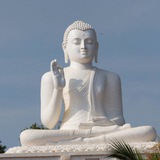
Forwarded from Buddha
Buddhists offered food as "amisa dana" to the monks during collecting alms food or "pindapata"
🥰1👏1🤗1
13. Na antaëikkhe na samuddamajjhe
na pabbatànam vivaram pavissa
Na vijjati so jagatippadeso
yatthaññhitam nappasahetha maccu. 128.
DEATH CANNOT BE OVERCOME
13. Not in the sky, nor in mid-ocean, nor in a mountain cave, is found that place on earth where abiding one will not be overcome by death. 128.
Story
King Suppabuddha, princess Yasodharà's father, being angry with the Buddha for having renounced his daughter started harassing him. The Buddha predicted that Suppabuddha would meet with a tragic death. Suppabuddha tried to avert it, but died as predicted by the Buddha.
===
Buddha dharma teachings channel:
https://invite.viber.com/?g2=AQAKw1y3rv%2F6sk61PI2W4izuIiaEZj8YZujhY1tSzL%2B07s7rFnVFDAd0bAYFaMLw
===
na pabbatànam vivaram pavissa
Na vijjati so jagatippadeso
yatthaññhitam nappasahetha maccu. 128.
DEATH CANNOT BE OVERCOME
13. Not in the sky, nor in mid-ocean, nor in a mountain cave, is found that place on earth where abiding one will not be overcome by death. 128.
Story
King Suppabuddha, princess Yasodharà's father, being angry with the Buddha for having renounced his daughter started harassing him. The Buddha predicted that Suppabuddha would meet with a tragic death. Suppabuddha tried to avert it, but died as predicted by the Buddha.
===
Buddha dharma teachings channel:
https://invite.viber.com/?g2=AQAKw1y3rv%2F6sk61PI2W4izuIiaEZj8YZujhY1tSzL%2B07s7rFnVFDAd0bAYFaMLw
===
Viber
Buddha
Buddha dharma teachings from the suttas and commentaries from Theravada tradition
💯1🏆1
Forwarded from Buddha
Bayon temple, a Khmer style temple built in the 12th century by King Jayavarman VII, Angkor Thom, Cambodia.
👍2❤1🫡1
Nalagirim gajavaram atimattabhutam Davaggicakkam-asaniva, sudarunam tam Mettambusekavidhina jitava munindo Tam tejasa bhavatu te jayamangalani.
Nalagiri the great elephant fully drunk,
Like a circle of jungle-fire, that one, terrible like a thunderbolt,
Through means of sprinkling the water of loving kindness, the Lord of Sages won.
Through that power may there be victorious auspices to you.
Jaya Mangala Gatha
Nalagiri the great elephant fully drunk,
Like a circle of jungle-fire, that one, terrible like a thunderbolt,
Through means of sprinkling the water of loving kindness, the Lord of Sages won.
Through that power may there be victorious auspices to you.
Jaya Mangala Gatha
🤩1😍1
Forwarded from Buddha
A Theravadin monk walked on Siwagrha temple, more popular known as Prambanan temple, Yogyakarta, Java island, Indonesia.
👍2🤩1😍1
Forwarded from Buddha Dharma books
Free Buddha Dharma ebook
The Buddha as a Teacher
By Bhante Shravasti Dhammika
Free download available:
https://budblooms.org/the-buddha-as-a-teacher/
===
The Buddha as a Teacher
By Bhante Shravasti Dhammika
Free download available:
https://budblooms.org/the-buddha-as-a-teacher/
===
🥰1😇1
Forwarded from Buddha Dharma books
Free Buddha Dharma ebook
The Buddha as a Teacher
By Bhante Shravasti Dhammika
A message, no matter how logical or true, is useless if it cannot be communicated to others. In the Dhamma we have a perfect teaching, and in the Buddha we have a perfect teacher, and the combination of these two meant that within a short time of being first proclaimed, the Dhamma became remarkably widespread. The Buddha was the first religious teacher who meant his message to be proclaimed to all humankind and who made a concrete effort to do this. He was the first religious universalist. He told his first disciples to spread the Dhamma far and wide. “Go forth for the good of the many, for the happiness of the many, out of compassion for the world, for the welfare, the good and the happiness of gods and men. Let no two of you go in the same direction. Teach the Dhamma which is beautiful in the beginning, beautiful in the middle and beautiful at the end. Proclaim both the letter and the spirit of the holy life completely fulfilled and perfectly pure” (Vin.IV,20).
Free download available:
https://budblooms.org/the-buddha-as-a-teacher/
===
The Buddha as a Teacher
By Bhante Shravasti Dhammika
A message, no matter how logical or true, is useless if it cannot be communicated to others. In the Dhamma we have a perfect teaching, and in the Buddha we have a perfect teacher, and the combination of these two meant that within a short time of being first proclaimed, the Dhamma became remarkably widespread. The Buddha was the first religious teacher who meant his message to be proclaimed to all humankind and who made a concrete effort to do this. He was the first religious universalist. He told his first disciples to spread the Dhamma far and wide. “Go forth for the good of the many, for the happiness of the many, out of compassion for the world, for the welfare, the good and the happiness of gods and men. Let no two of you go in the same direction. Teach the Dhamma which is beautiful in the beginning, beautiful in the middle and beautiful at the end. Proclaim both the letter and the spirit of the holy life completely fulfilled and perfectly pure” (Vin.IV,20).
Free download available:
https://budblooms.org/the-buddha-as-a-teacher/
===
👍1🏆1
Chapter 9
Pàpa Vagga
Evil
(Text and Translation by Ven. Nàrada)
1. Abhittharetha kalyane
pàpà cittam nivàraye
Dandham hi karoto puññam
pàpasmim ramatã mano. 116.
BE QUICK IN DOING GOOD; SUPPRESS EVIL
1. Make haste in doing good; 1 check your mind from evil; 2 for the mind of him who is slow in doing meritorious actions 3 delights in evil. 116.
Story
A husband and wife had only one under garment each and only one upper garment between the two of them. One day the husband heard the Dhamma from the Buddha and desired to offer to Him his only upper garment, but selfishness overcame him. Throughout the night he battled with his selfishness. Finally he offered the garment and exclaimed, "I have won! I have won!" Hearing his story, the king rewarded him handsomely.
===
Words of the Buddha channel:
https://invite.viber.com/?g2=AQAFqzqlj7FmI061PX17rxWMAtZ%2BRuso%2FH2KmHKZSgnv7v9DD8X0bDkKnZDr9JDq
===
Pàpa Vagga
Evil
(Text and Translation by Ven. Nàrada)
1. Abhittharetha kalyane
pàpà cittam nivàraye
Dandham hi karoto puññam
pàpasmim ramatã mano. 116.
BE QUICK IN DOING GOOD; SUPPRESS EVIL
1. Make haste in doing good; 1 check your mind from evil; 2 for the mind of him who is slow in doing meritorious actions 3 delights in evil. 116.
Story
A husband and wife had only one under garment each and only one upper garment between the two of them. One day the husband heard the Dhamma from the Buddha and desired to offer to Him his only upper garment, but selfishness overcame him. Throughout the night he battled with his selfishness. Finally he offered the garment and exclaimed, "I have won! I have won!" Hearing his story, the king rewarded him handsomely.
===
Words of the Buddha channel:
https://invite.viber.com/?g2=AQAFqzqlj7FmI061PX17rxWMAtZ%2BRuso%2FH2KmHKZSgnv7v9DD8X0bDkKnZDr9JDq
===
Viber
Words Of The Buddha
Daily teachings from Buddha Dharma
❤1👏1🙏1
Forwarded from Buddha
Kruba Sri Wichai Monument, Wat Phra That Doi Suthep, Lamphun, Thailand.
👍1👏1🤩1😍1🏆1
2. Pàpañ ce puriso kayirà
na tam kayirà punappunam
Na tamhi chandam kayiràtha
dukkho pàpassa uccayo. 117.
DO NO EVIL AGAIN AND AGAIN
2. Should a person commit evil, he should not do it again and again; he should not find pleasure therein: painful is the accumulation of evil. 117.
Story
A monk used to commit a wrong act again and again. The Buddha reproved him and uttered this stanza.
===
Dhammapada, beloved and favorite teachings of the Buddha channel:
https://invite.viber.com/?g2=AQBLD6phsgvP%2F061YjEM3K%2BNeH1Yb372b9mtfQX2EmuBpgoLUoc99BDMfzHghrme
===
na tam kayirà punappunam
Na tamhi chandam kayiràtha
dukkho pàpassa uccayo. 117.
DO NO EVIL AGAIN AND AGAIN
2. Should a person commit evil, he should not do it again and again; he should not find pleasure therein: painful is the accumulation of evil. 117.
Story
A monk used to commit a wrong act again and again. The Buddha reproved him and uttered this stanza.
===
Dhammapada, beloved and favorite teachings of the Buddha channel:
https://invite.viber.com/?g2=AQBLD6phsgvP%2F061YjEM3K%2BNeH1Yb372b9mtfQX2EmuBpgoLUoc99BDMfzHghrme
===
Viber
Dhammapada - Buddha Dharma Teachings
Daily teachings of the Dhammapada, beloved and favorite teachings of the Buddha
🙏1👌1🏆1
Forwarded from Words of the Buddha
Free Buddha Dharma ebook
Come and See – An Introductory Theravada Buddhist Meditation Manual
By Bhante Henepola Gunaratna
Free download here:
https://ftp.budaedu.org/ebooks/pdf/EN497.pdf
===
Come and See – An Introductory Theravada Buddhist Meditation Manual
By Bhante Henepola Gunaratna
Free download here:
https://ftp.budaedu.org/ebooks/pdf/EN497.pdf
===
👍1😇1😘1
Forwarded from Words of the Buddha
Free Buddha Dharma ebook
Come and See – An Introductory Theravada Buddhist Meditation Manual
By Bhante Henepola Gunaratna
"Come and See" is an open invitation to practice and realize the Dhamma for oneself. It’s less a philosophical treatise and more a guidebook for living a life of awareness, compassion, and liberation. Bhante Gunaratana’s style is warm, direct, and filled with deep practical wisdom.
Main Themes
1. Ehipassiko – “Come and See”
The book begins by exploring the meaning of Ehipassiko, a Pali word that means “come and see for yourself.” This phrase embodies the Buddha’s invitation to investigate the Dhamma through direct experience, rather than blind belief.
2. The Four Noble Truths
Bhante G explains these core teachings as a framework for understanding suffering:
Dukkha – Suffering exists in life.
Samudaya – Suffering has a cause: craving.
Nirodha – There is an end to suffering.
Magga – The Eightfold Path leads to the end of suffering.
3. The Noble Eightfold Path
The Eightfold Path is presented not just as theory, but as a practical roadmap :Right View, Right Intention, Right Speech, Right Action, Right Livelihood, Right Effort, Right Mindfulness, Right Concentration
Bhante emphasizes that these factors must work together—not separately—to lead to awakening.
4. Meditation (Bhāvanā)
Mindfulness and concentration practices are deeply emphasized:
Mindfulness (Sati) is the foundation of insight.
Loving-kindness (Mettā) and compassion are crucial for developing wholesome states of mind.
Vipassanā (insight meditation) is how one sees the impermanent, unsatisfactory, and non-self nature of reality.
5. Ethical Living
Ethical conduct (sīla) is essential for a stable and peaceful mind. Bhante discusses the Five Precepts as a basis for morality and spiritual growth.
6. Faith and Inquiry
The book insists on a balance between faith (saddhā) and investigative wisdom (vicaya). Belief alone is not enough; one must test the teachings through practice and inner experience.
7. Simplicity and Renunciation
Bhante draws on his life as a forest monk to illustrate the peace and clarity that come from renouncing unnecessary desires.
8. Practical Wisdom
"Come and See" includes stories, analogies, and reflections that make complex teachings accessible. Bhante encourages readers to develop patience, self-honesty, and clarity through consistent mindfulness.
Free download here:
https://ftp.budaedu.org/ebooks/pdf/EN497.pdf
===
Come and See – An Introductory Theravada Buddhist Meditation Manual
By Bhante Henepola Gunaratna
"Come and See" is an open invitation to practice and realize the Dhamma for oneself. It’s less a philosophical treatise and more a guidebook for living a life of awareness, compassion, and liberation. Bhante Gunaratana’s style is warm, direct, and filled with deep practical wisdom.
Main Themes
1. Ehipassiko – “Come and See”
The book begins by exploring the meaning of Ehipassiko, a Pali word that means “come and see for yourself.” This phrase embodies the Buddha’s invitation to investigate the Dhamma through direct experience, rather than blind belief.
2. The Four Noble Truths
Bhante G explains these core teachings as a framework for understanding suffering:
Dukkha – Suffering exists in life.
Samudaya – Suffering has a cause: craving.
Nirodha – There is an end to suffering.
Magga – The Eightfold Path leads to the end of suffering.
3. The Noble Eightfold Path
The Eightfold Path is presented not just as theory, but as a practical roadmap :Right View, Right Intention, Right Speech, Right Action, Right Livelihood, Right Effort, Right Mindfulness, Right Concentration
Bhante emphasizes that these factors must work together—not separately—to lead to awakening.
4. Meditation (Bhāvanā)
Mindfulness and concentration practices are deeply emphasized:
Mindfulness (Sati) is the foundation of insight.
Loving-kindness (Mettā) and compassion are crucial for developing wholesome states of mind.
Vipassanā (insight meditation) is how one sees the impermanent, unsatisfactory, and non-self nature of reality.
5. Ethical Living
Ethical conduct (sīla) is essential for a stable and peaceful mind. Bhante discusses the Five Precepts as a basis for morality and spiritual growth.
6. Faith and Inquiry
The book insists on a balance between faith (saddhā) and investigative wisdom (vicaya). Belief alone is not enough; one must test the teachings through practice and inner experience.
7. Simplicity and Renunciation
Bhante draws on his life as a forest monk to illustrate the peace and clarity that come from renouncing unnecessary desires.
8. Practical Wisdom
"Come and See" includes stories, analogies, and reflections that make complex teachings accessible. Bhante encourages readers to develop patience, self-honesty, and clarity through consistent mindfulness.
Free download here:
https://ftp.budaedu.org/ebooks/pdf/EN497.pdf
===
👏1👌1💯1
The Buddha said this:
“Mendicants, if wanderers of other religions were to ask: ‘Reverends, all things have what as their root? What produces them? What is their origin? What is their meeting place? What is their chief? What is their ruler? What is their overseer? What is their core?’ You should answer them: ‘Reverends, all things are rooted in desire. They are produced by application of mind. Contact is their origin. Feeling is their meeting place. Immersion is their chief. Mindfulness is their ruler. Wisdom is their overseer. Freedom is their core.’ When questioned by wanderers of other religions, that’s how you should answer them.”
Partial excerpts from AN 8.83 Mūlakasutta: Rooted
“Mendicants, if wanderers of other religions were to ask: ‘Reverends, all things have what as their root? What produces them? What is their origin? What is their meeting place? What is their chief? What is their ruler? What is their overseer? What is their core?’ You should answer them: ‘Reverends, all things are rooted in desire. They are produced by application of mind. Contact is their origin. Feeling is their meeting place. Immersion is their chief. Mindfulness is their ruler. Wisdom is their overseer. Freedom is their core.’ When questioned by wanderers of other religions, that’s how you should answer them.”
Partial excerpts from AN 8.83 Mūlakasutta: Rooted
❤1🎉1🙏1😇1
Forwarded from Words of the Buddha
Enlightenments, Not Enlightenment
Awakening is not the same for everyone—even spiritual masters manifest their wisdom differently and took various paths to get there.
By Jack Kornfield
Part 1 of 3
On a meditation retreat several years ago, late one evening after the dharma talk, a woman raised her hand and asked one last question: “Is enlightenment just a myth?” When we teachers went back to our evening meeting, we asked each other this question. We exchanged stories about great spiritual teachers—the creative freedom of Ajahn Chah (1918–92), the enormous field of metta [lovingkindness] around Dipa Ma (1911–89), the joyous laughter of Poonja (1910–97)—and of our own awakenings. Of course there is enlightenment. But the word enlightenment is used in different ways, and that can be confusing. Is Zen, Tibetan, Hindu, or Theravada enlightenment the same? What is the difference between an enlightenment experience and full enlightenment? What do enlightened people look like?
Approaches to Enlightenment
Early on in my practice in Asia, I was forced to deal with these questions quite directly. My teachers, Ajahn Chah in Thailand and Mahasi Sayadaw in Burma, were considered among the most enlightened masters of Theravada Buddhism. While they both described the goal of practice as freedom from greed, hatred and delusion, they didn’t agree about how to attain enlightenment, or how it is experienced. I started my monastic training practicing in community with Ajahn Chah. Then I went to study in a monastery of Mahasi Sayadaw, where the path of liberation focuses entirely on long silent meditation retreats.
In the Mahasi system, you sit and walk for weeks in the retreat context and continuously note the arising of breath, thought, feelings, and sensations over and over until the mindfulness is so refined there is nothing but instantaneous arising and passing. You pass through stages of luminosity, joy, fear, and the dissolution of all you took to be solid. The mind becomes unmoving, resting in a place of stillness and equanimity, transparent to all experience—thoughts and fears, longings and love. Out of this there comes a dropping away of identity with anything in this world, an opening to the unconditioned beyond mind and body; you enter into the stream of liberation. As taught by Mahasi Sayadaw, this first taste of stream-entry to enlightenment requires purification and strong concentration leading to an experience of cessation that begins to uproot greed, hatred, and delusion.
When I returned to practice in Ajahn Chah’s community following more than a year of silent Mahasi retreat, I recounted all of these experiences—dissolving my body into light, profound insights into emptiness, hours of vast stillness, and freedom. Ajahn Chah understood and appreciated them from his own deep wisdom. Then he smiled and said, “Well, something else to let go of.” His approach to enlightenment was not based on having any particular meditation experience, no matter how profound. As Ajahn Chah described them, meditative states are not important in themselves. Meditation is a way to quiet the mind so you can practice all day long wherever you are; see when there is grasping or aversion, clinging or suffering; and then let it go. What’s left is enlightenment, always found here and now, a release of identification with the changing conditions of the world, a resting in awareness. This involves a simple yet profound shift of identity from the myriad, ever-changing conditioned states to the unconditioned consciousness—the awareness which knows them all. In Ajahn Chah’s approach, release from entanglement in greed, hatred, and delusion does not happen through retreat, concentration, and cessation but from this profound shift in identity.
How can we understand these seemingly different approaches to enlightenment? The Buddhist texts contain some of the same contrasting denoscriptions.
Awakening is not the same for everyone—even spiritual masters manifest their wisdom differently and took various paths to get there.
By Jack Kornfield
Part 1 of 3
On a meditation retreat several years ago, late one evening after the dharma talk, a woman raised her hand and asked one last question: “Is enlightenment just a myth?” When we teachers went back to our evening meeting, we asked each other this question. We exchanged stories about great spiritual teachers—the creative freedom of Ajahn Chah (1918–92), the enormous field of metta [lovingkindness] around Dipa Ma (1911–89), the joyous laughter of Poonja (1910–97)—and of our own awakenings. Of course there is enlightenment. But the word enlightenment is used in different ways, and that can be confusing. Is Zen, Tibetan, Hindu, or Theravada enlightenment the same? What is the difference between an enlightenment experience and full enlightenment? What do enlightened people look like?
Approaches to Enlightenment
Early on in my practice in Asia, I was forced to deal with these questions quite directly. My teachers, Ajahn Chah in Thailand and Mahasi Sayadaw in Burma, were considered among the most enlightened masters of Theravada Buddhism. While they both described the goal of practice as freedom from greed, hatred and delusion, they didn’t agree about how to attain enlightenment, or how it is experienced. I started my monastic training practicing in community with Ajahn Chah. Then I went to study in a monastery of Mahasi Sayadaw, where the path of liberation focuses entirely on long silent meditation retreats.
In the Mahasi system, you sit and walk for weeks in the retreat context and continuously note the arising of breath, thought, feelings, and sensations over and over until the mindfulness is so refined there is nothing but instantaneous arising and passing. You pass through stages of luminosity, joy, fear, and the dissolution of all you took to be solid. The mind becomes unmoving, resting in a place of stillness and equanimity, transparent to all experience—thoughts and fears, longings and love. Out of this there comes a dropping away of identity with anything in this world, an opening to the unconditioned beyond mind and body; you enter into the stream of liberation. As taught by Mahasi Sayadaw, this first taste of stream-entry to enlightenment requires purification and strong concentration leading to an experience of cessation that begins to uproot greed, hatred, and delusion.
When I returned to practice in Ajahn Chah’s community following more than a year of silent Mahasi retreat, I recounted all of these experiences—dissolving my body into light, profound insights into emptiness, hours of vast stillness, and freedom. Ajahn Chah understood and appreciated them from his own deep wisdom. Then he smiled and said, “Well, something else to let go of.” His approach to enlightenment was not based on having any particular meditation experience, no matter how profound. As Ajahn Chah described them, meditative states are not important in themselves. Meditation is a way to quiet the mind so you can practice all day long wherever you are; see when there is grasping or aversion, clinging or suffering; and then let it go. What’s left is enlightenment, always found here and now, a release of identification with the changing conditions of the world, a resting in awareness. This involves a simple yet profound shift of identity from the myriad, ever-changing conditioned states to the unconditioned consciousness—the awareness which knows them all. In Ajahn Chah’s approach, release from entanglement in greed, hatred, and delusion does not happen through retreat, concentration, and cessation but from this profound shift in identity.
How can we understand these seemingly different approaches to enlightenment? The Buddhist texts contain some of the same contrasting denoscriptions.
Telegram
Words of the Buddha
Daily teachings of Buddha Dharma
💯1🆒1
Forwarded from Words of the Buddha
In many texts, nirvana is described in the language of negation, and as in the approach taught by Mahasi Sayadaw, enlightenment is presented as the end of suffering through the putting out of the fires of craving, the uprooting of all forms of clinging. The elimination of suffering is practiced by purification and concentration, by confronting the forces of greed and hate and overcoming them. When the Buddha was asked, “Do you teach annihilation? Is nirvana the end of things as we know them?” he responded, “I teach only one form of annihilation: the extinction of greed, the extinction of hatred, the extinction of delusion. This I call nirvana.”
There is in the texts, as well, a more positive way of understanding enlightenment. Here nirvana is described as the highest happiness; as peace, freedom, purity, stillness; and as the unconditioned, the timeless, the undying. In this understanding, as in Ajahn Chah’s approach, liberation comes through a shift of identity—a release from attachment to the changing conditions of the world, a resting in consciousness itself, the deathless.
In this understanding, liberation is a shift of identity from taking anything as “self.” Asked, “How is it that one is not to be seen by the king of death?” the Buddha responded, “For one who takes nothing whatsoever as I or me or mine, such a one is freed from the snares of the king of death.” In just this way, Ajahn Chah instructed us to rest in awareness and not identify with any experience as I or mine.
I found a similar practice in Bombay with Sri Nisargadatta, a master of Advaita [a nondualistic practice of self-inquiry derived from Hinduism]. His teachings about enlightenment demanded a shift from identifying with any experience to resting in consciousness wherever you are. His focus was not about annihilation of greed and hate. In fact, when asked if he ever got impatient, Nisargadatta joyfully explained, “I see, hear and taste as you do, feel hunger and thirst; if lunch is not served on time, even impatience will arise. All this I perceive quite clearly, but somehow I am not in it. There is awareness of it all and a sense of immense distance. Impatience arises; hunger arises. Even when illness and death of this body arise, they have nothing to do with who I am.” This is enlightenment as a shift in identity.
So here we have different visions of enlightenment. On the one hand, we have the liberation from greed, hatred, and delusion attained through powerful concentration and purification, emphasized by many masters from Mahasi and Sunlun Sayadaw to Rinzai Zen. On the other hand, we have the shift of identity reflected in the teachings of Ajahn Chah, Buddhadasa, Soto Zen, and Dzogchen. And there are many other approaches; if you practice Pure Land Buddhism, which is the most widespread tradition in China, the approach to enlightenment involves devotion and surrender, being carried by the Buddha’s “grace.”
===
Words of the Buddha channel:
https://news.1rj.ru/str/wordsofbuddha
===
There is in the texts, as well, a more positive way of understanding enlightenment. Here nirvana is described as the highest happiness; as peace, freedom, purity, stillness; and as the unconditioned, the timeless, the undying. In this understanding, as in Ajahn Chah’s approach, liberation comes through a shift of identity—a release from attachment to the changing conditions of the world, a resting in consciousness itself, the deathless.
In this understanding, liberation is a shift of identity from taking anything as “self.” Asked, “How is it that one is not to be seen by the king of death?” the Buddha responded, “For one who takes nothing whatsoever as I or me or mine, such a one is freed from the snares of the king of death.” In just this way, Ajahn Chah instructed us to rest in awareness and not identify with any experience as I or mine.
I found a similar practice in Bombay with Sri Nisargadatta, a master of Advaita [a nondualistic practice of self-inquiry derived from Hinduism]. His teachings about enlightenment demanded a shift from identifying with any experience to resting in consciousness wherever you are. His focus was not about annihilation of greed and hate. In fact, when asked if he ever got impatient, Nisargadatta joyfully explained, “I see, hear and taste as you do, feel hunger and thirst; if lunch is not served on time, even impatience will arise. All this I perceive quite clearly, but somehow I am not in it. There is awareness of it all and a sense of immense distance. Impatience arises; hunger arises. Even when illness and death of this body arise, they have nothing to do with who I am.” This is enlightenment as a shift in identity.
So here we have different visions of enlightenment. On the one hand, we have the liberation from greed, hatred, and delusion attained through powerful concentration and purification, emphasized by many masters from Mahasi and Sunlun Sayadaw to Rinzai Zen. On the other hand, we have the shift of identity reflected in the teachings of Ajahn Chah, Buddhadasa, Soto Zen, and Dzogchen. And there are many other approaches; if you practice Pure Land Buddhism, which is the most widespread tradition in China, the approach to enlightenment involves devotion and surrender, being carried by the Buddha’s “grace.”
===
Words of the Buddha channel:
https://news.1rj.ru/str/wordsofbuddha
===
Telegram
Words of the Buddha
Daily teachings of Buddha Dharma
❤1👍1🫡1