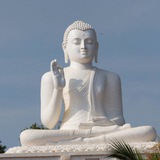
Forwarded from Buddha
Kruba Sri Wichai Monument, Wat Phra That Doi Suthep, Lamphun, Thailand.
👍1👏1🤩1😍1🏆1
2. Pàpañ ce puriso kayirà
na tam kayirà punappunam
Na tamhi chandam kayiràtha
dukkho pàpassa uccayo. 117.
DO NO EVIL AGAIN AND AGAIN
2. Should a person commit evil, he should not do it again and again; he should not find pleasure therein: painful is the accumulation of evil. 117.
Story
A monk used to commit a wrong act again and again. The Buddha reproved him and uttered this stanza.
===
Dhammapada, beloved and favorite teachings of the Buddha channel:
https://invite.viber.com/?g2=AQBLD6phsgvP%2F061YjEM3K%2BNeH1Yb372b9mtfQX2EmuBpgoLUoc99BDMfzHghrme
===
na tam kayirà punappunam
Na tamhi chandam kayiràtha
dukkho pàpassa uccayo. 117.
DO NO EVIL AGAIN AND AGAIN
2. Should a person commit evil, he should not do it again and again; he should not find pleasure therein: painful is the accumulation of evil. 117.
Story
A monk used to commit a wrong act again and again. The Buddha reproved him and uttered this stanza.
===
Dhammapada, beloved and favorite teachings of the Buddha channel:
https://invite.viber.com/?g2=AQBLD6phsgvP%2F061YjEM3K%2BNeH1Yb372b9mtfQX2EmuBpgoLUoc99BDMfzHghrme
===
Viber
Dhammapada - Buddha Dharma Teachings
Daily teachings of the Dhammapada, beloved and favorite teachings of the Buddha
🙏1👌1🏆1
Forwarded from Words of the Buddha
Free Buddha Dharma ebook
Come and See – An Introductory Theravada Buddhist Meditation Manual
By Bhante Henepola Gunaratna
Free download here:
https://ftp.budaedu.org/ebooks/pdf/EN497.pdf
===
Come and See – An Introductory Theravada Buddhist Meditation Manual
By Bhante Henepola Gunaratna
Free download here:
https://ftp.budaedu.org/ebooks/pdf/EN497.pdf
===
👍1😇1😘1
Forwarded from Words of the Buddha
Free Buddha Dharma ebook
Come and See – An Introductory Theravada Buddhist Meditation Manual
By Bhante Henepola Gunaratna
"Come and See" is an open invitation to practice and realize the Dhamma for oneself. It’s less a philosophical treatise and more a guidebook for living a life of awareness, compassion, and liberation. Bhante Gunaratana’s style is warm, direct, and filled with deep practical wisdom.
Main Themes
1. Ehipassiko – “Come and See”
The book begins by exploring the meaning of Ehipassiko, a Pali word that means “come and see for yourself.” This phrase embodies the Buddha’s invitation to investigate the Dhamma through direct experience, rather than blind belief.
2. The Four Noble Truths
Bhante G explains these core teachings as a framework for understanding suffering:
Dukkha – Suffering exists in life.
Samudaya – Suffering has a cause: craving.
Nirodha – There is an end to suffering.
Magga – The Eightfold Path leads to the end of suffering.
3. The Noble Eightfold Path
The Eightfold Path is presented not just as theory, but as a practical roadmap :Right View, Right Intention, Right Speech, Right Action, Right Livelihood, Right Effort, Right Mindfulness, Right Concentration
Bhante emphasizes that these factors must work together—not separately—to lead to awakening.
4. Meditation (Bhāvanā)
Mindfulness and concentration practices are deeply emphasized:
Mindfulness (Sati) is the foundation of insight.
Loving-kindness (Mettā) and compassion are crucial for developing wholesome states of mind.
Vipassanā (insight meditation) is how one sees the impermanent, unsatisfactory, and non-self nature of reality.
5. Ethical Living
Ethical conduct (sīla) is essential for a stable and peaceful mind. Bhante discusses the Five Precepts as a basis for morality and spiritual growth.
6. Faith and Inquiry
The book insists on a balance between faith (saddhā) and investigative wisdom (vicaya). Belief alone is not enough; one must test the teachings through practice and inner experience.
7. Simplicity and Renunciation
Bhante draws on his life as a forest monk to illustrate the peace and clarity that come from renouncing unnecessary desires.
8. Practical Wisdom
"Come and See" includes stories, analogies, and reflections that make complex teachings accessible. Bhante encourages readers to develop patience, self-honesty, and clarity through consistent mindfulness.
Free download here:
https://ftp.budaedu.org/ebooks/pdf/EN497.pdf
===
Come and See – An Introductory Theravada Buddhist Meditation Manual
By Bhante Henepola Gunaratna
"Come and See" is an open invitation to practice and realize the Dhamma for oneself. It’s less a philosophical treatise and more a guidebook for living a life of awareness, compassion, and liberation. Bhante Gunaratana’s style is warm, direct, and filled with deep practical wisdom.
Main Themes
1. Ehipassiko – “Come and See”
The book begins by exploring the meaning of Ehipassiko, a Pali word that means “come and see for yourself.” This phrase embodies the Buddha’s invitation to investigate the Dhamma through direct experience, rather than blind belief.
2. The Four Noble Truths
Bhante G explains these core teachings as a framework for understanding suffering:
Dukkha – Suffering exists in life.
Samudaya – Suffering has a cause: craving.
Nirodha – There is an end to suffering.
Magga – The Eightfold Path leads to the end of suffering.
3. The Noble Eightfold Path
The Eightfold Path is presented not just as theory, but as a practical roadmap :Right View, Right Intention, Right Speech, Right Action, Right Livelihood, Right Effort, Right Mindfulness, Right Concentration
Bhante emphasizes that these factors must work together—not separately—to lead to awakening.
4. Meditation (Bhāvanā)
Mindfulness and concentration practices are deeply emphasized:
Mindfulness (Sati) is the foundation of insight.
Loving-kindness (Mettā) and compassion are crucial for developing wholesome states of mind.
Vipassanā (insight meditation) is how one sees the impermanent, unsatisfactory, and non-self nature of reality.
5. Ethical Living
Ethical conduct (sīla) is essential for a stable and peaceful mind. Bhante discusses the Five Precepts as a basis for morality and spiritual growth.
6. Faith and Inquiry
The book insists on a balance between faith (saddhā) and investigative wisdom (vicaya). Belief alone is not enough; one must test the teachings through practice and inner experience.
7. Simplicity and Renunciation
Bhante draws on his life as a forest monk to illustrate the peace and clarity that come from renouncing unnecessary desires.
8. Practical Wisdom
"Come and See" includes stories, analogies, and reflections that make complex teachings accessible. Bhante encourages readers to develop patience, self-honesty, and clarity through consistent mindfulness.
Free download here:
https://ftp.budaedu.org/ebooks/pdf/EN497.pdf
===
👏1👌1💯1
The Buddha said this:
“Mendicants, if wanderers of other religions were to ask: ‘Reverends, all things have what as their root? What produces them? What is their origin? What is their meeting place? What is their chief? What is their ruler? What is their overseer? What is their core?’ You should answer them: ‘Reverends, all things are rooted in desire. They are produced by application of mind. Contact is their origin. Feeling is their meeting place. Immersion is their chief. Mindfulness is their ruler. Wisdom is their overseer. Freedom is their core.’ When questioned by wanderers of other religions, that’s how you should answer them.”
Partial excerpts from AN 8.83 Mūlakasutta: Rooted
“Mendicants, if wanderers of other religions were to ask: ‘Reverends, all things have what as their root? What produces them? What is their origin? What is their meeting place? What is their chief? What is their ruler? What is their overseer? What is their core?’ You should answer them: ‘Reverends, all things are rooted in desire. They are produced by application of mind. Contact is their origin. Feeling is their meeting place. Immersion is their chief. Mindfulness is their ruler. Wisdom is their overseer. Freedom is their core.’ When questioned by wanderers of other religions, that’s how you should answer them.”
Partial excerpts from AN 8.83 Mūlakasutta: Rooted
❤1🎉1🙏1😇1
Forwarded from Words of the Buddha
Enlightenments, Not Enlightenment
Awakening is not the same for everyone—even spiritual masters manifest their wisdom differently and took various paths to get there.
By Jack Kornfield
Part 1 of 3
On a meditation retreat several years ago, late one evening after the dharma talk, a woman raised her hand and asked one last question: “Is enlightenment just a myth?” When we teachers went back to our evening meeting, we asked each other this question. We exchanged stories about great spiritual teachers—the creative freedom of Ajahn Chah (1918–92), the enormous field of metta [lovingkindness] around Dipa Ma (1911–89), the joyous laughter of Poonja (1910–97)—and of our own awakenings. Of course there is enlightenment. But the word enlightenment is used in different ways, and that can be confusing. Is Zen, Tibetan, Hindu, or Theravada enlightenment the same? What is the difference between an enlightenment experience and full enlightenment? What do enlightened people look like?
Approaches to Enlightenment
Early on in my practice in Asia, I was forced to deal with these questions quite directly. My teachers, Ajahn Chah in Thailand and Mahasi Sayadaw in Burma, were considered among the most enlightened masters of Theravada Buddhism. While they both described the goal of practice as freedom from greed, hatred and delusion, they didn’t agree about how to attain enlightenment, or how it is experienced. I started my monastic training practicing in community with Ajahn Chah. Then I went to study in a monastery of Mahasi Sayadaw, where the path of liberation focuses entirely on long silent meditation retreats.
In the Mahasi system, you sit and walk for weeks in the retreat context and continuously note the arising of breath, thought, feelings, and sensations over and over until the mindfulness is so refined there is nothing but instantaneous arising and passing. You pass through stages of luminosity, joy, fear, and the dissolution of all you took to be solid. The mind becomes unmoving, resting in a place of stillness and equanimity, transparent to all experience—thoughts and fears, longings and love. Out of this there comes a dropping away of identity with anything in this world, an opening to the unconditioned beyond mind and body; you enter into the stream of liberation. As taught by Mahasi Sayadaw, this first taste of stream-entry to enlightenment requires purification and strong concentration leading to an experience of cessation that begins to uproot greed, hatred, and delusion.
When I returned to practice in Ajahn Chah’s community following more than a year of silent Mahasi retreat, I recounted all of these experiences—dissolving my body into light, profound insights into emptiness, hours of vast stillness, and freedom. Ajahn Chah understood and appreciated them from his own deep wisdom. Then he smiled and said, “Well, something else to let go of.” His approach to enlightenment was not based on having any particular meditation experience, no matter how profound. As Ajahn Chah described them, meditative states are not important in themselves. Meditation is a way to quiet the mind so you can practice all day long wherever you are; see when there is grasping or aversion, clinging or suffering; and then let it go. What’s left is enlightenment, always found here and now, a release of identification with the changing conditions of the world, a resting in awareness. This involves a simple yet profound shift of identity from the myriad, ever-changing conditioned states to the unconditioned consciousness—the awareness which knows them all. In Ajahn Chah’s approach, release from entanglement in greed, hatred, and delusion does not happen through retreat, concentration, and cessation but from this profound shift in identity.
How can we understand these seemingly different approaches to enlightenment? The Buddhist texts contain some of the same contrasting denoscriptions.
Awakening is not the same for everyone—even spiritual masters manifest their wisdom differently and took various paths to get there.
By Jack Kornfield
Part 1 of 3
On a meditation retreat several years ago, late one evening after the dharma talk, a woman raised her hand and asked one last question: “Is enlightenment just a myth?” When we teachers went back to our evening meeting, we asked each other this question. We exchanged stories about great spiritual teachers—the creative freedom of Ajahn Chah (1918–92), the enormous field of metta [lovingkindness] around Dipa Ma (1911–89), the joyous laughter of Poonja (1910–97)—and of our own awakenings. Of course there is enlightenment. But the word enlightenment is used in different ways, and that can be confusing. Is Zen, Tibetan, Hindu, or Theravada enlightenment the same? What is the difference between an enlightenment experience and full enlightenment? What do enlightened people look like?
Approaches to Enlightenment
Early on in my practice in Asia, I was forced to deal with these questions quite directly. My teachers, Ajahn Chah in Thailand and Mahasi Sayadaw in Burma, were considered among the most enlightened masters of Theravada Buddhism. While they both described the goal of practice as freedom from greed, hatred and delusion, they didn’t agree about how to attain enlightenment, or how it is experienced. I started my monastic training practicing in community with Ajahn Chah. Then I went to study in a monastery of Mahasi Sayadaw, where the path of liberation focuses entirely on long silent meditation retreats.
In the Mahasi system, you sit and walk for weeks in the retreat context and continuously note the arising of breath, thought, feelings, and sensations over and over until the mindfulness is so refined there is nothing but instantaneous arising and passing. You pass through stages of luminosity, joy, fear, and the dissolution of all you took to be solid. The mind becomes unmoving, resting in a place of stillness and equanimity, transparent to all experience—thoughts and fears, longings and love. Out of this there comes a dropping away of identity with anything in this world, an opening to the unconditioned beyond mind and body; you enter into the stream of liberation. As taught by Mahasi Sayadaw, this first taste of stream-entry to enlightenment requires purification and strong concentration leading to an experience of cessation that begins to uproot greed, hatred, and delusion.
When I returned to practice in Ajahn Chah’s community following more than a year of silent Mahasi retreat, I recounted all of these experiences—dissolving my body into light, profound insights into emptiness, hours of vast stillness, and freedom. Ajahn Chah understood and appreciated them from his own deep wisdom. Then he smiled and said, “Well, something else to let go of.” His approach to enlightenment was not based on having any particular meditation experience, no matter how profound. As Ajahn Chah described them, meditative states are not important in themselves. Meditation is a way to quiet the mind so you can practice all day long wherever you are; see when there is grasping or aversion, clinging or suffering; and then let it go. What’s left is enlightenment, always found here and now, a release of identification with the changing conditions of the world, a resting in awareness. This involves a simple yet profound shift of identity from the myriad, ever-changing conditioned states to the unconditioned consciousness—the awareness which knows them all. In Ajahn Chah’s approach, release from entanglement in greed, hatred, and delusion does not happen through retreat, concentration, and cessation but from this profound shift in identity.
How can we understand these seemingly different approaches to enlightenment? The Buddhist texts contain some of the same contrasting denoscriptions.
Telegram
Words of the Buddha
Daily teachings of Buddha Dharma
💯1🆒1
Forwarded from Words of the Buddha
In many texts, nirvana is described in the language of negation, and as in the approach taught by Mahasi Sayadaw, enlightenment is presented as the end of suffering through the putting out of the fires of craving, the uprooting of all forms of clinging. The elimination of suffering is practiced by purification and concentration, by confronting the forces of greed and hate and overcoming them. When the Buddha was asked, “Do you teach annihilation? Is nirvana the end of things as we know them?” he responded, “I teach only one form of annihilation: the extinction of greed, the extinction of hatred, the extinction of delusion. This I call nirvana.”
There is in the texts, as well, a more positive way of understanding enlightenment. Here nirvana is described as the highest happiness; as peace, freedom, purity, stillness; and as the unconditioned, the timeless, the undying. In this understanding, as in Ajahn Chah’s approach, liberation comes through a shift of identity—a release from attachment to the changing conditions of the world, a resting in consciousness itself, the deathless.
In this understanding, liberation is a shift of identity from taking anything as “self.” Asked, “How is it that one is not to be seen by the king of death?” the Buddha responded, “For one who takes nothing whatsoever as I or me or mine, such a one is freed from the snares of the king of death.” In just this way, Ajahn Chah instructed us to rest in awareness and not identify with any experience as I or mine.
I found a similar practice in Bombay with Sri Nisargadatta, a master of Advaita [a nondualistic practice of self-inquiry derived from Hinduism]. His teachings about enlightenment demanded a shift from identifying with any experience to resting in consciousness wherever you are. His focus was not about annihilation of greed and hate. In fact, when asked if he ever got impatient, Nisargadatta joyfully explained, “I see, hear and taste as you do, feel hunger and thirst; if lunch is not served on time, even impatience will arise. All this I perceive quite clearly, but somehow I am not in it. There is awareness of it all and a sense of immense distance. Impatience arises; hunger arises. Even when illness and death of this body arise, they have nothing to do with who I am.” This is enlightenment as a shift in identity.
So here we have different visions of enlightenment. On the one hand, we have the liberation from greed, hatred, and delusion attained through powerful concentration and purification, emphasized by many masters from Mahasi and Sunlun Sayadaw to Rinzai Zen. On the other hand, we have the shift of identity reflected in the teachings of Ajahn Chah, Buddhadasa, Soto Zen, and Dzogchen. And there are many other approaches; if you practice Pure Land Buddhism, which is the most widespread tradition in China, the approach to enlightenment involves devotion and surrender, being carried by the Buddha’s “grace.”
===
Words of the Buddha channel:
https://news.1rj.ru/str/wordsofbuddha
===
There is in the texts, as well, a more positive way of understanding enlightenment. Here nirvana is described as the highest happiness; as peace, freedom, purity, stillness; and as the unconditioned, the timeless, the undying. In this understanding, as in Ajahn Chah’s approach, liberation comes through a shift of identity—a release from attachment to the changing conditions of the world, a resting in consciousness itself, the deathless.
In this understanding, liberation is a shift of identity from taking anything as “self.” Asked, “How is it that one is not to be seen by the king of death?” the Buddha responded, “For one who takes nothing whatsoever as I or me or mine, such a one is freed from the snares of the king of death.” In just this way, Ajahn Chah instructed us to rest in awareness and not identify with any experience as I or mine.
I found a similar practice in Bombay with Sri Nisargadatta, a master of Advaita [a nondualistic practice of self-inquiry derived from Hinduism]. His teachings about enlightenment demanded a shift from identifying with any experience to resting in consciousness wherever you are. His focus was not about annihilation of greed and hate. In fact, when asked if he ever got impatient, Nisargadatta joyfully explained, “I see, hear and taste as you do, feel hunger and thirst; if lunch is not served on time, even impatience will arise. All this I perceive quite clearly, but somehow I am not in it. There is awareness of it all and a sense of immense distance. Impatience arises; hunger arises. Even when illness and death of this body arise, they have nothing to do with who I am.” This is enlightenment as a shift in identity.
So here we have different visions of enlightenment. On the one hand, we have the liberation from greed, hatred, and delusion attained through powerful concentration and purification, emphasized by many masters from Mahasi and Sunlun Sayadaw to Rinzai Zen. On the other hand, we have the shift of identity reflected in the teachings of Ajahn Chah, Buddhadasa, Soto Zen, and Dzogchen. And there are many other approaches; if you practice Pure Land Buddhism, which is the most widespread tradition in China, the approach to enlightenment involves devotion and surrender, being carried by the Buddha’s “grace.”
===
Words of the Buddha channel:
https://news.1rj.ru/str/wordsofbuddha
===
Telegram
Words of the Buddha
Daily teachings of Buddha Dharma
❤1👍1🫡1
3. Puññam ce puriso kayirà
kayiràth'etam punappunam
Tamhi chandam kayiràtha
sukho puññassa uccayo. 118.
DO GOOD AGAIN AND AGAIN
3. Should a person perform a meritorious action, he should do it again and again; he should find pleasure therein: blissful is the accumulation of merit. 118.
Story
A poor but devout woman offered some food to an Arahant. Bitten by a serpent, she died and was born in a heavenly state. As a goddess she came early in the morning to clean the premises of the Arahant to increase her good fortune. The Arahant prevented her from doing so. She was grieved. The Buddha perceived her sad state of mind and advised her.
===
Ajahn Chah, Buddhist teacher of Thai forest meditation of Theravada Buddhism channel:
https://news.1rj.ru/str/ajahnchah_buddhism
===
kayiràth'etam punappunam
Tamhi chandam kayiràtha
sukho puññassa uccayo. 118.
DO GOOD AGAIN AND AGAIN
3. Should a person perform a meritorious action, he should do it again and again; he should find pleasure therein: blissful is the accumulation of merit. 118.
Story
A poor but devout woman offered some food to an Arahant. Bitten by a serpent, she died and was born in a heavenly state. As a goddess she came early in the morning to clean the premises of the Arahant to increase her good fortune. The Arahant prevented her from doing so. She was grieved. The Buddha perceived her sad state of mind and advised her.
===
Ajahn Chah, Buddhist teacher of Thai forest meditation of Theravada Buddhism channel:
https://news.1rj.ru/str/ajahnchah_buddhism
===
Telegram
Ajahn Chah - Theravada Thailand Buddhism
Collection of teachings of Venerable Ajahn Chah, a foremost meditation and Buddhist teacher from Thailand
👍1🥰1🆒1
Forwarded from Buddha
Giant Reclining Buddha statue, Ko Yin Lay Pagoda, Mawlamyine, Myanmar.
👍1🥰1👌1🤗1
Enlightenments, Not Enlightenment
Awakening is not the same for everyone—even spiritual masters manifest their wisdom differently and took various paths to get there.
By Jack Kornfield
Part 2 of 3
To understand these differences, it is wisest to speak of enlightenment with the plural s—as enlightenments. It’s the same way with God. There are so many forms: Jehovah, Allah, Brahma, Jesus, Kali, and so forth. As soon as followers say they know the one true God, conflict arises. Similarly, if you speak of enlightenment as one thing, conflict arises and you miss the truth.
We know that the Buddha taught many different approaches to enlightenment, all as skillful means to release grasping of the limited sense of self and return to the inherent purity of consciousness. Similarly, we will discover that the teachings on enlightened consciousness include many dimensions. When you actually experience consciousness free of identification with changing conditions, liberated from greed and hate, you find it multifaceted, like a mandala or a jewel with many sides. Through one facet, the enlightened heart shines as luminous clarity, through another as perfect peace, through another as boundless compassion. Consciousness is timeless, ever-present, completely empty and full of all things. But when a teacher or tradition emphasizes only one of these qualities over the others, it is easy to be confused, as if true enlightenment can be tasted in only one way. Like the particle-and-wave nature of light, enlightenment consciousness is experienced in a myriad of beautiful ways.
Gateways to Enlightenment
So what practices lead to these enlightenments? Most centrally, Buddhism uses the liberating practices of mindfulness and lovingkindness. These are supported by the practice of virtue, which frees us from being caught in reactive energies that would cause harm to ourselves or others. Added to this are practices of composure, or concentration, where we learn to quiet the mind; and practices of wisdom, which can see clearly how all things arise and pass, how they cannot be possessed. Through these practices come purification and healing and the arising of profound compassion. Gradually, there is a shift of identity from being the person who is caught in suffering to liberation. Releasing the sense of self and all the changing conditions of the world brings stream-entry, the first stage of enlightenment.
The most common gates to stream-entry in the Theravada tradition are the gateway of impermanence, the gateway of suffering, and the gateway of selflessness. When we open through the gateway of impermanence, we see more and more deeply how every experience is born and dies, how every moment is new. In one monastery where I practiced, we were trained to experience how all of life is vibration. Through long hours of refined concentration, we came to sense all the sounds and sights, the breath, the procession of thoughts—everything we took to be ourself—as a field of changing energy. Experience shimmered, dissolving moment by moment. Then we shifted our attention from the vibrations to rest in the spacious heart of awareness. I and other, inside and outside—everything dropped away and we came to know the vast stillness beyond all change. This is enlightenment through the gate of impermanence.
Sometimes we enter enlightenment through the gate of suffering. We sit in the fire of human experience, and instead of running from it, we awaken through it. In the Fire Sermon, the Buddha declares, “All is burning. The eye, the nose, the tongue, the body, the mind, the world is burning. With what is it burning? It is burning with the fires of greed, of hatred, and of delusion.” Through the gate of suffering we face the fires of desire, hate, war, racism, and fear. We open to dissatisfaction, grief, and loss. We accept the inherent suffering in life and we are released. We discover that suffering is not “our” pain, it is “the” pain—the pain of the world. A profound dispassion arises, compassion fills the heart, and we find liberation.
Awakening is not the same for everyone—even spiritual masters manifest their wisdom differently and took various paths to get there.
By Jack Kornfield
Part 2 of 3
To understand these differences, it is wisest to speak of enlightenment with the plural s—as enlightenments. It’s the same way with God. There are so many forms: Jehovah, Allah, Brahma, Jesus, Kali, and so forth. As soon as followers say they know the one true God, conflict arises. Similarly, if you speak of enlightenment as one thing, conflict arises and you miss the truth.
We know that the Buddha taught many different approaches to enlightenment, all as skillful means to release grasping of the limited sense of self and return to the inherent purity of consciousness. Similarly, we will discover that the teachings on enlightened consciousness include many dimensions. When you actually experience consciousness free of identification with changing conditions, liberated from greed and hate, you find it multifaceted, like a mandala or a jewel with many sides. Through one facet, the enlightened heart shines as luminous clarity, through another as perfect peace, through another as boundless compassion. Consciousness is timeless, ever-present, completely empty and full of all things. But when a teacher or tradition emphasizes only one of these qualities over the others, it is easy to be confused, as if true enlightenment can be tasted in only one way. Like the particle-and-wave nature of light, enlightenment consciousness is experienced in a myriad of beautiful ways.
Gateways to Enlightenment
So what practices lead to these enlightenments? Most centrally, Buddhism uses the liberating practices of mindfulness and lovingkindness. These are supported by the practice of virtue, which frees us from being caught in reactive energies that would cause harm to ourselves or others. Added to this are practices of composure, or concentration, where we learn to quiet the mind; and practices of wisdom, which can see clearly how all things arise and pass, how they cannot be possessed. Through these practices come purification and healing and the arising of profound compassion. Gradually, there is a shift of identity from being the person who is caught in suffering to liberation. Releasing the sense of self and all the changing conditions of the world brings stream-entry, the first stage of enlightenment.
The most common gates to stream-entry in the Theravada tradition are the gateway of impermanence, the gateway of suffering, and the gateway of selflessness. When we open through the gateway of impermanence, we see more and more deeply how every experience is born and dies, how every moment is new. In one monastery where I practiced, we were trained to experience how all of life is vibration. Through long hours of refined concentration, we came to sense all the sounds and sights, the breath, the procession of thoughts—everything we took to be ourself—as a field of changing energy. Experience shimmered, dissolving moment by moment. Then we shifted our attention from the vibrations to rest in the spacious heart of awareness. I and other, inside and outside—everything dropped away and we came to know the vast stillness beyond all change. This is enlightenment through the gate of impermanence.
Sometimes we enter enlightenment through the gate of suffering. We sit in the fire of human experience, and instead of running from it, we awaken through it. In the Fire Sermon, the Buddha declares, “All is burning. The eye, the nose, the tongue, the body, the mind, the world is burning. With what is it burning? It is burning with the fires of greed, of hatred, and of delusion.” Through the gate of suffering we face the fires of desire, hate, war, racism, and fear. We open to dissatisfaction, grief, and loss. We accept the inherent suffering in life and we are released. We discover that suffering is not “our” pain, it is “the” pain—the pain of the world. A profound dispassion arises, compassion fills the heart, and we find liberation.
Telegram
Dhammapada - Buddha Dharma Teachings
Daily teachings of the Dhammapada, beloved and favorite teachings of the Buddha
🙏2👏1
My friend Salam, a Palestinian journalist and activist, passed through the gate of suffering when brutally beaten in Israeli prisons. This kind of suffering happens on every side in war. When I first met Salam in San Francisco, he was being honored for his hospice service. I asked him what brought him to this work. “One time I died,” Salam told me. Kicked by a guard, he lay on the floor of the jail with blood coming out of his mouth, and his consciousness floated out of his body. Suddenly, he felt so peaceful—a kind of bliss—as he saw he wasn’t that body. “I was so much more: I was the boot and the guard, the goat calling outside the walls of the police station. I was all of it,” Salam told me. “When I got out of jail, I couldn’t take sides anymore. I married a Jewish woman and had Jewish-Palestinian children. That is my answer.” Salam explains, “Now I sit with people who are dying because they are afraid, and I can hold their hands and reassure them that it’s perfectly safe.” He awakened through the gate of suffering.
Sometimes we awaken through the gate of selflessness. The experience of selflessness can happen in the simplest ways. In walking meditation, we notice with every step the unbidden arising of thoughts, feelings, sensations, only to observe them disappear. To whom do they belong? Where do they go? Back into the void, which is where yesterday went, as well as our childhood, Socrates, Genghis Khan, and the builders of the pyramids.
As we let go of clinging, we feel the tentative selflessness of things. Sometimes boundaries dissolve, and we can’t separate ourself from the plum tree, the birdsong, or the morning traffic. The whole sense of self becomes empty experience arising in consciousness. More and more deeply, we realize the joy of “no self, no problem.” We taste enlightenment through the gate of selflessness and emptiness.
There are many other gates: the gates of compassion, of purity, of surrender, of love. There is also what is called the “gateless gate.” One teacher describes it this way: “I would go for months of retreat training, and nothing spectacular would happen, no great experiences. Yet somehow everything changed. What most transformed me were the endless hours of mindfulness and compassion, giving a caring attention to what I was doing. I discovered how I automatically tighten and grasp, and with that realization I started to let go, to open to an appreciation of whatever was present. I found an ease. I gave up striving. I became less serious, less concerned with myself. My kindness deepened. I experienced a profound freedom, simply the fruit of being present over and over.” This was her gateless gate.
===
Part 1 of 3:
https://news.1rj.ru/str/wordsofbuddha/4743
Part 2 of 3:
https://news.1rj.ru/str/dhammapadas/3408
Part 3 of 3:
https://news.1rj.ru/str/lorddivinebuddha/3870
===
Dhammapada, beloved and favorite teachings of the Buddha channel:
https://news.1rj.ru/str/dhammapadas
===
Sometimes we awaken through the gate of selflessness. The experience of selflessness can happen in the simplest ways. In walking meditation, we notice with every step the unbidden arising of thoughts, feelings, sensations, only to observe them disappear. To whom do they belong? Where do they go? Back into the void, which is where yesterday went, as well as our childhood, Socrates, Genghis Khan, and the builders of the pyramids.
As we let go of clinging, we feel the tentative selflessness of things. Sometimes boundaries dissolve, and we can’t separate ourself from the plum tree, the birdsong, or the morning traffic. The whole sense of self becomes empty experience arising in consciousness. More and more deeply, we realize the joy of “no self, no problem.” We taste enlightenment through the gate of selflessness and emptiness.
There are many other gates: the gates of compassion, of purity, of surrender, of love. There is also what is called the “gateless gate.” One teacher describes it this way: “I would go for months of retreat training, and nothing spectacular would happen, no great experiences. Yet somehow everything changed. What most transformed me were the endless hours of mindfulness and compassion, giving a caring attention to what I was doing. I discovered how I automatically tighten and grasp, and with that realization I started to let go, to open to an appreciation of whatever was present. I found an ease. I gave up striving. I became less serious, less concerned with myself. My kindness deepened. I experienced a profound freedom, simply the fruit of being present over and over.” This was her gateless gate.
===
Part 1 of 3:
https://news.1rj.ru/str/wordsofbuddha/4743
Part 2 of 3:
https://news.1rj.ru/str/dhammapadas/3408
Part 3 of 3:
https://news.1rj.ru/str/lorddivinebuddha/3870
===
Dhammapada, beloved and favorite teachings of the Buddha channel:
https://news.1rj.ru/str/dhammapadas
===
Telegram
Dhammapada - Buddha Dharma Teachings
Daily teachings of the Dhammapada, beloved and favorite teachings of the Buddha
❤1🕊1
Thus I heard: At one time the Gracious One was dwelling near Sāvatthī, in Jetavana, at Anāthapiṇḍika’s monastery. Then at that time the Gracious One was instructing, rousing, enthusing, & cheering the monks with a Dhamma talk connected with Emancipation. Those monks, after making it their goal, applying their minds, considering it with all their mind, were listening to Dhamma with an attentive ear.
Then the Gracious One, having understood the significance of it, on that occasion uttered this exalted utterance:
“There is that sphere,where there is no earth, no water, no fire, no air, no sphere of infinite space, no sphere of infinite consciousness, no sphere of nothingness, no sphere of neither perception nor non-perception, no this world, no world beyond, neither Moon nor Sun. There, I say there is surely no coming, no going, no persisting, no passing away, no rebirth It is quite without support, unmoving, without an object,—just this is the end of suffering.”
Udana 8.1: Paṭhamanibbānapaṭi saṁyutta sutta
Then the Gracious One, having understood the significance of it, on that occasion uttered this exalted utterance:
“There is that sphere,where there is no earth, no water, no fire, no air, no sphere of infinite space, no sphere of infinite consciousness, no sphere of nothingness, no sphere of neither perception nor non-perception, no this world, no world beyond, neither Moon nor Sun. There, I say there is surely no coming, no going, no persisting, no passing away, no rebirth It is quite without support, unmoving, without an object,—just this is the end of suffering.”
Udana 8.1: Paṭhamanibbānapaṭi saṁyutta sutta
🙏3👌1🕊1
Free Buddha Dharma ebook
Seeing Through
A Guide to Insight Meditation
By Bhikkhu Katukurunde Nanananda
Free download available:
https://www.lotuslibrary.com/wp-content/uploads/2024/12/2015-seeing-through_Nanananda.pdf
===
Seeing Through
A Guide to Insight Meditation
By Bhikkhu Katukurunde Nanananda
Free download available:
https://www.lotuslibrary.com/wp-content/uploads/2024/12/2015-seeing-through_Nanananda.pdf
===
👏1🏆1
Free Buddha Dharma ebook
Seeing Through
A Guide to Insight Meditation
By Bhikkhu Katukurunde Nanananda
Insight meditation paves the way to that penetrative wisdom which delivers the mind from bondage to Samsāra. This bondage often baffles the thinker because there is a 'catch' in the tools he has to take up to break it. Percepts are subtly elusive and concepts are tacitly delusive. So the insight worker has to forge his own tools to break this bondage, going the Buddha's Middle Way.
The present sermon, based on a verse from the 'Section on the Wise' in the Dhammapada, might drop some helpful hints for the insight meditator climbing the steep path of meditative attention alone, apart, untiring. The original sermon in Sinhala was cassetted at the request of Venerable Navagamuve Sugunasära Thera during my stay at Meetirigala Nissarana Vanaya. It touches upon the progressive stages in Insight Meditation and the last four of the 16 steps in Änāpānasati meditation, while drawing upon the implications of the Dhammapada verse.
This sermon has now been published in Sinhala under the noscript 'Vidasun Upades' at the instance of Mr. U. Mapa, the Public Trustee, under the auspices of the 'Bhikkhu Kasyapa' Trust' in memory of the late Venerable Kassapa Thera of Vajirārāma, Bambalapitiya.
Free download available:
https://www.lotuslibrary.com/wp-content/uploads/2024/12/2015-seeing-through_Nanananda.pdf
===
Seeing Through
A Guide to Insight Meditation
By Bhikkhu Katukurunde Nanananda
Insight meditation paves the way to that penetrative wisdom which delivers the mind from bondage to Samsāra. This bondage often baffles the thinker because there is a 'catch' in the tools he has to take up to break it. Percepts are subtly elusive and concepts are tacitly delusive. So the insight worker has to forge his own tools to break this bondage, going the Buddha's Middle Way.
The present sermon, based on a verse from the 'Section on the Wise' in the Dhammapada, might drop some helpful hints for the insight meditator climbing the steep path of meditative attention alone, apart, untiring. The original sermon in Sinhala was cassetted at the request of Venerable Navagamuve Sugunasära Thera during my stay at Meetirigala Nissarana Vanaya. It touches upon the progressive stages in Insight Meditation and the last four of the 16 steps in Änāpānasati meditation, while drawing upon the implications of the Dhammapada verse.
This sermon has now been published in Sinhala under the noscript 'Vidasun Upades' at the instance of Mr. U. Mapa, the Public Trustee, under the auspices of the 'Bhikkhu Kasyapa' Trust' in memory of the late Venerable Kassapa Thera of Vajirārāma, Bambalapitiya.
Free download available:
https://www.lotuslibrary.com/wp-content/uploads/2024/12/2015-seeing-through_Nanananda.pdf
===
👌1💯1