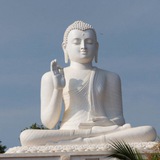
Dhammapada Verse 28
Mahakassapatthera Vatthu
Pamadam appamadena
yada nudati pandito
pannapasadamaruyha
asoko sokinim pajam
pabbatatthova bhumatthe
dhiro1 bale2 avekkhati.
Verse 28: The wise one dispels negligence by means of mindfulness; he ascends the tower of wisdom and being free from sorrow looks at the sorrowing beings. Just as one on the mountain top looks at those on the plain below, so also, the wise one (the arahat) looks at the foolish and the ignorant (worldlings).
1. dhiro: the wise one; in this context, the arahat.
2. bile: the foolish; in this context, the worldings.
The Story of Thera Mahakassapa
While residing at the Jetavana monastery, the Buddha uttered Verse (28) of this book, with reference to Thera Mahakassapa.
On one occasion, while Thera Mahakassapa was staying at Pipphali cave, he spent his time developing the mental image of light (aloka kasina) and trying to find out through Divine Vision, beings who were mindful and beings who were negligent, also those who were about to die and those who were about to be born.
From his monastery, the Buddha saw through his Divine Vision what Thera Mahakassapa was doing and wanted to warn him that he was wasting his time. So he sent forth his radiance and appeared seated before the thera and exhorted him thus: "My son Kassapa, the number of births and deaths of beings is innumerable and cannot be counted. It is not your concern to count them; it is the concern only of the Buddhas."
Then the Buddha spoke in verse as follows:
Verse 28. The wise one dispels negligence by means of mindfulness; he ascends the pinnacle of wisdom and being free from sorrow looks at the sorrowing beings. Just as one on the mountain top looks at those on the plain below, so also, the wise one (the arahat) looks at the foolish and the ignorant (worldlings).
Dhammapada, beloved and favorite teachings of the Buddha channel:
https://news.1rj.ru/str/dhammapadas
====================
Mahakassapatthera Vatthu
Pamadam appamadena
yada nudati pandito
pannapasadamaruyha
asoko sokinim pajam
pabbatatthova bhumatthe
dhiro1 bale2 avekkhati.
Verse 28: The wise one dispels negligence by means of mindfulness; he ascends the tower of wisdom and being free from sorrow looks at the sorrowing beings. Just as one on the mountain top looks at those on the plain below, so also, the wise one (the arahat) looks at the foolish and the ignorant (worldlings).
1. dhiro: the wise one; in this context, the arahat.
2. bile: the foolish; in this context, the worldings.
The Story of Thera Mahakassapa
While residing at the Jetavana monastery, the Buddha uttered Verse (28) of this book, with reference to Thera Mahakassapa.
On one occasion, while Thera Mahakassapa was staying at Pipphali cave, he spent his time developing the mental image of light (aloka kasina) and trying to find out through Divine Vision, beings who were mindful and beings who were negligent, also those who were about to die and those who were about to be born.
From his monastery, the Buddha saw through his Divine Vision what Thera Mahakassapa was doing and wanted to warn him that he was wasting his time. So he sent forth his radiance and appeared seated before the thera and exhorted him thus: "My son Kassapa, the number of births and deaths of beings is innumerable and cannot be counted. It is not your concern to count them; it is the concern only of the Buddhas."
Then the Buddha spoke in verse as follows:
Verse 28. The wise one dispels negligence by means of mindfulness; he ascends the pinnacle of wisdom and being free from sorrow looks at the sorrowing beings. Just as one on the mountain top looks at those on the plain below, so also, the wise one (the arahat) looks at the foolish and the ignorant (worldlings).
Dhammapada, beloved and favorite teachings of the Buddha channel:
https://news.1rj.ru/str/dhammapadas
====================
Telegram
Dhammapada - Buddha Dharma Teachings
Daily teachings of the Dhammapada, beloved and favorite teachings of the Buddha
❤1👍1
Dhammapada Verse 29
Dvesahayakabhikkhu Vatthu
Appamatto pamattesu
suttesu bahujagaro
abalassa mva sighasso
hitva yati sumedhaso.1
Verse 29: Mindful amongst the negligent, highly vigilant amongst the drowsy, the man of wisdom advances like a race-horse, leaving the jade behind.
1. sumedhaso: the wise one: the wise one advances steadily until he realizes Magga, Phala and Nibbana, leaving the negligent ones behind in the round of rebirths (samsara).
The Story of the Two Companion Bhikkhus
While residing at the Jetavana monastery, the Buddha tittered Verse (29) of this book, with reference to two bhikkhus, who were friends.
Two bhikkhus, after obtaining a subject of meditation from the Buddha, went to a monastery in the forest. One of them, being negligent, spent his time warming himself by the fire and talking to young novices throughout the first watch of the night, and generally idling away his time. The other faithfully performed the duties of a bhikkhu. He walked in meditation during the first watch, rested during the second watch and again meditated during the last watch of the night. Thus, being diligent and ever mindful, the second bhikkhu attained arahatship within a short time.
At the end of the rainy season (vassa) both of them went to pay obeisance to the Buddha, and the Buddha asked them how they had spent their time during the vassa. To this, the lazy and negligent bhikkhu answered that the other bhikkhu had been idling away his time, just lying down and sleeping. The Buddha then asked, "But, what about you?" His reply was that he generally sat warming himself by the fire during the first watch of the night and then sat up without sleeping. But the Buddha knew quite well how the two bhikkhus had spent their time, so he said to the idle one: "Though you are lazy and negligent you claim to be diligent and ever mindful; but you have made the other bhikkhu appear to be lazy and negligent though he is diligent and ever mindful. You are like a weak and slow horse compared to my son who is like a strong, fleet-footed horse."
Then the Buddha spoke in verse as follows:
Verse 29: Mindful amongst the negligent, highly vigilant amongst the drowsy, the man of wisdom advances like a race-horse, leaving the jade behind.
Buddha dharma teachings channel:
https://invite.viber.com/?g2=AQAKw1y3rv%2F6sk61PI2W4izuIiaEZj8YZujhY1tSzL%2B07s7rFnVFDAd0bAYFaMLw
Dvesahayakabhikkhu Vatthu
Appamatto pamattesu
suttesu bahujagaro
abalassa mva sighasso
hitva yati sumedhaso.1
Verse 29: Mindful amongst the negligent, highly vigilant amongst the drowsy, the man of wisdom advances like a race-horse, leaving the jade behind.
1. sumedhaso: the wise one: the wise one advances steadily until he realizes Magga, Phala and Nibbana, leaving the negligent ones behind in the round of rebirths (samsara).
The Story of the Two Companion Bhikkhus
While residing at the Jetavana monastery, the Buddha tittered Verse (29) of this book, with reference to two bhikkhus, who were friends.
Two bhikkhus, after obtaining a subject of meditation from the Buddha, went to a monastery in the forest. One of them, being negligent, spent his time warming himself by the fire and talking to young novices throughout the first watch of the night, and generally idling away his time. The other faithfully performed the duties of a bhikkhu. He walked in meditation during the first watch, rested during the second watch and again meditated during the last watch of the night. Thus, being diligent and ever mindful, the second bhikkhu attained arahatship within a short time.
At the end of the rainy season (vassa) both of them went to pay obeisance to the Buddha, and the Buddha asked them how they had spent their time during the vassa. To this, the lazy and negligent bhikkhu answered that the other bhikkhu had been idling away his time, just lying down and sleeping. The Buddha then asked, "But, what about you?" His reply was that he generally sat warming himself by the fire during the first watch of the night and then sat up without sleeping. But the Buddha knew quite well how the two bhikkhus had spent their time, so he said to the idle one: "Though you are lazy and negligent you claim to be diligent and ever mindful; but you have made the other bhikkhu appear to be lazy and negligent though he is diligent and ever mindful. You are like a weak and slow horse compared to my son who is like a strong, fleet-footed horse."
Then the Buddha spoke in verse as follows:
Verse 29: Mindful amongst the negligent, highly vigilant amongst the drowsy, the man of wisdom advances like a race-horse, leaving the jade behind.
Buddha dharma teachings channel:
https://invite.viber.com/?g2=AQAKw1y3rv%2F6sk61PI2W4izuIiaEZj8YZujhY1tSzL%2B07s7rFnVFDAd0bAYFaMLw
Viber
Buddha
Buddha dharma teachings from the suttas and commentaries from Theravada tradition
❤1👍1
Overcoming Ill Will
How to change the way we interact with those who anger us
By Bhante Henepola Gunaratana
As a practice that trains the mind to become gentle and considerate, metta is a powerful method to dissolve our habits of thinking about, speaking to, and treating others with ill will.
In the Discourse on Repression of Ill Will (Aghata Vinaya Sutta), Sariputta, one of the Buddha’s leading disciples, offers five practices for overcoming ill will and practicing loving-friendliness. These examples show us simple ways to think about complex, difficult situations. When we are with others, as our metta is sprouting in our hearts, we may face situations that challenge us. We know that we need to overcome whatever ill will remains in our minds toward others, but we are tempted to fall into old patterns of judging and distancing ourselves from them. These practices offer a different way of interacting with people who anger us.
The Dirty Rag
We may come across people whose words are kind, but whose bodily behavior is not. They make promises they can’t keep and act evasively, or say nice things to us but act poorly. We can consider behaving toward them like the monk who, while walking down the road, comes across a dirty rag. The rag is so filthy he can’t even pick it up with his hands, so he holds it with one foot while he kicks it with the other foot to clean it off. Then he picks it up with two fingers, shakes it off, brings it home, and washes it. He sees that this once-dirty rag is in fact completely functional and he sews it onto his patchwork robes!
When we encounter people whose deeds are not good but whose words are pleasant, we can search for ways to arouse loving-friendliness within ourselves. We can certainly find one reason or another to do so—we can grasp onto their kind words in the same way the monk saw the value of the cloth obscured by dirt. We admire and respect these people for their words and arouse our own loving-friendliness to share with them. If we are able to associate with them and show them loving-friendliness, it might encourage them to change their way of acting. But we do not pay attention to their actions. Focusing on and encouraging others’ positive words gives their kindness room to blossom naturally. Additionally, when we learn to practice compassion and equanimity toward people in this way, our own thoughts of ill will toward them are subdued.
Keep in mind that the layers of conditioning on a person have made them difficult to handle, just like the layers of dirt on the cloth. Perhaps they have faced hardship unknown to us—such as losing a friend or family member, home, or job. Maybe they were mistreated or abused as a child and this contributed to their thinking that rough behavior is a normal part of life. What matters for us is that we see that someone is suffering. We can offer them our loving-friendliness.
The Algae-Covered Pond
Next, consider how you become angry with a person whose speech is unkind but whose actions are respectful. For example, someone disparages you for doing a task incorrectly but then does the task for you so that you can learn from them. Sariputta compares this type of person to a pond covered with algae. Say that there is a pond nearby on a hot day when you are very thirsty. You are sweaty and feeling exhausted, and a cool dip would feel so refreshing. But the pond is covered with algae, so how do you dive in? First you must clear the algae away with both hands.
Similarly, you can overlook this person’s challenges and recognize that their heart opens to compassion and loving-friendliness from time to time. On this basis, you develop loving-friendliness toward that person. The ill will you may have felt toward them diminishes on its own.
The Hoofprint Puddle
The third type of person speaks both unwholesome words and does unwholesome deeds, but from time to time their heart opens to noble, friendly, and compassionate things. Sariputta suggests that such a person can be compared to a puddle on the road.
How to change the way we interact with those who anger us
By Bhante Henepola Gunaratana
As a practice that trains the mind to become gentle and considerate, metta is a powerful method to dissolve our habits of thinking about, speaking to, and treating others with ill will.
In the Discourse on Repression of Ill Will (Aghata Vinaya Sutta), Sariputta, one of the Buddha’s leading disciples, offers five practices for overcoming ill will and practicing loving-friendliness. These examples show us simple ways to think about complex, difficult situations. When we are with others, as our metta is sprouting in our hearts, we may face situations that challenge us. We know that we need to overcome whatever ill will remains in our minds toward others, but we are tempted to fall into old patterns of judging and distancing ourselves from them. These practices offer a different way of interacting with people who anger us.
The Dirty Rag
We may come across people whose words are kind, but whose bodily behavior is not. They make promises they can’t keep and act evasively, or say nice things to us but act poorly. We can consider behaving toward them like the monk who, while walking down the road, comes across a dirty rag. The rag is so filthy he can’t even pick it up with his hands, so he holds it with one foot while he kicks it with the other foot to clean it off. Then he picks it up with two fingers, shakes it off, brings it home, and washes it. He sees that this once-dirty rag is in fact completely functional and he sews it onto his patchwork robes!
When we encounter people whose deeds are not good but whose words are pleasant, we can search for ways to arouse loving-friendliness within ourselves. We can certainly find one reason or another to do so—we can grasp onto their kind words in the same way the monk saw the value of the cloth obscured by dirt. We admire and respect these people for their words and arouse our own loving-friendliness to share with them. If we are able to associate with them and show them loving-friendliness, it might encourage them to change their way of acting. But we do not pay attention to their actions. Focusing on and encouraging others’ positive words gives their kindness room to blossom naturally. Additionally, when we learn to practice compassion and equanimity toward people in this way, our own thoughts of ill will toward them are subdued.
Keep in mind that the layers of conditioning on a person have made them difficult to handle, just like the layers of dirt on the cloth. Perhaps they have faced hardship unknown to us—such as losing a friend or family member, home, or job. Maybe they were mistreated or abused as a child and this contributed to their thinking that rough behavior is a normal part of life. What matters for us is that we see that someone is suffering. We can offer them our loving-friendliness.
The Algae-Covered Pond
Next, consider how you become angry with a person whose speech is unkind but whose actions are respectful. For example, someone disparages you for doing a task incorrectly but then does the task for you so that you can learn from them. Sariputta compares this type of person to a pond covered with algae. Say that there is a pond nearby on a hot day when you are very thirsty. You are sweaty and feeling exhausted, and a cool dip would feel so refreshing. But the pond is covered with algae, so how do you dive in? First you must clear the algae away with both hands.
Similarly, you can overlook this person’s challenges and recognize that their heart opens to compassion and loving-friendliness from time to time. On this basis, you develop loving-friendliness toward that person. The ill will you may have felt toward them diminishes on its own.
The Hoofprint Puddle
The third type of person speaks both unwholesome words and does unwholesome deeds, but from time to time their heart opens to noble, friendly, and compassionate things. Sariputta suggests that such a person can be compared to a puddle on the road.
❤1👍1
Suppose you are walking along a road and there is no water or well. You are thirsty and tired, desperately looking for water. Almost dehydrated, you find a little rainwater that has collected in the hoofprint of a cow in the middle of the road. There’s very little water, and if you try to scoop it up by hand, you’ll make it muddy. What to do? You kneel down and slowly bring your mouth to that bit of water and sip it without disturbing the mud, thus quenching your thirst.
From time to time, even with their bad words and deeds, you’ll find that this person’s heart opens to loving-friendliness, compassion, appreciative joy, and equanimity. When you recognize a moment when their heart is open, take advantage of it—enter quickly. Say some loving words to keep their heart open. Speak kindly, showing metta in your tone and words. This is a wonderful opportunity to share with someone the benefit of metta. By patiently practicing loving-friendliness toward this person, despite all their weaknesses, you can produce a miracle. Others might give up and over time get tired and burn out. They might blame metta, saying it doesn’t work; while it is a normal reaction to blame something that doesn’t work, look closely. If you do something haphazardly and fail, don’t blame the system. Find out what could be done differently and make the necessary adjustments.
Similarly, you can find a way even with this kind of person to cultivate loving-friendliness. Use whatever possible opening you can get to overcome your feelings of ill will, just as you would sip the water in the cow’s hoofprint.
The Sick Traveler
The fourth type of person you may feel ill will toward has no visible redeeming qualities: their words are negative, their behavior is bad, and their heart does not open at all for anything noble.
Coming across such a person is like finding a patient, a sick man, walking alone on a road where there is no hospital, no village, and no other humans around. There is no water, no house to rest in, not a single tree to provide him shelter. This person is afflicted and suffering from severe sickness. He needs immediate medical attention—otherwise he will die. You see him and feel very sorry for him. Your heart melts. You think, “How can I help this man? He needs water, medicine, food, and clothes. He needs somebody to help him.” When your heart responds with empathy, you find a way to help this person. Listen to that voice that wants to help him, and let that spark of kindness grow. Then you will volunteer to help that person in spite of any difficulty.
Similarly, when people are completely negative in thought, word, and deed, we can practice metta. Although we might normally react to them with anger, still we need to find a reason to develop thoughts of loving-friendliness and compassion toward them. Then we become like the sick person’s medicine.
One who practices metta should think about how this person’s unwholesome behavior creates so much suffering for himself, both now and in the future. If this man gives up his bad behavior and cultivates wholesome bodily and verbal behavior, he could find peace and happiness in this life. He could enjoy things available to him without grumbling. He could have many friends and live a happy and healthy life. So instead, think: “I should help him to get rid of his hatred; if I do, I will be glad for the rest of my life thinking that I have done something wonderful.” Rather than being angry with such a person, let your heart open to him to see how much he suffers by acting in such a harmful way.
The Clear Lake
The fifth person’s words and behavior are sweet, and their heart is open for noble practices.
This person can be likened to a clear, calm lake. The water is sweet and cool, and the pool is surrounded by soft grass and shade trees. If someone comes along tired and overheated, taking a dip in this lake is most refreshing. In a similar way, this person’s thoughts are sweet and wonderful, and their words are beautiful and friendly. Their deeds are friendly, beautiful, and pure.
From time to time, even with their bad words and deeds, you’ll find that this person’s heart opens to loving-friendliness, compassion, appreciative joy, and equanimity. When you recognize a moment when their heart is open, take advantage of it—enter quickly. Say some loving words to keep their heart open. Speak kindly, showing metta in your tone and words. This is a wonderful opportunity to share with someone the benefit of metta. By patiently practicing loving-friendliness toward this person, despite all their weaknesses, you can produce a miracle. Others might give up and over time get tired and burn out. They might blame metta, saying it doesn’t work; while it is a normal reaction to blame something that doesn’t work, look closely. If you do something haphazardly and fail, don’t blame the system. Find out what could be done differently and make the necessary adjustments.
Similarly, you can find a way even with this kind of person to cultivate loving-friendliness. Use whatever possible opening you can get to overcome your feelings of ill will, just as you would sip the water in the cow’s hoofprint.
The Sick Traveler
The fourth type of person you may feel ill will toward has no visible redeeming qualities: their words are negative, their behavior is bad, and their heart does not open at all for anything noble.
Coming across such a person is like finding a patient, a sick man, walking alone on a road where there is no hospital, no village, and no other humans around. There is no water, no house to rest in, not a single tree to provide him shelter. This person is afflicted and suffering from severe sickness. He needs immediate medical attention—otherwise he will die. You see him and feel very sorry for him. Your heart melts. You think, “How can I help this man? He needs water, medicine, food, and clothes. He needs somebody to help him.” When your heart responds with empathy, you find a way to help this person. Listen to that voice that wants to help him, and let that spark of kindness grow. Then you will volunteer to help that person in spite of any difficulty.
Similarly, when people are completely negative in thought, word, and deed, we can practice metta. Although we might normally react to them with anger, still we need to find a reason to develop thoughts of loving-friendliness and compassion toward them. Then we become like the sick person’s medicine.
One who practices metta should think about how this person’s unwholesome behavior creates so much suffering for himself, both now and in the future. If this man gives up his bad behavior and cultivates wholesome bodily and verbal behavior, he could find peace and happiness in this life. He could enjoy things available to him without grumbling. He could have many friends and live a happy and healthy life. So instead, think: “I should help him to get rid of his hatred; if I do, I will be glad for the rest of my life thinking that I have done something wonderful.” Rather than being angry with such a person, let your heart open to him to see how much he suffers by acting in such a harmful way.
The Clear Lake
The fifth person’s words and behavior are sweet, and their heart is open for noble practices.
This person can be likened to a clear, calm lake. The water is sweet and cool, and the pool is surrounded by soft grass and shade trees. If someone comes along tired and overheated, taking a dip in this lake is most refreshing. In a similar way, this person’s thoughts are sweet and wonderful, and their words are beautiful and friendly. Their deeds are friendly, beautiful, and pure.
❤1👍1
Everything is ideal. It is easy for us to cultivate loving-friendliness toward that person. If you are unable to calm the anger you may feel toward such a person, reflect on their good qualities without harboring any jealousy. Know that it is possible for you as well to become like a clear lake in your thoughts, words, and deeds.
Consider the ways in which you can try to cultivate loving-friendliness equally toward all these five types of people without discrimination. Of course, you may find that it is not very easy—that there are times when you want to give in to ill will. Stretching our capacity for loving-friendliness sometimes requires that we make a great sacrifice—but what we sacrifice are our comfort, thoughts, feelings, and attitudes. In other words, we sacrifice our old way of relating to the world. Remember that the purpose of developing metta for these people is to make yourself calm and peaceful. To make others comfortable, first make yourself comfortable with them. It is not very easy, but in time we may see it as worthwhile—even natural!
Patience, Mindfulness, and Metta Go Together
Another traditional story about Sariputta from the Dhammapada shows how metta helps us overcome ill will. One day when Venerable Sariputta was on his alms round, a brahmin and a few of the brahmin’s friends saw him in the distance. They discussed how noble and patient Sariputta was. This brahmin said that he wanted to test Sariputta’s patience, so he slowly went behind him and gave a very serious blow to Sariputta’s back. Venerable Sariputta continued his alms round without even turning back to see who had struck him.
The brahmin felt so guilty that he rushed in front of Sariputta and apologized. When Sariputta asked him why he was apologizing, the brahmin said that he had given him a strong blow. Sariputta forgave him and continued his alms round. Then feeling even more guilty, the brahmin said, “Sir, if you really forgive me, I would like you to come to my house and have your meal there.” Accepting his invitation, Sariputta went to his house and after the meal gave him a dharma talk.
Meanwhile the news spread around that a brahmin had struck Venerable Sariputta. Many people in the neighborhood gathered with clubs, sticks, and rocks to attack the brahmin. As soon as Sariputta finished his talk, he saw the people armed with all these weapons. Realizing what would happen to the brahmin, Sariputta used his mindfulness and compassion to help him. He gave his alms bowl to the brahmin and asked him to follow him. The angry people asked Sariputta to take his alms bowl back, yet he retorted, “Why?”
“Because we want to beat him up.”
“Why?”
“Because he attacked you.”
“I have forgiven him. You have not been attacked. So you all go home. This brahmin is a good man now.”
After this episode the monks assembled in the discussion hall and started talking about the incident. Then the Buddha asked them what the topic of their discussion was. When they reported the incident, the Buddha said:
One should not strike a brahmin
And a brahmin should not set anger loose.
Shame on the one who hits a brahmin
And greater shame on the one who sets anger loose.
For the brahmin, nothing is better
Than restraining the mind
From what it cherishes.
Whenever one turns away from the intent to harm,
Suffering is allayed.
We can learn from Sariputta’s example and from the Buddha’s teaching. Though it may be tempting to set anger loose, we may find that patience and loving-friendliness are essential for overcoming such emotions. If you find your patience tested, think of a person with only one eye—how his or her compassionate friends and relatives would do whatever they could to protect the one eye. Similarly, imagine there is a person who has great faith in practicing mindfulness but is always forgetful. Rather than getting angry, as a person practicing metta protect this person’s faith, just as a compassionate person does everything possible to protect the sight of the one-eyed friend.
Consider the ways in which you can try to cultivate loving-friendliness equally toward all these five types of people without discrimination. Of course, you may find that it is not very easy—that there are times when you want to give in to ill will. Stretching our capacity for loving-friendliness sometimes requires that we make a great sacrifice—but what we sacrifice are our comfort, thoughts, feelings, and attitudes. In other words, we sacrifice our old way of relating to the world. Remember that the purpose of developing metta for these people is to make yourself calm and peaceful. To make others comfortable, first make yourself comfortable with them. It is not very easy, but in time we may see it as worthwhile—even natural!
Patience, Mindfulness, and Metta Go Together
Another traditional story about Sariputta from the Dhammapada shows how metta helps us overcome ill will. One day when Venerable Sariputta was on his alms round, a brahmin and a few of the brahmin’s friends saw him in the distance. They discussed how noble and patient Sariputta was. This brahmin said that he wanted to test Sariputta’s patience, so he slowly went behind him and gave a very serious blow to Sariputta’s back. Venerable Sariputta continued his alms round without even turning back to see who had struck him.
The brahmin felt so guilty that he rushed in front of Sariputta and apologized. When Sariputta asked him why he was apologizing, the brahmin said that he had given him a strong blow. Sariputta forgave him and continued his alms round. Then feeling even more guilty, the brahmin said, “Sir, if you really forgive me, I would like you to come to my house and have your meal there.” Accepting his invitation, Sariputta went to his house and after the meal gave him a dharma talk.
Meanwhile the news spread around that a brahmin had struck Venerable Sariputta. Many people in the neighborhood gathered with clubs, sticks, and rocks to attack the brahmin. As soon as Sariputta finished his talk, he saw the people armed with all these weapons. Realizing what would happen to the brahmin, Sariputta used his mindfulness and compassion to help him. He gave his alms bowl to the brahmin and asked him to follow him. The angry people asked Sariputta to take his alms bowl back, yet he retorted, “Why?”
“Because we want to beat him up.”
“Why?”
“Because he attacked you.”
“I have forgiven him. You have not been attacked. So you all go home. This brahmin is a good man now.”
After this episode the monks assembled in the discussion hall and started talking about the incident. Then the Buddha asked them what the topic of their discussion was. When they reported the incident, the Buddha said:
One should not strike a brahmin
And a brahmin should not set anger loose.
Shame on the one who hits a brahmin
And greater shame on the one who sets anger loose.
For the brahmin, nothing is better
Than restraining the mind
From what it cherishes.
Whenever one turns away from the intent to harm,
Suffering is allayed.
We can learn from Sariputta’s example and from the Buddha’s teaching. Though it may be tempting to set anger loose, we may find that patience and loving-friendliness are essential for overcoming such emotions. If you find your patience tested, think of a person with only one eye—how his or her compassionate friends and relatives would do whatever they could to protect the one eye. Similarly, imagine there is a person who has great faith in practicing mindfulness but is always forgetful. Rather than getting angry, as a person practicing metta protect this person’s faith, just as a compassionate person does everything possible to protect the sight of the one-eyed friend.
❤1👍1
From Loving-Kindness in Plain English: The Practice of Metta, by Bhante Gunaratana.
Bhante Henepola Gunaratana is a Buddhist monk from Sri Lanka and the author of Mindfulness in Plain English. He is president of the Bhavana Society in High View, West Virginia, an organization that promotes meditation and monastic life.
Bhante Henepola Gunaratana is a Buddhist monk from Sri Lanka and the author of Mindfulness in Plain English. He is president of the Bhavana Society in High View, West Virginia, an organization that promotes meditation and monastic life.
❤1👍1
Free Buddha Dharma ebook
Dhammapada: With Translation, Explanatory Texts And Notes
Translated by Ven. Narada Maha Thera
Free download available:
http://ftp.budaedu.org/ebooks/pdf/EN014.pdf
Dhammapada: With Translation, Explanatory Texts And Notes
Translated by Ven. Narada Maha Thera
Free download available:
http://ftp.budaedu.org/ebooks/pdf/EN014.pdf
❤2👍1
When you’ve laid down arms toward all creatures, not harming even a single one, don’t wish for a child, let alone a companion: live alone like a horned rhino.
When feelings for friends and loved ones are tied up in selfish love, you miss out on the goal. Seeing this peril in intimacy, live alone like a horned rhino.
As a spreading bamboo gets entangled, so does concern for partners and children. Like a bamboo shoot unobstructed, live alone like a horned rhino.
At ease in any quarter, unresisting, content with whatever comes your way; prevailing over adversities, dauntless, live alone like a horned rhino.
Having shed the marks of the home life, like the fallen leaves of the Shady Orchid Tree; having cut the bonds of the home life, a hero would live alone like a horned rhino.
Clearly we praise the blessing of a friend, it’s good to be with friends your equal or better. but failing to find them, eating blamelessly, live alone like a horned rhino.
Partial excepts from Snp 1.3 : Khaggavisāṇasutta
===
When feelings for friends and loved ones are tied up in selfish love, you miss out on the goal. Seeing this peril in intimacy, live alone like a horned rhino.
As a spreading bamboo gets entangled, so does concern for partners and children. Like a bamboo shoot unobstructed, live alone like a horned rhino.
At ease in any quarter, unresisting, content with whatever comes your way; prevailing over adversities, dauntless, live alone like a horned rhino.
Having shed the marks of the home life, like the fallen leaves of the Shady Orchid Tree; having cut the bonds of the home life, a hero would live alone like a horned rhino.
Clearly we praise the blessing of a friend, it’s good to be with friends your equal or better. but failing to find them, eating blamelessly, live alone like a horned rhino.
Partial excepts from Snp 1.3 : Khaggavisāṇasutta
===
❤2👍1🥰1
What’s in a Word? Anattā
By Andrew Olendzki
In Sanskrit the word ātman is used by Hindus for the soul, that most essential part of the self that is deeply embedded in the body but is immaterial and indestructible and reincarnates when one dies. Buddhists reject this idea as a comforting but mistaken viewpoint that does not stand up to deep empirical investigation and posit instead a foundational concept of anātman (“not-ātman” or “non-ātman”), which in Pali is spelled anattā.
The Buddhist critique of ātman is subtle and goes beyond simply denying that a self exists. At the heart of the matter is how to regard the very word “exists.” According to Buddhism, phenomenological events do occur, but ontological entities do not underlie them. The functions associated with a self, such as thoughts and emotions, “exist” in the sense that they happen, but it is a projection of our language and imagination to say further that a solid entity, a spiritual essence, an unchanging substance or a transcendent energy therefore “exists” as something beyond these occurrences.
The processes known as the five aggregates really do take place: Bodies unfold as transient material configurations in a changing material environment; feelings of pleasure and pain arise and pass away according to circumstances; the mind perceptually interprets the information flowing in upon the senses to create stories; emotional responses take place every moment and result in volitional actions; and awareness of all this unfolds in a stream of conscious moments, one following another. The Buddhist insight is simply that there is nothing that remains constant amid all this change. No agent is in control of what happens, and there is no one to whom it all belongs. Even rebirth is a flowing on of the stream from one life to another: the one who is born is not the same as the one who dies.
Early Buddhists emphasized that there is no person within the five aggregate functions outlined above, and therefore the interdependent psychological factors co-arising to construct lived experience are best described by the word “non-self” or “not-self.” Later Buddhists extended this thought to declare that there are no substantial realities underlying the interdependent metaphysical phenomena making up the entire cosmos—it is all best described as empty of self.
The concept need not be as mysterious as it is often taken to be. Just see the difference in your own experience, next time it rains on your picnic or someone cuts you off in traffic, if you don’t take it personally. This is just what is happening; no self, no problem.
Andrew Olendzki is a professor at Lesley University and the director of its graduate program in Mindfulness Studies. He teaches two Tricycle Online Courses: Going Forth and Living in Harmony, and he created the daily email course Dhamma Wheel.
By Andrew Olendzki
In Sanskrit the word ātman is used by Hindus for the soul, that most essential part of the self that is deeply embedded in the body but is immaterial and indestructible and reincarnates when one dies. Buddhists reject this idea as a comforting but mistaken viewpoint that does not stand up to deep empirical investigation and posit instead a foundational concept of anātman (“not-ātman” or “non-ātman”), which in Pali is spelled anattā.
The Buddhist critique of ātman is subtle and goes beyond simply denying that a self exists. At the heart of the matter is how to regard the very word “exists.” According to Buddhism, phenomenological events do occur, but ontological entities do not underlie them. The functions associated with a self, such as thoughts and emotions, “exist” in the sense that they happen, but it is a projection of our language and imagination to say further that a solid entity, a spiritual essence, an unchanging substance or a transcendent energy therefore “exists” as something beyond these occurrences.
The processes known as the five aggregates really do take place: Bodies unfold as transient material configurations in a changing material environment; feelings of pleasure and pain arise and pass away according to circumstances; the mind perceptually interprets the information flowing in upon the senses to create stories; emotional responses take place every moment and result in volitional actions; and awareness of all this unfolds in a stream of conscious moments, one following another. The Buddhist insight is simply that there is nothing that remains constant amid all this change. No agent is in control of what happens, and there is no one to whom it all belongs. Even rebirth is a flowing on of the stream from one life to another: the one who is born is not the same as the one who dies.
Early Buddhists emphasized that there is no person within the five aggregate functions outlined above, and therefore the interdependent psychological factors co-arising to construct lived experience are best described by the word “non-self” or “not-self.” Later Buddhists extended this thought to declare that there are no substantial realities underlying the interdependent metaphysical phenomena making up the entire cosmos—it is all best described as empty of self.
The concept need not be as mysterious as it is often taken to be. Just see the difference in your own experience, next time it rains on your picnic or someone cuts you off in traffic, if you don’t take it personally. This is just what is happening; no self, no problem.
Andrew Olendzki is a professor at Lesley University and the director of its graduate program in Mindfulness Studies. He teaches two Tricycle Online Courses: Going Forth and Living in Harmony, and he created the daily email course Dhamma Wheel.
❤1👍1
The Dhammapada: Verses and Stories
Translated by Daw Mya Tin, M.A.
Edited by Editorial Committee, Burma Tipitaka Association Rangoon, Burma, 1986
Dhammapada Verse 30
Magha Vatthu
Appamadena1 maghava
devanam setthatam gato
appamadam pasamanti
pamado garahito sada.
Verse 30: Through mindfulness (in doing meritorious deeds) Magha became king of the devas. Mindfulness is always praised, but negligence is always blamed.
1. appamadena: through mindfulness; i.e., mindfulness in doing meritorious deeds. In the above story, Magha, the young man from Macala village, by cleaning and clearing land and making roads was reborn as Indra or Sakka, king of the devas. (The devas are celestial beings.)
The Story of Magha
While residing at the Kutagara monastery near Vesali, the Buddha uttered Verse (30) of this book, with reference to Sakka, king of the devas.
On one occasion, a Licchavi prince, named Mahali, came to listen to a religious discourse given by the Buddha. The discourse given was Sakkapanha Suttanta. The Buddha spoke of Sakka vividly in glowing terms; so, Mahali thought that the Buddha must have personally met Sakka. To make sure, he asked the Buddha, and the Buddha replied, "Mahali, I do know Sakka; I also know what has made him a Sakka." He then told Mahali that Sakka, king of the devas, was in a previous existence a young man by the name of Magha, in the village of Macala. The youth Magha and his thirty-two companions went about building roads and rest houses. Magha took upon himself also to observe seven obligations. These seven obligations are that throughout his life, (1) he would support his parents; (2) he would respect the elders ; (3) he would be gentle of speech; (4) he would avoid back-biting; (5) he would not be avaricious, but would be generous; (6) he would speak the truth; and (7) he would restrain himself from losing his temper.
It was because of his good deeds and right conduct in that existence that Magha was reborn as Sakka, king of the devas.
Then the Buddha spoke in verse as follows:
Verse 30: Through mindfulness (in doing meritorious deeds) Magha became king of the devas. Mindfulness is always praised, but negligence is always blamed.
At the end of the discourse Mahali attained Sotapatti Fruition.
Words of the Buddha channel:
https://invite.viber.com/?g2=AQAFqzqlj7FmI061PX17rxWMAtZ%2BRuso%2FH2KmHKZSgnv7v9DD8X0bDkKnZDr9JDq
Translated by Daw Mya Tin, M.A.
Edited by Editorial Committee, Burma Tipitaka Association Rangoon, Burma, 1986
Dhammapada Verse 30
Magha Vatthu
Appamadena1 maghava
devanam setthatam gato
appamadam pasamanti
pamado garahito sada.
Verse 30: Through mindfulness (in doing meritorious deeds) Magha became king of the devas. Mindfulness is always praised, but negligence is always blamed.
1. appamadena: through mindfulness; i.e., mindfulness in doing meritorious deeds. In the above story, Magha, the young man from Macala village, by cleaning and clearing land and making roads was reborn as Indra or Sakka, king of the devas. (The devas are celestial beings.)
The Story of Magha
While residing at the Kutagara monastery near Vesali, the Buddha uttered Verse (30) of this book, with reference to Sakka, king of the devas.
On one occasion, a Licchavi prince, named Mahali, came to listen to a religious discourse given by the Buddha. The discourse given was Sakkapanha Suttanta. The Buddha spoke of Sakka vividly in glowing terms; so, Mahali thought that the Buddha must have personally met Sakka. To make sure, he asked the Buddha, and the Buddha replied, "Mahali, I do know Sakka; I also know what has made him a Sakka." He then told Mahali that Sakka, king of the devas, was in a previous existence a young man by the name of Magha, in the village of Macala. The youth Magha and his thirty-two companions went about building roads and rest houses. Magha took upon himself also to observe seven obligations. These seven obligations are that throughout his life, (1) he would support his parents; (2) he would respect the elders ; (3) he would be gentle of speech; (4) he would avoid back-biting; (5) he would not be avaricious, but would be generous; (6) he would speak the truth; and (7) he would restrain himself from losing his temper.
It was because of his good deeds and right conduct in that existence that Magha was reborn as Sakka, king of the devas.
Then the Buddha spoke in verse as follows:
Verse 30: Through mindfulness (in doing meritorious deeds) Magha became king of the devas. Mindfulness is always praised, but negligence is always blamed.
At the end of the discourse Mahali attained Sotapatti Fruition.
Words of the Buddha channel:
https://invite.viber.com/?g2=AQAFqzqlj7FmI061PX17rxWMAtZ%2BRuso%2FH2KmHKZSgnv7v9DD8X0bDkKnZDr9JDq
Viber
Words Of The Buddha
Daily teachings from Buddha Dharma
❤1👍1
Nalagirim gajavaram atimattabhutam Davaggicakkam-asaniva, sudarunam tam Mettambusekavidhina jitava munindo Tam tejasa bhavatu te jayamangalani.
Nalagiri the great elephant fully drunk,
Like a circle of jungle-fire, that one, terrible like a thunderbolt,
Through means of sprinkling the water of loving kindness, the Lord of Sages won.
Through that power may there be victorious auspices to you.
Jaya Mangala Gatha
Nalagiri the great elephant fully drunk,
Like a circle of jungle-fire, that one, terrible like a thunderbolt,
Through means of sprinkling the water of loving kindness, the Lord of Sages won.
Through that power may there be victorious auspices to you.
Jaya Mangala Gatha
❤3👍2🥰1
Dhammapada Verse 31
Annatarabhikkhu Vatthu
Appamadarato bhikkhu1
pamade bhayadassi2 va
samyojanam anum thulam
daham aggiva gacchati.
Verse 31: A bhikkhu who takes delight in mindfulness and sees danger in negligence, advances like fire, burning up all fetters, great and small.
1. appamadarato bhikkhu: a bhikkhu who takes delight in mindfulness, i.e., in the practice of Tranquillity and Insight Development.
2. pamade bhayadassi: seeing danger in negligence, i.e., negligence which would lead to continued existence in the round of rebirths (samsara).
The Story of A Certain Bhikkhu
While residing at the Jetavana monastery, the Buddha uttered Verse (31) of this book, with reference to a certain bhikkhu.
A certain bhikkhu, after obtaining a subject of meditation from the Buddha, went to the forest to meditate. Although he tried hard he made very little progress in his meditation practice. As a result, he became very depressed and frustrated. So, with the thought of getting further specific instructions from the Buddha, he set out for the Jetavana monastery. On his way, he came across a big blazing fire. He ran up to the top of a mountain and observed the fire from there. As the fire spread, it suddenly occurred to him that just as the fire burnt up everything, so also Magga Insight will burn up all fetters of life, big and small.
Meanwhile, from the Gandhakuti hall in the Jetavana monastery, the Buddha was aware of what the bhikkhu was thinking. So, he transmitted his radiance and appeared to the bhikkhu and spoke to him. "My son," he said, "you are on the right line of thought; keep it up. All beings must burn up all fetters of life with Magga Insight."
Then the Buddha spoke in verse as follows:
Verse 31: A bhikkhu who takes delight in mindfulness and sees danger in negligence, advances like fire, burning up all fetters, great and small.
At the end of the discourse that bhikkhu attained arahatship then and there.
Dhammapada, beloved and favorite teachings of the Buddha channel:
https://invite.viber.com/?g2=AQBLD6phsgvP%2F061YjEM3K%2BNeH1Yb372b9mtfQX2EmuBpgoLUoc99BDMfzHghrme
Annatarabhikkhu Vatthu
Appamadarato bhikkhu1
pamade bhayadassi2 va
samyojanam anum thulam
daham aggiva gacchati.
Verse 31: A bhikkhu who takes delight in mindfulness and sees danger in negligence, advances like fire, burning up all fetters, great and small.
1. appamadarato bhikkhu: a bhikkhu who takes delight in mindfulness, i.e., in the practice of Tranquillity and Insight Development.
2. pamade bhayadassi: seeing danger in negligence, i.e., negligence which would lead to continued existence in the round of rebirths (samsara).
The Story of A Certain Bhikkhu
While residing at the Jetavana monastery, the Buddha uttered Verse (31) of this book, with reference to a certain bhikkhu.
A certain bhikkhu, after obtaining a subject of meditation from the Buddha, went to the forest to meditate. Although he tried hard he made very little progress in his meditation practice. As a result, he became very depressed and frustrated. So, with the thought of getting further specific instructions from the Buddha, he set out for the Jetavana monastery. On his way, he came across a big blazing fire. He ran up to the top of a mountain and observed the fire from there. As the fire spread, it suddenly occurred to him that just as the fire burnt up everything, so also Magga Insight will burn up all fetters of life, big and small.
Meanwhile, from the Gandhakuti hall in the Jetavana monastery, the Buddha was aware of what the bhikkhu was thinking. So, he transmitted his radiance and appeared to the bhikkhu and spoke to him. "My son," he said, "you are on the right line of thought; keep it up. All beings must burn up all fetters of life with Magga Insight."
Then the Buddha spoke in verse as follows:
Verse 31: A bhikkhu who takes delight in mindfulness and sees danger in negligence, advances like fire, burning up all fetters, great and small.
At the end of the discourse that bhikkhu attained arahatship then and there.
Dhammapada, beloved and favorite teachings of the Buddha channel:
https://invite.viber.com/?g2=AQBLD6phsgvP%2F061YjEM3K%2BNeH1Yb372b9mtfQX2EmuBpgoLUoc99BDMfzHghrme
Viber
Dhammapada - Buddha Dharma Teachings
Daily teachings of the Dhammapada, beloved and favorite teachings of the Buddha
❤1👍1
Dhammapada Verse 32
Nigamavasitissatthera Vatthu
Appamadarato bhikkhu
pamade bhayadassi va
abhabbo parihanaya1
nibbanasseva santike.
Verse 32: A bhikkhu who takes delight in mindfulness and sees danger in negligence will not fall away; he is, indeed, very close to Nibbana.
1. abhabbo parihanaya: Unable to fall away; here it means, unable to fall away from the practice of Tranquillity and Insight Development and the benefits thereof, i.e., Magga and Phala. (The Commentary)
The Story of Thera Nigamavasitissa
While residing at the Jetavana monastery, the Buddha uttered Verse (32) of this book, with reference to Thera Nigamavasitissa.
Nigamavasitissa was born and brought up in a small market town near Savatthi. After becoming a bhikkhu he lived a very simple life, with very few wants. For alms-food, he used to go to the village where his relatives were staying and took whatever was offered to him. He kept away from big occasions. Even when Anathapindika and King Pasenadi of Kosala made offerings on a grand scale, the thera did not go.
Some bhikkhus then started talking about the thera that he kept close to his relatives and that he did not care to go even when people like Anathapindika and King Pasenadi were making offerings on a grand scale, etc. When the Buddha was told about this, he sent for the thera and asked him. The thera respectfully explained to the Buddha that it was true he frequently went to his village, but it was only to get alms-food, that when he had received enough food, he did not go any further, and that he never cared whether the food was delicious or not. Whereupon, instead of blaming him, the Buddha praised him for his conduct in the presence of the other bhikkhus. He also told them that to live contentedly with only a few wants is in conformity with the practice of the Buddha and the Noble Ones (Ariyas), and that all bhikkhus should, indeed, be like Thera Tissa from the small market town. In this connection, he further related the story of the king of the parrots.
Once upon a time, the king of the parrots lived in a grove of fig trees on the banks of the Ganges river, with a large number of his followers. When the fruits were eaten, all the parrots left the grove, except the parrot king, who was well contented with whatever was left in the tree where he dwelt, be it shoot or leaf or bark. Sakka, knowing this and wanting to test the virtue of the parrot king, withered up the tree by his supernormal power. Then, assuming the form of geese, Sakka and his queen, Sujata, came to where the parrot king was and asked him why he did not leave the old withered tree as the others had done and why he did not go to other trees which were still bearing fruits. The parrot king replied, "Because of a feeling of gratitude towards the tree I did not leave and as long as I could get just enough food to sustain myself I shall not forsake it. It would be ungrateful for me to desert this tree even though it be inanimate."
Much impressed by this reply, Sakka revealed himself. He took water from the Ganges and poured it over the withered fig tree and instantly, it was rejuvenated; it stood with branches lush and green, and fully decked with fruits. Thus, the wise even as animals are not greedy; they are contented with whatever is available.
The parrot king in the story was the Buddha himself; Sakka was Anuruddha.
Then the Buddha spoke in verse as follows:
Verse 32: A bhikkhu who takes delight in mindfulness and sees danger in negligence will not fall away*, he is, indeed, very close to Nibbana.
At the end of the discourse, Thera Tissa attained arahatship.
* will not fall away: It means, will not fall away from Tranquillity and Insight Development Practice and is assured of attaining Magga and Phalla. (The Commentary)
End of Chapter Two: Mindfulness (Appamdavagga)
Buddha dharma teachings channel:
https://news.1rj.ru/str/lorddivinebuddha
====================
Nigamavasitissatthera Vatthu
Appamadarato bhikkhu
pamade bhayadassi va
abhabbo parihanaya1
nibbanasseva santike.
Verse 32: A bhikkhu who takes delight in mindfulness and sees danger in negligence will not fall away; he is, indeed, very close to Nibbana.
1. abhabbo parihanaya: Unable to fall away; here it means, unable to fall away from the practice of Tranquillity and Insight Development and the benefits thereof, i.e., Magga and Phala. (The Commentary)
The Story of Thera Nigamavasitissa
While residing at the Jetavana monastery, the Buddha uttered Verse (32) of this book, with reference to Thera Nigamavasitissa.
Nigamavasitissa was born and brought up in a small market town near Savatthi. After becoming a bhikkhu he lived a very simple life, with very few wants. For alms-food, he used to go to the village where his relatives were staying and took whatever was offered to him. He kept away from big occasions. Even when Anathapindika and King Pasenadi of Kosala made offerings on a grand scale, the thera did not go.
Some bhikkhus then started talking about the thera that he kept close to his relatives and that he did not care to go even when people like Anathapindika and King Pasenadi were making offerings on a grand scale, etc. When the Buddha was told about this, he sent for the thera and asked him. The thera respectfully explained to the Buddha that it was true he frequently went to his village, but it was only to get alms-food, that when he had received enough food, he did not go any further, and that he never cared whether the food was delicious or not. Whereupon, instead of blaming him, the Buddha praised him for his conduct in the presence of the other bhikkhus. He also told them that to live contentedly with only a few wants is in conformity with the practice of the Buddha and the Noble Ones (Ariyas), and that all bhikkhus should, indeed, be like Thera Tissa from the small market town. In this connection, he further related the story of the king of the parrots.
Once upon a time, the king of the parrots lived in a grove of fig trees on the banks of the Ganges river, with a large number of his followers. When the fruits were eaten, all the parrots left the grove, except the parrot king, who was well contented with whatever was left in the tree where he dwelt, be it shoot or leaf or bark. Sakka, knowing this and wanting to test the virtue of the parrot king, withered up the tree by his supernormal power. Then, assuming the form of geese, Sakka and his queen, Sujata, came to where the parrot king was and asked him why he did not leave the old withered tree as the others had done and why he did not go to other trees which were still bearing fruits. The parrot king replied, "Because of a feeling of gratitude towards the tree I did not leave and as long as I could get just enough food to sustain myself I shall not forsake it. It would be ungrateful for me to desert this tree even though it be inanimate."
Much impressed by this reply, Sakka revealed himself. He took water from the Ganges and poured it over the withered fig tree and instantly, it was rejuvenated; it stood with branches lush and green, and fully decked with fruits. Thus, the wise even as animals are not greedy; they are contented with whatever is available.
The parrot king in the story was the Buddha himself; Sakka was Anuruddha.
Then the Buddha spoke in verse as follows:
Verse 32: A bhikkhu who takes delight in mindfulness and sees danger in negligence will not fall away*, he is, indeed, very close to Nibbana.
At the end of the discourse, Thera Tissa attained arahatship.
* will not fall away: It means, will not fall away from Tranquillity and Insight Development Practice and is assured of attaining Magga and Phalla. (The Commentary)
End of Chapter Two: Mindfulness (Appamdavagga)
Buddha dharma teachings channel:
https://news.1rj.ru/str/lorddivinebuddha
====================
Telegram
Buddha
Buddha dharma teachings from the suttas and commentaries
❤2👍1
Free Buddha Dharma ebook
Progress of Insight Through The Seven Stages of Purification
By Mahasi Sayadaw Gyi
Mahasi sayadaw had kindly written a synopsis of the whole discourse in 1979, before his mission to United Kingdom, and this had been translated into English by U Nyi Nyi, a member of the Executive Committee of the Buddha Sasana Nuggaha Organization, as well as a translator of a number of discourses of Mahasi Sayadaw, in 1980.
Both English translation and the original Myanmar discourse had been printed together in 1980 and distributed as a Dhamma gift, but never put on sale at the bookshop of the Mahasi Meditation Centre.
Now, after nearly 40-years, since the stock balance becomes very low, the Buddha Sasana Nuggaha Organization had sought the approval of the Ovadacarya Sayadaws to print and publish a second edition and also to put on sale to yogis.
Free download here:
http://www.mediafire.com/file/0uxkzapix22mety/
Progress of Insight Through The Seven Stages of Purification
By Mahasi Sayadaw Gyi
Mahasi sayadaw had kindly written a synopsis of the whole discourse in 1979, before his mission to United Kingdom, and this had been translated into English by U Nyi Nyi, a member of the Executive Committee of the Buddha Sasana Nuggaha Organization, as well as a translator of a number of discourses of Mahasi Sayadaw, in 1980.
Both English translation and the original Myanmar discourse had been printed together in 1980 and distributed as a Dhamma gift, but never put on sale at the bookshop of the Mahasi Meditation Centre.
Now, after nearly 40-years, since the stock balance becomes very low, the Buddha Sasana Nuggaha Organization had sought the approval of the Ovadacarya Sayadaws to print and publish a second edition and also to put on sale to yogis.
Free download here:
http://www.mediafire.com/file/0uxkzapix22mety/
❤1👍1