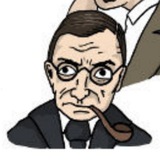
Immanuel Kant was a very boring man.
He never married, and probably died a virgin. The townsfolk were said to set their watches by his daily walks, as they were taken at such precise times. He basically never left his home town. His biography pretty much consists of: "He wrote some philosophy. He didn't write much philosophy for a while. He read Hume, and that made him write more philosophy." According to wikipedia, John T. Goldthwait supposedly refuted the idea that Kant was so boring, in his introduction to Observations on the Feeling of the Beautiful and Sublime, with the following two facts:
1. While he never married, he had an active social life, including a friendship with Joseph Green, an English merchant.
2. It is a myth that he never traveled more than 16 kilometers from his hometown. He once traveled as far as 20 kilometers to tutor philosophy, and another time as far as 145 kilometers, again to tutor philosophy.
Now, and maybe this is just me, but if I arrive at the end of my life and a biographer is charged with defending me against accusations of being boring, I should hope that they can come up with something better than "once traveled a small distance to teach philosophy, and had one friend."
David Hume and Albert Camus, on the other hand, liked to party. The woman at the bar is Elizabeth of Behemia, who also never married. She is best known for her correspondences with Descartes, where she criticized his substance dualism.
If you are interested in the philosophy of Immanuel Kant, Robert Wolff has a great lecture series on YouTube that he is putting out for free. He's also super old, and tells a lot of great old man stories, if that's your thing.
He never married, and probably died a virgin. The townsfolk were said to set their watches by his daily walks, as they were taken at such precise times. He basically never left his home town. His biography pretty much consists of: "He wrote some philosophy. He didn't write much philosophy for a while. He read Hume, and that made him write more philosophy." According to wikipedia, John T. Goldthwait supposedly refuted the idea that Kant was so boring, in his introduction to Observations on the Feeling of the Beautiful and Sublime, with the following two facts:
1. While he never married, he had an active social life, including a friendship with Joseph Green, an English merchant.
2. It is a myth that he never traveled more than 16 kilometers from his hometown. He once traveled as far as 20 kilometers to tutor philosophy, and another time as far as 145 kilometers, again to tutor philosophy.
Now, and maybe this is just me, but if I arrive at the end of my life and a biographer is charged with defending me against accusations of being boring, I should hope that they can come up with something better than "once traveled a small distance to teach philosophy, and had one friend."
David Hume and Albert Camus, on the other hand, liked to party. The woman at the bar is Elizabeth of Behemia, who also never married. She is best known for her correspondences with Descartes, where she criticized his substance dualism.
If you are interested in the philosophy of Immanuel Kant, Robert Wolff has a great lecture series on YouTube that he is putting out for free. He's also super old, and tells a lot of great old man stories, if that's your thing.
😁3
Hypatia of Alexandria was Greek mathematician, philosopher, and astronomer that lived and taught in Alexandria. She was accused of satanic sorcery by a Christian mob and murdered. This was partially because of her use of the astrolabe, an intricate device that was used by the Greeks to predict the path of the stars, tell the time, measure angles, and later on even measure latitude. It was probably the most advanced device in the ancient world, and in many ways the technological precursor to mechanical watches.
At the time of Hypatia's death, Alexandria was the intellectual center of the world, where philosophers and mathematicians gathered to teach and debate ideas from across the known world. Hypatia taught Platonic philosophy, Ptolemy's system of celestial movement, and the advanced mathematics of Euclid (her father was the one who brought Euclid's Elements to the city). She was known as a gifted teacher, and undoubtedly one of the greatest thinkers of the time. Her death was in many ways political, with the religious zealots trying to seize power and purge the more free thinking pagan philosophers. Some historians mark this as the turning point of the Alexandria as the hub of intellectualism, and the library was burned soon after (although this is controversial, to say the least, and probably not related). Most of Hypatia's original work was, as you might imagine, lost. After all, typically when you murder someone for heresy, you don't preserve their writings for future generations.
Note that many historians believe a political power struggle between Orestes, the governer, and Cyril the Bishop was the real reason she was killed. According to this account, it was her political affiliation more than her religion or philosophy that caused her downfall, the as the Christian followers of Cyril blamed her for turning Orestes against them (who was also a Christian). If it was her philosophy, it is a bit ironic that the tradition of Platonism, Ptolemy, and Mathematics (and even the astrolabe) was preserved in Europe primarily by the Christian intellectuals.
At the time of Hypatia's death, Alexandria was the intellectual center of the world, where philosophers and mathematicians gathered to teach and debate ideas from across the known world. Hypatia taught Platonic philosophy, Ptolemy's system of celestial movement, and the advanced mathematics of Euclid (her father was the one who brought Euclid's Elements to the city). She was known as a gifted teacher, and undoubtedly one of the greatest thinkers of the time. Her death was in many ways political, with the religious zealots trying to seize power and purge the more free thinking pagan philosophers. Some historians mark this as the turning point of the Alexandria as the hub of intellectualism, and the library was burned soon after (although this is controversial, to say the least, and probably not related). Most of Hypatia's original work was, as you might imagine, lost. After all, typically when you murder someone for heresy, you don't preserve their writings for future generations.
Note that many historians believe a political power struggle between Orestes, the governer, and Cyril the Bishop was the real reason she was killed. According to this account, it was her political affiliation more than her religion or philosophy that caused her downfall, the as the Christian followers of Cyril blamed her for turning Orestes against them (who was also a Christian). If it was her philosophy, it is a bit ironic that the tradition of Platonism, Ptolemy, and Mathematics (and even the astrolabe) was preserved in Europe primarily by the Christian intellectuals.
If a bear has ennui in the forest and there is no one around to tell, is it really in despair?
"You betrayed the proletariat cause!"
"No, YOU betrayed the proletariat cause!"
"You"
"You"
"Stop copying me!"
"Stop copying me."
"No, YOU betrayed the proletariat cause!"
"You"
"You"
"Stop copying me!"
"Stop copying me."
The Hague Congress of 1872 was a congress of the International Workingmen's Association, held one year after the Paris Comune collapsed. Karl Marx wanted the proletariat to take control of the state apparatus next time, so the revolution could defend itself. Mikhail Bakunin accused Marx of authoritarianism, and the conflict drove a wedge between the Marxists and the Anarchists.
"Hey Sartre. Sartre. Why did the chicken have a self-nihilating nothingness that haunted the core of its being? To get to the other side!"
"Hell is other people" is the famous line from Sartre's play "No Exit". The characters in the play were literally in hell, and their only punishment was to be stuck in a small room with each other forever. For Sartre, it doesn't really mean that other people suck, or are annoying, but to live under their contant gaze for eternity would be hell. Sort of like how Dostoyevsky spent five years in a Prison Camp in Siberia, and said the worst part of the whole thing was that he never had even a single moment alone the entire time. Actually, maybe that's where Sartre got the idea, so maybe Dostoyevsky is Sartre's muse. A lot of his books are kind of just French retellings of Dostoyevky's very Russian novels. They drink wine instead of vodka. They have ennui instead of murder people. That kind of thing.
Merleau-Ponty was a French Phenomenologist who was in the friend circle with Sartre, de Beauvoir and Camus. He was sort of the dork of the group, who would tell dad jokes and stuff like that. I don't really have any hard evidence for that, but you can kind of tell from his face.
Merleau-Ponty was a French Phenomenologist who was in the friend circle with Sartre, de Beauvoir and Camus. He was sort of the dork of the group, who would tell dad jokes and stuff like that. I don't really have any hard evidence for that, but you can kind of tell from his face.
😁2