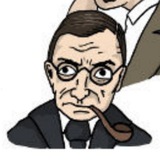
"What was your last cult?"
"The Epicureans. It was like 90% just eating pots of cheese though, kind of lame."
"The Epicureans. It was like 90% just eating pots of cheese though, kind of lame."
The Pythagoreans were an ancient group of mathematicians and philosophers that lived around the 6th century BC in Greece. They were lead by Pythagoras and very little is known about them, with none of their writings surviving. A lot of mythology is build up around them, including such things as Pythagoras being all knowing, traveling through time and space, and having mystical powers. They supposedly believed a bunch of weird stuff, like the musical scales having mystic properties, and not being able to eat beans (with a wide variety of reasons given by different accounts, even stuff like that you would lose part of your soul when you farted). One story about them is that Pythagoras murdered his student, Hippasus, for discovering irrational numbers (numbers which cannot be expressed as a ratio of two integers). The proof in the comic is for the square root of two (sometimes it is the golden ratio in the story), and is probably not the one discovered by the Pythagoreans, since they aren't known to have algebraic proofs. The Pythagorean Theorem, which is related, was proven with geometry.
Some people are going to say this was an unfair portrayal of Sam Harris, but considering I didn't have him say anything openly sexist, I'd say it was pretty generous.
Of course, the entire premise of philosophy being "solved" is ridiculous, since Leibniz already solved it when he wrote the Monadology
Emo Plato: "If you are in a cave with a bunch of happy people, and you go outside and discover how sad everything is, you are obligated to go back into the cave and totally bum everyone out until they are just as sad as you."
de Beauvoir: "Wait, weren't we supposed to be defeating the Nazis?"
Camus: "Oh yeah, that's right. Oh well, I'm sure it will work itself out."
Camus: "Oh yeah, that's right. Oh well, I'm sure it will work itself out."
During the occupation of Paris all three of Sartre, de Beauvoir, and Camus worked with the Resistance in various ways. Primarily, they wrote articles for Combat newspaper, of which Camus was the editor. Immediately after the war, they wrote a lot of rather self-aggrandizing articles about themselves, and their role in the resistance (not an uncommon occurrence at that time, everyone was very eager to paint themselves as a resistance fighter, for obvious reasons). Sartre's dialogue in the first panels are basically quotes from his article The Republic of Silence, which condemned intellectuals, and others, who collaborated or did not actively resist. However, being interviewed on the subject some thirty years later, he realized that things were not so black and white. Many who did not resist were terrified of death, and hopeless that their efforts would have any effect. Even those who did resist often played it safe, and only did what they knew they could get away with. Sartre, for example, wrote No Exit during the occupation, a play he claimed was a metaphor for the Germans, but the play was not censored, and many German officers attended and even mingled with the cast. Simone de Beauvoir wrote and published She Came to Stay, which also went uncensored, as did Camus's The Stranger. In other words, they weren't exactly setting off car bombs, they were mostly doing what they did during the non-war years: writing plays, novels, and philosophy. That isn't to say that they played no part in resisting the Germans, but...well, the story about using cheese to lure in women is supposedly true.