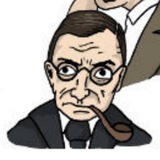
By the way, if you are being bullied in school, the advice you will often get from your parents and teachers is to ignore them and they will stop. This is bad advice. Trust me, if you bite them, that will be the end of it.
Diogenes and Plato had several run-ins, which have sort of been passed down through the ages (so who knows how much of it is real). Diogenes usually got the better of him. Examples include:
Plato was discoursing on his theory of ideas and, pointing to the cups on the table before him, said while there are many cups in the world, there is only one 'idea' of a cup, and this cupness precedes the existence of all particular cups. "I can see the cups on the table," said Diogenes, "but I can't see the 'cupness'".
"That's because you have the eyes to see the cup," said Plato, "but", tapping his head with his forefinger, "you don't have the intellect with which to comprehend 'cupness'."
Diogenes walked up to the table, examined a cup and, looking inside, asked, "Is it empty?" Plato nodded. "Where is the 'emptiness' which precedes this empty cup?" asked Diogenes. Plato allowed himself a few moments to collect his thoughts, but Diogenes reached over and, tapping Plato's head with his finger, said "I think you will find here is the 'emptiness'".
and
When Plato gave Socrates's definition of man as "featherless bipeds" and was much praised for the definition, Diogenes plucked a chicken and brought it into Plato's Academy, saying, "Behold! I've brought you a man." After this incident, "with broad flat nails" was added to Plato's definition.
and
Diogenes was knee deep in a stream washing vegetables. Coming up to him, Plato said, "My good Diogenes, if you knew how to pay court to Dionysius, you wouldn't have to wash vegetables." "And," replied Diogenes, "If you knew how to wash vegetables, you wouldn't have to pay court to Dionysius."
But not always:
When invited to the house of Plato, he trampled upon his carpet, saying that he thereby trampled on the vanity of Plato, to which Plato retorted "How much pride you expose to view, Diogenes, by seeming not to be proud."
Diogenes claimed to have gotten his morality from a dog, and would supposedly really bite at people's ankles. He said:
The dog is honest; he is not impressed by grand words, fancy clothes, or noscripts. He is loyal to those who are good to him; he bites those who ill-treat him or his friends, and he's not embarrassed to do what he does to live.
Plato was discoursing on his theory of ideas and, pointing to the cups on the table before him, said while there are many cups in the world, there is only one 'idea' of a cup, and this cupness precedes the existence of all particular cups. "I can see the cups on the table," said Diogenes, "but I can't see the 'cupness'".
"That's because you have the eyes to see the cup," said Plato, "but", tapping his head with his forefinger, "you don't have the intellect with which to comprehend 'cupness'."
Diogenes walked up to the table, examined a cup and, looking inside, asked, "Is it empty?" Plato nodded. "Where is the 'emptiness' which precedes this empty cup?" asked Diogenes. Plato allowed himself a few moments to collect his thoughts, but Diogenes reached over and, tapping Plato's head with his finger, said "I think you will find here is the 'emptiness'".
and
When Plato gave Socrates's definition of man as "featherless bipeds" and was much praised for the definition, Diogenes plucked a chicken and brought it into Plato's Academy, saying, "Behold! I've brought you a man." After this incident, "with broad flat nails" was added to Plato's definition.
and
Diogenes was knee deep in a stream washing vegetables. Coming up to him, Plato said, "My good Diogenes, if you knew how to pay court to Dionysius, you wouldn't have to wash vegetables." "And," replied Diogenes, "If you knew how to wash vegetables, you wouldn't have to pay court to Dionysius."
But not always:
When invited to the house of Plato, he trampled upon his carpet, saying that he thereby trampled on the vanity of Plato, to which Plato retorted "How much pride you expose to view, Diogenes, by seeming not to be proud."
Diogenes claimed to have gotten his morality from a dog, and would supposedly really bite at people's ankles. He said:
The dog is honest; he is not impressed by grand words, fancy clothes, or noscripts. He is loyal to those who are good to him; he bites those who ill-treat him or his friends, and he's not embarrassed to do what he does to live.
Also...I thought the sign was strictly prohibiting NOT doing those things.
Also, make sure to exercise your own radical freedom, and buy the t-shirt of panel 2.
Legends say there was a man once who read all the way through Phenomenology of Spirit, cover to cover, but the moment he read the final page he died of exhaustion.
I don't know what kind of explanation you are really expecting. A dialectical one, I guess? Good luck.
The Allegory of the Cave is one of the more famous parables by Plato, where he imagines a group of people chained in a cave, knowing only the shadows on the wall in front of them. He says they would presume that the shadows were the real world, having known nothing else. He then asks us to imagine a prisoner who broke free. He would first have a hard time looking at the light of the fire, because his eyes wouldn't be used to it. He would think the fire were less clear than the shadows. When he walked outside into the sun, he would be even more dazzled by the brightness, but with time would come to understand the "true world". Plato then says that he would be obligated to go back into the cave and teach the prisoners about the true world, even though they would mock him and be reluctant.
You can watch a great animated version narrated by Orson Welles here.
Movies like The Matrix are said by some to have similar themes, and much, much more Kung Fu. Plato probably could have learned a thing or two on the Kung Fu front from The Wachowskis, when you get down to it.
You can watch a great animated version narrated by Orson Welles here.
Movies like The Matrix are said by some to have similar themes, and much, much more Kung Fu. Plato probably could have learned a thing or two on the Kung Fu front from The Wachowskis, when you get down to it.