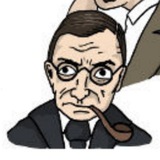
Besides, what are you so mad about? It's not like you weren't going to destroy yourselves in the next hundreds years or so anyway.
"What is theoretical basis for not wanting to destroy the planet? Come on guys, just...can we not?"
"Yeah, but probably only like...sheep and followers are good at the jobs, when you think about it..."
Marx: "you can take our lives, but you can never take our surplus labor value!"
John Locke gave us one of the first modern theories of language, well before philosophy of language really took off. He more or less described language as a representation of the ideas of the speaker, rather than referring to external objects in the world. So if someone talks about a tree, the word "tree" doesn't strictly refer to a concrete object that exists, but only represents the idea of a tree in the mind of a person attempting to communicate. According to this view, mistakes in understanding language are mistakes in correctly interpreting the intent or ideas of the speaker.
Later theorists of language, like Roland Barthes, who is most famous for his ideas about the "death of the author", viewed language as a much more public enterprise. Once a given speech act occurs, or especially a given text, it is open to interpretation and re-interpretation by the public. The original intentions or ideas of the author aren't necessarily more valid than those of any other interpreter.
Later theorists of language, like Roland Barthes, who is most famous for his ideas about the "death of the author", viewed language as a much more public enterprise. Once a given speech act occurs, or especially a given text, it is open to interpretation and re-interpretation by the public. The original intentions or ideas of the author aren't necessarily more valid than those of any other interpreter.
Francis Bacon was an early 17th century philosopher, best known for being one of the earlier philosophers who believed all knowledge had to be systematically empirical. He believed that through a system something like what we now think of as the "scientific method", we could come to understand the world. He was skeptical about all passed down dogmas which were not empirically tested.
Zera Yacob was also a 17th century philosopher, from Ethiopia. Like Bacon, he was very skeptical of dogmas, and thought all things needed to be considered. However, unlike Bacon, he believed it was human reason that was the primary method of examining the world. Obviously we needed to observe the world too, but he was also skeptical of moral, social, and religious institutions which asked us to believe things only because we were told them. He thought all beliefs should be subject to the examination of human reason and rationality. He believed that the best morality was harmonizing among different people along the ultimate principle of reason.
Hegel believed that reason operated quite differently from earlier philosophers like Yacob, who thought reason was a sort of absolute thing that you could use to come to a truth about a set beliefs. Instead, Hegel found reason or rationality more like a conversation that interrogates a given circumstances and moves towards a better set of ideas, rather than something immediately called the "truth" in the moment. In other words, reason was more like a debate or a courtroom verdict, rather than merely a way of thinking that produces truth.
Zera Yacob was also a 17th century philosopher, from Ethiopia. Like Bacon, he was very skeptical of dogmas, and thought all things needed to be considered. However, unlike Bacon, he believed it was human reason that was the primary method of examining the world. Obviously we needed to observe the world too, but he was also skeptical of moral, social, and religious institutions which asked us to believe things only because we were told them. He thought all beliefs should be subject to the examination of human reason and rationality. He believed that the best morality was harmonizing among different people along the ultimate principle of reason.
Hegel believed that reason operated quite differently from earlier philosophers like Yacob, who thought reason was a sort of absolute thing that you could use to come to a truth about a set beliefs. Instead, Hegel found reason or rationality more like a conversation that interrogates a given circumstances and moves towards a better set of ideas, rather than something immediately called the "truth" in the moment. In other words, reason was more like a debate or a courtroom verdict, rather than merely a way of thinking that produces truth.