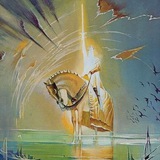
Forwarded from Sagittarius Granorum (Sagittarius Hyperboreius)
"Now the wheel, instead of being simply a ‘solar’ sign as is commonly thought in our time, is before all else a symbol of the world, which can be understood without difficulty. In the symbolic language of India, one speaks constantly of the ‘wheel of things’ or of the ‘wheel of life’, which corresponds precisely to this signification." - Rene Guenon, The Fundmanetal Symbols of the Sacred Science.
Forwarded from Ghost of de Maistre
"My entire thought is founded upon that 𝑝ℎ𝑖𝑙𝑜𝑠𝑜𝑝ℎ𝑖𝑎 𝑝𝑒𝑟𝑒𝑛𝑛𝑖𝑠 which I perceive to be the essence of Platonism, especially in the form (i.e., Neo-Platonism and Christian Platonism) in which it traverses the whole history of European philosophy, from Plotinus, Dionysius the Areopagite, and Augustine to Baader and Vladimir Soloviev. In principle, philosophy coincides here with speculative mysticism."
~ 𝑻𝒉𝒆 𝑼𝒏𝒌𝒏𝒐𝒘𝒂𝒃𝒍𝒆: 𝑨𝒏 𝑶𝒏𝒕𝒐𝒍𝒐𝒈𝒊𝒄𝒂𝒍 𝑰𝒏𝒕𝒓𝒐𝒅𝒖𝒄𝒕𝒊𝒐𝒏 𝒕𝒐 𝒕𝒉𝒆 𝑷𝒉𝒊𝒍𝒐𝒔𝒐𝒑𝒉𝒚 𝒐𝒇 𝑹𝒆𝒍𝒊𝒈𝒊𝒐𝒏, 𝒃𝒚 𝑺.𝑳. 𝑭𝒓𝒂𝒏𝒌
~ 𝑻𝒉𝒆 𝑼𝒏𝒌𝒏𝒐𝒘𝒂𝒃𝒍𝒆: 𝑨𝒏 𝑶𝒏𝒕𝒐𝒍𝒐𝒈𝒊𝒄𝒂𝒍 𝑰𝒏𝒕𝒓𝒐𝒅𝒖𝒄𝒕𝒊𝒐𝒏 𝒕𝒐 𝒕𝒉𝒆 𝑷𝒉𝒊𝒍𝒐𝒔𝒐𝒑𝒉𝒚 𝒐𝒇 𝑹𝒆𝒍𝒊𝒈𝒊𝒐𝒏, 𝒃𝒚 𝑺.𝑳. 𝑭𝒓𝒂𝒏𝒌
Forwarded from Turambarion ᛉ
"We remember on this subject a conversation we had in Bucharest in 1938 with Corneliu Codreanu, the leader of the Rumanian Iron Guard, one of the brightest and most idealistic figures of the 'nationalist' movements of the preceding period.
To indicate the differences between Fascism, National Socialism and his own movement, Codreanu referred to the three principles of a human organism: its form, its vital force, and its spirit. He said by way of analogy that a movement of political resurgence, while not neglecting the other two, could appeal especially to one of them, in the vaster organism corresponding to the nation. For him, Fascism had concentrated its interest on the element of 'form', like the Roman doctrine of the state. National Socialism emphasised the vital force by its references to 'race' and Volk. Codreanu himself wanted to start from spirit and give a religious colour, or rather a mystical one, to his movement."
- Julius Evola, Fascism and Tradition
To indicate the differences between Fascism, National Socialism and his own movement, Codreanu referred to the three principles of a human organism: its form, its vital force, and its spirit. He said by way of analogy that a movement of political resurgence, while not neglecting the other two, could appeal especially to one of them, in the vaster organism corresponding to the nation. For him, Fascism had concentrated its interest on the element of 'form', like the Roman doctrine of the state. National Socialism emphasised the vital force by its references to 'race' and Volk. Codreanu himself wanted to start from spirit and give a religious colour, or rather a mystical one, to his movement."
- Julius Evola, Fascism and Tradition
Forwarded from Der Schattige Wald 🇬🇱
I still think Empedocles' elements should replace Left and Right.
"And the elements incessantly exchange their places continually,
Sometimes by Love all coming together into one,
Sometimes again each one carried off by the hatred of Strife."
"And the elements incessantly exchange their places continually,
Sometimes by Love all coming together into one,
Sometimes again each one carried off by the hatred of Strife."
🔥3
Forwarded from Quantus tremor est futurus - Actaeon Journal
The left-wing and right-wing of government only had meaning for a single moment: conflict over the absolute veto power of the king. With the defeat of the monarchies a new era begins, and politicisation acts to secure victory or accept defeat. This is the point at which conservatives lost all sense of decision, that all political acts are a type of judgement which absolutely resolve or elevate struggle. To maintain a loyal opposition, a parliamentary mediation which acts against sovereignty, is only to create a political interim and abyss.
It is no mistake that the left-wing began to take on conservative elements once the right-wing acquiesced, then disappeared from politicisation itself. The old conservatives performed the greatest act of progress, or neutralisation, with the gutting of cities in the 1980s and 1990s. This absolute neutralisation of territory ended the era of liberal politics – after which, the only question could be, "To which liberal party do we give an absolute veto?"
Today, our social revolutionaries do not know what decisions are to be made of their votes and conflicts, even though the answer has become obvious. There is no connection, not even at the highest levels. Conflict can only dissipate and expand, until it is reconstituted as an elemental power.
It is no mistake that the left-wing began to take on conservative elements once the right-wing acquiesced, then disappeared from politicisation itself. The old conservatives performed the greatest act of progress, or neutralisation, with the gutting of cities in the 1980s and 1990s. This absolute neutralisation of territory ended the era of liberal politics – after which, the only question could be, "To which liberal party do we give an absolute veto?"
Today, our social revolutionaries do not know what decisions are to be made of their votes and conflicts, even though the answer has become obvious. There is no connection, not even at the highest levels. Conflict can only dissipate and expand, until it is reconstituted as an elemental power.
🔥2
New political compass just dropped. Choose your faction:
Anonymous Poll
19%
Air
50%
Fire
14%
Water
17%
Earth
🔥5
Forwarded from The Exaltation of Beauty
Fire.jpg
1.1 MB
This canvas by a late 17th-century painter is part of a group of four works, all at the Museo del Prado, that express the idea of the Elements through motives drawn from classical mythology. The image that embodies Fire might be taken for Jupiter, given his handful of lightening bolts and the shining star that accompanies him. However, it is more likely to be Prometheus, who has just stolen one of the Sun’s rays. His beardless and youthful appearance certainly does not belong to Jupiter, and the salamander at his feet is not related to the father of the gods, either. In fact, this reptile is a well-known embodiment of fire and is often present in allusions to that element.
Air.jpg
1.1 MB
The female figure that represents Air is accompanied by the Winds. In her right hand, she carries a bag that sprinkles water, representing rain, while the ray of light represents storms and lightning. Her exact identity is unclear, however. It was thought she might represent Dawn, but she is not accompanied by the proper attributes. Another possibility is Juno, who embodied Air on other occasions, but her traditional iconography is not present. It was also thought she represents the birds-of-paradise.
Earth.jpg
1.1 MB
Here, the element Earth is represented with total clarity by the goddess Ceres. The summer fruit she carries, especially sheaves of wheat, and the fact that she is suckling a baby—an expression of fecundity—make her immediately recognizable. The lion and tortoise are also attributes of Earth, although they are associated with the Cybele rather than Ceres. In that sense, Ripa’s analogy between the lion and the farmer is well known: the lion erases its footprints with its tail, while the farmer, when sowing, erases his prints as he covers the seeds.
Water.jpg
1.1 MB
Water is embodied here by Ocean’s sister and wife, Thetis, who was queen of the seas. A crown and scepter underline her royal character, and she is accompanied by a dolphin and an enormous conch shell, as well as small seashells and snails that allude to the oceanic realm, and thus, to water.
The source of these four works is the Madrid circle of painters, but cannot be confidently attributed to any known artist and there are even some differences among them. The Air is attributed to Luca Giordano, while the other three are always listed as anonymous, without mention of their school or possible circle.
The source of these four works is the Madrid circle of painters, but cannot be confidently attributed to any known artist and there are even some differences among them. The Air is attributed to Luca Giordano, while the other three are always listed as anonymous, without mention of their school or possible circle.
Forwarded from Ghost of de Maistre
"Baader compares God to an alchemist who uses a receptacle (the creature) to prepare the Tincture that he needs (His Son). According to Baader, the alchemist does not dispose of the receptacle once the work is finished. In the magnanimity of his joy before the completed task, he confers upon this receptacle the Tincture of eternal life."
- 𝑨𝒄𝒄𝒆𝒔𝒔 𝒕𝒐 𝑾𝒆𝒔𝒕𝒆𝒓𝒏 𝑬𝒔𝒐𝒕𝒆𝒓𝒊𝒄𝒊𝒔𝒎, 𝒃𝒚 𝑨𝒏𝒕𝒐𝒊𝒏𝒆 𝑭𝒂𝒊𝒗𝒓𝒆
- 𝑨𝒄𝒄𝒆𝒔𝒔 𝒕𝒐 𝑾𝒆𝒔𝒕𝒆𝒓𝒏 𝑬𝒔𝒐𝒕𝒆𝒓𝒊𝒄𝒊𝒔𝒎, 𝒃𝒚 𝑨𝒏𝒕𝒐𝒊𝒏𝒆 𝑭𝒂𝒊𝒗𝒓𝒆
Forwarded from Self-Immolation
"Thus philosophy, a thing of the highest utility, flourished in antiquity among the barbarians, shedding its light over the nations. And afterwards it came to Greece. First in its ranks were the prophets of the Egyptians; and the Chaldeans among the Assyrians; and the Druids among the Gauls; and the Sramanas among the Bactrians ("Σαρμαναίοι Βάκτρων"); and the philosophers of the Celts; and the Magi of the Persians, who foretold the Saviour's birth, and came into the land of Judaea guided by a star. The Indian gymnosophists are also in the number, and the other barbarian philosophers. And of these there are two classes, some of them called Sramanas ("Σαρμάναι"), and others Brahmins ("Βραχμάναι")."
Clement of Alexandria, Stromata
Clement of Alexandria, Stromata
Within the philosopher, the Great Work mirrors God's great act of Creation.
Forwarded from Ghost of de Maistre
"And the same, in the tenth book of the Republic, mentions Eros the son of Armenius, who is Zoroaster. Zoroaster, then, writes: These were composed by Zoroaster, the son of Armenius, a Pamphylian by birth: having died in battle, and been in Hades, I learned them of the gods. This Zoroaster, Plato says, having been placed on the funeral pyre, rose again to life in twelve days. He alludes perchance to the resurrection, or perchance to the fact that the path for souls to ascension lies through the twelve signs of the zodiac; and he himself says, that the descending pathway to birth is the same. In the same way we are to understand the twelve labours of Hercules, after which the soul obtains release from this entire world."
~ 𝑻𝒉𝒆 𝑺𝒕𝒓𝒐𝒎𝒂𝒕𝒂, 𝑩𝒐𝒐𝒌 𝑽, 𝑪𝒉𝒂𝒑𝒕𝒆𝒓 𝑿𝑰𝑽, 𝒃𝒚 𝑺𝒕. 𝑪𝒍𝒆𝒎𝒆𝒏𝒕 𝒐𝒇 𝑨𝒍𝒆𝒙𝒂𝒏𝒅𝒓𝒊𝒂
~ 𝑻𝒉𝒆 𝑺𝒕𝒓𝒐𝒎𝒂𝒕𝒂, 𝑩𝒐𝒐𝒌 𝑽, 𝑪𝒉𝒂𝒑𝒕𝒆𝒓 𝑿𝑰𝑽, 𝒃𝒚 𝑺𝒕. 𝑪𝒍𝒆𝒎𝒆𝒏𝒕 𝒐𝒇 𝑨𝒍𝒆𝒙𝒂𝒏𝒅𝒓𝒊𝒂
👍2
Forwarded from Sagittarius Granorum (Sagittarius Hyperboreius)
That 9/11 this year would fall on a sunday is of course very auspicious given that a sunday is of course and end, much like 9/11 represents an end. But paradox of paradoxes! An end is also a beginning, Janus has two faces after all, and so, given that the monarch of the previous world dominion has died just a few days ago, we must admit that the omens are either very terrible indeed, or alternatively cause for a healthy sense of optimism. Either way, whatever happens it is Fortunas doing or Gods will, maybe both.
Via Evolae will now maintain radio silence until tomorrow afternoon. Be that as it may, we want to wish a good afternoon too you all and a pleasant eveing on this eventful day. God be with you all.
Via Evolae will now maintain radio silence until tomorrow afternoon. Be that as it may, we want to wish a good afternoon too you all and a pleasant eveing on this eventful day. God be with you all.