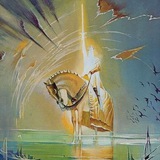
Halls of the Hyperboreads
Even as living mortals joined they in the fray and fought; and they were haling away each the bodies of the others' slain. Therein he set also soft fallow-land, rich tilth and wide, that was three times ploughed; and ploughers full many therein were wheeling…
But when he had wrought the shield, great and sturdy, then wrought he for him a corselet brighter than the blaze of fire, and he wrought for him a heavy helmet, fitted to his temples, a fair helm, richly-dight, and set thereon a crest of gold; and he wrought him greaves of pliant tin."
- Homer, Iliad XVIII 474-614
- Homer, Iliad XVIII 474-614
👍1👎1
Forwarded from Der Schattige Wald 🇬🇱
"For as I passed by, and beheld your devotions, I found an altar with this innoscription, To The Unknown God. Whom therefore ye ignorantly worship, Him declare I unto you."
~ Acts 17:23
~ Acts 17:23
👍3👎1🔥1
Forwarded from Solitary Individual
Must the morning always come again?
Does the power of earthly things never end?
Unholy industry consumes
The heavenly mantle of night.
Novalis
Does the power of earthly things never end?
Unholy industry consumes
The heavenly mantle of night.
Novalis
❤3👎1
Forwarded from Der Schattige Wald 🇬🇱
"Socrates, like all amateurs, often spoke as confidently and decisively as if he, among all the screech-owls of his fatherland, were the only one who sat on Minerva's helmet — The Socrateses of our time, the canonical teachers of the public and patron saints of the falsely revered arts and honours have not been blessed to equal their model in all his sweet faults. Because they infinitely deviate from the evidence of his ignorance, one must marvel at all their ingenious readings and glosses of their antisocratic daemons on our master's virtues as beauties of free translations; and it is as misguided to trust them as to follow them."
~ Hamann
~ Hamann
💩5👎1
Forwarded from Hwitgeard
The church father Tertullian asked "What has Athens to do with Jerusalem?" and the Anglo-Saxon monk Alcuin asked "What has Ingeld to do with Christ?" Tertullian believed that heresy began with Greek philosophy and likewise Alcuin believed that Germanic heroes such as Ingeld were blasphemous distractions to Christian faith. Both held similar beliefs that pre-Christian teachings and heroic legends should be dismissed and ignored.
However these may be early examples of the 'Celebration Parallax.' Indeed, what does Athens have to do with Jerusalem? What does Ingeld have to do with Christ? What does Israel and its history have to do with the European peoples?
However these may be early examples of the 'Celebration Parallax.' Indeed, what does Athens have to do with Jerusalem? What does Ingeld have to do with Christ? What does Israel and its history have to do with the European peoples?
👎8🔥4
Forwarded from Sagittarius Granorum (Sagittarius Hyperboreius)
Here we see the intellectual dishonesty which our contemporaries have to resort to in their anti-christian rhetoric of racial idolatry. It is not only dishonest, but indeed downright propagandistic, towards which the only defence possible is correct eduction on the subject being propagandized.
Tertullian's criticism towards Athens and Greek Philosophy exists in the context of his attacks on the Gnostic heresy, and very specifically in this context. It is obvious that whomsoever made the post above has not really familiarized himself properly with the content of the wider patristic tradition, nor with even the most general of the Church's theology. Otherwise we must assume that he has instead chosen to ignore it in favour of providing a more powerful narrative. Even as recently as the late Pope Benedict XVI (see The Regensburg Lecture) we have had defences of Greek Philosophy in the Christian context. Again, to those who are educated on the matter this kind of dishonest framing and selectivity is scandalous, but regardless, we are not done.
Alcuin's question is specifically worded: "Verba Dei legantur in sacerdotali convivio: ibi decet lectorem audiri, non citharistam, sermones patrum, non carmina gentilium. Quid Hinieldus cum Christo?" and it is to this day a controversial one, which has been answered (by other Christian authors) in various ways (the paper is about 23 pages). Here again is that selective, cowardly propagandism that seeks to oversimplifiy (or simply overlook) the rather complex argument instigated by "Quid Hinieldus cum Christo?"
Rather than making his own conclusions and sharing them with his readers, the author of this post has elected to instead ask leading questions with information presented in bad faith.
Tertullian's criticism towards Athens and Greek Philosophy exists in the context of his attacks on the Gnostic heresy, and very specifically in this context. It is obvious that whomsoever made the post above has not really familiarized himself properly with the content of the wider patristic tradition, nor with even the most general of the Church's theology. Otherwise we must assume that he has instead chosen to ignore it in favour of providing a more powerful narrative. Even as recently as the late Pope Benedict XVI (see The Regensburg Lecture) we have had defences of Greek Philosophy in the Christian context. Again, to those who are educated on the matter this kind of dishonest framing and selectivity is scandalous, but regardless, we are not done.
Alcuin's question is specifically worded: "Verba Dei legantur in sacerdotali convivio: ibi decet lectorem audiri, non citharistam, sermones patrum, non carmina gentilium. Quid Hinieldus cum Christo?" and it is to this day a controversial one, which has been answered (by other Christian authors) in various ways (the paper is about 23 pages). Here again is that selective, cowardly propagandism that seeks to oversimplifiy (or simply overlook) the rather complex argument instigated by "Quid Hinieldus cum Christo?"
Rather than making his own conclusions and sharing them with his readers, the author of this post has elected to instead ask leading questions with information presented in bad faith.
www.catholiceducation.org
Faith, Reason and the University: Memories and Reflections
Here is a Vatican translation of the address Benedict XVI delivered to scientists at the University of Regensburg, where he was a professor and vice r...
👍7👎6😁1
Forwarded from Revolt Against The Modern World
"...Those who do not know that this great myth became fact when the Virgin conceived are, indeed, to be pitied. But Christians also need to be reminded that what became fact was a myth, that it carries with it into the world of fact all the properties of a myth. God is more than a god, not less; Christ is more than Balder, not less. We must not be ashamed of the mythical radiance resting on our theology. We must not be nervous about 'parallels' and 'pagan Christs': they ought to be there ‐ it would be a stumbling block if they weren’t. We must not, in false spirituality, withhold our imaginative welcome. If God chooses to be mythopoeic ‐ and is not the sky itself a myth ‐ shall we refuse to be mythopathic? For this is the marriage of heaven and earth: perfect myth and perfect fact: claiming not only our love and our obedience, but also our wonder and delight, addressed to the savage, the child, and the poet in each one of us no less than to the moralist, the scholar, and the philosopher."
~C.S. Lewis
~C.S. Lewis
👍6💩5👎1
Forwarded from Sagittarius Granorum (Sagittarius Hyperboreius)
"The peculiar quality of the ‘joy’ in successful Fantasy can thus be explained as a sudden glimpse of the underlying reality or truth…But in the “eucatastrophe” we see in a brief vision that the answer may be greater—it may be a far off gleam or echo of evangelium in the real world…it has long been my feeling (a joyous feeling) that God redeemed the corrupt making-creatures, men, in a way fitting to this aspect, as to others, of their strange nature. The Gospels contain a fairy-story, or a story of a larger kind which embraces all the essence of fairy-stories." - J.R.R. Tolkien, On Fairystories.
"The Birth of Christ is the eucatastrophe of man’s history. The Resurrection is the eucatastrophe of the story of the Incarnaton. This story begins and ends in joy." - J.R.R. Tolkien, On Fairystories.
Taken from this article:
https://tifwe.org/tolkiens-christmas-joy-at-work/
"The Birth of Christ is the eucatastrophe of man’s history. The Resurrection is the eucatastrophe of the story of the Incarnaton. This story begins and ends in joy." - J.R.R. Tolkien, On Fairystories.
Taken from this article:
https://tifwe.org/tolkiens-christmas-joy-at-work/
Institute For Faith, Work & Economics
Tolkien’s Christmas Joy at Work
J.R.R. Tolkien recognized the importance of discovering joy in the dazzle and frazzle of Christmastime.
👎1
The reality of myth does not rely on any material-historical phenomenon or exist to explain such events, but in fact precedes them, and as such its truth will always remain above any 'lessons of history' that can be rationalized from simple facts. Myth is, then, incomprehensible to rationalistic man even though he has all the facts and the experts to look them over. No man with his gaze fixed downward, staring at the ground, sees the horizon stretched ahead of him or the splendor of Heaven displayed above.
❤10👎2
Forwarded from Sagittarius Hyperboreius
"When myths on sacred subjects are incongruous in thought, by that very fact they cry aloud, as it were, and summon us not to believe them literally, but to study and track down their hidden meaning." - Emperor Julian the Apostate in his letter against Heracleios the Cynic.
❤8👎4👍3
Forwarded from Lazarus Symposium
“ALL GREAT WARS ARE RELIGIOUS WARS, so they were in the past, are in the present and will be in the future. Earlier they were that even in the consciousness of the warriors: whether Charlemagne fought against the Saxons, whether the ‘Franks’ set out for the liberation of the Holy Sepulchre, whether, later, the invading Turks were beaten back, whether the German emperors defended their empire against the Italian cities, whether Protestants and Catholics fought each other for supremacy in the Reformation age, the battle leaders were always aware that they were fighting for their faith and we, who attempt to recognise the world- historical significance of these wars in retrospect, understand that those feelings and thoughts of the warriors arose from a deep cause.”
Werner sombart, Traders and heroes
Werner sombart, Traders and heroes
👎1
Lazarus Symposium
“ALL GREAT WARS ARE RELIGIOUS WARS, so they were in the past, are in the present and will be in the future. Earlier they were that even in the consciousness of the warriors: whether Charlemagne fought against the Saxons, whether the ‘Franks’ set out for the…
All great religions are warrior religions.
🔥12👎1😁1
Forwarded from Völks Sturm
The fact that Dugin understands Dionysus more and is far closer to the truth than the likes of the Apollonians will always be funny
"The Logos of Dionysus is the matrix of warriors and peasants. Hence his Indian campaign and accompanying vegetable cults. But his war and his agrarian cults are connected not to material efforts and workdays, but with game and holiday. He is the god of the mysteries which serve to raise the earthly, bring it up to the heavenly, and open up for the mortal the path to eternity. Apollo embodies the divine order that does not know chaos. He is the god of kings and priests, a god who does not tolerate impurity or compromise. He is the god of the upper horizon. He does not bring things to order, he is order. Dionysus descends to chaos, ready to deal with what is imperfect, but he translates chaos into order, perfects the imperfect. His role in the Mediterranean civilization of the light Logos is also bright, although qualitatively darker than Apollo."
Dugin I have mixed opinions of but his understanding of Dionysus is correct.
"The Logos of Dionysus is the matrix of warriors and peasants. Hence his Indian campaign and accompanying vegetable cults. But his war and his agrarian cults are connected not to material efforts and workdays, but with game and holiday. He is the god of the mysteries which serve to raise the earthly, bring it up to the heavenly, and open up for the mortal the path to eternity. Apollo embodies the divine order that does not know chaos. He is the god of kings and priests, a god who does not tolerate impurity or compromise. He is the god of the upper horizon. He does not bring things to order, he is order. Dionysus descends to chaos, ready to deal with what is imperfect, but he translates chaos into order, perfects the imperfect. His role in the Mediterranean civilization of the light Logos is also bright, although qualitatively darker than Apollo."
Dugin I have mixed opinions of but his understanding of Dionysus is correct.
👏2👍1👎1
Forwarded from Diary of an Underground Ronin
“In a world full of inferior values, every order of greatness is dragged through dirt.”
— Ernst Junger
— Ernst Junger
👎1🔥1
Forwarded from Der Schattige Wald 🇬🇱
“For our generation walks as in Hades, without the divine.”
~ Friedrich Hölderlin
~ Friedrich Hölderlin
❤6👎1
Forwarded from Quantus tremor est futurus - Actaeon Journal
"I am not the great thinker of the age. I am its sacrifice."
Every last man, think this.
Every last man, think this.
😁3👎1
A most intriguing look into Aryan myth and initiation through the symbol of the sword. Specifically in this video Schwerpunkt looks into commonalities between the Germanic and Scythian-Turkic-Hunnic cultures and how, when they met in continental Europe during the Migration Era, a certain spiritual current was rekindled that contributed to the development of the Mystery of the Grail and the rise of the chivalrous Middle Ages.
YouTube
Sacred/magic swords in the Irano-Germanic culture
THOUSANDS of videos more at 🦅⚡ https://www.youtube.com/channel/UCzmVYmxIvkrjmBNgLJMJYEw/videos
ENDLESS playlists at 🦅⚡ https://www.youtube.com/@wol.im.hiut.und.immer.wol./playlists🦅⚡
https://www.youtube.com/playlist?list=PLsTzegJZgtyiIO-id7pv0mPp__dRNtECh…
ENDLESS playlists at 🦅⚡ https://www.youtube.com/@wol.im.hiut.und.immer.wol./playlists🦅⚡
https://www.youtube.com/playlist?list=PLsTzegJZgtyiIO-id7pv0mPp__dRNtECh…
👍2👎1
Forwarded from The Golden One
💥📚 New Book-Review!
The Germanization of Early Medieval Christianity by James C. Russel
🔹Indo-European Religion vs Christianity
🔸The Power of the Christian God
🔹The Christian Pantheon
🔸The Germanisation of Christianity
🔹The Christianity of the Middle Ages
🔸Religiocultural View of War
🔹The Situation in Greece and Rome
🔸Conclusion
📖 Read the review here: https://thegoldenone.se/2023/02/05/the-germanization-of-early-medieval-christianity/
The Germanization of Early Medieval Christianity by James C. Russel
🔹Indo-European Religion vs Christianity
🔸The Power of the Christian God
🔹The Christian Pantheon
🔸The Germanisation of Christianity
🔹The Christianity of the Middle Ages
🔸Religiocultural View of War
🔹The Situation in Greece and Rome
🔸Conclusion
📖 Read the review here: https://thegoldenone.se/2023/02/05/the-germanization-of-early-medieval-christianity/
👍3👎1😁1