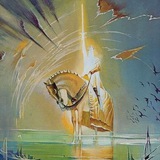
Forwarded from Orphic Inscendence (Naida)
Krishna Stealing the Clothes of the Bathing Gopis
Unknown Author. The National Museum of India
Unknown Author. The National Museum of India
🔥4❤2👍1👎1
Forwarded from Quantus tremor est futurus - Actaeon Journal
"What Nietzsche could not see was that reasoning and law were bound together in the Greek world, impossibly like the Titans and Olympians, like the Gordian Knot. The lesson of Alexander: one can unbind the knot as instinct, but it must be bound again as law."
The introductory critique of Nietzsche is available as an essay here:
https://actaeon.substack.com/p/to-the-true-friedricha-nietzschego
The introductory critique of Nietzsche is available as an essay here:
https://actaeon.substack.com/p/to-the-true-friedricha-nietzschego
Quantus tremor est futurus - Actaeon Journal
To the True Friedricha Nietzschego
First of a Meta-perspective on the Titan
👎1🔥1
Forwarded from Sagittarius Granorum (Sagittarius Hyperboreius)
All at once, or in rapid succession; disorienting, profound, simple, accurate. The most thoughtful form of schizoposting I've ever had the delight of experiencing in real time:
https://news.1rj.ru/str/actaeonjournal
https://news.1rj.ru/str/actaeonjournal
Telegram
Quantus tremor est futurus - Actaeon Journal
Magnus ab integro saeclorum nascitur ordo.
👎1
Forwarded from Quantus tremor est futurus - Actaeon Journal
One of the recent discussions is that of the NPC, the man totally lost to images in the mind, the spirit. This is a repeat of the Counter-enlightenment ideas in lesser form. To be able to visualize is not enough.
When the poetic or schizophrenic spirit hears the word "apple" he sees a tree, a field, the hidden microcosm of pollen wafting in the wind, a sunset, entire orchards, a man poisoned by arsenic. This is opposed to the modern man who sees, absolutely nothing.
The apocalypse in a word, iconomachy.
What separates the poet and the schizophrenic is their capacity of self-limitation, the giving of absolute form. One must have the intuition, the ability to see like a Cyclops, and yet also the will and control over the hand that we see with Hephaestus – without this, the greatest work of art, indeed, something beyond art – – the Shield of Achilles – – would never have been possible.
When the poetic or schizophrenic spirit hears the word "apple" he sees a tree, a field, the hidden microcosm of pollen wafting in the wind, a sunset, entire orchards, a man poisoned by arsenic. This is opposed to the modern man who sees, absolutely nothing.
The apocalypse in a word, iconomachy.
What separates the poet and the schizophrenic is their capacity of self-limitation, the giving of absolute form. One must have the intuition, the ability to see like a Cyclops, and yet also the will and control over the hand that we see with Hephaestus – without this, the greatest work of art, indeed, something beyond art – – the Shield of Achilles – – would never have been possible.
🔥3❤1👍1👎1
"And on the fire he [Hephaestus] put stubborn bronze and tin and precious gold and silver; and thereafter he set on the anvil-block a great anvil, and took in one hand a massive hammer, and in the other took he the tongs. First fashioned he a shield, great and sturdy, adorning it cunningly in every part, and round about it set a bright rim, threefold and glittering, and therefrom made fast a silver baldric. Five were the layers of the shield itself; and on it he wrought many curious devices with cunning skill. Therein he wrought the earth, therein the heavens therein the sea, and the unwearied sun, and the moon at the full, and therein all the constellations wherewith heaven is crowned—the Pleiades, and the Hyades and the mighty Orion, and the Bear, that men call also the Wain, that circleth ever in her place, and watcheth Orion, and alone hath no part in the baths of Ocean. Therein fashioned he also two cities of mortal men exceeding fair. In the one there were marriages and feastings, and by the light of the blazing torches they were leading the brides from their bowers through the city, and loud rose the bridal song. And young men were whirling in the dance, and in their midst flutes and lyres sounded continually; and there the women stood each before her door and marvelled. But the folk were gathered in the place of assembly; for there a strife had arisen, and two men were striving about the blood-price of a man slain; the one avowed that he had paid all, declaring his cause to the people, but the other refused to accept aught; and each was fain to win the issue on the word of a daysman. Moreover, the folk were cheering both, shewing favour to this side and to that. And heralds held back the folk, and the elders were sitting upon polished stones in the sacred circle, holding in their hands the staves of the loud-voiced heralds. Therewith then would they spring up and give judgment, each in turn. And in the midst lay two talents of gold, to be given to him whoso among them should utter the most righteous judgment. But around the other city lay in leaguer two hosts of warriors gleaming in armour. And twofold plans found favour with them, either to lay waste the town or to divide in portions twain all the substance that the lovely city contained within. Howbeit the besieged would nowise hearken thereto, but were arming to meet the foe in an ambush. The wall were their dear wives and little children guarding, as they stood thereon, and therewithal the men that were holden of old age; but the rest were faring forth, led of Ares and Pallas Athene, both fashioned in gold, and of gold was the raiment wherewith they were clad. Goodly were they and tall in their harness, as beseemeth gods, clear to view amid the rest, and the folk at their feet were smaller. But when they were come to the place where it seemed good unto them to set their ambush, in a river-bed where was a watering-place for all herds alike, there they sate them down, clothed about with flaming bronze. Thereafter were two scouts set by them apart from the host, waiting till they should have sight of the sheep and sleek cattle. And these came presently, and two herdsmen followed with them playing upon pipes; and of the guile wist they not at all. But the liers-in-wait, when they saw these coming on, rushed forth against them and speedily cut off the herds of cattle and fair flocks of white-fleeced sheep, and slew the herdsmen withal. But the besiegers, as they sat before the places of gathering and heard much tumult among the kine, mounted forthwith behind their high-stepping horses, and set out thitherward, and speedily came upon them. Then set they their battle in array and fought beside the river banks, and were ever smiting one another with bronze-tipped spears. And amid them Strife and Tumult joined in the fray, and deadly Fate, grasping one man alive, fresh-wounded, another without a wound, and another she dragged dead through the mellay by the feet; and the raiment that she had about her shoulders was red with the blood of men. ...
👎1
Halls of the Hyperboreads
"And on the fire he [Hephaestus] put stubborn bronze and tin and precious gold and silver; and thereafter he set on the anvil-block a great anvil, and took in one hand a massive hammer, and in the other took he the tongs. First fashioned he a shield, great…
Even as living mortals joined they in the fray and fought; and they were haling away each the bodies of the others' slain. Therein he set also soft fallow-land, rich tilth and wide, that was three times ploughed; and ploughers full many therein were wheeling their yokes and driving them this way and that. And whensoever after turning they came to the headland of the field, then would a man come forth to each and give into his hands a cup of honey-sweet wine; and the ploughmen would turn them in the furrows, eager to reach the headland of the deep tilth. And the field grew black behind and seemed verily as it had been ploughed, for all that it was of gold; herein was the great marvel of the work. Therein he set also a king's demesne-land, wherein labourers were reaping, bearing sharp sickles in their hands. Some handfuls were falling in rows to the ground along the swathe, while others the binders of sheaves were binding with twisted ropes of straw. Three binders stood hard by them, while behind them boys would gather the handfuls, and bearing them in their arms would busily give them to the binders; and among them the king, staff in hand, was standing in silence at the swathe, joying in his heart. And heralds apart beneath an oak were making ready a feast, and were dressing a great ox they had slain for sacrifice; and the women sprinkled the flesh with white barley in abundance, for the workers' mid-day meal. Therein he set also a vineyard heavily laden with clusters, a vineyard fair and wrought of gold; black were the grapes, and the vines were set up throughout on silver poles. And around it he drave a trench of cyanus, and about that a fence of tin; and one single path led thereto, whereby the vintagers went and came, whensoever they gathered the vintage. And maidens and youths in childish glee were bearing the honey-sweet fruit in wicker baskets. And in their midst a boy made pleasant music with a clear-toned lyre, and thereto sang sweetly the Linos-song with his delicate voice; and his fellows beating the earth in unison therewith followed on with bounding feet mid dance and shoutings. And therein he wrought a herd of straight-horned kine: the kine were fashioned of gold and tin, and with lowing hasted they forth from byre to pasture beside the sounding river, beside the waving reed. And golden were the herdsmen that walked beside the kine, four in number, and nine dogs swift of foot followed after them. But two dread lions amid the foremost kine were holding a loud-lowing bull, and he, bellowing mightily, was haled of them, while after him pursued the dogs and young men. The lions twain had rent the hide of the great bull, and were devouring the inward parts and the black blood, while the herdsmen vainly sought to fright them, tarring on the swift hounds. Howbeit these shrank from fastening on the lions, but stood hard by and barked and sprang aside. Therein also the famed god of the two strong arms wrought a pasture in a fair dell, a great pasture of white-fleeced sheep, and folds, and roofed huts, and pens. Therein furthermore the famed god of the two strong arms cunningly wrought a dancing-floor like unto that which in wide Cnosus Daedalus fashioned of old for fair-tressed Ariadne. There were youths dancing and maidens of the price of many cattle, holding their hands upon the wrists one of the other. Of these the maidens were clad in fine linen, while the youths wore well-woven tunics faintly glistening with oil; and the maidens had fair chaplets, and the youths had daggers of gold hanging from silver baldrics. Now would they run round with cunning feet exceeding lightly, as when a potter sitteth by his wheel that is fitted between his hands and maketh trial of it whether it will run; and now again would they run in rows toward each other. And a great company stood around the lovely dance, taking joy therein; and two tumblers whirled up and down through the midst of them as leaders in the dance. Therein he set also the great might of the river Oceanus, around the uttermost rim of the strongly-wrought shield. ...
👍1👎1
Halls of the Hyperboreads
Even as living mortals joined they in the fray and fought; and they were haling away each the bodies of the others' slain. Therein he set also soft fallow-land, rich tilth and wide, that was three times ploughed; and ploughers full many therein were wheeling…
But when he had wrought the shield, great and sturdy, then wrought he for him a corselet brighter than the blaze of fire, and he wrought for him a heavy helmet, fitted to his temples, a fair helm, richly-dight, and set thereon a crest of gold; and he wrought him greaves of pliant tin."
- Homer, Iliad XVIII 474-614
- Homer, Iliad XVIII 474-614
👍1👎1
Forwarded from Der Schattige Wald 🇬🇱
"For as I passed by, and beheld your devotions, I found an altar with this innoscription, To The Unknown God. Whom therefore ye ignorantly worship, Him declare I unto you."
~ Acts 17:23
~ Acts 17:23
👍3👎1🔥1
Forwarded from Solitary Individual
Must the morning always come again?
Does the power of earthly things never end?
Unholy industry consumes
The heavenly mantle of night.
Novalis
Does the power of earthly things never end?
Unholy industry consumes
The heavenly mantle of night.
Novalis
❤3👎1
Forwarded from Der Schattige Wald 🇬🇱
"Socrates, like all amateurs, often spoke as confidently and decisively as if he, among all the screech-owls of his fatherland, were the only one who sat on Minerva's helmet — The Socrateses of our time, the canonical teachers of the public and patron saints of the falsely revered arts and honours have not been blessed to equal their model in all his sweet faults. Because they infinitely deviate from the evidence of his ignorance, one must marvel at all their ingenious readings and glosses of their antisocratic daemons on our master's virtues as beauties of free translations; and it is as misguided to trust them as to follow them."
~ Hamann
~ Hamann
💩5👎1
Forwarded from Hwitgeard
The church father Tertullian asked "What has Athens to do with Jerusalem?" and the Anglo-Saxon monk Alcuin asked "What has Ingeld to do with Christ?" Tertullian believed that heresy began with Greek philosophy and likewise Alcuin believed that Germanic heroes such as Ingeld were blasphemous distractions to Christian faith. Both held similar beliefs that pre-Christian teachings and heroic legends should be dismissed and ignored.
However these may be early examples of the 'Celebration Parallax.' Indeed, what does Athens have to do with Jerusalem? What does Ingeld have to do with Christ? What does Israel and its history have to do with the European peoples?
However these may be early examples of the 'Celebration Parallax.' Indeed, what does Athens have to do with Jerusalem? What does Ingeld have to do with Christ? What does Israel and its history have to do with the European peoples?
👎8🔥4
Forwarded from Sagittarius Granorum (Sagittarius Hyperboreius)
Here we see the intellectual dishonesty which our contemporaries have to resort to in their anti-christian rhetoric of racial idolatry. It is not only dishonest, but indeed downright propagandistic, towards which the only defence possible is correct eduction on the subject being propagandized.
Tertullian's criticism towards Athens and Greek Philosophy exists in the context of his attacks on the Gnostic heresy, and very specifically in this context. It is obvious that whomsoever made the post above has not really familiarized himself properly with the content of the wider patristic tradition, nor with even the most general of the Church's theology. Otherwise we must assume that he has instead chosen to ignore it in favour of providing a more powerful narrative. Even as recently as the late Pope Benedict XVI (see The Regensburg Lecture) we have had defences of Greek Philosophy in the Christian context. Again, to those who are educated on the matter this kind of dishonest framing and selectivity is scandalous, but regardless, we are not done.
Alcuin's question is specifically worded: "Verba Dei legantur in sacerdotali convivio: ibi decet lectorem audiri, non citharistam, sermones patrum, non carmina gentilium. Quid Hinieldus cum Christo?" and it is to this day a controversial one, which has been answered (by other Christian authors) in various ways (the paper is about 23 pages). Here again is that selective, cowardly propagandism that seeks to oversimplifiy (or simply overlook) the rather complex argument instigated by "Quid Hinieldus cum Christo?"
Rather than making his own conclusions and sharing them with his readers, the author of this post has elected to instead ask leading questions with information presented in bad faith.
Tertullian's criticism towards Athens and Greek Philosophy exists in the context of his attacks on the Gnostic heresy, and very specifically in this context. It is obvious that whomsoever made the post above has not really familiarized himself properly with the content of the wider patristic tradition, nor with even the most general of the Church's theology. Otherwise we must assume that he has instead chosen to ignore it in favour of providing a more powerful narrative. Even as recently as the late Pope Benedict XVI (see The Regensburg Lecture) we have had defences of Greek Philosophy in the Christian context. Again, to those who are educated on the matter this kind of dishonest framing and selectivity is scandalous, but regardless, we are not done.
Alcuin's question is specifically worded: "Verba Dei legantur in sacerdotali convivio: ibi decet lectorem audiri, non citharistam, sermones patrum, non carmina gentilium. Quid Hinieldus cum Christo?" and it is to this day a controversial one, which has been answered (by other Christian authors) in various ways (the paper is about 23 pages). Here again is that selective, cowardly propagandism that seeks to oversimplifiy (or simply overlook) the rather complex argument instigated by "Quid Hinieldus cum Christo?"
Rather than making his own conclusions and sharing them with his readers, the author of this post has elected to instead ask leading questions with information presented in bad faith.
www.catholiceducation.org
Faith, Reason and the University: Memories and Reflections
Here is a Vatican translation of the address Benedict XVI delivered to scientists at the University of Regensburg, where he was a professor and vice r...
👍7👎6😁1
Forwarded from Revolt Against The Modern World
"...Those who do not know that this great myth became fact when the Virgin conceived are, indeed, to be pitied. But Christians also need to be reminded that what became fact was a myth, that it carries with it into the world of fact all the properties of a myth. God is more than a god, not less; Christ is more than Balder, not less. We must not be ashamed of the mythical radiance resting on our theology. We must not be nervous about 'parallels' and 'pagan Christs': they ought to be there ‐ it would be a stumbling block if they weren’t. We must not, in false spirituality, withhold our imaginative welcome. If God chooses to be mythopoeic ‐ and is not the sky itself a myth ‐ shall we refuse to be mythopathic? For this is the marriage of heaven and earth: perfect myth and perfect fact: claiming not only our love and our obedience, but also our wonder and delight, addressed to the savage, the child, and the poet in each one of us no less than to the moralist, the scholar, and the philosopher."
~C.S. Lewis
~C.S. Lewis
👍6💩5👎1
Forwarded from Sagittarius Granorum (Sagittarius Hyperboreius)
"The peculiar quality of the ‘joy’ in successful Fantasy can thus be explained as a sudden glimpse of the underlying reality or truth…But in the “eucatastrophe” we see in a brief vision that the answer may be greater—it may be a far off gleam or echo of evangelium in the real world…it has long been my feeling (a joyous feeling) that God redeemed the corrupt making-creatures, men, in a way fitting to this aspect, as to others, of their strange nature. The Gospels contain a fairy-story, or a story of a larger kind which embraces all the essence of fairy-stories." - J.R.R. Tolkien, On Fairystories.
"The Birth of Christ is the eucatastrophe of man’s history. The Resurrection is the eucatastrophe of the story of the Incarnaton. This story begins and ends in joy." - J.R.R. Tolkien, On Fairystories.
Taken from this article:
https://tifwe.org/tolkiens-christmas-joy-at-work/
"The Birth of Christ is the eucatastrophe of man’s history. The Resurrection is the eucatastrophe of the story of the Incarnaton. This story begins and ends in joy." - J.R.R. Tolkien, On Fairystories.
Taken from this article:
https://tifwe.org/tolkiens-christmas-joy-at-work/
Institute For Faith, Work & Economics
Tolkien’s Christmas Joy at Work
J.R.R. Tolkien recognized the importance of discovering joy in the dazzle and frazzle of Christmastime.
👎1
The reality of myth does not rely on any material-historical phenomenon or exist to explain such events, but in fact precedes them, and as such its truth will always remain above any 'lessons of history' that can be rationalized from simple facts. Myth is, then, incomprehensible to rationalistic man even though he has all the facts and the experts to look them over. No man with his gaze fixed downward, staring at the ground, sees the horizon stretched ahead of him or the splendor of Heaven displayed above.
❤10👎2
Forwarded from Sagittarius Hyperboreius
"When myths on sacred subjects are incongruous in thought, by that very fact they cry aloud, as it were, and summon us not to believe them literally, but to study and track down their hidden meaning." - Emperor Julian the Apostate in his letter against Heracleios the Cynic.
❤8👎4👍3
Forwarded from Lazarus Symposium
“ALL GREAT WARS ARE RELIGIOUS WARS, so they were in the past, are in the present and will be in the future. Earlier they were that even in the consciousness of the warriors: whether Charlemagne fought against the Saxons, whether the ‘Franks’ set out for the liberation of the Holy Sepulchre, whether, later, the invading Turks were beaten back, whether the German emperors defended their empire against the Italian cities, whether Protestants and Catholics fought each other for supremacy in the Reformation age, the battle leaders were always aware that they were fighting for their faith and we, who attempt to recognise the world- historical significance of these wars in retrospect, understand that those feelings and thoughts of the warriors arose from a deep cause.”
Werner sombart, Traders and heroes
Werner sombart, Traders and heroes
👎1
Lazarus Symposium
“ALL GREAT WARS ARE RELIGIOUS WARS, so they were in the past, are in the present and will be in the future. Earlier they were that even in the consciousness of the warriors: whether Charlemagne fought against the Saxons, whether the ‘Franks’ set out for the…
All great religions are warrior religions.
🔥12👎1😁1