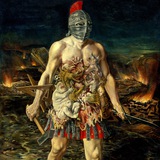
"Pacifism will rise and fall with the times. A period of weariness or one that lacks great ideas will always give it a clear field. And rightly, for when young men have no great aim before their eyes, why should they sacrifice themselves? When they have, on the other hand, they will of their own accord be carried away by the force that quails at nothing. The proud and indisputable right of the victor to decide the world’s destiny is so intoxicating a prospect to a race that does not doubt its call to greatness, that all else must appear of no account. In face of this, death, suffering, and all the horrors that lie on the surface of things fall away, and it is certain that the greater moral strength resides in such a conception. Every materialistic dissuasion weighs in the opposing scale—to be outweighed by the hero’s ‘So be it’ that encircles him with a supernatural glory. When all is at stake difficulties are nothing.
Once more it is Hölderlin who gives clear expression to all this:
‘I would not choose to die for nothing. But I would choose to fall for my country on a mound of slain.’"
~ Ernst Jünger, Copse 125
Once more it is Hölderlin who gives clear expression to all this:
‘I would not choose to die for nothing. But I would choose to fall for my country on a mound of slain.’"
~ Ernst Jünger, Copse 125
🔥1
"This raises the important question how one is to impress this on the soldier. How is one to proof and temper him for the frightful impressions of modern war when he crosses the frontier in unsuspecting enthusiasm?
Our enemies say we took young recruits into the slaughter-houses to accustom them to the sight of blood. This method would be effective and commendable if the endurance of the horrible were merely a matter of nerve. But, as I have said, brute force plays a smaller part here than one might think. Certainly hardness comes in. A schooling in manly exercise and sport, long marches, endurance of fatigue and privation, and the putting up with vexations of every sort, are all of them important. But they are not the essential. We have often seen weak nervous natures, men of little muscle and refined faces, who were capable of bearing a strain in a way that could not be explained by their bodily strength.
A generation worthy to represent its country in battle is not to be fashioned by any method: it springs from the primitive vigour of the people, and all the educational means by which these young men might seem to be brought up proceed from the same source as the nation has to thank for the possessing of these young men at all. It is easy to demand that historical associations shall be evoked in school and university, but what help are all the great ideas of the past if they do not fall on ears and hearts that feel themselves called to do the like? It is easy to say, too, that art must kindle a national consciousness, but if there is not in any case a depth of conviction, the only result is war memorials of plaster and boring historical pictures. The same is true of the family, of society, of the army, of philosophy, and anything by means of which men may be influenced. None of them can create ideas for which a man will die. They can represent these ideas and enforce them, give them expression, or carry them on further. But where there is not a disposition of the soul ready, they grip on air."
~ Ernst Jünger, Copse 125
Our enemies say we took young recruits into the slaughter-houses to accustom them to the sight of blood. This method would be effective and commendable if the endurance of the horrible were merely a matter of nerve. But, as I have said, brute force plays a smaller part here than one might think. Certainly hardness comes in. A schooling in manly exercise and sport, long marches, endurance of fatigue and privation, and the putting up with vexations of every sort, are all of them important. But they are not the essential. We have often seen weak nervous natures, men of little muscle and refined faces, who were capable of bearing a strain in a way that could not be explained by their bodily strength.
A generation worthy to represent its country in battle is not to be fashioned by any method: it springs from the primitive vigour of the people, and all the educational means by which these young men might seem to be brought up proceed from the same source as the nation has to thank for the possessing of these young men at all. It is easy to demand that historical associations shall be evoked in school and university, but what help are all the great ideas of the past if they do not fall on ears and hearts that feel themselves called to do the like? It is easy to say, too, that art must kindle a national consciousness, but if there is not in any case a depth of conviction, the only result is war memorials of plaster and boring historical pictures. The same is true of the family, of society, of the army, of philosophy, and anything by means of which men may be influenced. None of them can create ideas for which a man will die. They can represent these ideas and enforce them, give them expression, or carry them on further. But where there is not a disposition of the soul ready, they grip on air."
~ Ernst Jünger, Copse 125
🔥3
Forwarded from Archive
Monologue 44 Notes on the Peace by Junger in the modern context
When reading the peace one cannot help but think of three distinct parallels with how history really unfolded.
1. The politics of a post war Europe intended by Junger will lead the reader to feel compelled to compare it to the present day European Union. Whatever one feels about the Union, it is worth asking if Junger's Pan European program would resemble it, and if so, what would he think of this?
2. Throughout the essay, the role of religion is seen as important Junger, especially to provide a spiritual backbone to the war torn continent. Again one cannot help but draw parallels to how Germany did turn out, in which upon returning to the democratic process, it was none other than the Christian Democratic Union, whose leader Konrad Adenauer had campaigned much on a Christian humanism, urging his citizens to use religion to cope with their guilty conscience that arguably is still present in the German conscious today.
3. Western Europe quickly lost its geopolitical power after the war, England and France lost their colonies, and Germany was divided into two puppet states for the next half of the century. It was the Americans and Soviet Union that took the geopolitical throne in a bipolar world. The implications of this regarding the vision outlined in the Peace is surely something interesting to think about.
Archive
Monologue 44 Notes on the Peace by Junger in the modern context When reading the peace one cannot help but think of three distinct parallels with how history really unfolded. 1. The politics of a post war Europe intended by Junger will lead the reader to…
The Peace is often maligned by national socialists as this turn away from the spirit, towards liberalism and world government. But amnesty is a very old and aristocratic law of war. Carl Schmitt also writes about it, and if anything the necessity of forgetting is even more important once international law introduces the concept of crime into war.
Regarding unification of Europe in the wars, Jünger said that Germany should have taken the early territory it gained in France, then worked towards unification. The war was not Hitler, but a specific type of unification – in any case what was the result? "The world state progressed all the same, for all those national issues were already obsolete." The First World War ended the monarchies, and the Second World War ended the national states.
Later he says that Nuremberg was the end of the Jus Publicum Europaeum, and that Schmitt outlined this new order in The Nomos of the Earth. Jünger was looking forward when he wrote The Peace as with moves in a game of chess, he was speaking as a defendant of Germany, and for a European Amnesty which would save the Jus Publicum Europaeum.
Regarding unification of Europe in the wars, Jünger said that Germany should have taken the early territory it gained in France, then worked towards unification. The war was not Hitler, but a specific type of unification – in any case what was the result? "The world state progressed all the same, for all those national issues were already obsolete." The First World War ended the monarchies, and the Second World War ended the national states.
Later he says that Nuremberg was the end of the Jus Publicum Europaeum, and that Schmitt outlined this new order in The Nomos of the Earth. Jünger was looking forward when he wrote The Peace as with moves in a game of chess, he was speaking as a defendant of Germany, and for a European Amnesty which would save the Jus Publicum Europaeum.
Nomos of War
The Peace is often maligned by national socialists as this turn away from the spirit, towards liberalism and world government. But amnesty is a very old and aristocratic law of war. Carl Schmitt also writes about it, and if anything the necessity of forgetting…
The world state is itself existential, theological. There is a world unity and opposition to which all order is aligned, whether in ttack or defense. The world war is a civil war, and the cold war a cold civil war. It is not only limited due to nuclear weapons, and the catastrophic weakness of nations after the World Wars, it is a new type of war – delimited, irregular focused on all elements of subversion. It is the type of war which neutralizes the revolutionary wars, but also mobilizes them. Indeed, the democratic states prefigured their wars, and the partisan is the natural figure of the movement of the new nations – or rather spaces.
War is not weakened, the anti-war position is spatial in its attempt to eliminate the criminal type, the unhuman form which is always a threat to democracy. War becomes so pervasive that a simple vote on the world stage can hold an impossibly destructive power. Every veto of the Soviet Union was equal to the battles of the World Wars. And the race to include the most insignificant nations, to give them a vote in the world state was an attempt by America to unravel this legal weapon of the Soviet Union. The world became multipolar, but only as an intensification, and rearmament of the world duality.
Peace, then, is catastrophic, apocalyptic in its answer to the new conflict. It is the shearing of pain, that fear of the deathless and unnamed – so great that in eternal repetition all of them could never be found. There are two types of Unknown Soldier: he who disappeared with the Fatherland, and he who becomes like a wandering spirit in the Motherland because of the inescapable new form of combat.
Where war becomes eternal, peace can only meet it in kind. This is the reason for the apocalyptic language in Jünger's text. One is reconciling with the death of all lands, and the entire weight of history coming to a final brutal conflict.
War is not weakened, the anti-war position is spatial in its attempt to eliminate the criminal type, the unhuman form which is always a threat to democracy. War becomes so pervasive that a simple vote on the world stage can hold an impossibly destructive power. Every veto of the Soviet Union was equal to the battles of the World Wars. And the race to include the most insignificant nations, to give them a vote in the world state was an attempt by America to unravel this legal weapon of the Soviet Union. The world became multipolar, but only as an intensification, and rearmament of the world duality.
Peace, then, is catastrophic, apocalyptic in its answer to the new conflict. It is the shearing of pain, that fear of the deathless and unnamed – so great that in eternal repetition all of them could never be found. There are two types of Unknown Soldier: he who disappeared with the Fatherland, and he who becomes like a wandering spirit in the Motherland because of the inescapable new form of combat.
Where war becomes eternal, peace can only meet it in kind. This is the reason for the apocalyptic language in Jünger's text. One is reconciling with the death of all lands, and the entire weight of history coming to a final brutal conflict.
Forwarded from Lance's Legion
I lived this once, in a past life. I died on a firebase in the Viet highlands near Cambodia.
I led my men in battle, destroyed many enemy, and fell in the company of Titans.
AMERICA LIVES!
I led my men in battle, destroyed many enemy, and fell in the company of Titans.
AMERICA LIVES!
🔥1
Forwarded from Intel Slava
🇷🇺🇺🇦⚡Reports that from the very early morning a very serious battle has been going on in the direction: Marinka, Krasnogorsk, Avdeevka. Information is coming in about the most powerful artillery Fire in these minutes. All types of weapons are being sent in the direction of the positions and infrastructure of the Armed Forces of Ukraine. groups of the Allied Forces on the outskirts of Avdeevka. In general, we are observing the situation by the evening, it will become clear what's what!!! Let's support our Guys!!! Victory Will Be Ours, The Enemy Will Be Defeated!!!
🔥1
One of the great poets of World War I. And one of the few epic poets of the 20th century.
https://youtu.be/F1Hg8cyzXFA
https://youtu.be/F1Hg8cyzXFA
YouTube
David Jones - Welsh Mythology and World War I
A segment from: War of Words: Soldier-Poets of the Somme.
Fair use. Shared for research purposes.
War of Words: Soldier-Poets of the Somme is a documentary, first aired on BBC Two on 15 November 2014 as part of the centenary anniversary of World War I.
…
Fair use. Shared for research purposes.
War of Words: Soldier-Poets of the Somme is a documentary, first aired on BBC Two on 15 November 2014 as part of the centenary anniversary of World War I.
…
🔥2
Forwarded from Solitary Individual
Mars, surrounded by the Arts and Sciences, conquers Ignorance
Antoon Claeissens, 1605
Antoon Claeissens, 1605
Our first discussion on war recently reached 300 views. If you like what we do here please subscribe to our channel on youtube. Much more in the works:
https://youtu.be/EkcOopT_V_w
https://youtu.be/EkcOopT_V_w
YouTube
War and Heroism - Julius Evola and Ernst Jünger
A discussion of Julius Evola's "Metaphysics of War" and Ernst Jünger's "War as an Inner Experience". How does man experience heroism in the era of material warfare? And is it possible for the individual to overcome monstrous technology with a new type of…
🔥3
Nomos of War pinned «Our first discussion on war recently reached 300 views. If you like what we do here please subscribe to our channel on youtube. Much more in the works: https://youtu.be/EkcOopT_V_w»
"With the catastrophes we see figures emerging, which prove themselves equal to the cataclysms and which will outlive them when the incidental names have been long forgotten. Among these figures is, first and foremost, that of the Worker, marching confidently and unswervingly toward its goals. The fires of downfall only serve to throw it into an ever brighter light. For the moment it still radiates an ambiguous titanic glow; we cannot yet guess the royal capitals, the cosmic metropolises in which it will erect its thrones. The world wears its uniform and its armor, and at some point it will also don its festival attire. Since it is only at the start of its career, comparisons with any previously accomplished states would be improper.
In its train other figures surface, including those in which the suffering is sublimated. One of these is the Unknown Soldier, the Nameless, who for just this reason lives not only in every capital but also in every village, in every family. The battlefields, the temporal goals, and even the peoples he has represented sink into the realm of the uncertain. As the conflagrations cool, something else remains, a shared something, and now it is no longer will and passion but art and worship that turn to it.
Why is it that this second figure is so clearly connected in our memory with the First but not the Second World War? This comes from the clear delineations that emerged from that point forward of the forms and goals of the global civil war. The soldierly aspect fell therewith into second rank. Yet the Unknown Soldier remains a hero, a conqueror of fiery worlds, who shoulders great burdens in the midst of the mechanical devastation. In this sense he is also a true descendant of western chivalry.
The Second World War is distinguished from the First not only because the national questions mix openly with and subordinate themselves to those of civil war, but also due to the escalated mechanical development, which approaches extreme limits of automatism. This brings with it intensified assaults on nomos and ethos. In this connection, utterly hopeless encirclements result from overwhelming superior forces. The material battle escalates into one of encirclement and annihilation, into a Cannae without the ancient grandeur. The suffering increases in a manner that must necessarily exclude any heroic element."
~ Ernst Jünger
In its train other figures surface, including those in which the suffering is sublimated. One of these is the Unknown Soldier, the Nameless, who for just this reason lives not only in every capital but also in every village, in every family. The battlefields, the temporal goals, and even the peoples he has represented sink into the realm of the uncertain. As the conflagrations cool, something else remains, a shared something, and now it is no longer will and passion but art and worship that turn to it.
Why is it that this second figure is so clearly connected in our memory with the First but not the Second World War? This comes from the clear delineations that emerged from that point forward of the forms and goals of the global civil war. The soldierly aspect fell therewith into second rank. Yet the Unknown Soldier remains a hero, a conqueror of fiery worlds, who shoulders great burdens in the midst of the mechanical devastation. In this sense he is also a true descendant of western chivalry.
The Second World War is distinguished from the First not only because the national questions mix openly with and subordinate themselves to those of civil war, but also due to the escalated mechanical development, which approaches extreme limits of automatism. This brings with it intensified assaults on nomos and ethos. In this connection, utterly hopeless encirclements result from overwhelming superior forces. The material battle escalates into one of encirclement and annihilation, into a Cannae without the ancient grandeur. The suffering increases in a manner that must necessarily exclude any heroic element."
~ Ernst Jünger