This damned system, so hideously despicable, really bores one to death, i.e., if one has a certain sense of pride and taste
But all these tasteless, shallow people seem to fit in rather well, becoming consumerist zombie-bots who chase the empty dreams set up by those very monsters who exploit them
But all these tasteless, shallow people seem to fit in rather well, becoming consumerist zombie-bots who chase the empty dreams set up by those very monsters who exploit them
“How far Machinery Humiliates. — Machinery is impersonal; it robs the piece of work of its pride, of the individual merits and defects that cling to all work that is not machine-made – in other words, of its bit of humanity. Formerly, all buying from handicraftsmen meant a mark of distinction for their personalities, with whose productions people surrounded themselves. Furniture and dress accordingly became the symbols of mutual valuation and personal connection. Nowadays, on the other hand, we seem to live in the midst of anonymous and impersonal serfdom. – We must not buy the facilitation of labor too dearly. [We don't have to buy the facilitation of work at too high a price.]”
— Friedrich Nietzsche,
Human, All Too Human (Part II) (§2. 288)
— Friedrich Nietzsche,
Human, All Too Human (Part II) (§2. 288)
Forwarded from Anti-work quotes
“There comes a point in time when humans have an abundance of power [Kraft; strength] at their disposal. Science aims at establishing this slavery of nature.
Then humans acquire leisure: to cultivate themselves into something new, higher. A new aristocracy. It is then that a large number of virtues which are now conditions of existence are superseded.”
— Friedrich Nietzsche,
The Will to Power (953)
Then humans acquire leisure: to cultivate themselves into something new, higher. A new aristocracy. It is then that a large number of virtues which are now conditions of existence are superseded.”
— Friedrich Nietzsche,
The Will to Power (953)
Anti-work quotes
“There comes a point in time when humans have an abundance of power [Kraft; strength] at their disposal. Science aims at establishing this slavery of nature. Then humans acquire leisure: to cultivate themselves into something new, higher. A new aristocracy.…
Mf probably meant an actual imperialist aristocracy (as opposed to a libertarian aristocracy; reference to Renzo Novatore)
but doesn't matter, the quote is good, we've stolen it...
Why, Nietzsche himself was critical of "systematizers":
(Twilight of the Idols, 1. 26)
So, why should we construct an imaginary system of thought called "Nietzscheanism" and worship at its shrine?
We can just take all the good, anarchist insights he had—he had many of them—and reject the nonsense
but doesn't matter, the quote is good, we've stolen it...
Why, Nietzsche himself was critical of "systematizers":
“I mistrust all systematizers and avoid them. The will to a system is a lack of integrity.”
(Twilight of the Idols, 1. 26)
So, why should we construct an imaginary system of thought called "Nietzscheanism" and worship at its shrine?
We can just take all the good, anarchist insights he had—he had many of them—and reject the nonsense
“Century-old Quarantine. — Democratic institutions are centres of quarantine against the old plague of tyrannical desires. As such they are extremely useful and extremely tedious.”
— Friedrich Nietzsche,
Human, All Too Human (Part II) (§2. 289)
— Friedrich Nietzsche,
Human, All Too Human (Part II) (§2. 289)
“The Most Dangerous Partisan. — The most dangerous partisan is he whose defection would involve the ruin of the whole party – in other words, the best partisan.”
— Friedrich Nietzsche,
Human, All Too Human (Part II) (§2. 290)
— Friedrich Nietzsche,
Human, All Too Human (Part II) (§2. 290)
“The Victory of Democracy. — All political powers nowadays attempt to exploit the fear of Socialism for their own strengthening. Yet in the long run democracy alone gains the advantage, for all parties are now compelled to flatter ‘the masses’ and grant them facilities and liberties of all kinds, with the result that the masses finally become omnipotent. The masses are as far as possible removed from Socialism as a doctrine of altering the acquisition of property. If once they get the steering-wheel into their hands, through great majorities in their Parliaments, they will attack with progressive taxation the whole dominant system of capitalists, merchants, and financiers, and will in fact slowly create a middle class which may forget Socialism like a disease that has been overcome. – The practical result of this increasing democratization will next be a European league of nations, in which each individual nation, delimited by the proper geographical frontiers, has the position of a canton with its separate rights. Small account will be taken of the historic memories of previously existing nations, because the pious affection for these memories will be gradually uprooted under the democratic régime, with all its craze for novelty and experiment. The corrections of frontiers that will prove necessary will be so carried out as to serve the interests of the great cantons and at the same time that of the whole federation, but not that of any venerable memories. To find the standpoints for these corrections will be the task of future diplomats, who will have to be at the same time students of civilization, agriculturists, and commercial experts, with no armies but motives and utilities at their back. Then only will foreign and home politics be inseparably connected, whereas today the latter follows its haughty dictator, and gleans in sorry baskets the stubble that is left over from the harvest of the former.”
— Friedrich Nietzsche,
Human, All Too Human (Part II) (§2. 292)
— Friedrich Nietzsche,
Human, All Too Human (Part II) (§2. 292)
“Goal and Means of Democracy. — Democracy tries to create and guarantee independence for as many as possible in their opinions, way of life, and occupation. For this purpose democracy must withhold the political suffrage both from those who have nothing and from those who are really rich, as being the two intolerable classes of people. At the removal of these classes it must always work, because they are continually calling its task in question. In the same way democracy must prevent all measures that seem to aim at party organization. For the three great foes of independence, in that threefold sense, are the have-nots, the rich, and the parties. – I speak of democracy as of a thing to come. What at present goes by that name is distinguished from older forms of government only by the fact that it drives with new horses; the roads and the wheels are the same as of yore. – Has the danger really become less with these conveyances of the commonwealth?”
— Friedrich Nietzsche,
Human, All Too Human (Part II) (§2. 293)
— Friedrich Nietzsche,
Human, All Too Human (Part II) (§2. 293)
“If God, if mankind, as you affirm, have substance enough in themselves to be all in all to themselves, then I feel that I shall still less lack that, and that I shall have no complaint to make of my ‘emptiness.’ I am not nothing in the sense of emptiness, but I am the creative nothing, the nothing out of which I myself as creator create everything.”
— Max Stirner
— Max Stirner
Forwarded from x
"If religion has set up the proposition that we are sinners altogether, I set over against it the other: we are perfect altogether!
For we are, every moment, all that we can be; and we never need be more."
Max Stirner, The Ego and Its Own
For we are, every moment, all that we can be; and we never need be more."
Max Stirner, The Ego and Its Own
“Discretion and Success. — That great quality of discretion, which is fundamentally the virtue of virtues, their ancestress and queen, has in common life by no means always success on its side. The wooer would find himself deceived if he had wooed that virtue only for the sake of success. For it is rated by practical people as suspicious, and is confused with cunning and hypocrisy: he who obviously lacks discretion, the man who quickly grasps and sometimes misses his grasp, has prejudice on his side – [that] he is an honest, trustworthy fellow. Practical people, accordingly, do not like the prudent man, thinking he is to them a danger. Moreover, we often assume the prudent man to be anxious, preoccupied, pedantic – unpractical, butterfly people find him uncomfortable, because he does not live in their happy-go-lucky way, without thinking of actions and duties; he appears among them as their embodied conscience, and the bright day is dimmed to their eyes before his gaze. Thus when success and popularity fail him, he may often say by way of private consolation, ‘So high are the taxes you have to pay for the possession of the most precious thing among humans – still it is worth the price!’”
— Friedrich Nietzsche,
Human, All Too Human (Part II) (§2. 294)
— Friedrich Nietzsche,
Human, All Too Human (Part II) (§2. 294)
Forwarded from mehkum-e-hikmah (josephine kalieda)
pragmatic political action over despotic morality of ressentiment
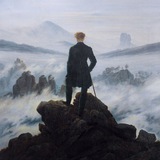
“Et in Arcadia Ego. — I looked down, over waves of hills, to a milky-green lake, through firs and pines austere with age; rocky crags of all shapes about me, the soil gay with flowers and grasses. A herd of cattle moved, stretched, and expanded itself before me; single cows and groups in the distance, in the clearest evening light, hard by the forest of pines; others nearer and darker; all in calm and eventide contentment. My watch pointed to half-past six. The bull of the herd had stepped into the white foaming brook, and went forward slowly, now striving against, now giving way to his tempestuous course; thus, no doubt, he took his sort of fierce pleasure. Two dark brown beings, of Bergamasque origin, tended the herd, the girl dressed almost like a boy. On the left, overhanging cliffs and fields of snow above broad belts of woodland; to the right, two enormous ice-covered peaks, high above me, shimmering in the veil of the sunny haze – all large, silent, and bright. The beauty of the whole was awe-inspiring and induced to a mute worship of the moment and its revelation. Unconsciously, as if nothing could be more natural, you peopled this pure, clear world of light (which had no trace of yearning, of expectancy, of looking forward or backward) with Greek heroes. You felt it all as Poussin and his school felt – at once heroic and idyllic. – So individual humans too have lived, constantly feeling themselves in the world and the world in themselves, and among them one of the greatest humans, the inventor of a heroico-idyllic form of philosophy – Epicurus.”
— Friedrich Nietzsche,
Human, All Too Human (Part II) (§2. 295)
— Friedrich Nietzsche,
Human, All Too Human (Part II) (§2. 295)
My faith in human dignity consists in the belief that man is the greatest scamp on earth. Human dignity must be associated with the idea of a scamp and not with that of an obedient, disciplined and regimented soldier. The scamp is probably the most glorious type of human being, as the soldier is the lowest type, according to this conception. …
I am doing my best to glorify the scamp or vagabond. I hope I shall succeed. For things are not so simple as they sometimes seem. In this present age of threats to democracy and individual liberty, probably only the scamp and the spirit of the scamp alone will save us from becoming lost as serially numbered units in the masses of disciplined, obedient, regimented and uniformed coolies. The scamp will be the last and most formidable enemy of dictatorships. He will be the champion of human dignity and individual freedom, and will be the last to be conquered. All modern civilization depends entirely upon him.
— Lin Yutang, The Importance of Living (chapter 1. §3)