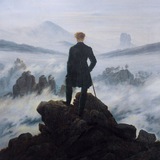
“Theories of the state, of the nation, of the economy, trade, justice — they all now have the character of a preparatory apologia; it seems, indeed, as though the only task of all active spirit not used up in propelling the great economy- and power-machine is the defence and exculpation of the present.
Before what accuser? one asks in perplexity.
Before its own bad conscience.”
— Friedrich Nietzsche,
Untimely Meditations (IIII. §6)
Before what accuser? one asks in perplexity.
Before its own bad conscience.”
— Friedrich Nietzsche,
Untimely Meditations (IIII. §6)
❤1👎1
“And the task of modern art, too, suddenly becomes clear: stupefaction or delirium! To put to sleep or to intoxicate! To silence the conscience, by one means or the other! To help the modern soul to forget its feeling of guilt, not to help it to return to innocence! And this at least for moments at a time! To defend man against himself by compelling him to silence and to an inability to hear! — the few who have felt what this most shameful of tasks, this dreadful degradation of art, really means will find their souls filling to the brim with regret and pity: but also with a new mighty longing. He who desired to liberate art, to restore its desecrated sanctity, would first have to have liberated himself from the modern soul; only when innocent himself could he discover the innocence of art, and he thus has two tremendous acts of purification and consecration to accomplish. If he were victorious, if he spoke to men out of his liberated soul in the language of his liberated art, only then would he encounter his greatest danger and his most tremendous battle; men would rather tear him and his art to pieces than admit they must perish for shame in the face of them. It is possible that the redemption of art, the only gleam of light to be hoped for in the modern age, will be an event reserved to only a couple of solitary souls, while the many continue to gaze into the flickering and smoky fire of their art: for they do not want light, they want bedazzlement; they hate light — when it is thrown upon themselves.”
— Friedrich Nietzsche,
Untimely Meditations (IIII. §6)
— Friedrich Nietzsche,
Untimely Meditations (IIII. §6)
👍2👎1
Forwarded from Dionysian Anarchism (Der Übermenschliche Eigner)
“[T]hose who are placed in positions which demand the surrender of personality, which insist on strict conformity to definite political policies and opinions, must deteriorate, must become mechanical, must lose all capacity to give anything really vital. The world is full of such unfortunate cripples. Their dream is to ‘arrive,’ no matter at what cost. If only we would stop to consider what it means to ‘arrive,’ we would pity the unfortunate victim. Instead of that, we look to the artist, the poet, the writer, the dramatist and thinker who have ‘arrived,’ as the final authority on all matters, whereas in reality their ‘arrival’ is synonymous with mediocrity, with the denial and betrayal of what might in the beginning have meant something real and ideal. The ‘arrived’ artists are dead souls upon the intellectual horizon. The uncompromising and daring spirits never ‘arrive.’ Their life represents an endless battle with the stupidity and the dullness of their time. They must remain what Nietzsche calls ‘untimely,’ because everything that strives for new form, new expression or new values, is always doomed to be untimely.”
— Emma Goldman,
Intellectual Proletarians
— Emma Goldman,
Intellectual Proletarians
👍3👎1
our misfortune is that we so condemn those unfortunate petty thieves and as much do we praise the real mega giga robbers
❤1👎1💯1
Dionysian Anarchism
"Universal Truth"
I will answer Pilate's question: What is truth? Truth is the free thought, the free idea, the free spirit; truth is what is free from you, what is not your own, what is not in your power. But truth is also the completely unindependent, impersonal, unreal, and incorporeal; truth cannot step forward as you do, cannot move, change, develop; truth awaits and receives everything from you, and itself is only through you; for it exists only – in your head. You concede that the truth is a thought, but say that not every thought is a true one, or, as you are also likely to express it, not every thought is truly and really a thought. And by what do you measure and recognize the thought? By your impotence, namely, by your being no longer able to make any successful assault on it! When it overpowers you, inspires you, and carries you away, then you hold it to be the true one. Its dominion over you certifies to you its truth; and, when it possesses you, and you are possessed by it, then you feel well with it, for then you have found your — lord and master. When you were seeking the truth, what did your heart then long for? For your master! You did not aspire to your might, but to a Mighty One, and wanted to exalt a Mighty One (‘Exalt ye the Lord our God!’*). The truth, my dear Pilate, is — the Lord, and all who seek the truth are seeking and praising the Lord. Where does the Lord exist? Where else but in your head? He is only spirit, and, wherever you believe you really see him, there he is a — ghost; for the Lord is merely something that is thought of, and it was only the Christian pains and agony to make the invisible visible, the spiritual corporeal, that generated the ghost and was the frightful misery of the belief in ghosts.
* Psalms 99:5
— Max Stirner
🔥2👎1
“Toward a psychology of the artist. — If there is to be art, if there is to be any aesthetic doing and seeing, one physiological condition is indispensable: frenzy. Frenzy must first have enhanced the excitability of the whole machine; else there is no art. All kinds of frenzy, however diversely conditioned, have the strength to accomplish this: above all, the frenzy of sexual excitement, this most ancient and original form of frenzy. Also the frenzy that follows all great cravings, all strong affects; the frenzy of feasts, contests, feats of daring, victory, all extreme movement; the frenzy of cruelty; the frenzy in destruction, the frenzy under certain meteorological influences, as for example the frenzy of spring; or under the influence of narcotics; and finally the frenzy of will, the frenzy of an overcharged and swollen will. What is essential in such frenzy is the feeling of increased strength and fullness. Out of this feeling one lends to things, one forces them to accept from us, one violates them — this process is called idealizing. Let us get rid of a prejudice here: idealizing does not consist, as is commonly held, in subtracting or discounting the petty and inconsequential. What is decisive is rather a tremendous drive to bring out the main features so that the others disappear in the process.”
— Friedrich Nietzsche,
Twilight of the Idols (§9. 8)
— Friedrich Nietzsche,
Twilight of the Idols (§9. 8)
🔥3👎1
“In this state one enriches everything out of one's own fullness: whatever one sees, whatever one wills, is seen swelled, taut, strong, overloaded with strength. A man in this state transforms things until they mirror his power — until they are reflections of his perfection. This need to transform into perfection is — art. Even everything that he is not yet, becomes for him an occasion of joy in himself; in art man enjoys himself as perfection.
It would be permissible to imagine an opposite state, a specific anti-artistry by instinct — a mode of being which would impoverish all things, making them thin and consumptive. And, as a matter of fact, history is rich in such anti-artists, in such people who are starved by life and must of necessity grab things, eat them out, and make them more meager. This is, for example, the case of the genuine Christian — of Pascal, for example: a Christian who would at the same time be an artist simply does not occur. One should not be childish and object by naming Raphael or some homeopathic Christian of the nineteenth century: Raphael said Yes, Raphael did Yes; consequently, Raphael was no Christian.”
— Friedrich Nietzsche,
Twilight of the Idols (§9. 9)
It would be permissible to imagine an opposite state, a specific anti-artistry by instinct — a mode of being which would impoverish all things, making them thin and consumptive. And, as a matter of fact, history is rich in such anti-artists, in such people who are starved by life and must of necessity grab things, eat them out, and make them more meager. This is, for example, the case of the genuine Christian — of Pascal, for example: a Christian who would at the same time be an artist simply does not occur. One should not be childish and object by naming Raphael or some homeopathic Christian of the nineteenth century: Raphael said Yes, Raphael did Yes; consequently, Raphael was no Christian.”
— Friedrich Nietzsche,
Twilight of the Idols (§9. 9)
👍1👎1
“As to the great mass of working girls and women, how much independence is gained if the narrowness and lack of freedom of the home is exchanged for the narrowness and lack of freedom of the factory, sweat-shop, department store, or office?”
— Emma Goldman,
Anarchism and Other Essays (chapter 10)
— Emma Goldman,
Anarchism and Other Essays (chapter 10)
🔥3👎1
“What is the meaning of the conceptual opposites which I have introduced into aesthetics, Apollonian and Dionysian, both conceived as kinds of frenzy? The Apollonian frenzy excites the eye above all, so that it gains the power of vision. The painter, the sculptor, the epic poet are visionaries par excellence. In the Dionysian state, on the other hand, the whole affective system is excited and enhanced: so that it discharges all its means of expression at once and drives forth simultaneously the power of representation, imitation, transfiguration, transformation, and every kind of mimicking and acting. The essential feature here remains the ease of metamorphosis, the inability not to react (similar to certain hysterical types who also, upon any suggestion, enter into any role). It is impossible for the Dionysian type not to understand any suggestion; he does not overlook any sign of an affect; he possesses the instinct of understanding and guessing in the highest degree, just as he commands the art of communication in the highest degree. He enters into any skin, into any affect: he constantly transforms himself.
Music, as we understand it today, is also a total excitement and a total discharge of the affects, but even so only the remnant of a much fuller world of expression of the affects, a mere residue of the Dionysian histrionicism. To make music possible as a separate art, a number of senses, especially the muscle sense, have been immobilized (at least relatively, for to a certain degree all rhythm still appeals to our muscles); so that man no longer bodily imitates and represents everything he feels. Nevertheless, that is really the normal Dionysian state, at least the original state. Music is the specialization of this state attained slowly at the expense of those faculties which are most closely related to it.”
— Friedrich Nietzsche,
Twilight of the Idols (§9. 10)
Music, as we understand it today, is also a total excitement and a total discharge of the affects, but even so only the remnant of a much fuller world of expression of the affects, a mere residue of the Dionysian histrionicism. To make music possible as a separate art, a number of senses, especially the muscle sense, have been immobilized (at least relatively, for to a certain degree all rhythm still appeals to our muscles); so that man no longer bodily imitates and represents everything he feels. Nevertheless, that is really the normal Dionysian state, at least the original state. Music is the specialization of this state attained slowly at the expense of those faculties which are most closely related to it.”
— Friedrich Nietzsche,
Twilight of the Idols (§9. 10)
👎2❤1
Dionysian Anarchism
All "masculine" abominations, proud slaves, "free" self-enslavers, (spiritual/moral) weaklings, hideous creatures, envious & vengeful spirits, bootlicking undesirables, self-loathers, cannibalistic hatemongers, zombified non-beings... assemble: get ready to…
the perfect way to describe a Sanghi/fascist doesn't exi----
👎2💯1
“The actor, the mime, the dancer, the musician, and the lyric poet are basically related in their instincts and, at bottom, one — but gradually they have become specialized and separated from each other, even to the point of mutual opposition. The lyric poet remained united with the musician for the longest time; the actor, with the dancer.
The architect represents neither a Dionysian nor an Apollonian state: here it is the great act of will, the will that moves mountains, the frenzy of the great will which aspires to art. The most powerful human beings have always inspired architects; the architect has always been under the spell of power. His buildings are supposed to render pride visible, and the victory over gravity, the will to power. Architecture is a kind of eloquence of power in forms — now persuading, even flattering, now only commanding. The highest feeling of power and sureness finds expression in a grand style. The power which no longer needs any proof, which spurns pleasing, which does not answer lightly, which feels no witness near, which lives oblivious of all opposition to it, which reposes within itself, fatalistically, a law among laws — that speaks of itself as a grand style.”
— Friedrich Nietzsche,
Twilight of the Idols (§9. 11)
The architect represents neither a Dionysian nor an Apollonian state: here it is the great act of will, the will that moves mountains, the frenzy of the great will which aspires to art. The most powerful human beings have always inspired architects; the architect has always been under the spell of power. His buildings are supposed to render pride visible, and the victory over gravity, the will to power. Architecture is a kind of eloquence of power in forms — now persuading, even flattering, now only commanding. The highest feeling of power and sureness finds expression in a grand style. The power which no longer needs any proof, which spurns pleasing, which does not answer lightly, which feels no witness near, which lives oblivious of all opposition to it, which reposes within itself, fatalistically, a law among laws — that speaks of itself as a grand style.”
— Friedrich Nietzsche,
Twilight of the Idols (§9. 11)
👍2👎1
Dionysian Anarchism
Photo
By our best enemies we do not want to be spared, nor by those either whom we love from the very heart.
I know the hatred and envy of your hearts. Ye are not great enough not to know of hatred and envy. Then be great enough not to be ashamed of them!
And if ye cannot be saints of knowledge, then, I pray you, be at least its warriors. They are the companions and forerunners of such saintship.
I see many soldiers; could I but see many warriors! “Uniform” one calleth what they wear; may it not be uniform what they therewith hide!
Ye shall be those whose eyes ever seek for an enemy—for your enemy. And with some of you there is hatred at first sight.
Your enemy shall ye seek; your war shall ye wage, and for the sake of your thoughts! And if your thoughts succumb, your uprightness shall still shout triumph thereby!
— Friedrich Nietzsche,
Thus Spoke Zarathustra
👍3👎1