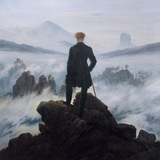
“Toward a psychology of the artist. — If there is to be art, if there is to be any aesthetic doing and seeing, one physiological condition is indispensable: frenzy. Frenzy must first have enhanced the excitability of the whole machine; else there is no art. All kinds of frenzy, however diversely conditioned, have the strength to accomplish this: above all, the frenzy of sexual excitement, this most ancient and original form of frenzy. Also the frenzy that follows all great cravings, all strong affects; the frenzy of feasts, contests, feats of daring, victory, all extreme movement; the frenzy of cruelty; the frenzy in destruction, the frenzy under certain meteorological influences, as for example the frenzy of spring; or under the influence of narcotics; and finally the frenzy of will, the frenzy of an overcharged and swollen will. What is essential in such frenzy is the feeling of increased strength and fullness. Out of this feeling one lends to things, one forces them to accept from us, one violates them — this process is called idealizing. Let us get rid of a prejudice here: idealizing does not consist, as is commonly held, in subtracting or discounting the petty and inconsequential. What is decisive is rather a tremendous drive to bring out the main features so that the others disappear in the process.”
— Friedrich Nietzsche,
Twilight of the Idols (§9. 8)
— Friedrich Nietzsche,
Twilight of the Idols (§9. 8)
🔥3👎1
“In this state one enriches everything out of one's own fullness: whatever one sees, whatever one wills, is seen swelled, taut, strong, overloaded with strength. A man in this state transforms things until they mirror his power — until they are reflections of his perfection. This need to transform into perfection is — art. Even everything that he is not yet, becomes for him an occasion of joy in himself; in art man enjoys himself as perfection.
It would be permissible to imagine an opposite state, a specific anti-artistry by instinct — a mode of being which would impoverish all things, making them thin and consumptive. And, as a matter of fact, history is rich in such anti-artists, in such people who are starved by life and must of necessity grab things, eat them out, and make them more meager. This is, for example, the case of the genuine Christian — of Pascal, for example: a Christian who would at the same time be an artist simply does not occur. One should not be childish and object by naming Raphael or some homeopathic Christian of the nineteenth century: Raphael said Yes, Raphael did Yes; consequently, Raphael was no Christian.”
— Friedrich Nietzsche,
Twilight of the Idols (§9. 9)
It would be permissible to imagine an opposite state, a specific anti-artistry by instinct — a mode of being which would impoverish all things, making them thin and consumptive. And, as a matter of fact, history is rich in such anti-artists, in such people who are starved by life and must of necessity grab things, eat them out, and make them more meager. This is, for example, the case of the genuine Christian — of Pascal, for example: a Christian who would at the same time be an artist simply does not occur. One should not be childish and object by naming Raphael or some homeopathic Christian of the nineteenth century: Raphael said Yes, Raphael did Yes; consequently, Raphael was no Christian.”
— Friedrich Nietzsche,
Twilight of the Idols (§9. 9)
👍1👎1
“As to the great mass of working girls and women, how much independence is gained if the narrowness and lack of freedom of the home is exchanged for the narrowness and lack of freedom of the factory, sweat-shop, department store, or office?”
— Emma Goldman,
Anarchism and Other Essays (chapter 10)
— Emma Goldman,
Anarchism and Other Essays (chapter 10)
🔥3👎1
“What is the meaning of the conceptual opposites which I have introduced into aesthetics, Apollonian and Dionysian, both conceived as kinds of frenzy? The Apollonian frenzy excites the eye above all, so that it gains the power of vision. The painter, the sculptor, the epic poet are visionaries par excellence. In the Dionysian state, on the other hand, the whole affective system is excited and enhanced: so that it discharges all its means of expression at once and drives forth simultaneously the power of representation, imitation, transfiguration, transformation, and every kind of mimicking and acting. The essential feature here remains the ease of metamorphosis, the inability not to react (similar to certain hysterical types who also, upon any suggestion, enter into any role). It is impossible for the Dionysian type not to understand any suggestion; he does not overlook any sign of an affect; he possesses the instinct of understanding and guessing in the highest degree, just as he commands the art of communication in the highest degree. He enters into any skin, into any affect: he constantly transforms himself.
Music, as we understand it today, is also a total excitement and a total discharge of the affects, but even so only the remnant of a much fuller world of expression of the affects, a mere residue of the Dionysian histrionicism. To make music possible as a separate art, a number of senses, especially the muscle sense, have been immobilized (at least relatively, for to a certain degree all rhythm still appeals to our muscles); so that man no longer bodily imitates and represents everything he feels. Nevertheless, that is really the normal Dionysian state, at least the original state. Music is the specialization of this state attained slowly at the expense of those faculties which are most closely related to it.”
— Friedrich Nietzsche,
Twilight of the Idols (§9. 10)
Music, as we understand it today, is also a total excitement and a total discharge of the affects, but even so only the remnant of a much fuller world of expression of the affects, a mere residue of the Dionysian histrionicism. To make music possible as a separate art, a number of senses, especially the muscle sense, have been immobilized (at least relatively, for to a certain degree all rhythm still appeals to our muscles); so that man no longer bodily imitates and represents everything he feels. Nevertheless, that is really the normal Dionysian state, at least the original state. Music is the specialization of this state attained slowly at the expense of those faculties which are most closely related to it.”
— Friedrich Nietzsche,
Twilight of the Idols (§9. 10)
👎2❤1
Dionysian Anarchism
All "masculine" abominations, proud slaves, "free" self-enslavers, (spiritual/moral) weaklings, hideous creatures, envious & vengeful spirits, bootlicking undesirables, self-loathers, cannibalistic hatemongers, zombified non-beings... assemble: get ready to…
the perfect way to describe a Sanghi/fascist doesn't exi----
👎2💯1
“The actor, the mime, the dancer, the musician, and the lyric poet are basically related in their instincts and, at bottom, one — but gradually they have become specialized and separated from each other, even to the point of mutual opposition. The lyric poet remained united with the musician for the longest time; the actor, with the dancer.
The architect represents neither a Dionysian nor an Apollonian state: here it is the great act of will, the will that moves mountains, the frenzy of the great will which aspires to art. The most powerful human beings have always inspired architects; the architect has always been under the spell of power. His buildings are supposed to render pride visible, and the victory over gravity, the will to power. Architecture is a kind of eloquence of power in forms — now persuading, even flattering, now only commanding. The highest feeling of power and sureness finds expression in a grand style. The power which no longer needs any proof, which spurns pleasing, which does not answer lightly, which feels no witness near, which lives oblivious of all opposition to it, which reposes within itself, fatalistically, a law among laws — that speaks of itself as a grand style.”
— Friedrich Nietzsche,
Twilight of the Idols (§9. 11)
The architect represents neither a Dionysian nor an Apollonian state: here it is the great act of will, the will that moves mountains, the frenzy of the great will which aspires to art. The most powerful human beings have always inspired architects; the architect has always been under the spell of power. His buildings are supposed to render pride visible, and the victory over gravity, the will to power. Architecture is a kind of eloquence of power in forms — now persuading, even flattering, now only commanding. The highest feeling of power and sureness finds expression in a grand style. The power which no longer needs any proof, which spurns pleasing, which does not answer lightly, which feels no witness near, which lives oblivious of all opposition to it, which reposes within itself, fatalistically, a law among laws — that speaks of itself as a grand style.”
— Friedrich Nietzsche,
Twilight of the Idols (§9. 11)
👍2👎1
Dionysian Anarchism
Photo
By our best enemies we do not want to be spared, nor by those either whom we love from the very heart.
I know the hatred and envy of your hearts. Ye are not great enough not to know of hatred and envy. Then be great enough not to be ashamed of them!
And if ye cannot be saints of knowledge, then, I pray you, be at least its warriors. They are the companions and forerunners of such saintship.
I see many soldiers; could I but see many warriors! “Uniform” one calleth what they wear; may it not be uniform what they therewith hide!
Ye shall be those whose eyes ever seek for an enemy—for your enemy. And with some of you there is hatred at first sight.
Your enemy shall ye seek; your war shall ye wage, and for the sake of your thoughts! And if your thoughts succumb, your uprightness shall still shout triumph thereby!
— Friedrich Nietzsche,
Thus Spoke Zarathustra
👍3👎1
“The psychological tact of the Germans seems very questionable to me, in view of quite a number of cases which modesty prevents me from enumerating. In one case I shall not lack a great occasion to substantiate my thesis: I bear the Germans a grudge for having made such a mistake about Kant and his ‘backdoor philosophy,’ as I call it — for that was not the type of intellectual integrity.”
— Friedrich Nietzsche,
Twilight of the Idols (§9. 16)
— Friedrich Nietzsche,
Twilight of the Idols (§9. 16)
👍3
“The most spiritual human beings, if we assume that they are the most courageous, also experience by far the most painful tragedies: but just for that reason they honor life because it pits its greatest opposition against them.”
— Friedrich Nietzsche,
Twilight of the Idols (§9. 17)
— Friedrich Nietzsche,
Twilight of the Idols (§9. 17)
👍3👎1
“Beautiful and ugly [‘fair and foul’]. — Nothing is more conditional — or, let us say, narrower — than our feeling for beauty. Whoever would think of it apart from man's joy in man would immediately lose any foothold. ‘Beautiful in itself’ is a mere phrase, not even a concept. In the beautiful, man posits himself as the measure of perfection; in special cases he worships himself in it. A species cannot do otherwise but thus affirm itself alone. Its lowest instinct, that of self-preservation and self-expansion, still radiates in such sublimities. Man believes the world itself to be overloaded with beauty — and he forgets himself as the cause of this. He alone has presented the world with beauty — alas! only with a very human, all-too-human beauty. At bottom, man mirrors himself in things; he considers everything beautiful that reflects his own image: the judgment ‘beautiful’ is the vanity of his species. For a little suspicion may whisper this question into the skeptic's ear: Is the world really beautified by the fact that man thinks it beautiful? He has humanized it, that is all. But nothing, absolutely nothing, guarantees that man should be the model of beauty. Who knows what he looks like in the eyes of a higher judge of beauty? Daring perhaps? Perhaps even amusing? Perhaps a little arbitrary?
‘O Dionysus, divine one, why do you pull me by my ears?’ Ariadne once asked her philosophic lover during one of those famous dialogues on Naxos. ‘I find a kind of humor in your ears, Ariadne: why are they not even longer?’”
— Friedrich Nietzsche,
Twilight of the Idols (§9. 19)
‘O Dionysus, divine one, why do you pull me by my ears?’ Ariadne once asked her philosophic lover during one of those famous dialogues on Naxos. ‘I find a kind of humor in your ears, Ariadne: why are they not even longer?’”
— Friedrich Nietzsche,
Twilight of the Idols (§9. 19)
mein liebes süßestes Kätzchen,
mein revolutionäres Mädchen...
wie für dich mein ganzes Herz voller Leidenschaft ist! –
welche Etwas jenseits von Liebe und Freundschaft ist –
bist du mein Engel?
oder... mein Teufel?
oh, eigentlich bist du beides!
das Leben meines Herzens...
du bist ein Kätzchen und eine Löwin,
auch meine anbetungswürdige Göttin!
die furchtbare, unbesiegbare Kriegerin.
du und ich, wir werden zum Märchen –
eine Ewigkeit mit dir, mein Schätzchen!
von: Dionysos
an: meri jungli billi
mein revolutionäres Mädchen...
wie für dich mein ganzes Herz voller Leidenschaft ist! –
welche Etwas jenseits von Liebe und Freundschaft ist –
bist du mein Engel?
oder... mein Teufel?
oh, eigentlich bist du beides!
das Leben meines Herzens...
du bist ein Kätzchen und eine Löwin,
auch meine anbetungswürdige Göttin!
die furchtbare, unbesiegbare Kriegerin.
du und ich, wir werden zum Märchen –
eine Ewigkeit mit dir, mein Schätzchen!
von: Dionysos
an: meri jungli billi
❤2