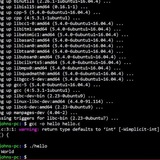
Quitting a Script without exiting the shell
I wrote a simple bash noscript that has a series of menus made with
The problem is that
I guess I could put the whole noscript in a
What’s the proper way to quit a noscript? Thanks for your time!
UPDATE:
I’m a clown. I had only ever run
I really appreciate all the quick responses!
https://redd.it/1f85r2h
@r_bash
I wrote a simple bash noscript that has a series of menus made with
if statements. If a user selects an invalid option, I want the noscript to quit right away.The problem is that
exit kills the terminal this noscript is running in, & return doesn’t work since it’s not a “function or sources noscript.”I guess I could put the whole noscript in a
while loop just so I can use break in the if else statements, but is there a better way to do this?What’s the proper way to quit a noscript? Thanks for your time!
UPDATE:
I’m a clown. I had only ever run
exit directly from a terminal, & from a sourced noscript. I just assumed it always closed the terminal. My bad.I really appreciate all the quick responses!
https://redd.it/1f85r2h
@r_bash
Reddit
From the bash community on Reddit
Explore this post and more from the bash community
AutoPilot - it's siimple | Automate the setup of a new system with ease
# AutoPilot - It's simple.
[**AutoPilot**](https://github.com/Noam-Alum/AutoPilot/) is a free-to-use, [well documented](https://docs.alum.sh/AutoPilot/Introduction.html) bash noscript (for both **Debian** and **RHEL** related operating systems) written by [me](https://www.linkedin.com/in/noam-alum/) meant to automate the process of setting up a new system.
It uses [YAML](https://en.wikipedia.org/wiki/YAML) for its configuration file, so it is very easy to set up, and you can create numerous configuration files for different occasions. (I like to call them *"Profiles"* 🙃)
https://preview.redd.it/hc8790ev8nmd1.png?width=269&format=png&auto=webp&s=480f775b873bad386577d30c524fcfefc7b6ca64
**Current available directives (**[v1.0.0](https://github.com/Noam-Alum/AutoPilot/releases/tag/v1.0.0)**):**
* [SELinux](https://docs.alum.sh/AutoPilot/directives/SELinux.html)
* [Users](https://docs.alum.sh/AutoPilot/directives/Users.html)
* [Run\_Lines](https://docs.alum.sh/AutoPilot/directives/Run_Lines.html)
* [Installed\_packages](https://docs.alum.sh/AutoPilot/directives/Installed_packages.html)
* [Plugins](https://docs.alum.sh/AutoPilot/directives/Plugins.html)
* [Network\_Configuration](https://docs.alum.sh/AutoPilot/directives/Network_Configuration.html)
* [Environment\_configuration](https://docs.alum.sh/AutoPilot/directives/Environment_configuration.html)
* [Cronjobs](https://docs.alum.sh/AutoPilot/directives/Cronjobs.html)
* [Repo](https://docs.alum.sh/AutoPilot/directives/Repo.html)
* [Time](https://docs.alum.sh/AutoPilot/directives/Time.html)
**Use cases:**
|**Use Case**|**Denoscription**|
|:-|:-|
|**Educational Institutions**|Educational institutions can leverage AutoPilot to quickly deploy standardized environments for students and faculty.|
|**Development Environments**|Developers can use New System to configure their development machines with the necessary programming languages, libraries, frameworks, and tools.|
|**Personal Use**|Individuals who frequently set up new machines or reinstall their operating systems can benefit from AutoPilot by automating the setup process.|
|**Testing and QA**|AutoPilot automates test environment setup, providing quality assurance teams and testers with consistent, repeatable configurations and necessary tools.|
|**Temporary Setups**|For temporary or event-based setups like trade shows or conferences, AutoPilot quickly prepares machines with the required software and settings, making deployment and management easier for short periods.|
|**Rescue and Recovery**|When a system needs recovery or rebuilding after a failure, AutoPilot automates software reinstallation and settings reconfiguration, reducing the time to restore it to its original state.|
|**Company Deployment**|A company can use AutoPilot to quickly configure new machines, ensuring consistent software and settings. This includes installing productivity tools, setting up configurations, and applying security policies.|
|**OS Migration**|When switching operating systems, AutoPilot automates setup of applications, configurations, and settings, ensuring a smooth transition and minimizing manual reinstallation and reconfiguration.|
|**System Formatting**|If you need to format and reinstall your operating system, AutoPilot handles post-installation setup. It automates software installation, configuration, and personalization, helping you get back to work faster.|
>I hope someone could find this helpful 😁, if you want to request a new feature you can do that [here](https://github.com/Noam-Alum/AutoPilot/issues/new?assignees=Noam-Alum&labels=feature+request&projects=&template=feature-request.md&noscript=Feature+request+%7C+%5Bfeature+request+short+denoscription%5D).
**Links:**
* [GitHub](https://github.com/Noam-Alum/AutoPilot/)
* [Documentation](https://docs.alum.sh/AutoPilot/Introduction.html)
* [Contribute](https://github.com/Noam-Alum/AutoPilot/blob/main/CONTRIBUTING.md)
https://redd.it/1f88k58
@r_bash
# AutoPilot - It's simple.
[**AutoPilot**](https://github.com/Noam-Alum/AutoPilot/) is a free-to-use, [well documented](https://docs.alum.sh/AutoPilot/Introduction.html) bash noscript (for both **Debian** and **RHEL** related operating systems) written by [me](https://www.linkedin.com/in/noam-alum/) meant to automate the process of setting up a new system.
It uses [YAML](https://en.wikipedia.org/wiki/YAML) for its configuration file, so it is very easy to set up, and you can create numerous configuration files for different occasions. (I like to call them *"Profiles"* 🙃)
https://preview.redd.it/hc8790ev8nmd1.png?width=269&format=png&auto=webp&s=480f775b873bad386577d30c524fcfefc7b6ca64
**Current available directives (**[v1.0.0](https://github.com/Noam-Alum/AutoPilot/releases/tag/v1.0.0)**):**
* [SELinux](https://docs.alum.sh/AutoPilot/directives/SELinux.html)
* [Users](https://docs.alum.sh/AutoPilot/directives/Users.html)
* [Run\_Lines](https://docs.alum.sh/AutoPilot/directives/Run_Lines.html)
* [Installed\_packages](https://docs.alum.sh/AutoPilot/directives/Installed_packages.html)
* [Plugins](https://docs.alum.sh/AutoPilot/directives/Plugins.html)
* [Network\_Configuration](https://docs.alum.sh/AutoPilot/directives/Network_Configuration.html)
* [Environment\_configuration](https://docs.alum.sh/AutoPilot/directives/Environment_configuration.html)
* [Cronjobs](https://docs.alum.sh/AutoPilot/directives/Cronjobs.html)
* [Repo](https://docs.alum.sh/AutoPilot/directives/Repo.html)
* [Time](https://docs.alum.sh/AutoPilot/directives/Time.html)
**Use cases:**
|**Use Case**|**Denoscription**|
|:-|:-|
|**Educational Institutions**|Educational institutions can leverage AutoPilot to quickly deploy standardized environments for students and faculty.|
|**Development Environments**|Developers can use New System to configure their development machines with the necessary programming languages, libraries, frameworks, and tools.|
|**Personal Use**|Individuals who frequently set up new machines or reinstall their operating systems can benefit from AutoPilot by automating the setup process.|
|**Testing and QA**|AutoPilot automates test environment setup, providing quality assurance teams and testers with consistent, repeatable configurations and necessary tools.|
|**Temporary Setups**|For temporary or event-based setups like trade shows or conferences, AutoPilot quickly prepares machines with the required software and settings, making deployment and management easier for short periods.|
|**Rescue and Recovery**|When a system needs recovery or rebuilding after a failure, AutoPilot automates software reinstallation and settings reconfiguration, reducing the time to restore it to its original state.|
|**Company Deployment**|A company can use AutoPilot to quickly configure new machines, ensuring consistent software and settings. This includes installing productivity tools, setting up configurations, and applying security policies.|
|**OS Migration**|When switching operating systems, AutoPilot automates setup of applications, configurations, and settings, ensuring a smooth transition and minimizing manual reinstallation and reconfiguration.|
|**System Formatting**|If you need to format and reinstall your operating system, AutoPilot handles post-installation setup. It automates software installation, configuration, and personalization, helping you get back to work faster.|
>I hope someone could find this helpful 😁, if you want to request a new feature you can do that [here](https://github.com/Noam-Alum/AutoPilot/issues/new?assignees=Noam-Alum&labels=feature+request&projects=&template=feature-request.md&noscript=Feature+request+%7C+%5Bfeature+request+short+denoscription%5D).
**Links:**
* [GitHub](https://github.com/Noam-Alum/AutoPilot/)
* [Documentation](https://docs.alum.sh/AutoPilot/Introduction.html)
* [Contribute](https://github.com/Noam-Alum/AutoPilot/blob/main/CONTRIBUTING.md)
https://redd.it/1f88k58
@r_bash
GitHub
GitHub - Noam-Alum/AutoPilot: Automate the setup of a new system with ease, AutoPilot - it's simple.
Automate the setup of a new system with ease, AutoPilot - it's simple. - Noam-Alum/AutoPilot
Help parsing a text file
I'm writing a noscript that needs to parse a text file and call another noscript depending on what it finds.
This is an example of the text file data:
555555:
- x.x.x.x/32
- x.x.x.x/24
- x.x.x.x/32
555556:
555557:
555558:
- x.x.x.x/32
- x.x.x.x/24
555559:
555560:
From the above file, think of each number as a VM. I need to run one noscript on each VM without trailing IPs, and the same noscript plus a different noscript on the VMs with trailing IPs.
Grabbing the VMs without IPs is easy enough, of course. I'm having a hard time determining how I'll grab each VM with IPs and all their IPs (since the number of IPs vary wildly). I thought I'd bounce this off the interwebz and see if anyone could give me an idea or three?
Maybe a while loop for when I find IPs but even though I'm at a loss thinking how I'll grab only those IPs with the corresponding VM.
https://redd.it/1f8bgpi
@r_bash
I'm writing a noscript that needs to parse a text file and call another noscript depending on what it finds.
This is an example of the text file data:
555555:
- x.x.x.x/32
- x.x.x.x/24
- x.x.x.x/32
555556:
555557:
555558:
- x.x.x.x/32
- x.x.x.x/24
555559:
555560:
From the above file, think of each number as a VM. I need to run one noscript on each VM without trailing IPs, and the same noscript plus a different noscript on the VMs with trailing IPs.
Grabbing the VMs without IPs is easy enough, of course. I'm having a hard time determining how I'll grab each VM with IPs and all their IPs (since the number of IPs vary wildly). I thought I'd bounce this off the interwebz and see if anyone could give me an idea or three?
Maybe a while loop for when I find IPs but even though I'm at a loss thinking how I'll grab only those IPs with the corresponding VM.
https://redd.it/1f8bgpi
@r_bash
Reddit
From the bash community on Reddit
Explore this post and more from the bash community
single quote (apostrophe) in filename breaks command
I have a huge collection of karaoke (zip) files that I'm trying to clean up, I've found several corrupt zip files while randomly opening a few to make sure the files were named correctly. So I decided to do a little noscript to test the zips, return the lines with "FAILED" and delete them. This one-liner finds them just fine
But theres the glaring error "sh: 1: Syntax error: Unterminated quoted string" every time grep matches one, so I can't get a clean output to use to send to rm. I've been digging around for a few days but haven't found a solution
https://redd.it/1f8fmv5
@r_bash
I have a huge collection of karaoke (zip) files that I'm trying to clean up, I've found several corrupt zip files while randomly opening a few to make sure the files were named correctly. So I decided to do a little noscript to test the zips, return the lines with "FAILED" and delete them. This one-liner finds them just fine
find . -type f -name "*.zip" -exec bash -c 'zip -T "{}" | grep FAILED' \;But theres the glaring error "sh: 1: Syntax error: Unterminated quoted string" every time grep matches one, so I can't get a clean output to use to send to rm. I've been digging around for a few days but haven't found a solution
https://redd.it/1f8fmv5
@r_bash
Reddit
From the bash community on Reddit
Explore this post and more from the bash community
SSID's not showing up when trying to echo them.
Hi all,
I am trying to write a noscript that will make connecting to wifi on my openbsd laptop easier. I have the noscript mostly complete; however, I get the error:
./wifiscanner.sh: line 7: echo "SSID: $ssid": command not found
here is my noscript so far:
#! /usr/local/bin/bash
doas ifconfig iwn0 up
for i in $(ifconfig iwn0 scan |
sed '/iwn0/,/network/d' |
sed -e 's/.*nwid\(.*\)chan.* /\1/' |
sed '/""/d' |sed '/0x0/d' | tr -d '""'|
head -n 10| while read ssid;
do
ssid_var="${ssid}"
'echo "SSID: $ssid"' :**
done) ;
do
read -p "Select your SSID: (e.g, ssid1) " ssid_name
done
read -p "Enter your WPA key: " WPAkey
echo "ifconfig iwn0 nwid ${ssid_name} wpakey ${WPAkey}"
without the apostrophes nothing shows up. How do I go about fixing this?
Thank you
https://redd.it/1f8kh5h
@r_bash
Hi all,
I am trying to write a noscript that will make connecting to wifi on my openbsd laptop easier. I have the noscript mostly complete; however, I get the error:
./wifiscanner.sh: line 7: echo "SSID: $ssid": command not found
here is my noscript so far:
#! /usr/local/bin/bash
doas ifconfig iwn0 up
for i in $(ifconfig iwn0 scan |
sed '/iwn0/,/network/d' |
sed -e 's/.*nwid\(.*\)chan.* /\1/' |
sed '/""/d' |sed '/0x0/d' | tr -d '""'|
head -n 10| while read ssid;
do
ssid_var="${ssid}"
'echo "SSID: $ssid"' :**
done) ;
do
read -p "Select your SSID: (e.g, ssid1) " ssid_name
done
read -p "Enter your WPA key: " WPAkey
echo "ifconfig iwn0 nwid ${ssid_name} wpakey ${WPAkey}"
without the apostrophes nothing shows up. How do I go about fixing this?
Thank you
https://redd.it/1f8kh5h
@r_bash
Reddit
From the bash community on Reddit
Explore this post and more from the bash community
Running via cronjob, any way to check the server load and try again later if it's too high?
I'm writing a noscript that I'll run via cronjob at around 1am. It'll take about 15 minutes to complete, so I only want to do it if the server load is low.
This is where I am:
attempt=0
# server load is less than 3 and there have been less than 5 attempts
if (( $(awk '{ print $1; }' < /proc/loadavg) < 3 && $attempt < 5))
then
# do stuff
else
# server load is over 3, try again in an hour
let attempt++
fi
The question is, how do I get it to stop and try again in an hour without tying up server resources?
My original solution: create an empty text file and touch it upon completion, then the beginning of the noscript would look at the
Is there a better way?
https://redd.it/1f90a2b
@r_bash
I'm writing a noscript that I'll run via cronjob at around 1am. It'll take about 15 minutes to complete, so I only want to do it if the server load is low.
This is where I am:
attempt=0
# server load is less than 3 and there have been less than 5 attempts
if (( $(awk '{ print $1; }' < /proc/loadavg) < 3 && $attempt < 5))
then
# do stuff
else
# server load is over 3, try again in an hour
let attempt++
fi
The question is, how do I get it to stop and try again in an hour without tying up server resources?
My original solution: create an empty text file and touch it upon completion, then the beginning of the noscript would look at the
lastmodified time and stop if the time is less than 24 hours. Then set 5 separate cronjobs, knowing that 4 of them should fail every time.Is there a better way?
https://redd.it/1f90a2b
@r_bash
Reddit
From the bash community on Reddit
Explore this post and more from the bash community
Sending mail through bash, is mailx still the right option?
I'm writing a noscript that will be run via cronjob late at night, and I'd like for it to email the results to me.
When I use
If mailx is still right, does the
This is the man for mailx:
NAME
mailx - send and receive Internet mail
SYNOPSIS
mailx -BDdEFintv~ -s subject -a attachment -c cc-addr -b bcc-
addr -r from-addr -h hops -A account -S vari-
able[=value] to-addr . . .
mailx -BDdeEHiInNRv~ -T name -A account -S variable[=value] -f
name
mailx -BDdeEinNRv~ -A account -S variable[=value] -u user
https://redd.it/1f8zn0x
@r_bash
I'm writing a noscript that will be run via cronjob late at night, and I'd like for it to email the results to me.
When I use
man mail, the result is mailx. I can't find anyone talking about mailx in the last decade, though! Is this still the best way to send mail through bash, or has it been replaced with someone else?If mailx is still right, does the
[-r from_address] need to be a valid account on the server? I don't see anything about it being validated, so it seems like it could be anything :-O Ideally I would use root@myserver.com, which is the address when I get other server-related emails, but I'm not sure that I have a username/password for it.This is the man for mailx:
NAME
mailx - send and receive Internet mail
SYNOPSIS
mailx -BDdEFintv~ -s subject -a attachment -c cc-addr -b bcc-
addr -r from-addr -h hops -A account -S vari-
able[=value] to-addr . . .
mailx -BDdeEHiInNRv~ -T name -A account -S variable[=value] -f
name
mailx -BDdeEinNRv~ -A account -S variable[=value] -u user
https://redd.it/1f8zn0x
@r_bash
Reddit
From the bash community on Reddit
Explore this post and more from the bash community
Any way to tell if noscript is ran via command line versus cron?
Inside of a bash noscript, is there a way to tell whether the noscript was ran via command line versus crontab?
I know that I can send a variable, like so:
# bash foo.sh bar
And then in the noscript, use:
if [ $1 -eq "bar" ]
then
# it was ran via command line
fi
but is that the best way?
The goal here would be to printf results to the screen if it's ran via command line, or email them if it's ran via crontab.
https://redd.it/1f93hp3
@r_bash
Inside of a bash noscript, is there a way to tell whether the noscript was ran via command line versus crontab?
I know that I can send a variable, like so:
# bash foo.sh bar
And then in the noscript, use:
if [ $1 -eq "bar" ]
then
# it was ran via command line
fi
but is that the best way?
The goal here would be to printf results to the screen if it's ran via command line, or email them if it's ran via crontab.
https://redd.it/1f93hp3
@r_bash
Reddit
From the bash community on Reddit
Explore this post and more from the bash community
A Bash + Python tool to watch a target in Satellite Imagery
I built a Bash + Python tool to watch a target in satellite imagery: [https://github.com/kamangir/blue-geo/tree/main/blue\_geo/watch](https://github.com/kamangir/blue-geo/tree/main/blue_geo/watch)
Here is the github repo: [https://github.com/kamangir/blue-geo](https://github.com/kamangir/blue-geo) The tool is also pip-installable: [https://pypi.org/project/blue-geo/](https://pypi.org/project/blue-geo/)
Here are three examples:
1. The recent Chilcotin River Landslide in British Columbia.
2. Burning Man 2024.
3. Mount Etna.
https://i.redd.it/z0b42i6huwmd1.gif
https://i.redd.it/y53fih6huwmd1.gif
https://i.redd.it/jh5cch6huwmd1.gif
This is how the tool is called,
u/batch eval - \
blue_geo watch - \
target=burning-man-2024 \
to=aws_batch - \
publish \
geo-watch-2024-09-04-burning-man-2024-a
This is how a target is defined,
burning-man-2024:
catalog: EarthSearch
collection: sentinel_2_l1c
params:
height: 0.051
width: 0.12
query_args:
datetime: 2024-08-18/2024-09-15
lat: 40.7864
lon: -119.2065
radius: 0.01
It runs a map-reduce on AWS Batch.
All targets are watched on Sentinel-2 through Copernicus and EarthSearch.
https://redd.it/1f9cvyx
@r_bash
I built a Bash + Python tool to watch a target in satellite imagery: [https://github.com/kamangir/blue-geo/tree/main/blue\_geo/watch](https://github.com/kamangir/blue-geo/tree/main/blue_geo/watch)
Here is the github repo: [https://github.com/kamangir/blue-geo](https://github.com/kamangir/blue-geo) The tool is also pip-installable: [https://pypi.org/project/blue-geo/](https://pypi.org/project/blue-geo/)
Here are three examples:
1. The recent Chilcotin River Landslide in British Columbia.
2. Burning Man 2024.
3. Mount Etna.
https://i.redd.it/z0b42i6huwmd1.gif
https://i.redd.it/y53fih6huwmd1.gif
https://i.redd.it/jh5cch6huwmd1.gif
This is how the tool is called,
u/batch eval - \
blue_geo watch - \
target=burning-man-2024 \
to=aws_batch - \
publish \
geo-watch-2024-09-04-burning-man-2024-a
This is how a target is defined,
burning-man-2024:
catalog: EarthSearch
collection: sentinel_2_l1c
params:
height: 0.051
width: 0.12
query_args:
datetime: 2024-08-18/2024-09-15
lat: 40.7864
lon: -119.2065
radius: 0.01
It runs a map-reduce on AWS Batch.
All targets are watched on Sentinel-2 through Copernicus and EarthSearch.
https://redd.it/1f9cvyx
@r_bash
lolcat reconfiguration help needed please
Was hoping you could help out a total noob. You may have seen this noscript - lolcat piped out for all commands. Its fun, it's nice, but it creates some unwanted behavior at times. Its also not my noscript (im a noob). However, i thought, at least for my purposes, it would be a better noscript if exclusion commands could be added to the noscript, for example this noscript 'lolcats' all commands, including things like 'exit' and prevents them executing. So i'd like to be able to add a list of commands in the *.bashrc noscript that excludes lolcat from executing, such as 'exit'. Any help is appreciated. Thanks.
lol()
{
if -t 1 ; then
"$@" | lolcat
else
"$@"
fi
}
bind 'RETURN: "\e1~lol \e[4~\n"'
or this one has aliases created, but i'd like to do the opposite, instead of adding every command to be lolcat, create an exclusion list of commands not to be lolcat.
lol()
{
if [ -t 1 ; then
"$@" | lolcat
else
"$@"
fi
}
COMMANDS=(
ls
cat
)
for COMMAND in "${COMMANDS@}"; do
alias "${COMMAND}=lol ${COMMAND}"
alias ".${COMMAND}=$(which ${COMMAND})"
done
https://redd.it/1f9k1q5
@r_bash
Was hoping you could help out a total noob. You may have seen this noscript - lolcat piped out for all commands. Its fun, it's nice, but it creates some unwanted behavior at times. Its also not my noscript (im a noob). However, i thought, at least for my purposes, it would be a better noscript if exclusion commands could be added to the noscript, for example this noscript 'lolcats' all commands, including things like 'exit' and prevents them executing. So i'd like to be able to add a list of commands in the *.bashrc noscript that excludes lolcat from executing, such as 'exit'. Any help is appreciated. Thanks.
lol()
{
if -t 1 ; then
"$@" | lolcat
else
"$@"
fi
}
bind 'RETURN: "\e1~lol \e[4~\n"'
or this one has aliases created, but i'd like to do the opposite, instead of adding every command to be lolcat, create an exclusion list of commands not to be lolcat.
lol()
{
if [ -t 1 ; then
"$@" | lolcat
else
"$@"
fi
}
COMMANDS=(
ls
cat
)
for COMMAND in "${COMMANDS@}"; do
alias "${COMMAND}=lol ${COMMAND}"
alias ".${COMMAND}=$(which ${COMMAND})"
done
https://redd.it/1f9k1q5
@r_bash
Reddit
From the bash community on Reddit
Explore this post and more from the bash community
missing final newline:
I just discovered that this does not work as I expect it to do:
this prints only "bar" but not "foo" because the final newline is missing.
For my current use-case I found a work-around:
In my case it is ok to sort the lines.
How do you solve this, so that it is ok if the final line does not have a newline?
https://redd.it/1f9pgy9
@r_bash
| while read -r line; do ...I just discovered that this does not work as I expect it to do:
echo -en "bar\nfoo" | while read var;do echo $var; done
this prints only "bar" but not "foo" because the final newline is missing.
For my current use-case I found a work-around:
echo -en "bar\nfoo"| sort | while read var;do echo $var; done
In my case it is ok to sort the lines.
How do you solve this, so that it is ok if the final line does not have a newline?
https://redd.it/1f9pgy9
@r_bash
Reddit
From the bash community on Reddit
Explore this post and more from the bash community
Has anyone encountered ' An error occurred in before all hook' when using shellspec?
I have implemented a unit test for a Shell using shellspec. And I am always thrown the above error in 'before all' and 'after all' both. Even though the log contains exit code 0 which basically indicating there is no error none of my tests are executing.
I have added extra logs and also redirected the errors but still I am facing this error and am out of options. I am using the latest version of Shellspec as well.
I am mocking git commands in my test noscript. But it is quite necessary for my tests as well.
I even checked for the relevent OS type in the setup method
# Determine OS type
OS_TYPE=$(uname 2>/dev/null || echo "Unknown")
case "$OS_TYPE" in
Darwin|Linux)
TMP_DIR="/tmp"
;;
CYGWIN*|MINGW*|MSYS*)
if command -v cygpath >/dev/null 2>&1; then
TMP_DIR="$(cygpath -m "${TEMP:-/tmp}")"
else
echo "Error: cygpath not found" >&2
exit 1
fi
;;
*)
echo "Error: Unsupported OS: $OS_TYPE" >&2
exit 1
;;
esac
Any guidance is immensely appreciated.
https://redd.it/1f9s8b4
@r_bash
I have implemented a unit test for a Shell using shellspec. And I am always thrown the above error in 'before all' and 'after all' both. Even though the log contains exit code 0 which basically indicating there is no error none of my tests are executing.
I have added extra logs and also redirected the errors but still I am facing this error and am out of options. I am using the latest version of Shellspec as well.
I am mocking git commands in my test noscript. But it is quite necessary for my tests as well.
I even checked for the relevent OS type in the setup method
# Determine OS type
OS_TYPE=$(uname 2>/dev/null || echo "Unknown")
case "$OS_TYPE" in
Darwin|Linux)
TMP_DIR="/tmp"
;;
CYGWIN*|MINGW*|MSYS*)
if command -v cygpath >/dev/null 2>&1; then
TMP_DIR="$(cygpath -m "${TEMP:-/tmp}")"
else
echo "Error: cygpath not found" >&2
exit 1
fi
;;
*)
echo "Error: Unsupported OS: $OS_TYPE" >&2
exit 1
;;
esac
Any guidance is immensely appreciated.
https://redd.it/1f9s8b4
@r_bash
Reddit
From the bash community on Reddit
Explore this post and more from the bash community
GitHub - oscarrivera2028/d-coding-companion: A coding companion that can be used to fix bugs in the terminal
https://github.com/oscarrivera2028/d-coding-companion
https://redd.it/1f9u6er
@r_bash
https://github.com/oscarrivera2028/d-coding-companion
https://redd.it/1f9u6er
@r_bash
GitHub
GitHub - oscarrivera2028/d-coding-companion: A coding companion that can be used to fix bugs in the terminal
A coding companion that can be used to fix bugs in the terminal - oscarrivera2028/d-coding-companion
Weird issue with sed hating on equals signs, I think?
Hey all, I been working to automate username and password updates for a kickstart file, but sed isn't playing nicely with me. The relevant code looks something like this:
Where the relevant text should go from one of these to the other:
After much tinkering, the only thing that seems to be setting this off is the = sign in the code, but then I can't seem to find a way to escape the = sign in my code! Pls help!!!
https://redd.it/1f9whl1
@r_bash
Hey all, I been working to automate username and password updates for a kickstart file, but sed isn't playing nicely with me. The relevant code looks something like this:
$username=hello$password=yeetsed -i "s/name=(*.) --password=(*.) --/name=$username --password=$password --/" ./packer/ks.cfgWhere the relevant text should go from one of these to the other:
user --groups=wheel --name=user --password=kdljdfd --iscrypted --gecos="Rocky User"user --groups=wheel --name=hello --password=yeet --iscrypted --gecos="Rocky User"After much tinkering, the only thing that seems to be setting this off is the = sign in the code, but then I can't seem to find a way to escape the = sign in my code! Pls help!!!
https://redd.it/1f9whl1
@r_bash
Reddit
From the bash community on Reddit
Explore this post and more from the bash community
Final noscript to clean /tmp, improvements welcome!
I wanted to get a little more practice in with bash, so (mainly for fun) I sorta reinvented the wheel a little.
*Quick backstory:*
My VPS uses WHM/cPanel, and I don't know if this is a problem strictly with them or if it's universal. But back in the good ol' days, I just had session files in the /tmp/ directory and I could run tmpwatch via cron to clear it out. But awhile back, the session files started going to:
# 56 is for PHP 5.6, which I still have for a few legacy hosting clients
/tmp/systemd-private-[foo]-ea-php56-php-fpm.service-[bar]/tmp
# 74 is for PHP 7.4, the version used for the majority of the accounts
/tmp/systemd-private-[foo]-ea-php74-php-fpm.service-[bar]/tmp
And since \[foo\] and \[bar\] were somewhat random and changed regularly, there was no good way to set up a cron to clean them.
cPanel recommended this one-liner:
find /tmp/systemd-private*php-fpm.service* -name sess_* ! -mtime -1 -exec rm -f '{}' \;
but I don't like the idea of running `rm` via cron, so I built this noscript as my own alternative.
*So this is what I built:*
My noscript loops through /tmp and the subdirectories in /tmp, and runs tmpwatch on each of them if necessary.
I've set it to run via crontab at 1am, and if the server load is greater than 3 then it tries again at 2am. If the load is still high, it tries again at 3am, and then after that it gives up. This alone is a pretty big improvement over the cPanel one-liner, because sometimes I would have a high load when it started and then the load would skyrocket!
In theory, crontab should email the printf text to the root email address. Or if you run it via command line, it'll print those results to the terminal.
I'm open to any suggestions on making it faster or better! Otherwise, maybe it'll help someone else that found themselves in the same position :-)
#!/bin/sh
#################################################
# Save as tmpwatch.sh, then upload to /root and set permission to 0755
#
# To run from SSH:
# bash tmpwatch.sh
#
# To set in crontab from SSH:
# crontab -e
# i (to insert)
# paste or type this to run daily at 1am:
# 0 1 * * * bash tmpwatch.sh
# Save it by pressing Esc, then type :wq and hit Enter
#
# Crontab Format:
# minute hour day month day-of-the-week command
# * means "every"
#
#################################################
# try to run a max of 3 times; 1am, 2am, and 3am
# you can change the 3 to whatever you prefer, I chose this to avoid high traffic times
for attempts in {1..3}
do
# only run if server load is < 3
# you can change the 3 to whatever you prefer, too
if (( $(awk '{ print int($1 * 100); }' < /proc/loadavg) < (3 * 100) ))
then
### Clean /tmp directory
# thanks to @ZetaZoid, r/linux4noobs for the "find" command line
sizeStart=$(nice -n 19 ionice -c 3 find /tmp/ -maxdepth 1 -type f -exec du -b {} + | awk '{sum += $1} END {print sum}')
# if there are files in the /tmp directory, run tmpwatch to remove them
# else, move on to the subdirectories
if [[ -n $sizeStart && $sizeStart -ge 0 ]]
then
nice -n 19 ionice -c 3 tmpwatch -m 12 /tmp
sleep 5
sizeEnd=$(nice -n 19 ionice -c 3 find /tmp/ -maxdepth 1 -type f -exec du -b {} + | awk '{sum += $1} END {print sum}')
if [[ -z $sizeEnd ]]
then
sizeEnd=0
fi
if (( $sizeStart > $sizeEnd ))
then
body+="tmpwatch -m 12 /tmp ...\n"
body+="$sizeStart -> $sizeEnd\n\n"
fi
fi
### Clean /tmp subdirectories
for i in $(ls -d /tmp/systemd-private-*)
do
i+="/tmp"
if [[ -d "$i" ]]
I wanted to get a little more practice in with bash, so (mainly for fun) I sorta reinvented the wheel a little.
*Quick backstory:*
My VPS uses WHM/cPanel, and I don't know if this is a problem strictly with them or if it's universal. But back in the good ol' days, I just had session files in the /tmp/ directory and I could run tmpwatch via cron to clear it out. But awhile back, the session files started going to:
# 56 is for PHP 5.6, which I still have for a few legacy hosting clients
/tmp/systemd-private-[foo]-ea-php56-php-fpm.service-[bar]/tmp
# 74 is for PHP 7.4, the version used for the majority of the accounts
/tmp/systemd-private-[foo]-ea-php74-php-fpm.service-[bar]/tmp
And since \[foo\] and \[bar\] were somewhat random and changed regularly, there was no good way to set up a cron to clean them.
cPanel recommended this one-liner:
find /tmp/systemd-private*php-fpm.service* -name sess_* ! -mtime -1 -exec rm -f '{}' \;
but I don't like the idea of running `rm` via cron, so I built this noscript as my own alternative.
*So this is what I built:*
My noscript loops through /tmp and the subdirectories in /tmp, and runs tmpwatch on each of them if necessary.
I've set it to run via crontab at 1am, and if the server load is greater than 3 then it tries again at 2am. If the load is still high, it tries again at 3am, and then after that it gives up. This alone is a pretty big improvement over the cPanel one-liner, because sometimes I would have a high load when it started and then the load would skyrocket!
In theory, crontab should email the printf text to the root email address. Or if you run it via command line, it'll print those results to the terminal.
I'm open to any suggestions on making it faster or better! Otherwise, maybe it'll help someone else that found themselves in the same position :-)
#!/bin/sh
#################################################
# Save as tmpwatch.sh, then upload to /root and set permission to 0755
#
# To run from SSH:
# bash tmpwatch.sh
#
# To set in crontab from SSH:
# crontab -e
# i (to insert)
# paste or type this to run daily at 1am:
# 0 1 * * * bash tmpwatch.sh
# Save it by pressing Esc, then type :wq and hit Enter
#
# Crontab Format:
# minute hour day month day-of-the-week command
# * means "every"
#
#################################################
# try to run a max of 3 times; 1am, 2am, and 3am
# you can change the 3 to whatever you prefer, I chose this to avoid high traffic times
for attempts in {1..3}
do
# only run if server load is < 3
# you can change the 3 to whatever you prefer, too
if (( $(awk '{ print int($1 * 100); }' < /proc/loadavg) < (3 * 100) ))
then
### Clean /tmp directory
# thanks to @ZetaZoid, r/linux4noobs for the "find" command line
sizeStart=$(nice -n 19 ionice -c 3 find /tmp/ -maxdepth 1 -type f -exec du -b {} + | awk '{sum += $1} END {print sum}')
# if there are files in the /tmp directory, run tmpwatch to remove them
# else, move on to the subdirectories
if [[ -n $sizeStart && $sizeStart -ge 0 ]]
then
nice -n 19 ionice -c 3 tmpwatch -m 12 /tmp
sleep 5
sizeEnd=$(nice -n 19 ionice -c 3 find /tmp/ -maxdepth 1 -type f -exec du -b {} + | awk '{sum += $1} END {print sum}')
if [[ -z $sizeEnd ]]
then
sizeEnd=0
fi
if (( $sizeStart > $sizeEnd ))
then
body+="tmpwatch -m 12 /tmp ...\n"
body+="$sizeStart -> $sizeEnd\n\n"
fi
fi
### Clean /tmp subdirectories
for i in $(ls -d /tmp/systemd-private-*)
do
i+="/tmp"
if [[ -d "$i" ]]
then
sizeStart=$(nice -n 19 ionice -c 3 du -s $i | awk '{print $1}')
nice -n 19 ionice -c 3 tmpwatch -m 12 $i
sleep 5
sizeEnd=$(nice -n 19 ionice -c 3 du -s $i | awk '{print $1}')
if (( $sizeStart > $sizeEnd ))
then
body+="tmpwatch -m 12 $i ...\n"
body+="$sizeStart -> $sizeEnd\n\n"
fi
fi
done
if [[ -n $body ]]
then
printf "$body"
fi
break
else
# server load was high, try again in an hour
sleep 3600
fi
done
https://redd.it/1fa8ccc
@r_bash
sizeStart=$(nice -n 19 ionice -c 3 du -s $i | awk '{print $1}')
nice -n 19 ionice -c 3 tmpwatch -m 12 $i
sleep 5
sizeEnd=$(nice -n 19 ionice -c 3 du -s $i | awk '{print $1}')
if (( $sizeStart > $sizeEnd ))
then
body+="tmpwatch -m 12 $i ...\n"
body+="$sizeStart -> $sizeEnd\n\n"
fi
fi
done
if [[ -n $body ]]
then
printf "$body"
fi
break
else
# server load was high, try again in an hour
sleep 3600
fi
done
https://redd.it/1fa8ccc
@r_bash
Reddit
From the bash community on Reddit
Explore this post and more from the bash community
How to Replace a Line with Another Line, Programmatically?
Hi all
I would like to write a bash noscript, that takes the file
and replaces the line
with the line
I would like the match to look for a full line match (e.g.
and not a partial string in a line
(so for example, this line
even tho there's a partial string in it that matches)
If there are several ways/programs to do it, please write,
it's nice to learn various ways.
Thank you evry much
https://redd.it/1falc6z
@r_bash
Hi all
I would like to write a bash noscript, that takes the file
/etc/ssh/sshd_config, and replaces the line
#Port 22 with the line
Port 5000.I would like the match to look for a full line match (e.g.
#Port 22), and not a partial string in a line
(so for example, this line
##Port 2244 will not be matched and then replaced, even tho there's a partial string in it that matches)
If there are several ways/programs to do it, please write,
it's nice to learn various ways.
Thank you evry much
https://redd.it/1falc6z
@r_bash
Reddit
From the bash community on Reddit
Explore this post and more from the bash community