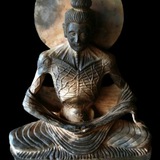
"[...] Agora durma. Carma é carma. Seja de Zen. Lembre-se, em tranquilidade, de que o Absoluto, o Tao, esta dentro de você, que nenhum padre, culto, dogma, livro, frase, ensinamento ou professor se interpõe entre você e ele. Saiba que o Bem e o Mal são irrelevantes, assim como Eu e Você, Dentro e Fora, a Vida e a Morte. Entre na Esfera onde não há medo da morte, nem esperança de pós-vida, onde você é livre dos obstáculos da vida ou de necessidades de salvação. Você é, em si mesmo, o Tao. Seja você, agora, uma rocha contral qual as ondas da Vida se lançam em vão ..."
- Toranaga em Xógum, James Clavell
- Toranaga em Xógum, James Clavell
Forwarded from Traditionalism & Metaphysics (Horse Master)
hans_dieter_betz__greek_magical_papyri_in_translabookos-org.pdf
15.5 MB
Greek magical papyri
Forwarded from Traditionalism & Metaphysics (Horse Master)
The Xenocratean theory interprets daemonic nature in geometric terms. By means of an analogy, he describes the gods as equilateral triangles whose sides are all equal, mankind as scalene triangles whose sides are all unequal, and the mediating daemons as isosceles triangles which have partly equal and partly unequal sides. From this analogy, Xenocrates draws the conclusion that the δαίμονες [daemons] mediate between the divine and human spheres of activity, and are in possession of both “πάθος θνητοῦ καὶ θεοῦ δύναμιν” (mortal passion and divine power).
The contrary position develops out of Hesiod and Empedocles (c. 490–430 BC) — to whom Plutarch directly appeals. He notes Plato’s denoscription of the daemons as being an intermediary class of supernatural beings existing between gods and men, and weds this to both Hesiod’s notion of “ἁγνοὺς δαίμονας” (good daemons) who are the “φύλακας ἀνθρώπων” (guardians of mankind) and Empedocles’ idea of the δαίμονες as being the souls of dead men who are in the midst of becoming “κολασθέντες” (cleansed) and “καθαρθέντες” (chastised) so as to achieve a higher, natural, position in the hierarchy of beings.
The contrary position develops out of Hesiod and Empedocles (c. 490–430 BC) — to whom Plutarch directly appeals. He notes Plato’s denoscription of the daemons as being an intermediary class of supernatural beings existing between gods and men, and weds this to both Hesiod’s notion of “ἁγνοὺς δαίμονας” (good daemons) who are the “φύλακας ἀνθρώπων” (guardians of mankind) and Empedocles’ idea of the δαίμονες as being the souls of dead men who are in the midst of becoming “κολασθέντες” (cleansed) and “καθαρθέντες” (chastised) so as to achieve a higher, natural, position in the hierarchy of beings.
Forwarded from Traditionalism & Metaphysics (Horse Master)
The connection between the daemons and the souls of the dead is further exemplified by means of the goddess Hecate, in her guises as the queen both of daemons and the dead. Hecate’s position in relation to the daemons is revealed most clearly by Eusebius. In Praeparatio evangelica, he twice describes her as the ἄρχων (ruler) of the “πονηρῶν δαιμόνων” (malicious daemons). As ruler of the dead, Hecate is described in Apollonius of Rhodes’ (third century BC) Argonautica both as “χθονίην” (chthonic) and as the “ἐνέροισιν ἄνασσαν” (queen of those below), denoting her rulership over the dead. This connection is strengthened by a passage from the Orphici hymni describing Hecate in connection with “ψυχαῖς νεκύων” (souls of the dead).
– Christopher A. Plaisance, Evocating the Gods
(Triple-formed representation of Hecate. Marble, Roman copy after an original of the Hellenistic period.)
– Christopher A. Plaisance, Evocating the Gods
(Triple-formed representation of Hecate. Marble, Roman copy after an original of the Hellenistic period.)
Forwarded from Magick Matters
"The Demiurge in Ancient Thought: Secondary Gods and Divine Mediators" by Carl Sean O'Brien
Lord Krishna says: Those who are not faithful on the path of devotional service cannot attain Me, O conqueror of foes, but return to birth and death in this material world.
- Bhagavad Gita 9.3
- Bhagavad Gita 9.3
Forwarded from Видео | К Другому Мифу
🇬🇧 Our books and other noscripts in English.
Several of them free to read and download.
http://askrsvarte.org/eu/books
#одинизм #асатру #blót #forneskja #fornsiðr #asatru #odinism #традиционализм
Several of them free to read and download.
http://askrsvarte.org/eu/books
#одинизм #асатру #blót #forneskja #fornsiðr #asatru #odinism #традиционализм
SVARTE ASKE
Books
Evgeny Nechkasov (Askr Svarte) books in English and other languages. Almanacs and collective works.
Warha Europe
Lections and books in Russian
Warha Europe
Lections and books in Russian
Dionysos, also known as Bacchus, Eleutherios, or Liber, is one of Hellenism’s most important deities. Though He isn’t an Olympian, He is the legatee by which His father, King Zeus, acts on Earth, reigning with His father as the Sub-Lunar Demiurge and the Giver of the Graces (Charites). He is the Liberator and Deliverer, who gave up His life so we may be liberated from the continuing corporeal suffering that’s inherent in a boundless cycle of metemphyscosis.
https://hellenicfaith.com/dionysos/
https://hellenicfaith.com/dionysos/
Hellenic Faith
Dionysos
Dionysos, also known as Bacchus, Eleutherios, or Liber, is one of Hellenism’s most important deities. Though He isn’t an Olympian, He is the legatee by which His father, King Zeus, acts on Earth, r…
Forwarded from The Classical Wisdom Tradition
King Zeus, whether we pray or not, give us what is good for us; what is bad for us, give us not, however hard we pray for it.
Socrates, Second Alcibiades, 143
Socrates, Second Alcibiades, 143
"97. O homem que não tem fé cega, que conhece o Incriado, que cortou todas os laços, destruiu todas as causas (para o kamma, bom e mau), e deitou fora todos os desejos – ele, na verdade, é o mais excelente dos homens."
Forwarded from Bhakti Vikasa Swami (Official)
On the path of Kṛṣṇa consciousness there may be many upheavals. We cannot know what to expect. Kṛṣṇa Is anxious to see the obstacles in the path of devotion removed from His devotees’ lives so that they can worship Him purely. Sometimes removal of those obstacles may seem painful. Just as in surgery, the pain is necessary but short-lived, and afterwards the patient continues to enjoy the benefit.
- Bhakti Vikāsa Swami
From the book 'Patropadesa' Volume 1
books.bvks.com
- Bhakti Vikāsa Swami
From the book 'Patropadesa' Volume 1
books.bvks.com
Forwarded from Hinduism As It Is (Hɪɴᴅᴜɪꜱᴍ(सनातन धर्म:)🕉️)
When Sadhu Vaswani was asked, "Which way do you follow to reach God? The Gita speaks of Karma Yoga, Bhakti yoga, Gyana yoga and Raja yoga and other yogas. There are so many other paths, what is the path that you follow?"
He said, "My Yoga, the path that I follow is Alpa Marga."
And they asked him, "What is Alpa Marga? We have not heard of it."
He said, "Alpa means small. My way is the little way."
What are the sadhanas on this path? Alpa Bolan, Alpa Ahar, Alpa Nidra- these are the three sadhanas.
•Alpa bolan means speak less.
•Alpa ahar means eat less.
•And Alpa nidra means sleep less.
This Alpa Marga can go together with Bhakti Marga. The two are allied. I have tried other Yogas too. But I have found that the Alpa Yoga is one of the easiest way for beginners of Yoga.
~Conversations with Dada Vaswani
🌷@HinduismAsItIs🌷
🌼@SpiritualGroup🌼
He said, "My Yoga, the path that I follow is Alpa Marga."
And they asked him, "What is Alpa Marga? We have not heard of it."
He said, "Alpa means small. My way is the little way."
What are the sadhanas on this path? Alpa Bolan, Alpa Ahar, Alpa Nidra- these are the three sadhanas.
•Alpa bolan means speak less.
•Alpa ahar means eat less.
•And Alpa nidra means sleep less.
This Alpa Marga can go together with Bhakti Marga. The two are allied. I have tried other Yogas too. But I have found that the Alpa Yoga is one of the easiest way for beginners of Yoga.
~Conversations with Dada Vaswani
🌷@HinduismAsItIs🌷
🌼@SpiritualGroup🌼