Lord Krishna says: Those who are not faithful on the path of devotional service cannot attain Me, O conqueror of foes, but return to birth and death in this material world.
- Bhagavad Gita 9.3
- Bhagavad Gita 9.3
Forwarded from Видео | К Другому Мифу
🇬🇧 Our books and other noscripts in English.
Several of them free to read and download.
http://askrsvarte.org/eu/books
#одинизм #асатру #blót #forneskja #fornsiðr #asatru #odinism #традиционализм
Several of them free to read and download.
http://askrsvarte.org/eu/books
#одинизм #асатру #blót #forneskja #fornsiðr #asatru #odinism #традиционализм
SVARTE ASKE
Books
Evgeny Nechkasov (Askr Svarte) books in English and other languages. Almanacs and collective works.
Warha Europe
Lections and books in Russian
Warha Europe
Lections and books in Russian
Dionysos, also known as Bacchus, Eleutherios, or Liber, is one of Hellenism’s most important deities. Though He isn’t an Olympian, He is the legatee by which His father, King Zeus, acts on Earth, reigning with His father as the Sub-Lunar Demiurge and the Giver of the Graces (Charites). He is the Liberator and Deliverer, who gave up His life so we may be liberated from the continuing corporeal suffering that’s inherent in a boundless cycle of metemphyscosis.
https://hellenicfaith.com/dionysos/
https://hellenicfaith.com/dionysos/
Hellenic Faith
Dionysos
Dionysos, also known as Bacchus, Eleutherios, or Liber, is one of Hellenism’s most important deities. Though He isn’t an Olympian, He is the legatee by which His father, King Zeus, acts on Earth, r…
Forwarded from The Classical Wisdom Tradition
King Zeus, whether we pray or not, give us what is good for us; what is bad for us, give us not, however hard we pray for it.
Socrates, Second Alcibiades, 143
Socrates, Second Alcibiades, 143
"97. O homem que não tem fé cega, que conhece o Incriado, que cortou todas os laços, destruiu todas as causas (para o kamma, bom e mau), e deitou fora todos os desejos – ele, na verdade, é o mais excelente dos homens."
Forwarded from Bhakti Vikasa Swami (Official)
On the path of Kṛṣṇa consciousness there may be many upheavals. We cannot know what to expect. Kṛṣṇa Is anxious to see the obstacles in the path of devotion removed from His devotees’ lives so that they can worship Him purely. Sometimes removal of those obstacles may seem painful. Just as in surgery, the pain is necessary but short-lived, and afterwards the patient continues to enjoy the benefit.
- Bhakti Vikāsa Swami
From the book 'Patropadesa' Volume 1
books.bvks.com
- Bhakti Vikāsa Swami
From the book 'Patropadesa' Volume 1
books.bvks.com
Forwarded from Hinduism As It Is (Hɪɴᴅᴜɪꜱᴍ(सनातन धर्म:)🕉️)
When Sadhu Vaswani was asked, "Which way do you follow to reach God? The Gita speaks of Karma Yoga, Bhakti yoga, Gyana yoga and Raja yoga and other yogas. There are so many other paths, what is the path that you follow?"
He said, "My Yoga, the path that I follow is Alpa Marga."
And they asked him, "What is Alpa Marga? We have not heard of it."
He said, "Alpa means small. My way is the little way."
What are the sadhanas on this path? Alpa Bolan, Alpa Ahar, Alpa Nidra- these are the three sadhanas.
•Alpa bolan means speak less.
•Alpa ahar means eat less.
•And Alpa nidra means sleep less.
This Alpa Marga can go together with Bhakti Marga. The two are allied. I have tried other Yogas too. But I have found that the Alpa Yoga is one of the easiest way for beginners of Yoga.
~Conversations with Dada Vaswani
🌷@HinduismAsItIs🌷
🌼@SpiritualGroup🌼
He said, "My Yoga, the path that I follow is Alpa Marga."
And they asked him, "What is Alpa Marga? We have not heard of it."
He said, "Alpa means small. My way is the little way."
What are the sadhanas on this path? Alpa Bolan, Alpa Ahar, Alpa Nidra- these are the three sadhanas.
•Alpa bolan means speak less.
•Alpa ahar means eat less.
•And Alpa nidra means sleep less.
This Alpa Marga can go together with Bhakti Marga. The two are allied. I have tried other Yogas too. But I have found that the Alpa Yoga is one of the easiest way for beginners of Yoga.
~Conversations with Dada Vaswani
🌷@HinduismAsItIs🌷
🌼@SpiritualGroup🌼
“[The sun is] The eye of Zeus, seeing all and understanding all, beholds these things too, if so He will, and fails not to mark what sort of justice is this that the city keeps within it. Now, therefore, may neither I myself be righteous among men, nor my son – for then it is a bad thing to be righteous – if indeed the unrighteous shall have the greater right. But I think that all-wise Zeus will not yet bring that to pass.
-Hesiod, Work and Days, 267
-Hesiod, Work and Days, 267
Forwarded from Ramana Maharshi | रमण महर्षि | ரமண மகரிஷி
NOT UTTERING FALSEHOOD
🌿Not keeping your word by refusing to give someone something that you have previously promised to hand over is a much greater mistake than whole-heartedly instructing an unfit person that Atma-Swarupa is the supreme reality.
~Ramana Maharshi
•Guru Vachaka Kovai, v. 820
______________________
Referring to Sri Krishna’s denoscription of his gospel as the supreme secret which should be disclosed only to his true devotees and never to others, Sri Bhagavan explained the doctrine of adhikara [fitness]. If the highest truth is taught to the unworthy, it is bound to be perverted and abused.
In fact the asuras like Hiranyakasipu were also Brahmavadins [expounders of Brahman]. They too declared ‘I am God’. Only by the ‘I’ they meant their ego. So they recognized no higher authority than their ego, and felt free to commit any sin. Indiscriminate preaching of the highest truth irrespective of the disciple’s fitness will therefore spell disaster and is forbidden by the Lord.
Here in this verse, Sri Ramana is saying that not fulfilling the promise, which indirectly implies that uttering falsehood, is an even bigger mistake than the mistake of giving the Highest Knowledge or Truth to an unfit and an immature aspirant.
🌷@ramanamaharishi🌷
🌼@SpiritualGroup🌼
🌿Not keeping your word by refusing to give someone something that you have previously promised to hand over is a much greater mistake than whole-heartedly instructing an unfit person that Atma-Swarupa is the supreme reality.
~Ramana Maharshi
•Guru Vachaka Kovai, v. 820
______________________
Referring to Sri Krishna’s denoscription of his gospel as the supreme secret which should be disclosed only to his true devotees and never to others, Sri Bhagavan explained the doctrine of adhikara [fitness]. If the highest truth is taught to the unworthy, it is bound to be perverted and abused.
In fact the asuras like Hiranyakasipu were also Brahmavadins [expounders of Brahman]. They too declared ‘I am God’. Only by the ‘I’ they meant their ego. So they recognized no higher authority than their ego, and felt free to commit any sin. Indiscriminate preaching of the highest truth irrespective of the disciple’s fitness will therefore spell disaster and is forbidden by the Lord.
Here in this verse, Sri Ramana is saying that not fulfilling the promise, which indirectly implies that uttering falsehood, is an even bigger mistake than the mistake of giving the Highest Knowledge or Truth to an unfit and an immature aspirant.
[Sri Ramana Reminiscences, p. 80.]🌷@ramanamaharishi🌷
🌼@SpiritualGroup🌼
Forwarded from Vajrarastra
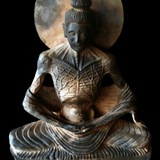
For all people that make the common question: "How can I practice Greco-Buddhism?"
Greco-Buddhism was not a religion, but a period of unique cultural syncretism. Greco-Buddhism didn't just disappeared into oblivion, but evolved as Buddhism was transmitted and disseminated into different regions and times. There's no need to "revive" Greco-Buddhism or any other Buddhist tradition tied to any specific period and peoples (Such as Tocharian Buddhism, Indo-Scythian Buddhism, etc). The "correct way" to practice Greco-Buddhism (or any other mentioned branch of historical Buddhism) is to follow Mahāyāna or Vajrayāna while incorporating veneration of Greco-Hellenic (Or related) deities as Dharmapālas.
Greco-Buddhism was not a religion, but a period of unique cultural syncretism. Greco-Buddhism didn't just disappeared into oblivion, but evolved as Buddhism was transmitted and disseminated into different regions and times. There's no need to "revive" Greco-Buddhism or any other Buddhist tradition tied to any specific period and peoples (Such as Tocharian Buddhism, Indo-Scythian Buddhism, etc). The "correct way" to practice Greco-Buddhism (or any other mentioned branch of historical Buddhism) is to follow Mahāyāna or Vajrayāna while incorporating veneration of Greco-Hellenic (Or related) deities as Dharmapālas.