Forwarded from The Classical Wisdom Tradition
King Zeus, whether we pray or not, give us what is good for us; what is bad for us, give us not, however hard we pray for it.
Socrates, Second Alcibiades, 143
Socrates, Second Alcibiades, 143
"97. O homem que não tem fé cega, que conhece o Incriado, que cortou todas os laços, destruiu todas as causas (para o kamma, bom e mau), e deitou fora todos os desejos – ele, na verdade, é o mais excelente dos homens."
Forwarded from Bhakti Vikasa Swami (Official)
On the path of Kṛṣṇa consciousness there may be many upheavals. We cannot know what to expect. Kṛṣṇa Is anxious to see the obstacles in the path of devotion removed from His devotees’ lives so that they can worship Him purely. Sometimes removal of those obstacles may seem painful. Just as in surgery, the pain is necessary but short-lived, and afterwards the patient continues to enjoy the benefit.
- Bhakti Vikāsa Swami
From the book 'Patropadesa' Volume 1
books.bvks.com
- Bhakti Vikāsa Swami
From the book 'Patropadesa' Volume 1
books.bvks.com
Forwarded from Hinduism As It Is (Hɪɴᴅᴜɪꜱᴍ(सनातन धर्म:)🕉️)
When Sadhu Vaswani was asked, "Which way do you follow to reach God? The Gita speaks of Karma Yoga, Bhakti yoga, Gyana yoga and Raja yoga and other yogas. There are so many other paths, what is the path that you follow?"
He said, "My Yoga, the path that I follow is Alpa Marga."
And they asked him, "What is Alpa Marga? We have not heard of it."
He said, "Alpa means small. My way is the little way."
What are the sadhanas on this path? Alpa Bolan, Alpa Ahar, Alpa Nidra- these are the three sadhanas.
•Alpa bolan means speak less.
•Alpa ahar means eat less.
•And Alpa nidra means sleep less.
This Alpa Marga can go together with Bhakti Marga. The two are allied. I have tried other Yogas too. But I have found that the Alpa Yoga is one of the easiest way for beginners of Yoga.
~Conversations with Dada Vaswani
🌷@HinduismAsItIs🌷
🌼@SpiritualGroup🌼
He said, "My Yoga, the path that I follow is Alpa Marga."
And they asked him, "What is Alpa Marga? We have not heard of it."
He said, "Alpa means small. My way is the little way."
What are the sadhanas on this path? Alpa Bolan, Alpa Ahar, Alpa Nidra- these are the three sadhanas.
•Alpa bolan means speak less.
•Alpa ahar means eat less.
•And Alpa nidra means sleep less.
This Alpa Marga can go together with Bhakti Marga. The two are allied. I have tried other Yogas too. But I have found that the Alpa Yoga is one of the easiest way for beginners of Yoga.
~Conversations with Dada Vaswani
🌷@HinduismAsItIs🌷
🌼@SpiritualGroup🌼
“[The sun is] The eye of Zeus, seeing all and understanding all, beholds these things too, if so He will, and fails not to mark what sort of justice is this that the city keeps within it. Now, therefore, may neither I myself be righteous among men, nor my son – for then it is a bad thing to be righteous – if indeed the unrighteous shall have the greater right. But I think that all-wise Zeus will not yet bring that to pass.
-Hesiod, Work and Days, 267
-Hesiod, Work and Days, 267
Forwarded from Ramana Maharshi | रमण महर्षि | ரமண மகரிஷி
NOT UTTERING FALSEHOOD
🌿Not keeping your word by refusing to give someone something that you have previously promised to hand over is a much greater mistake than whole-heartedly instructing an unfit person that Atma-Swarupa is the supreme reality.
~Ramana Maharshi
•Guru Vachaka Kovai, v. 820
______________________
Referring to Sri Krishna’s denoscription of his gospel as the supreme secret which should be disclosed only to his true devotees and never to others, Sri Bhagavan explained the doctrine of adhikara [fitness]. If the highest truth is taught to the unworthy, it is bound to be perverted and abused.
In fact the asuras like Hiranyakasipu were also Brahmavadins [expounders of Brahman]. They too declared ‘I am God’. Only by the ‘I’ they meant their ego. So they recognized no higher authority than their ego, and felt free to commit any sin. Indiscriminate preaching of the highest truth irrespective of the disciple’s fitness will therefore spell disaster and is forbidden by the Lord.
Here in this verse, Sri Ramana is saying that not fulfilling the promise, which indirectly implies that uttering falsehood, is an even bigger mistake than the mistake of giving the Highest Knowledge or Truth to an unfit and an immature aspirant.
🌷@ramanamaharishi🌷
🌼@SpiritualGroup🌼
🌿Not keeping your word by refusing to give someone something that you have previously promised to hand over is a much greater mistake than whole-heartedly instructing an unfit person that Atma-Swarupa is the supreme reality.
~Ramana Maharshi
•Guru Vachaka Kovai, v. 820
______________________
Referring to Sri Krishna’s denoscription of his gospel as the supreme secret which should be disclosed only to his true devotees and never to others, Sri Bhagavan explained the doctrine of adhikara [fitness]. If the highest truth is taught to the unworthy, it is bound to be perverted and abused.
In fact the asuras like Hiranyakasipu were also Brahmavadins [expounders of Brahman]. They too declared ‘I am God’. Only by the ‘I’ they meant their ego. So they recognized no higher authority than their ego, and felt free to commit any sin. Indiscriminate preaching of the highest truth irrespective of the disciple’s fitness will therefore spell disaster and is forbidden by the Lord.
Here in this verse, Sri Ramana is saying that not fulfilling the promise, which indirectly implies that uttering falsehood, is an even bigger mistake than the mistake of giving the Highest Knowledge or Truth to an unfit and an immature aspirant.
[Sri Ramana Reminiscences, p. 80.]🌷@ramanamaharishi🌷
🌼@SpiritualGroup🌼
Forwarded from Vajrarastra
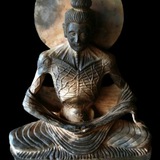
For all people that make the common question: "How can I practice Greco-Buddhism?"
Greco-Buddhism was not a religion, but a period of unique cultural syncretism. Greco-Buddhism didn't just disappeared into oblivion, but evolved as Buddhism was transmitted and disseminated into different regions and times. There's no need to "revive" Greco-Buddhism or any other Buddhist tradition tied to any specific period and peoples (Such as Tocharian Buddhism, Indo-Scythian Buddhism, etc). The "correct way" to practice Greco-Buddhism (or any other mentioned branch of historical Buddhism) is to follow Mahāyāna or Vajrayāna while incorporating veneration of Greco-Hellenic (Or related) deities as Dharmapālas.
Greco-Buddhism was not a religion, but a period of unique cultural syncretism. Greco-Buddhism didn't just disappeared into oblivion, but evolved as Buddhism was transmitted and disseminated into different regions and times. There's no need to "revive" Greco-Buddhism or any other Buddhist tradition tied to any specific period and peoples (Such as Tocharian Buddhism, Indo-Scythian Buddhism, etc). The "correct way" to practice Greco-Buddhism (or any other mentioned branch of historical Buddhism) is to follow Mahāyāna or Vajrayāna while incorporating veneration of Greco-Hellenic (Or related) deities as Dharmapālas.
Forwarded from शिवस्तोत्रावलीः 🔱🔯
The Shivasutras first awakening.
Sutra 1
https://news.1rj.ru/str/easterntantriks/9281
Sutra 2
https://news.1rj.ru/str/easterntantriks/9312
Sutra 3
https://news.1rj.ru/str/easterntantriks/9362
Sutra 4
https://news.1rj.ru/str/easterntantriks/9376
Sutra 5
https://news.1rj.ru/str/easterntantriks/9438
Sutra 6
https://news.1rj.ru/str/easterntantriks/9605
Sutra 7
https://news.1rj.ru/str/easterntantriks/9759
Sutra 8
https://news.1rj.ru/str/easterntantriks/9917
Sutra 9
https://news.1rj.ru/str/easterntantriks/9919
Sutra 10
https://news.1rj.ru/str/easterntantriks/10136
Summarizing the 8, 9, 10 Sutras.
https://news.1rj.ru/str/easterntantriks/10139
Expanded explanation of Shivasutra 8, 9, 10 from Swami Lakshmanjoo's.
The Five States of the Individual Subjective Body.
https://news.1rj.ru/str/easterntantriks/10198
Four States of "जाग्रत" Jāgrat/Wakefulness.
https://news.1rj.ru/str/easterntantriks/10230
Four States of "स्वप्न" Swapna/Dreaming.
https://news.1rj.ru/str/easterntantriks/10301
Four States of "सुषुप्ती" Sușupti/ Deep Sleep.
https://news.1rj.ru/str/easterntantriks/10333
Three States of "तुर्य" Turya/ The Fourth.
https://news.1rj.ru/str/easterntantriks/10335
Sutra 11
https://news.1rj.ru/str/easterntantriks/10397
Sutra 12
https://news.1rj.ru/str/easterntantriks/10481
Sutra 13
https://news.1rj.ru/str/easterntantriks/10559
Sutra 14
https://news.1rj.ru/str/easterntantriks/10574
Sutra 15
https://news.1rj.ru/str/easterntantriks/10657
Sutra 16
https://news.1rj.ru/str/easterntantriks/10673
Sutra 17
https://news.1rj.ru/str/easterntantriks/10702
Sutra 18
https://news.1rj.ru/str/easterntantriks/10702
Sutra 19
https://news.1rj.ru/str/easterntantriks/10817
Sutra 20
https://news.1rj.ru/str/easterntantriks/10977
Sutra 21
https://news.1rj.ru/str/easterntantriks/11010
Sutra 22
https://news.1rj.ru/str/easterntantriks/11176
Conclusion
https://news.1rj.ru/str/easterntantriks/11185
End of the first awakening of the individual Jiva (soul) to Universality.
Sutra 1
https://news.1rj.ru/str/easterntantriks/9281
Sutra 2
https://news.1rj.ru/str/easterntantriks/9312
Sutra 3
https://news.1rj.ru/str/easterntantriks/9362
Sutra 4
https://news.1rj.ru/str/easterntantriks/9376
Sutra 5
https://news.1rj.ru/str/easterntantriks/9438
Sutra 6
https://news.1rj.ru/str/easterntantriks/9605
Sutra 7
https://news.1rj.ru/str/easterntantriks/9759
Sutra 8
https://news.1rj.ru/str/easterntantriks/9917
Sutra 9
https://news.1rj.ru/str/easterntantriks/9919
Sutra 10
https://news.1rj.ru/str/easterntantriks/10136
Summarizing the 8, 9, 10 Sutras.
https://news.1rj.ru/str/easterntantriks/10139
Expanded explanation of Shivasutra 8, 9, 10 from Swami Lakshmanjoo's.
The Five States of the Individual Subjective Body.
https://news.1rj.ru/str/easterntantriks/10198
Four States of "जाग्रत" Jāgrat/Wakefulness.
https://news.1rj.ru/str/easterntantriks/10230
Four States of "स्वप्न" Swapna/Dreaming.
https://news.1rj.ru/str/easterntantriks/10301
Four States of "सुषुप्ती" Sușupti/ Deep Sleep.
https://news.1rj.ru/str/easterntantriks/10333
Three States of "तुर्य" Turya/ The Fourth.
https://news.1rj.ru/str/easterntantriks/10335
Sutra 11
https://news.1rj.ru/str/easterntantriks/10397
Sutra 12
https://news.1rj.ru/str/easterntantriks/10481
Sutra 13
https://news.1rj.ru/str/easterntantriks/10559
Sutra 14
https://news.1rj.ru/str/easterntantriks/10574
Sutra 15
https://news.1rj.ru/str/easterntantriks/10657
Sutra 16
https://news.1rj.ru/str/easterntantriks/10673
Sutra 17
https://news.1rj.ru/str/easterntantriks/10702
Sutra 18
https://news.1rj.ru/str/easterntantriks/10702
Sutra 19
https://news.1rj.ru/str/easterntantriks/10817
Sutra 20
https://news.1rj.ru/str/easterntantriks/10977
Sutra 21
https://news.1rj.ru/str/easterntantriks/11010
Sutra 22
https://news.1rj.ru/str/easterntantriks/11176
Conclusion
https://news.1rj.ru/str/easterntantriks/11185
End of the first awakening of the individual Jiva (soul) to Universality.
Forwarded from Spiritual Books Meditations
The Vedanta recognises no sin, it only recognises error. And the greatest error, says the Vedanta, is to say that you are weak, that you are a sinner, a miserable creature, and that you have no power and you cannot do this and that. Every time you think in that way, you, as it were, rivet one more link in the chain that binds you down, you add one more layer of hypnotism on to your own soul. Therefore, whosoever thinks he is weak is wrong, whosoever thinks he is impure is wrong, and is throwing a bad thought into the world. This we must always bear in mind that in the Vedanta there is no attempt at reconciling the present life — the hypnotised life, this false life which we have assumed — with the ideal; but this false life must go, and the real life which is always existing must manifest itself, must shine out. No man becomes purer and purer, it is a matter of greater manifestation. The veil drops away, and the native purity of the soul begins to manifest itself. Everything is ours already — infinite purity, freedom, love, and power.
━━━━━━━━━━━━━
Swami Vivekananda
━━━━━━━━━━━━━
Swami Vivekananda
Forwarded from ESTOICISMO
"Não diga a si mesmo nada além do que a impressão inicial lhe informa. Alguém lhe insultou, por exemplo. Diga isso, mas não que isso lhe causou algum mal. O fato de que meu filho está doente — isso eu posso ver. Mas 'que ele pode morrer', não. Foque nas primeiras impressões. Não extrapole e nada poderá lhe causar mal."
— Marco Aurélio
— Marco Aurélio
Forwarded from The Classical Wisdom Tradition
Below is a historically informed reading list to begin your journey. The order matters. This list is based on what we know some historical Platonists used as a curriculum.
The first two are short and straightforward and will transform your life if you engage seriously with them. I recommend reading them frequently and meditating on them daily.
This curriculum will take you through a plan of moral purification and gradually introduce you to deeper philosophical matters.
While not part of the "standard" historical Platonic curriculum, as far as I know, I do also recommend reading Book VII of Plato's Republic, which contains the famous cave allegory. Additionally, Sallust's On the Gods and the World is a good introduction to the Platonic path.
1. The Pythagorean Golden Verses
2. The Handbook of Epictetus
3. Select dialogues of Plato:
1. Alcibiades I
2. Gorgias
3. Phaedo
4. Cratylus
5. Theaetetus
6. Sophist
7. Statesman
8. Phaedrus
9. Symposium
10. Philebus
11. Timaeus
12. Parmenides
Moving on from here, there are ancient commentaries available on many of these texts, as well as numerous other Stoic and Platonic texts, such as those by Epictetus, Seneca, Plotinus and Proclus.
The first two are short and straightforward and will transform your life if you engage seriously with them. I recommend reading them frequently and meditating on them daily.
This curriculum will take you through a plan of moral purification and gradually introduce you to deeper philosophical matters.
While not part of the "standard" historical Platonic curriculum, as far as I know, I do also recommend reading Book VII of Plato's Republic, which contains the famous cave allegory. Additionally, Sallust's On the Gods and the World is a good introduction to the Platonic path.
1. The Pythagorean Golden Verses
2. The Handbook of Epictetus
3. Select dialogues of Plato:
1. Alcibiades I
2. Gorgias
3. Phaedo
4. Cratylus
5. Theaetetus
6. Sophist
7. Statesman
8. Phaedrus
9. Symposium
10. Philebus
11. Timaeus
12. Parmenides
Moving on from here, there are ancient commentaries available on many of these texts, as well as numerous other Stoic and Platonic texts, such as those by Epictetus, Seneca, Plotinus and Proclus.