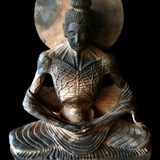
"Idiotas fazem coisas ruins e vão para o inferno.
Idiotas fazem coisas boas e vão para o céu.
Só o sábio irá além de fazer o bem e o mal
e ser liberado."
Chandrakirti
Idiotas fazem coisas boas e vão para o céu.
Só o sábio irá além de fazer o bem e o mal
e ser liberado."
Chandrakirti
"Then, Bāhiya, you should train yourself thus: In reference to the seen, there will be only the seen. In reference to the heard, only the heard. In reference to the sensed, only the sensed. In reference to the cognized, only the cognized. That is how you should train yourself. When for you there will be only the seen in reference to the seen, only the heard in reference to the heard, only the sensed in reference to the sensed, only the cognized in reference to the cognized, then, Bāhiya, there is no you in connection with that. When there is no you in connection with that, there is no you there. When there is no you there, you are neither here nor yonder nor between the two. This, just this, is the end of stress."
Bhaiya Sutta
Bhaiya Sutta
"Everyone will see that the Celestial Demiurge must have looked to the eternal, for the world is the fairest of creations and He is the best of causes”
Plato, Timaeus 29a
Plato, Timaeus 29a
"First, the dissolution of the physical body allows that body to be transformed with the semblance it had disappearing and its now non-functioning ethos handed over to the daimon, with the body's perceptions returning to their origin, then becoming separated with their purpose, transplanted, and with desire and eagerness journeying toward the physis devoid of logos. Thus does the mortal hasten through the harmonious structure, offering up, in the first realm, that vigour which grows and which fades, and - in the second one - those dishonourable machinations, no longer functioning. In the third, that eagerness which deceives, no longer functioning; in the fourth, the arrogance of command, no longer insatiable; in the fifth, profane insolence and reckless haste; in the sixth, the bad inclinations occasioned by riches, no longer functioning; and in the seventh realm, the lies that lie in wait.
[Thus] they become united with theos. For to so become of theos is the noble goal of those who seek to acquire knowledge."
Pymander
[Thus] they become united with theos. For to so become of theos is the noble goal of those who seek to acquire knowledge."
Pymander
"You who are earth-bound, why do you embrace death when you have the means to partake of immortality?"
Hermes Trismegistus
Hermes Trismegistus
Vaiṣṇavas, who do not accept the materialist premise of Lord Buddha's philosophy, see his teaching as limited but not entirely untrue. Śrīla Prabhupāda gives this perspective:
When the spiritual spark, which is described as one ten-thousandth part of the tip of a hair, is forced into material existence, that spark is covered by gross and subtle material elements. The material body is composed of five gross elements—earth, water, fire, air and ether—and three subtle elements—mind, intelligence and ego. When one attains liberation, he is freed from these material coverings. Indeed, success in yoga involves getting free from these material coverings and entering into spiritual existence. Lord Buddha's teachings of nirvāṇa are based on this principle. Lord Buddha instructed his followers to give up these material coverings by means of meditation and yoga. Lord Buddha did not give any information about the soul, but if one follows his instructions strictly, he will ultimately become free from the material coverings and attain nirvāṇa… Unfortunately, unless the living entity has information of the spiritual world and the Vaikuṇṭhas, there is a 99.9 percent chance of his falling down again into material.
When the spiritual spark, which is described as one ten-thousandth part of the tip of a hair, is forced into material existence, that spark is covered by gross and subtle material elements. The material body is composed of five gross elements—earth, water, fire, air and ether—and three subtle elements—mind, intelligence and ego. When one attains liberation, he is freed from these material coverings. Indeed, success in yoga involves getting free from these material coverings and entering into spiritual existence. Lord Buddha's teachings of nirvāṇa are based on this principle. Lord Buddha instructed his followers to give up these material coverings by means of meditation and yoga. Lord Buddha did not give any information about the soul, but if one follows his instructions strictly, he will ultimately become free from the material coverings and attain nirvāṇa… Unfortunately, unless the living entity has information of the spiritual world and the Vaikuṇṭhas, there is a 99.9 percent chance of his falling down again into material.
I am not mind, nor intellect, nor ego, nor the reflections of inner self (citta). I am not the five senses. I am beyond that. I am not the ether, nor the earth, nor the fire, nor the wind (the five elements). I am indeed, That eternal knowing and bliss, the auspicious (Śivam), love and pure consciousness.
Neither can I be termed as energy (prāṇa), nor five types of breath (vāyus), nor the seven material essences, nor the five sheaths(pañca-kośa). Neither am I the organ of Speech, nor the organs for Holding (Hand), Movement (Feet) or Excretion. I am indeed, That eternal knowing and bliss, the auspicious (Śivam), love and pure consciousness.
I have no hatred or dislike, nor affiliation or liking, nor greed, nor delusion, nor pride or haughtiness, nor feelings of envy or jealousy. I have no duty (dharma), nor any money, nor any desire (kāma), nor even liberation (mokṣa). I am indeed, That eternal knowing and bliss, the auspicious (Śivam), love and pure consciousness.
I have neither merit (virtue), nor demerit (vice). I do not commit sins or good deeds, nor have happiness or sorrow, pain or pleasure. I do not need mantras, holy places, noscriptures (Vedas), rituals or sacrifices (yajñas). I am none of the triad of the observer or one who experiences, the process of observing or experiencing, or any object being observed or experienced. I am indeed, That eternal knowing and bliss, the auspicious (Śivam), love and pure consciousness.
I do not have fear of death, as I do not have death. I have no separation from my true self, no doubt about my existence, nor have I discrimination on the basis of birth. I have no father or mother, nor did I have a birth. I am not the relative, nor the friend, nor the guru, nor the disciple. I am indeed, That eternal knowing and bliss, the auspicious (Śivam), love and pure consciousness.
I am all pervasive. I am without any attributes, and without any form. I have neither attachment to the world, nor to liberation (mukti). I have no wishes for anything because I am everything, everywhere, every time, always in equilibrium. I am indeed, That eternal knowing and bliss, the auspicious (Śivam), love and pure consciousness.
Neither can I be termed as energy (prāṇa), nor five types of breath (vāyus), nor the seven material essences, nor the five sheaths(pañca-kośa). Neither am I the organ of Speech, nor the organs for Holding (Hand), Movement (Feet) or Excretion. I am indeed, That eternal knowing and bliss, the auspicious (Śivam), love and pure consciousness.
I have no hatred or dislike, nor affiliation or liking, nor greed, nor delusion, nor pride or haughtiness, nor feelings of envy or jealousy. I have no duty (dharma), nor any money, nor any desire (kāma), nor even liberation (mokṣa). I am indeed, That eternal knowing and bliss, the auspicious (Śivam), love and pure consciousness.
I have neither merit (virtue), nor demerit (vice). I do not commit sins or good deeds, nor have happiness or sorrow, pain or pleasure. I do not need mantras, holy places, noscriptures (Vedas), rituals or sacrifices (yajñas). I am none of the triad of the observer or one who experiences, the process of observing or experiencing, or any object being observed or experienced. I am indeed, That eternal knowing and bliss, the auspicious (Śivam), love and pure consciousness.
I do not have fear of death, as I do not have death. I have no separation from my true self, no doubt about my existence, nor have I discrimination on the basis of birth. I have no father or mother, nor did I have a birth. I am not the relative, nor the friend, nor the guru, nor the disciple. I am indeed, That eternal knowing and bliss, the auspicious (Śivam), love and pure consciousness.
I am all pervasive. I am without any attributes, and without any form. I have neither attachment to the world, nor to liberation (mukti). I have no wishes for anything because I am everything, everywhere, every time, always in equilibrium. I am indeed, That eternal knowing and bliss, the auspicious (Śivam), love and pure consciousness.
"Ah! All the residents of Shivaloka are liberated souls. By Shiva's mercy how many of them are not only liberated, but are now pure devotees of Lord Krsna? To consider Shiva different from Lord Krsna is a great offence. The supreme personality of Godhead may forgive offences committed to Him, but He does not forgive those committed against Shiva."
- Brihad Bhagavatamrta
- Brihad Bhagavatamrta
"Lord Shiva said to Parvati: "One who initiates a disciple by giving a mantra is the guru. The mantra itself is the parama guru (superior guru), you are parapara guru (supreme guru) and I am paramesthi guru (eternal guru)."
- Mahanirvana Tantra
- Mahanirvana Tantra
Forwarded from The Classical Wisdom Tradition
Thus all beings proceed from, and are comprehended in the first being; all intellects emanate from one first intellect; all souls from one first soul; all natures blossom from one first nature; and all bodies proceed from the vital and luminous body of the world. And lastly, all these great monads are comprehended in the first one, from which both they and all their depending series are unfolded into light. Hence this first one is truly the unity of unities, the monad of monads, the principle of principles, the God of Gods, one and all things, and yet one prior to all.
Thomas Taylor, The Theology of the Greeks
Thomas Taylor, The Theology of the Greeks
Idiots do bad things and go to hell.
Idiots do good things and go to heaven.
Only the wise will go beyond doing good and bad and be liberated.
- Chandrakirti
Idiots do good things and go to heaven.
Only the wise will go beyond doing good and bad and be liberated.
- Chandrakirti
The characteristic of this form of Neoplatonism is that the emanations of the upper world are connected to the ones of the lower world by intermediate beings; the higher the gradation of these beings the more they resemble the character of demons and gods; yet the more they unite with physical matter the more they appear as spiritual forces asleep in all animals, plants, stones and all other creatures of nature. (...) We clearly see from the (teachings of the) Lauteren Brüder that the forces of the universal soul are changing their faces and that they can be perceived as forces, or angels of God, or spirits, or even Pneumata (depending on the level of emanation they are encountered at).
Theodor Hopfner
Theodor Hopfner
“But a soul that never saw the truth cannot take a human shape, since a human being must understand speech in terms of general forms, proceeding to bring many perceptions together into a reasoned unity. That process is the recollection of the things our soul saw when it was traveling with god, when it disregarded the things we now call real and lifted up its head to what is truly real instead.”
Plato
Plato
Lord Shiva said: "If a devotee of Lord Vishnu hates Me or if a devotee of Mine hates Vishnu, both will incur curses and never realize reality."
- Shiva Mahapurana, Rudra samhita 2.2, Sati khanda 43.21
- Shiva Mahapurana, Rudra samhita 2.2, Sati khanda 43.21
"To say what Hyle is, is not puerile. Hyle is the primary matter and the Philosopher’s Stone. Azoth is the seed of all metals, when it is extracted from magnesia and Silver.
Hyle is the Beginning of all things, a confused mass and primary matter, which is neither moist nor dry, not earth nor water, not light nor darkness, not air nor fire."
Hyle is the Beginning of all things, a confused mass and primary matter, which is neither moist nor dry, not earth nor water, not light nor darkness, not air nor fire."
Forwarded from The Classical Wisdom Tradition
Having a daily routine of devotion and contemplation in accordance with the principles of this tradition can immediately make a huge positive difference in your life. Do not get so bogged down in the technicalities of metaphysics or concerns about perfect historical accuracy that you do little or nothing. Get started now.
A good place to start if you are unsure is with a simple prayer (you can find many examples in this channel) & incense along with meditation on the Golden Verses or The Handbook (Enchiridion) of Epictetus.
A good place to start if you are unsure is with a simple prayer (you can find many examples in this channel) & incense along with meditation on the Golden Verses or The Handbook (Enchiridion) of Epictetus.
Forwarded from The Classical Wisdom Tradition
Everything you do and say and think should be predicated on the possibility of your imminent departure from life. But, if the gods exist, leaving this world can’t be something to fear, because they wouldn’t let anything bad happen to you.
Marcus Aurelius, Meditations 2.11
Marcus Aurelius, Meditations 2.11
Thereafter, at the end of the millennium, the Lord Himself in the form of Rudra, the destroyer, will annihilate the complete creation as the wind displaces the clouds.
- Srimad Bhagavatam Mahapurana 2.10.43
- Srimad Bhagavatam Mahapurana 2.10.43