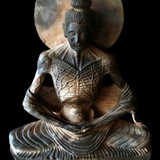
― Nagasena, o Nirvana é cessação?
― Sim, Majestade.
― Como assim?
― Todos os tolos não convertidos sentem prazer apegam-se aos sentidos e aos objetos dos sentidos. Deixam-se levar pela corrente. Não se libertam do nascimento, da velhice, da morte, do sofrimento. Mas o sábio discípulo não sente prazer, não se alegra nem sente satisfação, nem se apega aos objetos dos sentidos. Por aí, sucessivamente, cessam a sede (tanha), o apego, a existência, o nascimento, a velhice, a morte, o dukkha. Assim, o Nirvana é cessação.
Milinda Panha II
― Sim, Majestade.
― Como assim?
― Todos os tolos não convertidos sentem prazer apegam-se aos sentidos e aos objetos dos sentidos. Deixam-se levar pela corrente. Não se libertam do nascimento, da velhice, da morte, do sofrimento. Mas o sábio discípulo não sente prazer, não se alegra nem sente satisfação, nem se apega aos objetos dos sentidos. Por aí, sucessivamente, cessam a sede (tanha), o apego, a existência, o nascimento, a velhice, a morte, o dukkha. Assim, o Nirvana é cessação.
Milinda Panha II
Forwarded from MAHASIDDHAS, MAHAMUDRA & DZOGCHEN 👹
"The pure mind, the ubiquitous essence -
it is spontaneously, originally, perfect;
so strenuous engagement with the ten techniques
is unnecessary, superfluous.
I am inscrutable and cannot be cultivated.
All the ten techniques are likewise transcended,
so nothing can be done to affect me.
Those who try to approach me on a causal path,
desirous of catching a glimpse of my face,
seeking me through the ten techniques,
fall straight to earth like a tenderfoot sky-walker,
tumbling down due to deliberate effort.
I, the supreme source, I am the revelation,
and transcend every sphere of activity,
so a view of me cannot be cultivated,
and the ten techniques are meaningless.
If you still think that the ten techniques have purpose,
look at me, and finding nothing to see,
taking no view, remain at that zero-point.
Nothing ever separates us from unoriginated simplicity,
so vows and discipline are redundant;
the essence is always spontaneously present,
so any effort to find it is always superfluous;
self-sprung awareness has never been obscured,
so gnostic awareness cannot be generated;
everybody already lives on my level,
so there is no place to reach through purification;
I embrace all and everything,
so there can be no path that leads to me;
I am forever incapable of dualization,
so there is never anything to be labeled 'subtle';
my form embraces everything,
so there has never been any 'duality';
I am self-sprung awareness from the very beginning,
so I can never be nailed down;
since I am the heart of total presence,
there is no other source of secret precepts."
— Samantabhadra
Via RR
it is spontaneously, originally, perfect;
so strenuous engagement with the ten techniques
is unnecessary, superfluous.
I am inscrutable and cannot be cultivated.
All the ten techniques are likewise transcended,
so nothing can be done to affect me.
Those who try to approach me on a causal path,
desirous of catching a glimpse of my face,
seeking me through the ten techniques,
fall straight to earth like a tenderfoot sky-walker,
tumbling down due to deliberate effort.
I, the supreme source, I am the revelation,
and transcend every sphere of activity,
so a view of me cannot be cultivated,
and the ten techniques are meaningless.
If you still think that the ten techniques have purpose,
look at me, and finding nothing to see,
taking no view, remain at that zero-point.
Nothing ever separates us from unoriginated simplicity,
so vows and discipline are redundant;
the essence is always spontaneously present,
so any effort to find it is always superfluous;
self-sprung awareness has never been obscured,
so gnostic awareness cannot be generated;
everybody already lives on my level,
so there is no place to reach through purification;
I embrace all and everything,
so there can be no path that leads to me;
I am forever incapable of dualization,
so there is never anything to be labeled 'subtle';
my form embraces everything,
so there has never been any 'duality';
I am self-sprung awareness from the very beginning,
so I can never be nailed down;
since I am the heart of total presence,
there is no other source of secret precepts."
— Samantabhadra
Via RR
“The Aghori sets out to overcome human limitations by shattering internally every restraint, no matter how ancient or powerful the taboo, and also by creating a body/mind that is able to contain emotional, sensory and other experiences which would consume anyone not properly prepared.”
“Aghora is the apotheosis of Tantra, whose supreme deity is the mother goddess. Tantra has thus far been glimpsed in the West only in its most vulgar and debased forms, promulgated by unscrupulous scoundrels who equate sex with super consciousness. Sex is indeed central to Tantra, the cosmic sexual union of universal dualities. The aim of Tantra is Laya, return of the seeker to the state of undifferentiated existence.”
Robert Svoboda
“Aghora is the apotheosis of Tantra, whose supreme deity is the mother goddess. Tantra has thus far been glimpsed in the West only in its most vulgar and debased forms, promulgated by unscrupulous scoundrels who equate sex with super consciousness. Sex is indeed central to Tantra, the cosmic sexual union of universal dualities. The aim of Tantra is Laya, return of the seeker to the state of undifferentiated existence.”
Robert Svoboda
"The dharmakaya is like the ocean in which many waters are mixed and our various gurus are like drops from the ocean. All our gurus are manifestations of the dharmakaya, the absolute guru, the holy mind of all the buddhas; the absolute guru manifests in an ordinary form in accordance with the level of our karma. This ordinary form is the conventional guru, the essence of which is the absolute guru."
Kyabje Lama Zopa Rinpoche
Kyabje Lama Zopa Rinpoche
"From where do all the buddhas come? From the guru. From where do Buddha, Dharma and Sangha come? From the guru. And what is that guru? It is the absolute guru, the dharmakaya, the transcendental wisdom of nondual bliss and voidness."
Kyabje Lama Zopa Rinpoche
Kyabje Lama Zopa Rinpoche
"The mind has never been seen by any of the fully enlightened, supremely attained ones who have conquered inner adversaries, nor will they ever see it. Being formless the mind has no colour such as blue, yellow, red, white, maroon or crystal. The mind has no shape either short or long, either round or square; it is neither light nor dark. It has no sexual identity such as female, male or sexless."
Vairocanābhisaṃbodhi Sūtra
Vairocanābhisaṃbodhi Sūtra
"There is no cause or support for the Natural State. It is neither beginning nor end. If you turn your consciousness towards the Nature, there is nothing special to see or hear, nor is it possible to explain where it resides. This Nature is called unchangeable Dharmakaya. There are no Paths, no Bhumis, nothing. Everything - the whole phenomenal existence - is integrated with Awareness Wisdom. Everything is liberated there. If you do not realize this Nature purely yet expect to achieve the Three Kayas, there is no hope of receiving any result."
Chöza Bönmo
Chöza Bönmo
"Let go of the past, let go of the future. Let go of present. Having gone beyond becoming, with mind completely freed, you will never again come to birth and aging."
Dhammapada
Dhammapada
“Beings are the owners of their actions, the heirs of their actions; they spring from their actions, are bound to their actions, and are supported by their actions. Whatever deeds they do, good or bad, of those they shall be heirs.”
Bhikkhu Bodhi
Bhikkhu Bodhi
"The mind is the source of all experience, and by changing the direction of the mind, we can change the quality of everything we experience."
Mingyur Rinpoche
Mingyur Rinpoche
“I will be sick, I will grow old, I will die, I will be separated from those I love, my relations and so forth. In such manner, the fully ripened effect of my actions will come to me and to no one else, and I am therefore not above depending on what I did in former lives.”
To think like this again and again is the antidote to such things as arrogance. Make every effort not to become arrogant by meditating on this antidote.
Kangyur Rinpoche
To think like this again and again is the antidote to such things as arrogance. Make every effort not to become arrogant by meditating on this antidote.
Kangyur Rinpoche
"Buda nem sempre se manifesta como um Buda. Às vezes se manifesta como um demônio, às vezes, como uma mulher, um deus, um rei ou um estadista; aparece, também, em um bordel ou numa casa de jogo. Em todos os acontecimentos e ocasiões, Buda manifesta a pura essência do Dharmakaya (a natureza absoluta de Buda); sendo assim, sua mercê e compaixão fluem perenemente deste Dharmamaya, proporcionando salvação à humanidade."
Bukkyo Dendo Kyokai
Bukkyo Dendo Kyokai
The book I just sent is the Buddhist Cosmology presented by a Theravada Monk.
Kamma and Rebirth
Beings existing in saṃsāra perform actions with body, speech and mind. This is kamma (Skt. karma) and such actions always have a later effect (vipāka). If the actions are skilful (kusala) they lead to pleasant results, if they are unskilful (akusala) they lead to painful results. Note that this terminology is preferred to the use of “good” and “evil” because kamma is not a divine judgement, but a natural law. At the moment of death, when the body ceases to provide a substrate for consciousness, the next moment of consciousness will arise in a new body determined by the kamma made by that individual. This may be in any of the realms of being and may be either upward or downward depending on that person’s kamma. This process of repeated rebirth is both beginningless and endless unless that person achieves full awakening and makes an end of it. There is no ultimate purpose served within the process of rebirth itself, and seeing into the futility of saṃsāra is an important aspect of waking up.
Ajahn Punnadhammo
Beings existing in saṃsāra perform actions with body, speech and mind. This is kamma (Skt. karma) and such actions always have a later effect (vipāka). If the actions are skilful (kusala) they lead to pleasant results, if they are unskilful (akusala) they lead to painful results. Note that this terminology is preferred to the use of “good” and “evil” because kamma is not a divine judgement, but a natural law. At the moment of death, when the body ceases to provide a substrate for consciousness, the next moment of consciousness will arise in a new body determined by the kamma made by that individual. This may be in any of the realms of being and may be either upward or downward depending on that person’s kamma. This process of repeated rebirth is both beginningless and endless unless that person achieves full awakening and makes an end of it. There is no ultimate purpose served within the process of rebirth itself, and seeing into the futility of saṃsāra is an important aspect of waking up.
Ajahn Punnadhammo
"According to the Buddhist teachings, no matter how confused or deluded we may be at the moment, the underlying and essential nature of our being is clear and pure. In the same way that clouds can temporarily obscure but cannot damage the light-giving power of the sun, so too the temporary afflictions of body and mind—our confusion, anxiety, and the suffering they cause—can temporarily obscure but cannot destroy or even touch the fundamentally clear nature of our consciousness. Dwelling deep within our heart, and within the hearts of all beings without exception, is an inexhaustible source of love and wisdom. And the ultimate purpose of all spiritual practices, whether they are called Buddhist or not, is to uncover and make contact with this essentially pure nature."
Lama Yeshe
Lama Yeshe