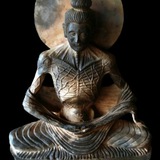
"The mind has never been seen by any of the fully enlightened, supremely attained ones who have conquered inner adversaries, nor will they ever see it. Being formless the mind has no colour such as blue, yellow, red, white, maroon or crystal. The mind has no shape either short or long, either round or square; it is neither light nor dark. It has no sexual identity such as female, male or sexless."
Vairocanābhisaṃbodhi Sūtra
Vairocanābhisaṃbodhi Sūtra
"There is no cause or support for the Natural State. It is neither beginning nor end. If you turn your consciousness towards the Nature, there is nothing special to see or hear, nor is it possible to explain where it resides. This Nature is called unchangeable Dharmakaya. There are no Paths, no Bhumis, nothing. Everything - the whole phenomenal existence - is integrated with Awareness Wisdom. Everything is liberated there. If you do not realize this Nature purely yet expect to achieve the Three Kayas, there is no hope of receiving any result."
Chöza Bönmo
Chöza Bönmo
"Let go of the past, let go of the future. Let go of present. Having gone beyond becoming, with mind completely freed, you will never again come to birth and aging."
Dhammapada
Dhammapada
“Beings are the owners of their actions, the heirs of their actions; they spring from their actions, are bound to their actions, and are supported by their actions. Whatever deeds they do, good or bad, of those they shall be heirs.”
Bhikkhu Bodhi
Bhikkhu Bodhi
"The mind is the source of all experience, and by changing the direction of the mind, we can change the quality of everything we experience."
Mingyur Rinpoche
Mingyur Rinpoche
“I will be sick, I will grow old, I will die, I will be separated from those I love, my relations and so forth. In such manner, the fully ripened effect of my actions will come to me and to no one else, and I am therefore not above depending on what I did in former lives.”
To think like this again and again is the antidote to such things as arrogance. Make every effort not to become arrogant by meditating on this antidote.
Kangyur Rinpoche
To think like this again and again is the antidote to such things as arrogance. Make every effort not to become arrogant by meditating on this antidote.
Kangyur Rinpoche
"Buda nem sempre se manifesta como um Buda. Às vezes se manifesta como um demônio, às vezes, como uma mulher, um deus, um rei ou um estadista; aparece, também, em um bordel ou numa casa de jogo. Em todos os acontecimentos e ocasiões, Buda manifesta a pura essência do Dharmakaya (a natureza absoluta de Buda); sendo assim, sua mercê e compaixão fluem perenemente deste Dharmamaya, proporcionando salvação à humanidade."
Bukkyo Dendo Kyokai
Bukkyo Dendo Kyokai
The book I just sent is the Buddhist Cosmology presented by a Theravada Monk.
Kamma and Rebirth
Beings existing in saṃsāra perform actions with body, speech and mind. This is kamma (Skt. karma) and such actions always have a later effect (vipāka). If the actions are skilful (kusala) they lead to pleasant results, if they are unskilful (akusala) they lead to painful results. Note that this terminology is preferred to the use of “good” and “evil” because kamma is not a divine judgement, but a natural law. At the moment of death, when the body ceases to provide a substrate for consciousness, the next moment of consciousness will arise in a new body determined by the kamma made by that individual. This may be in any of the realms of being and may be either upward or downward depending on that person’s kamma. This process of repeated rebirth is both beginningless and endless unless that person achieves full awakening and makes an end of it. There is no ultimate purpose served within the process of rebirth itself, and seeing into the futility of saṃsāra is an important aspect of waking up.
Ajahn Punnadhammo
Beings existing in saṃsāra perform actions with body, speech and mind. This is kamma (Skt. karma) and such actions always have a later effect (vipāka). If the actions are skilful (kusala) they lead to pleasant results, if they are unskilful (akusala) they lead to painful results. Note that this terminology is preferred to the use of “good” and “evil” because kamma is not a divine judgement, but a natural law. At the moment of death, when the body ceases to provide a substrate for consciousness, the next moment of consciousness will arise in a new body determined by the kamma made by that individual. This may be in any of the realms of being and may be either upward or downward depending on that person’s kamma. This process of repeated rebirth is both beginningless and endless unless that person achieves full awakening and makes an end of it. There is no ultimate purpose served within the process of rebirth itself, and seeing into the futility of saṃsāra is an important aspect of waking up.
Ajahn Punnadhammo
"According to the Buddhist teachings, no matter how confused or deluded we may be at the moment, the underlying and essential nature of our being is clear and pure. In the same way that clouds can temporarily obscure but cannot damage the light-giving power of the sun, so too the temporary afflictions of body and mind—our confusion, anxiety, and the suffering they cause—can temporarily obscure but cannot destroy or even touch the fundamentally clear nature of our consciousness. Dwelling deep within our heart, and within the hearts of all beings without exception, is an inexhaustible source of love and wisdom. And the ultimate purpose of all spiritual practices, whether they are called Buddhist or not, is to uncover and make contact with this essentially pure nature."
Lama Yeshe
Lama Yeshe
"According to Buddhist terminology, the ultimate goal of our individual human evolution is enlightenment or buddhahood. This state, which can be achieved by everyone, is attained when all the delusions—greed, hatred, ignorance and the like—presently obscuring our mind have been completely removed and when all our positive qualities have been fully developed. This state of complete fulfillment, of full awakening, is characterized by unlimited wisdom, unlimited compassion, and unlimited skill, or power."
Lama Yeshe
Lama Yeshe
"Living mindfully and with concentration, we see a deeper reality and are able to witness impermanence without fear, anger, or despair."
Thich Nhat Hanh
Thich Nhat Hanh
"No universal processo da criação não há, inerentemente, distinções entre o processo da vida e o da extinção, mas os homens fazem uma distinção, chamando a um nascimento e a outro de morte. Paralelamente, não havendo nenhuma discriminação entre o certo e o errado nos atos, os homens fazem uma distinção, para atender a sua tola conveniência."
Bukkyo Dendo Kyokai
Bukkyo Dendo Kyokai
"Sabendo-se que as coisas nem existem e nem são não-existentes, lembrando-se da natureza onírica de tudo, deve-se evitar todo o orgulho pessoal ou a exaltação dos bons atos, ou ainda, ser apanhado e envolvido por toda e qualquer coisa mais.
Para se evitar ser apanhado pela corrente dos desejos, deve-se aprender, desde o princípio, a não se aferrar às coisas, a fim de que não se acostume nem se apegue à elas. Não se deve apegar nem à existência nem à não-existência, nem a qualquer coisa interior ou exterior, nem às boas como às más coisas, nem ao certo nem ao errado.
A vida de ilusão começará a partir do momento em que houver apego às coisas.
Aquele que está seguindo o Nobre Caminho para a Iluminação não deve nutrir tristes recordações daquilo que passou, nem deve antegozar o futuro, deve, isto sim, com uma mente justa e tranquila, acolher aquilo que vier."
Bukkyo Dendo Kyokai
Para se evitar ser apanhado pela corrente dos desejos, deve-se aprender, desde o princípio, a não se aferrar às coisas, a fim de que não se acostume nem se apegue à elas. Não se deve apegar nem à existência nem à não-existência, nem a qualquer coisa interior ou exterior, nem às boas como às más coisas, nem ao certo nem ao errado.
A vida de ilusão começará a partir do momento em que houver apego às coisas.
Aquele que está seguindo o Nobre Caminho para a Iluminação não deve nutrir tristes recordações daquilo que passou, nem deve antegozar o futuro, deve, isto sim, com uma mente justa e tranquila, acolher aquilo que vier."
Bukkyo Dendo Kyokai
"A Iluminação não possui forma ou natureza definidas, com as quais ela pode se manifestar, porque na própria Iluminação não há nada a ser esclarecido.
A Iluminação existe unicamente porque existem a ilusão e a ignorância, se elas desaparecerem, a Iluminação também desaparecerá. O oposto é verdadeiro, isto é, a ilusão e a ignorância existem porque existe a Iluminação; quando cessar a Iluminação, a ignorância e a delusão também cessarão.
Portanto, não considerem a Iluminação como uma “coisa” a ser aferrada, a fim de que ela não se torne também um impecilho. Quando uma mente anuviada se ilumina, s trevas desaparecem e com elas a “coisa” a que chamamos Iluminação também deixa de existir.
Se os homens desejam e se apegam à Iluminação, isto significa que eles ainda alimentam a delusão; aqueles, portanto, que estiverem trilhando o caminho da Iluminação não deverão a ela se apegar, e, uma vez alcançada a Iluminação, nela não mais deverão pensar.
Quando se atingir, de fato, a Iluminação, poder-se-á ver que tudo encerra, em si mesmo, uma Iluminação; portanto, deve-se seguir o caminho da Iluminação até que se conclua que as paixões mundanas são, em si mesmas, Iluminação."
Bukkyo Dendo Kyokai
A Iluminação existe unicamente porque existem a ilusão e a ignorância, se elas desaparecerem, a Iluminação também desaparecerá. O oposto é verdadeiro, isto é, a ilusão e a ignorância existem porque existe a Iluminação; quando cessar a Iluminação, a ignorância e a delusão também cessarão.
Portanto, não considerem a Iluminação como uma “coisa” a ser aferrada, a fim de que ela não se torne também um impecilho. Quando uma mente anuviada se ilumina, s trevas desaparecem e com elas a “coisa” a que chamamos Iluminação também deixa de existir.
Se os homens desejam e se apegam à Iluminação, isto significa que eles ainda alimentam a delusão; aqueles, portanto, que estiverem trilhando o caminho da Iluminação não deverão a ela se apegar, e, uma vez alcançada a Iluminação, nela não mais deverão pensar.
Quando se atingir, de fato, a Iluminação, poder-se-á ver que tudo encerra, em si mesmo, uma Iluminação; portanto, deve-se seguir o caminho da Iluminação até que se conclua que as paixões mundanas são, em si mesmas, Iluminação."
Bukkyo Dendo Kyokai
"Este conceito da unidade universal - que as coisas, em sua natureza essencial, não possuem marcas distintas - é chamado de “Sunyata”. Por sunyata entende-se a não substancialidade, a não existência, algo que não tem natureza própria nem dualidade.
Pelo fato de as coisas não possuírem, em si mesmas, nenhuma forma ou características, é que podemos dizer que as coisas não nascem nem se destroem. Nada existe na natureza essencial as coisas que possa ser descrito em termos de discriminação; eis porque as coisas são consideradas não substanciais.
Como já foi mencionado, todas as coisas aparecem e desaparecem pelo concurso das causas e condições. Nada existe inteiramente só; tudo se interrelaciona.
Onde há luz, há sombra; onde há extensão, há pequenez, onde há branco, há preto. Como estas oposições, a própria natureza das coisas não pode existir sozinha, eis porque as coisas são chamadas de não substanciais ou sunyata.
Conclui-se, pois, que a Iluminação não pode existir à parte da ignorância, nem a ignorância, à parte da Iluminação. Se as coisas não se diferenciam em sua natureza essencial, como pode haver dualidade?"
Bukkyo Dendo Kyokai
Pelo fato de as coisas não possuírem, em si mesmas, nenhuma forma ou características, é que podemos dizer que as coisas não nascem nem se destroem. Nada existe na natureza essencial as coisas que possa ser descrito em termos de discriminação; eis porque as coisas são consideradas não substanciais.
Como já foi mencionado, todas as coisas aparecem e desaparecem pelo concurso das causas e condições. Nada existe inteiramente só; tudo se interrelaciona.
Onde há luz, há sombra; onde há extensão, há pequenez, onde há branco, há preto. Como estas oposições, a própria natureza das coisas não pode existir sozinha, eis porque as coisas são chamadas de não substanciais ou sunyata.
Conclui-se, pois, que a Iluminação não pode existir à parte da ignorância, nem a ignorância, à parte da Iluminação. Se as coisas não se diferenciam em sua natureza essencial, como pode haver dualidade?"
Bukkyo Dendo Kyokai
"People cherish the distinction of purity and impurity; but in the nature of things, there is no such distinction, except as it rises from false and absurd images in their mind.
In like manner people make a distinction between good and evil, but good and evil do not exist separately.
Those who are following the path to Enlightenment recognize no such duality, and it leads them to neither praise the good and condemn the evil, nor despise the good and condone the evil."
Bukkyo Dendo Kyokai
In like manner people make a distinction between good and evil, but good and evil do not exist separately.
Those who are following the path to Enlightenment recognize no such duality, and it leads them to neither praise the good and condemn the evil, nor despise the good and condone the evil."
Bukkyo Dendo Kyokai
"Buddha’s teaching leads us to non-duality, from the discriminating concept of two conflicting points of view. It is a mistake for people to seek a thing supposed to be good and right, and to flee from another supposed to be bad and evil.
If people insist that all things are empty and transitory, it is just as great a mistake to insist that all things are real and do not change. If a person becomes attached to his ego-personality, it is a mistake because it cannot save him from dissatisfaction or suffering. If he believes there is no ego, it is also a mistake and it would be useless for him to practice the Way of Truth. If people assert that everything is suffering, it is also a mistake; if they assert that everything is happiness, that is a mistake, too.
Buddha teaches the Middle Way transcending these prejudiced concepts, where duality merges into oneness."
Bukkyo Dendo Kyokai
If people insist that all things are empty and transitory, it is just as great a mistake to insist that all things are real and do not change. If a person becomes attached to his ego-personality, it is a mistake because it cannot save him from dissatisfaction or suffering. If he believes there is no ego, it is also a mistake and it would be useless for him to practice the Way of Truth. If people assert that everything is suffering, it is also a mistake; if they assert that everything is happiness, that is a mistake, too.
Buddha teaches the Middle Way transcending these prejudiced concepts, where duality merges into oneness."
Bukkyo Dendo Kyokai