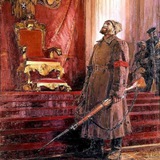
“You can’t do it without us,” the intellectuals who are accustomed to serving the capitalists and the capitalist state console themselves. Their arrogant calculation will not be justified: educated people are already standing out, going over to the side of the people, to the side of the working people, helping to break the resistance of the servants of capital. But there are many organizational talents in the peasantry and working class, and these talents are just beginning to recognize themselves, to awaken, to reach out to lively, creative, great work, to take on the task of building a socialist society on their own."
- Lenin
- Lenin
❤1
"The first step towards freeing the working people from this hard labor is the confiscation of landowners' lands, the introduction of workers' control, and the nationalization of banks. The next steps will be the nationalization of factories and factories, the forced organization of the entire population into consumer societies, which are at the same time companies for the sale of products, a state monopoly of trade in bread and other necessary items."
Forwarded from Marx Engels Lenin Institute
The latest Lalkar is out now! Featuring articles on Russia-DPRK relations, the British election and the coalition government in South Africa.
http://www.lalkar.org/
http://www.lalkar.org/
❤3
Forwarded from Marx Engels Lenin Institute
The challenge is to Learn!
Artist - M. Mitryashkin - 1958
Artist - M. Mitryashkin - 1958
❤1👍1
Forwarded from Hüseyin Dogru Journalist / red. media founder
This media is not supported in your browser
VIEW IN TELEGRAM
Deadly clashes continue to grip Bangladesh, where the death toll rose to at least 14 as police opened fire on protesters. With more than 7,000 government paramilitary troops deployed, more than 500 people have been injured since the protests turned fatal earlier this week.
Witness testimonies, video, and photographic evidence analyzed and authenticated by Amnesty International and its Crisis Evidence Lab have confirmed the use of force by police against the protesters.
Amid the escalating violence, the government announced that it would engage in dialogue with the students protesting the reinstatement of discriminatory quotas for government jobs. The students, however, have rejected the government’s proposal for talks.
The students continue to call for a nationwide shutdown of the South Asian country as protests spread to other parts of the country beyond the capital, Dhaka.
🟡 Join @theredstream 🟡 Boost our channel 🟡 YouTube 🟡 Instagram 🟡 Patreon
Witness testimonies, video, and photographic evidence analyzed and authenticated by Amnesty International and its Crisis Evidence Lab have confirmed the use of force by police against the protesters.
Amid the escalating violence, the government announced that it would engage in dialogue with the students protesting the reinstatement of discriminatory quotas for government jobs. The students, however, have rejected the government’s proposal for talks.
The students continue to call for a nationwide shutdown of the South Asian country as protests spread to other parts of the country beyond the capital, Dhaka.
🟡 Join @theredstream 🟡 Boost our channel 🟡 YouTube 🟡 Instagram 🟡 Patreon
Forwarded from Joti Brar
For those who missed it the first time: Harpal Brar and Caleb Maupin talk with each other (and with me) about the inextricable link between the present imperialist system and war.
https://thecommunists.org/2024/07/19/tv/caleb-maupin-harpal-brar-imperialism-and-war/
https://thecommunists.org/2024/07/19/tv/caleb-maupin-harpal-brar-imperialism-and-war/
The Communists
Caleb Maupin and Harpal Brar: Imperialism and war
What do Marxist theory and working-class history teach us about war, and how should this knowledge inform our struggle for a just and lasting peace?
Forwarded from Marx Engels Lenin Institute
One may become a demagogue out of sheer political innocence. But I have shown that you have descended to demagogy, and I will never tire of repeating that demagogues are the worst enemies of the working class. The worst enemies, because they arouse base instincts in the masses, because the unenlightened worker is unable to recognise his enemies in men who represent themselves, and sometimes sincerely so, as his friends. The worst enemies, because in the period of disunity and vacillation, when our movement is just beginning to take shape, nothing is easier than to employ demagogic methods to mislead the masses, who can realise their error only later by bitter experience.
Lenin - What Is To Be Done
👍1
Forwarded from Juche Songun channel
"We should be prepared for both words and actions. However fair-minded and just we are, we may become a bargaining chip for the strong and our precious history inherited with blood will loose its shine in a moment if we are weak"
KIM JONG UN
KIM JONG UN
Forwarded from Marx Engels Lenin Institute
Party members should not only work well but also study hard. Only when they gain knowledge can they look ahead and fight on confidently.
For 15 years the anti-Japanese guerrillas steadily fought Japanese imperialism and attained victory in the face of great hardships. They had to push their way through deep snows and cross countless steep mountains; they had to fight grim battles every day with the army and police of the Japanese imperialists, who were armed to the teeth. Our soldiers had no warm shelter and lacked clothes and food. But they always lived optimistically and fought bravely.
What, then, enabled them to have such conviction and courage?
The reason is that in spite of the severe handicaps facing them, they studied hard and grasped the righteousness of their revolutionary cause and looked confidently ahead to the day of victory. The greater the hardships, the more they studied, and this invigorated and encouraged them. Our Party members must study harder if they are to fight on with a firm conviction of victory, just as the anti-Japanese guerrillas had done previously.
Only when Party members study hard can they correctly analyse and solve any problems that arise and lead the masses. They are the vanguard fighters of the working masses. If they are to play the vanguard fighters’ role properly, they must study more than anybody else and raise their political, ideological and professional levels. When they attain considerable knowledge, they can then educate and guide others.
Having Party members intensify their studies is essential also to the qualitative consolidation of Party ranks.
Kim Il Sung - 'Party Members Must Study Hard' - January 1949
For 15 years the anti-Japanese guerrillas steadily fought Japanese imperialism and attained victory in the face of great hardships. They had to push their way through deep snows and cross countless steep mountains; they had to fight grim battles every day with the army and police of the Japanese imperialists, who were armed to the teeth. Our soldiers had no warm shelter and lacked clothes and food. But they always lived optimistically and fought bravely.
What, then, enabled them to have such conviction and courage?
The reason is that in spite of the severe handicaps facing them, they studied hard and grasped the righteousness of their revolutionary cause and looked confidently ahead to the day of victory. The greater the hardships, the more they studied, and this invigorated and encouraged them. Our Party members must study harder if they are to fight on with a firm conviction of victory, just as the anti-Japanese guerrillas had done previously.
Only when Party members study hard can they correctly analyse and solve any problems that arise and lead the masses. They are the vanguard fighters of the working masses. If they are to play the vanguard fighters’ role properly, they must study more than anybody else and raise their political, ideological and professional levels. When they attain considerable knowledge, they can then educate and guide others.
Having Party members intensify their studies is essential also to the qualitative consolidation of Party ranks.
Kim Il Sung - 'Party Members Must Study Hard' - January 1949
Forwarded from China Dream 中国梦🧧
🇨🇳⚡️Shanghai doctors perform first remote surgery for lung cancer
Dr Luo Qingquan of Shanghai Chest Hospital operated the robotic system in Shanghai, while the patient and team were in an operating room 5,000 km away in Kashgar in the Xinjiang Autonomous Region.
Preparation for the operation took a year. In March, the team performed the country's first remote robotic surgery on an animal to confirm its feasibility and safety.
The success of the operation reflects the development of domestic surgical robot technology. #China #robotics #medicine
Dr Luo Qingquan of Shanghai Chest Hospital operated the robotic system in Shanghai, while the patient and team were in an operating room 5,000 km away in Kashgar in the Xinjiang Autonomous Region.
Preparation for the operation took a year. In March, the team performed the country's first remote robotic surgery on an animal to confirm its feasibility and safety.
The success of the operation reflects the development of domestic surgical robot technology. #China #robotics #medicine
❤1
Forwarded from Quds News Network
The Palestinian-led movement Boycott, Divestment, and Sanctions (BDS) has called for "maximum pressure on all states to impose immediate targeted sanctions on Israel" following the unprecedented International Court of Justice ruling that Israel’s settlement policies and exploitation of natural resources in Palestinian territories violate international law.
Forwarded from Steve Sweeney Journalist
Media is too big
VIEW IN TELEGRAM
Lebanon’s Hezbollah issues a warning to Israel should it attempt any kind of ground invasion:
"If your tanks come to Lebanon's south, you will not suffer a shortage of tanks because you will have no tanks left."
"If your tanks come to Lebanon's south, you will not suffer a shortage of tanks because you will have no tanks left."
Forwarded from Marx Engels Lenin Institute
Not only are revolutionaries in general lagging behind the spontaneous awakening of the masses, but even worker-revolutionaries are lagging behind the spontaneous awakening of the working-class masses. This fact confirms with clear evidence, from the “practical” point of view, too, not only the absurdity but even the politically reactionary nature of the “pedagogics” to which we are so often treated in the discussion of our duties to the workers.
This fact proves that our very first and most pressing duty is to help to train working-class revolutionaries who will he on the same level in regard to Party activity as the revolutionaries from amongst the intellectuals (we emphasise the words “in regard to Party activity”, for, although necessary, it is neither so easy nor so pressingly necessary to bring the workers up to the level of intellectuals in other respects). Attention, therefore, must be devoted principally to raising the workers to the level of revolutionaries; it is not at all our task to descend to the level of the “working masses” as the Economists wish to do, or to the level of the “average worker” as Svoboda desires to do (and by this ascends to the second grade of Economist “pedagogics”).
I am far from denying the necessity for popular literature for the workers, and especially popular (of course, not vulgar) literature for the especially backward workers. But what annoys me is this constant confusion of pedagogics with questions of politics and organisation. You, gentlemen, who are so much concerned about the “average worker”, as a matter of fact, rather insult the workers by your desire to talk down to them when discussing working-class politics and working-class organisation. Talk about serious things in a serious manner; leave pedagogics to the pedagogues, and not to politicians and organisers! Are there not advanced people, “average people”, and “masses” among the intelligentsia too? Does not everyone recognise that popular literature is also required for the intelligentsia, and is not such literature written? Imagine someone, in an article on organising college or high-school students, repeating over and over again, as if he had made a new discovery, that first of all we must have an organisation of “average students”. The author of such an article would be ridiculed, and rightly so. Give us your ideas on organisation, if you have any, he would be told, and we ourselves will decide who is “average”, who above average, and who below. But if you have no organisational ideas of your own, then all your exertions in behalf of the “masses” and “average people” will be simply boring.
You must realise that these questions of “politics” and “organisation” are so serious in themselves that they cannot be dealt with in any other but a serious way. We can and must educate workers (and university and Gymnasium students) so that we may be able to discuss these questions with them. But once you do bring up these questions, you must give real replies to them; do not fall back on the “average”, or on the “masses”; do not try to dispose of the matter with facetious remarks and mere phrases.
Lenin - What Is To Be Done
❤1