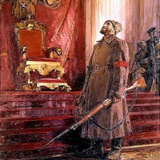
"The first step towards freeing the working people from this hard labor is the confiscation of landowners' lands, the introduction of workers' control, and the nationalization of banks. The next steps will be the nationalization of factories and factories, the forced organization of the entire population into consumer societies, which are at the same time companies for the sale of products, a state monopoly of trade in bread and other necessary items."
Forwarded from Marx Engels Lenin Institute
The latest Lalkar is out now! Featuring articles on Russia-DPRK relations, the British election and the coalition government in South Africa.
http://www.lalkar.org/
http://www.lalkar.org/
❤3
Forwarded from Marx Engels Lenin Institute
The challenge is to Learn!
Artist - M. Mitryashkin - 1958
Artist - M. Mitryashkin - 1958
❤1👍1
Forwarded from Hüseyin Dogru Journalist / red. media founder
This media is not supported in your browser
VIEW IN TELEGRAM
Deadly clashes continue to grip Bangladesh, where the death toll rose to at least 14 as police opened fire on protesters. With more than 7,000 government paramilitary troops deployed, more than 500 people have been injured since the protests turned fatal earlier this week.
Witness testimonies, video, and photographic evidence analyzed and authenticated by Amnesty International and its Crisis Evidence Lab have confirmed the use of force by police against the protesters.
Amid the escalating violence, the government announced that it would engage in dialogue with the students protesting the reinstatement of discriminatory quotas for government jobs. The students, however, have rejected the government’s proposal for talks.
The students continue to call for a nationwide shutdown of the South Asian country as protests spread to other parts of the country beyond the capital, Dhaka.
🟡 Join @theredstream 🟡 Boost our channel 🟡 YouTube 🟡 Instagram 🟡 Patreon
Witness testimonies, video, and photographic evidence analyzed and authenticated by Amnesty International and its Crisis Evidence Lab have confirmed the use of force by police against the protesters.
Amid the escalating violence, the government announced that it would engage in dialogue with the students protesting the reinstatement of discriminatory quotas for government jobs. The students, however, have rejected the government’s proposal for talks.
The students continue to call for a nationwide shutdown of the South Asian country as protests spread to other parts of the country beyond the capital, Dhaka.
🟡 Join @theredstream 🟡 Boost our channel 🟡 YouTube 🟡 Instagram 🟡 Patreon
Forwarded from Joti Brar
For those who missed it the first time: Harpal Brar and Caleb Maupin talk with each other (and with me) about the inextricable link between the present imperialist system and war.
https://thecommunists.org/2024/07/19/tv/caleb-maupin-harpal-brar-imperialism-and-war/
https://thecommunists.org/2024/07/19/tv/caleb-maupin-harpal-brar-imperialism-and-war/
The Communists
Caleb Maupin and Harpal Brar: Imperialism and war
What do Marxist theory and working-class history teach us about war, and how should this knowledge inform our struggle for a just and lasting peace?
Forwarded from Marx Engels Lenin Institute
One may become a demagogue out of sheer political innocence. But I have shown that you have descended to demagogy, and I will never tire of repeating that demagogues are the worst enemies of the working class. The worst enemies, because they arouse base instincts in the masses, because the unenlightened worker is unable to recognise his enemies in men who represent themselves, and sometimes sincerely so, as his friends. The worst enemies, because in the period of disunity and vacillation, when our movement is just beginning to take shape, nothing is easier than to employ demagogic methods to mislead the masses, who can realise their error only later by bitter experience.
Lenin - What Is To Be Done
👍1
Forwarded from Juche Songun channel
"We should be prepared for both words and actions. However fair-minded and just we are, we may become a bargaining chip for the strong and our precious history inherited with blood will loose its shine in a moment if we are weak"
KIM JONG UN
KIM JONG UN
Forwarded from Marx Engels Lenin Institute
Party members should not only work well but also study hard. Only when they gain knowledge can they look ahead and fight on confidently.
For 15 years the anti-Japanese guerrillas steadily fought Japanese imperialism and attained victory in the face of great hardships. They had to push their way through deep snows and cross countless steep mountains; they had to fight grim battles every day with the army and police of the Japanese imperialists, who were armed to the teeth. Our soldiers had no warm shelter and lacked clothes and food. But they always lived optimistically and fought bravely.
What, then, enabled them to have such conviction and courage?
The reason is that in spite of the severe handicaps facing them, they studied hard and grasped the righteousness of their revolutionary cause and looked confidently ahead to the day of victory. The greater the hardships, the more they studied, and this invigorated and encouraged them. Our Party members must study harder if they are to fight on with a firm conviction of victory, just as the anti-Japanese guerrillas had done previously.
Only when Party members study hard can they correctly analyse and solve any problems that arise and lead the masses. They are the vanguard fighters of the working masses. If they are to play the vanguard fighters’ role properly, they must study more than anybody else and raise their political, ideological and professional levels. When they attain considerable knowledge, they can then educate and guide others.
Having Party members intensify their studies is essential also to the qualitative consolidation of Party ranks.
Kim Il Sung - 'Party Members Must Study Hard' - January 1949
For 15 years the anti-Japanese guerrillas steadily fought Japanese imperialism and attained victory in the face of great hardships. They had to push their way through deep snows and cross countless steep mountains; they had to fight grim battles every day with the army and police of the Japanese imperialists, who were armed to the teeth. Our soldiers had no warm shelter and lacked clothes and food. But they always lived optimistically and fought bravely.
What, then, enabled them to have such conviction and courage?
The reason is that in spite of the severe handicaps facing them, they studied hard and grasped the righteousness of their revolutionary cause and looked confidently ahead to the day of victory. The greater the hardships, the more they studied, and this invigorated and encouraged them. Our Party members must study harder if they are to fight on with a firm conviction of victory, just as the anti-Japanese guerrillas had done previously.
Only when Party members study hard can they correctly analyse and solve any problems that arise and lead the masses. They are the vanguard fighters of the working masses. If they are to play the vanguard fighters’ role properly, they must study more than anybody else and raise their political, ideological and professional levels. When they attain considerable knowledge, they can then educate and guide others.
Having Party members intensify their studies is essential also to the qualitative consolidation of Party ranks.
Kim Il Sung - 'Party Members Must Study Hard' - January 1949
Forwarded from China Dream 中国梦🧧
🇨🇳⚡️Shanghai doctors perform first remote surgery for lung cancer
Dr Luo Qingquan of Shanghai Chest Hospital operated the robotic system in Shanghai, while the patient and team were in an operating room 5,000 km away in Kashgar in the Xinjiang Autonomous Region.
Preparation for the operation took a year. In March, the team performed the country's first remote robotic surgery on an animal to confirm its feasibility and safety.
The success of the operation reflects the development of domestic surgical robot technology. #China #robotics #medicine
Dr Luo Qingquan of Shanghai Chest Hospital operated the robotic system in Shanghai, while the patient and team were in an operating room 5,000 km away in Kashgar in the Xinjiang Autonomous Region.
Preparation for the operation took a year. In March, the team performed the country's first remote robotic surgery on an animal to confirm its feasibility and safety.
The success of the operation reflects the development of domestic surgical robot technology. #China #robotics #medicine
❤1
Forwarded from Quds News Network
The Palestinian-led movement Boycott, Divestment, and Sanctions (BDS) has called for "maximum pressure on all states to impose immediate targeted sanctions on Israel" following the unprecedented International Court of Justice ruling that Israel’s settlement policies and exploitation of natural resources in Palestinian territories violate international law.
Forwarded from Steve Sweeney Journalist
Media is too big
VIEW IN TELEGRAM
Lebanon’s Hezbollah issues a warning to Israel should it attempt any kind of ground invasion:
"If your tanks come to Lebanon's south, you will not suffer a shortage of tanks because you will have no tanks left."
"If your tanks come to Lebanon's south, you will not suffer a shortage of tanks because you will have no tanks left."
Forwarded from Marx Engels Lenin Institute
Not only are revolutionaries in general lagging behind the spontaneous awakening of the masses, but even worker-revolutionaries are lagging behind the spontaneous awakening of the working-class masses. This fact confirms with clear evidence, from the “practical” point of view, too, not only the absurdity but even the politically reactionary nature of the “pedagogics” to which we are so often treated in the discussion of our duties to the workers.
This fact proves that our very first and most pressing duty is to help to train working-class revolutionaries who will he on the same level in regard to Party activity as the revolutionaries from amongst the intellectuals (we emphasise the words “in regard to Party activity”, for, although necessary, it is neither so easy nor so pressingly necessary to bring the workers up to the level of intellectuals in other respects). Attention, therefore, must be devoted principally to raising the workers to the level of revolutionaries; it is not at all our task to descend to the level of the “working masses” as the Economists wish to do, or to the level of the “average worker” as Svoboda desires to do (and by this ascends to the second grade of Economist “pedagogics”).
I am far from denying the necessity for popular literature for the workers, and especially popular (of course, not vulgar) literature for the especially backward workers. But what annoys me is this constant confusion of pedagogics with questions of politics and organisation. You, gentlemen, who are so much concerned about the “average worker”, as a matter of fact, rather insult the workers by your desire to talk down to them when discussing working-class politics and working-class organisation. Talk about serious things in a serious manner; leave pedagogics to the pedagogues, and not to politicians and organisers! Are there not advanced people, “average people”, and “masses” among the intelligentsia too? Does not everyone recognise that popular literature is also required for the intelligentsia, and is not such literature written? Imagine someone, in an article on organising college or high-school students, repeating over and over again, as if he had made a new discovery, that first of all we must have an organisation of “average students”. The author of such an article would be ridiculed, and rightly so. Give us your ideas on organisation, if you have any, he would be told, and we ourselves will decide who is “average”, who above average, and who below. But if you have no organisational ideas of your own, then all your exertions in behalf of the “masses” and “average people” will be simply boring.
You must realise that these questions of “politics” and “organisation” are so serious in themselves that they cannot be dealt with in any other but a serious way. We can and must educate workers (and university and Gymnasium students) so that we may be able to discuss these questions with them. But once you do bring up these questions, you must give real replies to them; do not fall back on the “average”, or on the “masses”; do not try to dispose of the matter with facetious remarks and mere phrases.
Lenin - What Is To Be Done
❤1
Forwarded from Joti Brar
Just to reiterate, it is now a century since Britain had its first Labour government – a government which Lenin advocated workers should elect SO THAT THEY WOULD LEARN FROM THEIR OWN EXPERIENCE that it was a servant of imperialism and not a friend of the workers. So they would realise it was not and never could be a vehicle for socialism.
That very first Labour government in 1924 shocked workers by using police, army, spies and emergency powers to break strikes and sabotage the labour movement, which had begun the year on a wave of militancy. It left the civil service and state structures entirely intact and its ministers allowed themselves meekly to be directed in their new roles as frontpeople for a system of government over which they should expect to have no meaningful say.
Their eagerness to please their ruling-class masters and their rampant chauvinism in regard to the rightness of the criminal enterprise known as the British empire may surprise readers today, brought up as they have been to believe in the socialist foundations of this anti-worker organisation.
A few choice quotes from members of that first government can give an idea of where their loyalties lay then, and where they still lie today. (Spolier: it's not with the workers at home or the oppressed abroad.)
That same government appointed a Fabian, Sydney Olivier, to run the India office who stated:
The same Sydney Olivier had formerly been governor of Jamaica, and remarked:
Former railwaymen's union leader JH Thomas was appointed to the colonial office, and expressed the pious wish that
Three months later this great traitor to the working class reiterated that the Labour government
This first Labour administration, which was so keen to make it clear that the British empire was "safe in our hands" imprisoned communists in India and arrested nationalist leaders without trial, bombed Iraqi villages, supported counter-revolutionary attempts to overthrow the government of Dr Sun Yat-sen in China.
As leading Labour politician JR Clynes put it:
That very first Labour government in 1924 shocked workers by using police, army, spies and emergency powers to break strikes and sabotage the labour movement, which had begun the year on a wave of militancy. It left the civil service and state structures entirely intact and its ministers allowed themselves meekly to be directed in their new roles as frontpeople for a system of government over which they should expect to have no meaningful say.
Their eagerness to please their ruling-class masters and their rampant chauvinism in regard to the rightness of the criminal enterprise known as the British empire may surprise readers today, brought up as they have been to believe in the socialist foundations of this anti-worker organisation.
A few choice quotes from members of that first government can give an idea of where their loyalties lay then, and where they still lie today. (Spolier: it's not with the workers at home or the oppressed abroad.)
That same government appointed a Fabian, Sydney Olivier, to run the India office who stated:
The programme of constitutional democracy ... was not native to India ... It was impossible for the Indian people or Indian politicians to leap at once into the saddle and administer an ideal constitution ... The right of British statesmen, public servants, merchants and industrialists to be in India today was the fact that they had made the India of today, and that no home rule or national movement could have been possible in India had it not been for their work.
The same Sydney Olivier had formerly been governor of Jamaica, and remarked:
I have said that the West Indian negro is not fit for complete democratic citizenship in a constitution of modern parliamentary form, and I should certainly hold the same opinion with respect to any African native community.
Former railwaymen's union leader JH Thomas was appointed to the colonial office, and expressed the pious wish that
... it would be realised, when the time came for them to give up the seals of office, that they had not only been mindful of their responsibility, but had done nothing to weaken the position and prestige of this great empire.
Three months later this great traitor to the working class reiterated that the Labour government
... intended above all else to hand to their successors one thing when they gave up the seals of office and that was the general recognition of the fact that they were proud and jealous of, and were prepared to maintain, the empire.
This first Labour administration, which was so keen to make it clear that the British empire was "safe in our hands" imprisoned communists in India and arrested nationalist leaders without trial, bombed Iraqi villages, supported counter-revolutionary attempts to overthrow the government of Dr Sun Yat-sen in China.
As leading Labour politician JR Clynes put it:
In the same period of years, no Conservative or Liberal government has done more than we did to knit together the great Commonwealth of Nations which Britain calls her empire ... Far from wanting to lose our colonies, we are trying to keep them.
Forwarded from Joti Brar
All this only came as a surprise to those who had not been paying attention to the words and actions of the Labour party's founders.
As far back as 1901, the man who would go on to become Britain's first Labour prime minister, Ramsay MacDonald, told an audience in London:
The Fabian Society was the home of the chief theoreticians of the Labour party. Leading Fabians Beatrice and Sidney Webb were the authors of the Labour manifesto's clause iv, which was supposed to gull the general populace into believing the party had socialist intent.
Of course, clause iv was never acted on by the party in office, it remained a piece of paper until such time as the Labour party of Tony Blair in 1996 decided that such a genuflexion before the socialist-leaning sentiments of the masses was no longer necessary.
The Webbs wrote the following in an article in the New Statesman (which they founded) in 1913 discussing the falling birthrate amongst the upper stratum of workers and intelligentsia, which they plainly considered a disaster:
As far back as 1901, the man who would go on to become Britain's first Labour prime minister, Ramsay MacDonald, told an audience in London:
So far as the underlying spirit of imperialism is a frank acceptance of national duty exercised beyond the nation's political frontiers ... it cannot be condemned ... the compulsion to expand and to assume world responsibility is worthy at its origin.
The Fabian Society was the home of the chief theoreticians of the Labour party. Leading Fabians Beatrice and Sidney Webb were the authors of the Labour manifesto's clause iv, which was supposed to gull the general populace into believing the party had socialist intent.
Of course, clause iv was never acted on by the party in office, it remained a piece of paper until such time as the Labour party of Tony Blair in 1996 decided that such a genuflexion before the socialist-leaning sentiments of the masses was no longer necessary.
The Webbs wrote the following in an article in the New Statesman (which they founded) in 1913 discussing the falling birthrate amongst the upper stratum of workers and intelligentsia, which they plainly considered a disaster:
Into the scarcity thus created in particular districts, in particular sections of the labour market, or in particular social strata, there rush the offspring of the less thrifty, the less intellectual, the less foreseeing of races and classes – the unskilled casual labourers of our great cities, the races of eastern or southern Europe, the negroes, the Chinese possibly resulting, as already in parts of the USA, in such a heterogeneous and mongrel population that democratic self-government, or even the effective application of the policy of a national minimum of civilised life, will become increasingly unattainable.
If anything like this happens, it is difficult to avoid the melancholy conclusion that, in some cataclysm that is impossible for us to foresee, that civilisation characteristic of the western European races may go the way of half a dozen other civilisations that have within historic times preceded it; to be succeeded by a new social order developed by one or other of the coloured races, the negro, the kaffir or the Chinese.