Forwarded from Marx Engels Lenin Institute
Lalkar
OBITUARY – Harpal Singh Brar 1939-2025
Harpal Singh Brar died at 10.10am Indian time (4.40am UK time) on 25 January 2025, at 85 years of age. He was at the home of his nephew Manpreet Singh Badal, in Chandigarh, India. His close comrade and leader of the CPGB-ML Ella Rule, as well as his daughter…
🫡1
Forwarded from The Communists
Red Salute for Harpal Brar
by John Cartwright
From Punjab came in ’Sixty-Two
At first with Mao’s Red Book;
He analysed and thought it through:
A different path he took.
He set up with the Gang of Five
To keep a bright red flame;
Unswervingly he kept alive
His faith in Stalin’s aim.
From R.M.L. and A. of C.
He split from Scargill’s crew;
For twenty years C.P.G.B.
M.L. was always true.
And now he’s gone with Red salute
“We only want the Earth”
To gather revolution’s fruit
He strived for since his birth.
by John Cartwright
From Punjab came in ’Sixty-Two
At first with Mao’s Red Book;
He analysed and thought it through:
A different path he took.
He set up with the Gang of Five
To keep a bright red flame;
Unswervingly he kept alive
His faith in Stalin’s aim.
From R.M.L. and A. of C.
He split from Scargill’s crew;
For twenty years C.P.G.B.
M.L. was always true.
And now he’s gone with Red salute
“We only want the Earth”
To gather revolution’s fruit
He strived for since his birth.
❤1👏1
Forwarded from Communism
The modern state, no matter what its form, is essentially a capitalist machine — the state of the capitalists, the ideal personification of the total national capital. The more it proceeds to the taking over of productive forces, the more does it actually become the national capitalist, the more citizens does it exploit.
Anti-Dühring by Frederick Engels 1877
@Communism
❤1👍1
Forwarded from KFA UK
106 years ago on the 1st of March 1919 , the Korean people rose up against the colonial enslavement of the cruel Japanese imperialists .The reactionary Japanese imperialists brutally suppressed the uprising by force killing many innocent people. A total of 7 500 people were killed, 46 900 arrested and jailed and 15 900 wounded. This shows the gruesome barbarity of the samurai-wielding bloodthirsty Japanese imperialists.
Japan has never apologized for its crimes nor has it paid reparations to the Korean people. Instead, top Japanese politicians visit the shrine of the war criminals.
Japan has never apologized for its crimes nor has it paid reparations to the Korean people. Instead, top Japanese politicians visit the shrine of the war criminals.
🤬1
The first biography of Lenin was published on May 13, 1917 in the Bolshevik newspaper Soldatskaya Pravda.
Abroad, the first biography of Vladimir Ilyich appeared on November 28, 1917 in the magazine “Bulletin of the Russian Revolution” - the organ of the Foreign Representation of the Central Committee of the RSDLP (b) in Stockholm.
Source.
Abroad, the first biography of Vladimir Ilyich appeared on November 28, 1917 in the magazine “Bulletin of the Russian Revolution” - the organ of the Foreign Representation of the Central Committee of the RSDLP (b) in Stockholm.
Source.
👏1
Forwarded from USSR Pictures
Meeting of Fidel Castro with Cuban students studying in Minsk. Belarusian SSR, 1972
❤6
Forwarded from Communism
Gouache painting "Lenin", by Mylnikov, 1946
@Communism
Take the fundamental laws of modern states, take their administration, take freedom of assembly, freedom of the press, or “equality of all citizens before the law,” and you will see at every turn evidence of the hypocrisy of bourgeois democracy with which every honest and class-conscious worker is familiar. There is not a single state, however democratic, which has no loopholes or reservations in its constitution guaranteeing the bourgeoisie the possibility of dispatching troops against the workers, of proclaiming martial law, and so forth, in case of a “violation of public order,” and actually in case the exploited class “violates” its position of slavery and tries to behave in a non-slavish manner. Kautsky shamelessly embellishes bourgeois democracy and omits to mention, for instance, how the most democratic and republican bourgeoisie in America or Switzerland deal with workers on strike.
Lenin
The Proletarian Revolution and the Renegade Kautsk
@Communism
💯1
Forwarded from Communism
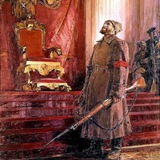
"V. I. Lenin in Riga", painting by Janis Andris Osis, 1985
@Communism
The liberals approach the language question in the same way as they approach all political questions—like hypocritical hucksters, holding out one hand (openly) to democracy and the other (behind their backs) to the feudalists and police.
Vladimir Lenin
Critical Remarks on the National Question
@Communism
❤1
Forwarded from Marx Engels Lenin Institute
🌏 106 years ago, on March 2, 1919, the First (founding) Congress of the Communist International opened in Moscow.
It was attended by 52 delegates from 35 parties and groups from 21 countries. Representatives of the communist parties of Soviet Russia, Germany, Austria, Hungary, Poland, Finland and other countries, as well as a number of communist groups (Czech, Bulgarian, Yugoslav, English, French, Swiss, etc.) took part in the congress. The social democratic parties of Sweden, Norway, Switzerland, the USA, and the Balkan Revolutionary Social Democratic Federation were represented at the congress.
The congress discussed and adopted the platform of the Communist International , developed on the basis of the instructions of V.I. Lenin. The new era, which began with the victory of the October Revolution, was characterized in the platform as an era of the disintegration of capitalism, its internal collapse, an era of the communist revolution of the proletariat. The task of winning and establishing the dictatorship of the proletariat was on the order of the day, the path to which lies through the consolidation of all revolutionary forces, a break with opportunism of all stripes, through the international solidarity of workers. In view of this, the congress recognized the need for the immediate founding of the Communist International.
One of the most important programmatic documents of the Comintern is the theses and report of V.I. Lenin on bourgeois democracy and the dictatorship of the proletariat presented to the 1st Congress. In his report, V.I. Lenin showed that bourgeois democracy, which the parties of the 2nd International defended under the guise of "democracy in general", is always in essence a class dictatorship of the bourgeoisie, a dictatorship of the minority, while the dictatorship of the proletariat, suppressing the resistance of the overthrown classes in the name of the interests of the majority, means democracy for the workers.
The Congress adopted a Manifesto to the Proletarians of the Whole World , which stated that the communists gathered in Moscow, representatives of the revolutionary proletariat of Europe, America and Asia, feel and recognize themselves as the successors and executors of the cause, the program of which was proclaimed by the founders of scientific communism, K. Marx and F. Engels, in the “Manifesto of the Communist Party.”
Assessing the role that the new International was to play, Lenin wrote in April 1919 that the Communist International "... accepted the fruits of the work of the Second International, cut away its opportunist, social-chauvinist, bourgeois and petty-bourgeois filth and began to implement the dictatorship of the proletariat." At the 1st Congress of the Comintern, according to Lenin, "... only the banner of communism was raised, around which the forces of the revolutionary proletariat were to gather." The full formation of the international proletarian organization of the new type was to be carried out by the 2nd Congress.
This post is a translation of a post from Kommunisti Mir
It was attended by 52 delegates from 35 parties and groups from 21 countries. Representatives of the communist parties of Soviet Russia, Germany, Austria, Hungary, Poland, Finland and other countries, as well as a number of communist groups (Czech, Bulgarian, Yugoslav, English, French, Swiss, etc.) took part in the congress. The social democratic parties of Sweden, Norway, Switzerland, the USA, and the Balkan Revolutionary Social Democratic Federation were represented at the congress.
The congress discussed and adopted the platform of the Communist International , developed on the basis of the instructions of V.I. Lenin. The new era, which began with the victory of the October Revolution, was characterized in the platform as an era of the disintegration of capitalism, its internal collapse, an era of the communist revolution of the proletariat. The task of winning and establishing the dictatorship of the proletariat was on the order of the day, the path to which lies through the consolidation of all revolutionary forces, a break with opportunism of all stripes, through the international solidarity of workers. In view of this, the congress recognized the need for the immediate founding of the Communist International.
One of the most important programmatic documents of the Comintern is the theses and report of V.I. Lenin on bourgeois democracy and the dictatorship of the proletariat presented to the 1st Congress. In his report, V.I. Lenin showed that bourgeois democracy, which the parties of the 2nd International defended under the guise of "democracy in general", is always in essence a class dictatorship of the bourgeoisie, a dictatorship of the minority, while the dictatorship of the proletariat, suppressing the resistance of the overthrown classes in the name of the interests of the majority, means democracy for the workers.
The Congress adopted a Manifesto to the Proletarians of the Whole World , which stated that the communists gathered in Moscow, representatives of the revolutionary proletariat of Europe, America and Asia, feel and recognize themselves as the successors and executors of the cause, the program of which was proclaimed by the founders of scientific communism, K. Marx and F. Engels, in the “Manifesto of the Communist Party.”
Assessing the role that the new International was to play, Lenin wrote in April 1919 that the Communist International "... accepted the fruits of the work of the Second International, cut away its opportunist, social-chauvinist, bourgeois and petty-bourgeois filth and began to implement the dictatorship of the proletariat." At the 1st Congress of the Comintern, according to Lenin, "... only the banner of communism was raised, around which the forces of the revolutionary proletariat were to gather." The full formation of the international proletarian organization of the new type was to be carried out by the 2nd Congress.
This post is a translation of a post from Kommunisti Mir
❤2