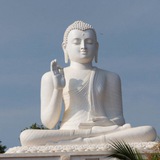
But we rarely go back to our inner peace, to our clarity, to the buddhanature in each of us, so that we can be in touch with Mother Earth.
Many people forget their own body. They live in an imaginary world. They have so many plans and fears, so many agitations and dreams, and they don’t live in their body. While we’re caught in fear and trying to plan our way out of fear, we aren’t able to see all the beauty that Mother Earth offers us. Mindfulness reminds you to go to your in-breath and to be totally with your in-breath, be totally with your out-breath. Bring your mind back to your body and be in the present moment. Look deeply straight in front of you at what is wonderful in the present moment. Mother Earth is so powerful, so generous, and so supportive. Your body is so wonderful. When you’ve practiced and you are solid like the earth, you face your difficulty directly, and it begins to dissipate.
Practice
Breathing in the Present
Please take a moment to enjoy the simple practice of mindful breathing: “Breathing in, I know that I am breathing in; breathing out, I know that I am breathing out.” If you do that with a little concentration, then you’ll be able to really be there. The moment you begin to practice mindful breathing, your body and your mind begin to come back together. It takes only 10 to 20 seconds to accomplish this miracle, the oneness of body and mind in the present moment. And every one of us can do it, even a child.
As the Buddha said, “The past no longer is, the future is not yet here; there is only one moment in which life is available, and that is the present moment.” To meditate with mindful breathing is to bring body and mind back to the present moment so that you do not miss your appointment with life.
Thich Nhat Hanh (1926–2022) was a Vietnamese Buddhist monk, author, and peace activist who was nominated for the Nobel Peace Prize by Martin Luther King Jr.
===
Dhammapada, beloved and favorite teachings of the Buddha channel:
https://news.1rj.ru/str/dhammapadas
_
Many people forget their own body. They live in an imaginary world. They have so many plans and fears, so many agitations and dreams, and they don’t live in their body. While we’re caught in fear and trying to plan our way out of fear, we aren’t able to see all the beauty that Mother Earth offers us. Mindfulness reminds you to go to your in-breath and to be totally with your in-breath, be totally with your out-breath. Bring your mind back to your body and be in the present moment. Look deeply straight in front of you at what is wonderful in the present moment. Mother Earth is so powerful, so generous, and so supportive. Your body is so wonderful. When you’ve practiced and you are solid like the earth, you face your difficulty directly, and it begins to dissipate.
Practice
Breathing in the Present
Please take a moment to enjoy the simple practice of mindful breathing: “Breathing in, I know that I am breathing in; breathing out, I know that I am breathing out.” If you do that with a little concentration, then you’ll be able to really be there. The moment you begin to practice mindful breathing, your body and your mind begin to come back together. It takes only 10 to 20 seconds to accomplish this miracle, the oneness of body and mind in the present moment. And every one of us can do it, even a child.
As the Buddha said, “The past no longer is, the future is not yet here; there is only one moment in which life is available, and that is the present moment.” To meditate with mindful breathing is to bring body and mind back to the present moment so that you do not miss your appointment with life.
Thich Nhat Hanh (1926–2022) was a Vietnamese Buddhist monk, author, and peace activist who was nominated for the Nobel Peace Prize by Martin Luther King Jr.
===
Dhammapada, beloved and favorite teachings of the Buddha channel:
https://news.1rj.ru/str/dhammapadas
_
Telegram
Dhammapada - Buddha Dharma Teachings
Daily teachings of the Dhammapada, beloved and favorite teachings of the Buddha
❤1👍1🙏1🏆1
Forwarded from Buddha Dharma books
Free Buddha Dharma ebook
Practical Insight Meditation
By Mahasi Sayadaw Gyi
The Venerable Mahasi Sayadawgyi had written his great work of treatise on Vipassana meditation in two volumes in 1945. The first publication was in 1954, followed by thirteen editions upto now. Volume I of this treatise had been translated into English by U Min Swe and published in December 1980.
Free download available:
http://www.mediafire.com/file/jyr3gq8r2whmq7s/
=============
Practical Insight Meditation
By Mahasi Sayadaw Gyi
The Venerable Mahasi Sayadawgyi had written his great work of treatise on Vipassana meditation in two volumes in 1945. The first publication was in 1954, followed by thirteen editions upto now. Volume I of this treatise had been translated into English by U Min Swe and published in December 1980.
Free download available:
http://www.mediafire.com/file/jyr3gq8r2whmq7s/
=============
👍2💯1
Dhammapada Verse 114
Kisagotami Vatthu
Yo ca vassasatam jive
apassam amatam padam
ekaham jivitam seyyo
passato amatam padam.
Verse 114: Better than a hundred years in the life of a person who does not perceive the Deathless (Nibbana), is a day in the life of one who perceives the Deathless (Nibbana).
The Story of Theri Kisagotami
While residing at the Jetavana monastery, thc Buddha uttered Verse (114) of this book, with reference to Kisagotami.
Kisagotami was the daughter of a rich man from Savatthi; she was known as Kisagotami because of her slim body. Kisagotami was married to a rich young man and a son was born to them. The boy died when he was just a toddler and Kisagotami was stricken with grief. Carrying the dead body of her son, she went about asking for medicine that would restore her son to life from everyone she happened to meet. People began to think that she had gone mad. But a wise man seeing her condition thought that he should be of some help to her. So, he said to her, "The Buddha is the person you should approach, he has the medicine you want; go to him." Thus, she went to the Buddha and asked him to give her the medicine that would restore her dead son to life.
The Buddha told her to get some mustard seeds from a house where there had been no death. Carrying her dead child in her bosom. Kisagotami went from house to house, with the request for some mustard seeds. Everyone was willing to help her, but she could not find a single house where death had not occurred. Then, she realized that hers was not the only family that had faced death and that there were more people dead than living. As soon as she realized this, her attitude towards her dead son changed; she was no longer attached to the dead body of her son.
She left the corpse in the jungle and returned to the Buddha and reported that she could find no house where death had not occurred. Then the Buddha said, "Gotami, you thought that you were the only one who had lost a son. As you have now realized, death comes to all beings; before their desires are satiated death takes them away." On hearing this, Kisagotami fully realized the impermanence, unsatisfactoriness and insubstantiality of the aggregates and attained Sotapatti Fruition.
Soon afterwards, Kisagotami became a bhikkhuni. One day, as she was lighting the lamps she saw the flames flaring up and dying out, and suddenly she clearly perceived the arising and the perishing of beings. The Buddha, through supernormal power, saw her from his monastery, and sent forth his radiance and appeared to her in person. Kisagotami was told to continue meditating on the impermanent nature of all beings and to strive hard to realize Nibbana.
Then the Buddha spoke in verse as follows:
Verse 114: Better than a hundred years in the life of a person who does not perceive the Deathless (Nibbana), is a day in the life of one who perceives the Deathless (Nibbana).
At the end of the discourse Theri Kisagotami attained arahatship.
Words of the Buddha channel:
https://invite.viber.com/?g2=AQAFqzqlj7FmI061PX17rxWMAtZ%2BRuso%2FH2KmHKZSgnv7v9DD8X0bDkKnZDr9JDq
====================
Kisagotami Vatthu
Yo ca vassasatam jive
apassam amatam padam
ekaham jivitam seyyo
passato amatam padam.
Verse 114: Better than a hundred years in the life of a person who does not perceive the Deathless (Nibbana), is a day in the life of one who perceives the Deathless (Nibbana).
The Story of Theri Kisagotami
While residing at the Jetavana monastery, thc Buddha uttered Verse (114) of this book, with reference to Kisagotami.
Kisagotami was the daughter of a rich man from Savatthi; she was known as Kisagotami because of her slim body. Kisagotami was married to a rich young man and a son was born to them. The boy died when he was just a toddler and Kisagotami was stricken with grief. Carrying the dead body of her son, she went about asking for medicine that would restore her son to life from everyone she happened to meet. People began to think that she had gone mad. But a wise man seeing her condition thought that he should be of some help to her. So, he said to her, "The Buddha is the person you should approach, he has the medicine you want; go to him." Thus, she went to the Buddha and asked him to give her the medicine that would restore her dead son to life.
The Buddha told her to get some mustard seeds from a house where there had been no death. Carrying her dead child in her bosom. Kisagotami went from house to house, with the request for some mustard seeds. Everyone was willing to help her, but she could not find a single house where death had not occurred. Then, she realized that hers was not the only family that had faced death and that there were more people dead than living. As soon as she realized this, her attitude towards her dead son changed; she was no longer attached to the dead body of her son.
She left the corpse in the jungle and returned to the Buddha and reported that she could find no house where death had not occurred. Then the Buddha said, "Gotami, you thought that you were the only one who had lost a son. As you have now realized, death comes to all beings; before their desires are satiated death takes them away." On hearing this, Kisagotami fully realized the impermanence, unsatisfactoriness and insubstantiality of the aggregates and attained Sotapatti Fruition.
Soon afterwards, Kisagotami became a bhikkhuni. One day, as she was lighting the lamps she saw the flames flaring up and dying out, and suddenly she clearly perceived the arising and the perishing of beings. The Buddha, through supernormal power, saw her from his monastery, and sent forth his radiance and appeared to her in person. Kisagotami was told to continue meditating on the impermanent nature of all beings and to strive hard to realize Nibbana.
Then the Buddha spoke in verse as follows:
Verse 114: Better than a hundred years in the life of a person who does not perceive the Deathless (Nibbana), is a day in the life of one who perceives the Deathless (Nibbana).
At the end of the discourse Theri Kisagotami attained arahatship.
Words of the Buddha channel:
https://invite.viber.com/?g2=AQAFqzqlj7FmI061PX17rxWMAtZ%2BRuso%2FH2KmHKZSgnv7v9DD8X0bDkKnZDr9JDq
====================
Viber
Words Of The Buddha
Daily teachings from Buddha Dharma
❤1👍1👏1💯1🏆1
Kisagotami and the mustard seeds parable
Kisagotami Vatthu
Dhammapada verse 114, Samyutta Nikaya 5.3
https://news.1rj.ru/str/dhammapadas/1037
https://news.1rj.ru/str/wordsofbuddha/2777
https://news.1rj.ru/str/dhammapadas/1881
Kisagotami Vatthu
Dhammapada verse 114, Samyutta Nikaya 5.3
https://news.1rj.ru/str/dhammapadas/1037
https://news.1rj.ru/str/wordsofbuddha/2777
https://news.1rj.ru/str/dhammapadas/1881
🙏2🥰1🕊1
Dhammapada Verse 115
Bahuputtikattheri Vatthu
Yo ca vassasatam jive
apassam dhammamuttamam1
ekaham jivitam seyyo
passato dhammamuttamam.
Verse 115: Better than a hundred years in the life of a person who does not comprehend the Noble Dhamma (Dhammamuttamam), is a day in the life of one who comprehends the Noble Dhamma.
1. dhammamuttamam: the Noble Dhamma or the Highest Dhamma (the Nine Transcendentals). The Nine Transcendentals are: four Maggas, four Phalas and Nibbana.
The Story of Theri Bahuputtika
While residing at the Jetavana monastery, the Buddha uttered Verse (115) of this book, with reference to Bahuputtika, a mother of many children.
Once in Savatthi, there lived a couple, with their seven sons and seven daughters. All the children got married and the family was doing quite well. Then, the father died and the mother kept all the property without giving anything to the children. Her sons and daughters wanted the inheritance, so they said, to their mother, "What benefit do we get from our property? Can't we make it multiply? Can't we look after our mother?" They said such things again and again so their mother thought that her children would look after her, and she finally divided up the property without leaving anything for herself.
After the division of the property, she first went to stay with her eldest son, but her daughter-in-law complained and said, "She has come and stayed with us, as if she has given us two shares!", and such other things. So, Bahuputtika went to stay with her second son, and the same things were said. Thus, she went from one son to another, from one daughter to the next; but none of them was willing to take her on for a long stretch of time and none paid her due respect.
The old lady was hurt and felt bitter against her children; she left her family and became a bhikkhuni. Because she was a mother of many children she came to he known as Bahuputtika. Bahuputika realized that she became a bhikkhuni only in her old age and that she must not be negligent, but must make use of the remaining period of her life to the utmost. So, for the whole night, she meditated on the Dhamma taught by the Buddha. The Buddha seeing her from the Jetavana monastery, through supernormal power, sent forth the radiance and appeared seated in front of her. Then the Buddha said to her, "The life of one who does not practise the Dhamma taught by me is useless, even if he were to live for a hundred years."
Then the Buddha spoke in verse as follows:
Verse 115: Better than a hundred years in the life of a person who does not comprehend the Noble Dhamma (Dhammamuttamam), is a day in the life of one who comprehends the Noble Dhamma.
End of Chapter Eight: The Thousand (Sahassavagga)
Dhammapada, beloved and favorite teachings of the Buddha channel:
https://invite.viber.com/?g2=AQBLD6phsgvP%2F061YjEM3K%2BNeH1Yb372b9mtfQX2EmuBpgoLUoc99BDMfzHghrme
====================
Bahuputtikattheri Vatthu
Yo ca vassasatam jive
apassam dhammamuttamam1
ekaham jivitam seyyo
passato dhammamuttamam.
Verse 115: Better than a hundred years in the life of a person who does not comprehend the Noble Dhamma (Dhammamuttamam), is a day in the life of one who comprehends the Noble Dhamma.
1. dhammamuttamam: the Noble Dhamma or the Highest Dhamma (the Nine Transcendentals). The Nine Transcendentals are: four Maggas, four Phalas and Nibbana.
The Story of Theri Bahuputtika
While residing at the Jetavana monastery, the Buddha uttered Verse (115) of this book, with reference to Bahuputtika, a mother of many children.
Once in Savatthi, there lived a couple, with their seven sons and seven daughters. All the children got married and the family was doing quite well. Then, the father died and the mother kept all the property without giving anything to the children. Her sons and daughters wanted the inheritance, so they said, to their mother, "What benefit do we get from our property? Can't we make it multiply? Can't we look after our mother?" They said such things again and again so their mother thought that her children would look after her, and she finally divided up the property without leaving anything for herself.
After the division of the property, she first went to stay with her eldest son, but her daughter-in-law complained and said, "She has come and stayed with us, as if she has given us two shares!", and such other things. So, Bahuputtika went to stay with her second son, and the same things were said. Thus, she went from one son to another, from one daughter to the next; but none of them was willing to take her on for a long stretch of time and none paid her due respect.
The old lady was hurt and felt bitter against her children; she left her family and became a bhikkhuni. Because she was a mother of many children she came to he known as Bahuputtika. Bahuputika realized that she became a bhikkhuni only in her old age and that she must not be negligent, but must make use of the remaining period of her life to the utmost. So, for the whole night, she meditated on the Dhamma taught by the Buddha. The Buddha seeing her from the Jetavana monastery, through supernormal power, sent forth the radiance and appeared seated in front of her. Then the Buddha said to her, "The life of one who does not practise the Dhamma taught by me is useless, even if he were to live for a hundred years."
Then the Buddha spoke in verse as follows:
Verse 115: Better than a hundred years in the life of a person who does not comprehend the Noble Dhamma (Dhammamuttamam), is a day in the life of one who comprehends the Noble Dhamma.
End of Chapter Eight: The Thousand (Sahassavagga)
Dhammapada, beloved and favorite teachings of the Buddha channel:
https://invite.viber.com/?g2=AQBLD6phsgvP%2F061YjEM3K%2BNeH1Yb372b9mtfQX2EmuBpgoLUoc99BDMfzHghrme
====================
Viber
Dhammapada - Buddha Dharma Teachings
Daily teachings of the Dhammapada, beloved and favorite teachings of the Buddha
💯1🏆1
Forwarded from Buddha Dharma books
Free Buddha Dharma ebook
Daily Buddhist Devotions
By Venerable K. Sri Dhammananda
Free download available:
http://ftp.budaedu.org/ebooks/pdf/EN070.pdf
=============
Daily Buddhist Devotions
By Venerable K. Sri Dhammananda
Free download available:
http://ftp.budaedu.org/ebooks/pdf/EN070.pdf
=============
❤1👍1🥰1
Dhammapada Verse 116
Culekasataka Vatthu
Abhittharetha kalyane
pipa cittam nivaraye
dandham hi karoto punnam
papasmim ramati mano.
Verse 116: One should make haste in doing good deeds; one should restrain one's mind from evil; for the mind of one who is slow in doing good tends to take delight in doing evil.
The Story of Culekasataka
While residing at the Jetavana monastery, the Buddha uttered Verse (116) of this book, with reference to a brahmin couple by the name of Culekasataka.
There was once a brahmin couple in Savatthi, who had only one outer garment between the two of them. Because of this they were also known as Ekasataka. As they had only one outer garment, both of them could not go out at the same time. So, the wife would go to listen to the discourse given by the Buddha during the day and the husband would go at night. One night, as the brahmin listened to the Buddha, his whole body came to be suffused with delightful satisfaction and he felt a strong desire to offer the outer garment he was wearing to the Buddha. But he realized that if he were to give away the only outer garment he had, there would be none left for him and his wife. So he wavered and hesitated. Thus, the first and the second watches of the night passed. Came the third watch and he said to himself, "If I am so miserly and hesitant, I will not be able to avoid falling to the four Lower Worlds (apayas); I shall now offer my outer garment to the Buddha." So saying, he placed the piece of cloth at the feet of the Buddha and cried out "I have won" three times.
King Pasenadi of Kosala, who was among the audience, heard those words and ordered a courtier to investigate. Learning about the brahmin's offering to the Buddha, the king commented that the brahmin had done something which was not easy to do and so should be rewarded. The king ordered his men to give the brahmin a piece of cloth as a reward for his faith and generosity. The brahmin offered that piece of cloth also to the Buddha and he was rewarded by the king with two pieces of cloth. Again, the brahmin offered the two pieces of cloth to the Buddha and he was rewarded with four. Thus, he offered to the Buddha whatever was given him by the king, and each time the king doubled his reward. When finally, the reward came up to thirty-two pieces of cloth, the brahmin kept one piece for himself and another for his wife, and offered the remaining thirty pieces to the Buddha.
Then, thinking again commented that the brahmin had truly performed a very difficult task and so must be rewarded fittingly. The king sent a messenger to the palace to bring two pieces of velvet cloth, each of which was worth one hundred thousand, and gave them to the brahmin. The brahmin made those two pieces of valuable cloth into two canopies and kept one in the Perfumed Chamber where the Buddha slept and the other in his own house above the place where a bhikkhu was regularly offered alms-food. When the king next went to Jatavana monastery to pay homage to the Buddha, he saw the velvet canopy and recognized it as the offering made by the brahmin and he was very pleased. This time he made a reward of seven kinds in fours (sabbacatukka), viz., four elephants, four horses, four female slaves, four male slaves, four errand boys, four villages and four thousands in cash.
When the bhikkhus heard about this, they asked the Buddha, "How is it that, in the case of this brahmin, a good deed done at present bears fruit immediately?" To them the Buddha replied "If the brahmin had offered his outer garment in the first watch of the night, he would have been rewarded with sixteen of each kind; if he had made his offering during the middle watch, he would have been rewarded with eight of each kind; since he had made his offering only during the last watch of the night, he was rewarded with only four of each kind." So, when one wants to give in charity, one should do so quickly; if one procrastinates, the reward comes slowly and only sparingly.
Culekasataka Vatthu
Abhittharetha kalyane
pipa cittam nivaraye
dandham hi karoto punnam
papasmim ramati mano.
Verse 116: One should make haste in doing good deeds; one should restrain one's mind from evil; for the mind of one who is slow in doing good tends to take delight in doing evil.
The Story of Culekasataka
While residing at the Jetavana monastery, the Buddha uttered Verse (116) of this book, with reference to a brahmin couple by the name of Culekasataka.
There was once a brahmin couple in Savatthi, who had only one outer garment between the two of them. Because of this they were also known as Ekasataka. As they had only one outer garment, both of them could not go out at the same time. So, the wife would go to listen to the discourse given by the Buddha during the day and the husband would go at night. One night, as the brahmin listened to the Buddha, his whole body came to be suffused with delightful satisfaction and he felt a strong desire to offer the outer garment he was wearing to the Buddha. But he realized that if he were to give away the only outer garment he had, there would be none left for him and his wife. So he wavered and hesitated. Thus, the first and the second watches of the night passed. Came the third watch and he said to himself, "If I am so miserly and hesitant, I will not be able to avoid falling to the four Lower Worlds (apayas); I shall now offer my outer garment to the Buddha." So saying, he placed the piece of cloth at the feet of the Buddha and cried out "I have won" three times.
King Pasenadi of Kosala, who was among the audience, heard those words and ordered a courtier to investigate. Learning about the brahmin's offering to the Buddha, the king commented that the brahmin had done something which was not easy to do and so should be rewarded. The king ordered his men to give the brahmin a piece of cloth as a reward for his faith and generosity. The brahmin offered that piece of cloth also to the Buddha and he was rewarded by the king with two pieces of cloth. Again, the brahmin offered the two pieces of cloth to the Buddha and he was rewarded with four. Thus, he offered to the Buddha whatever was given him by the king, and each time the king doubled his reward. When finally, the reward came up to thirty-two pieces of cloth, the brahmin kept one piece for himself and another for his wife, and offered the remaining thirty pieces to the Buddha.
Then, thinking again commented that the brahmin had truly performed a very difficult task and so must be rewarded fittingly. The king sent a messenger to the palace to bring two pieces of velvet cloth, each of which was worth one hundred thousand, and gave them to the brahmin. The brahmin made those two pieces of valuable cloth into two canopies and kept one in the Perfumed Chamber where the Buddha slept and the other in his own house above the place where a bhikkhu was regularly offered alms-food. When the king next went to Jatavana monastery to pay homage to the Buddha, he saw the velvet canopy and recognized it as the offering made by the brahmin and he was very pleased. This time he made a reward of seven kinds in fours (sabbacatukka), viz., four elephants, four horses, four female slaves, four male slaves, four errand boys, four villages and four thousands in cash.
When the bhikkhus heard about this, they asked the Buddha, "How is it that, in the case of this brahmin, a good deed done at present bears fruit immediately?" To them the Buddha replied "If the brahmin had offered his outer garment in the first watch of the night, he would have been rewarded with sixteen of each kind; if he had made his offering during the middle watch, he would have been rewarded with eight of each kind; since he had made his offering only during the last watch of the night, he was rewarded with only four of each kind." So, when one wants to give in charity, one should do so quickly; if one procrastinates, the reward comes slowly and only sparingly.
Telegram
Ajahn Chah - Theravada Thailand Buddhism
Collection of teachings of Venerable Ajahn Chah, a foremost meditation and Buddhist teacher from Thailand
💯1🏆1
Also, if one is too slow in doing good deeds, one may not be able to do it at all, for the mind tends to take delight in doing evil.
Then the Buddha spoke in verse as follows:
Verse 116: One should make haste in doing good deeds; one should restrain one's mind from evil; for the mind of one who is slow in doing good tends to take delight in doing evil.
Ajahn Chah, Buddhist teacher of Thai forest meditation of Theravada Buddhism channel:
https://news.1rj.ru/str/ajahnchah_buddhism
====================
Then the Buddha spoke in verse as follows:
Verse 116: One should make haste in doing good deeds; one should restrain one's mind from evil; for the mind of one who is slow in doing good tends to take delight in doing evil.
Ajahn Chah, Buddhist teacher of Thai forest meditation of Theravada Buddhism channel:
https://news.1rj.ru/str/ajahnchah_buddhism
====================
Telegram
Ajahn Chah - Theravada Thailand Buddhism
Collection of teachings of Venerable Ajahn Chah, a foremost meditation and Buddhist teacher from Thailand
👍1💯1🏆1