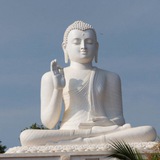
Dhammapada Verse 115
Bahuputtikattheri Vatthu
Yo ca vassasatam jive
apassam dhammamuttamam1
ekaham jivitam seyyo
passato dhammamuttamam.
Verse 115: Better than a hundred years in the life of a person who does not comprehend the Noble Dhamma (Dhammamuttamam), is a day in the life of one who comprehends the Noble Dhamma.
1. dhammamuttamam: the Noble Dhamma or the Highest Dhamma (the Nine Transcendentals). The Nine Transcendentals are: four Maggas, four Phalas and Nibbana.
The Story of Theri Bahuputtika
While residing at the Jetavana monastery, the Buddha uttered Verse (115) of this book, with reference to Bahuputtika, a mother of many children.
Once in Savatthi, there lived a couple, with their seven sons and seven daughters. All the children got married and the family was doing quite well. Then, the father died and the mother kept all the property without giving anything to the children. Her sons and daughters wanted the inheritance, so they said, to their mother, "What benefit do we get from our property? Can't we make it multiply? Can't we look after our mother?" They said such things again and again so their mother thought that her children would look after her, and she finally divided up the property without leaving anything for herself.
After the division of the property, she first went to stay with her eldest son, but her daughter-in-law complained and said, "She has come and stayed with us, as if she has given us two shares!", and such other things. So, Bahuputtika went to stay with her second son, and the same things were said. Thus, she went from one son to another, from one daughter to the next; but none of them was willing to take her on for a long stretch of time and none paid her due respect.
The old lady was hurt and felt bitter against her children; she left her family and became a bhikkhuni. Because she was a mother of many children she came to he known as Bahuputtika. Bahuputika realized that she became a bhikkhuni only in her old age and that she must not be negligent, but must make use of the remaining period of her life to the utmost. So, for the whole night, she meditated on the Dhamma taught by the Buddha. The Buddha seeing her from the Jetavana monastery, through supernormal power, sent forth the radiance and appeared seated in front of her. Then the Buddha said to her, "The life of one who does not practise the Dhamma taught by me is useless, even if he were to live for a hundred years."
Then the Buddha spoke in verse as follows:
Verse 115: Better than a hundred years in the life of a person who does not comprehend the Noble Dhamma (Dhammamuttamam), is a day in the life of one who comprehends the Noble Dhamma.
End of Chapter Eight: The Thousand (Sahassavagga)
Dhammapada, beloved and favorite teachings of the Buddha channel:
https://invite.viber.com/?g2=AQBLD6phsgvP%2F061YjEM3K%2BNeH1Yb372b9mtfQX2EmuBpgoLUoc99BDMfzHghrme
====================
Bahuputtikattheri Vatthu
Yo ca vassasatam jive
apassam dhammamuttamam1
ekaham jivitam seyyo
passato dhammamuttamam.
Verse 115: Better than a hundred years in the life of a person who does not comprehend the Noble Dhamma (Dhammamuttamam), is a day in the life of one who comprehends the Noble Dhamma.
1. dhammamuttamam: the Noble Dhamma or the Highest Dhamma (the Nine Transcendentals). The Nine Transcendentals are: four Maggas, four Phalas and Nibbana.
The Story of Theri Bahuputtika
While residing at the Jetavana monastery, the Buddha uttered Verse (115) of this book, with reference to Bahuputtika, a mother of many children.
Once in Savatthi, there lived a couple, with their seven sons and seven daughters. All the children got married and the family was doing quite well. Then, the father died and the mother kept all the property without giving anything to the children. Her sons and daughters wanted the inheritance, so they said, to their mother, "What benefit do we get from our property? Can't we make it multiply? Can't we look after our mother?" They said such things again and again so their mother thought that her children would look after her, and she finally divided up the property without leaving anything for herself.
After the division of the property, she first went to stay with her eldest son, but her daughter-in-law complained and said, "She has come and stayed with us, as if she has given us two shares!", and such other things. So, Bahuputtika went to stay with her second son, and the same things were said. Thus, she went from one son to another, from one daughter to the next; but none of them was willing to take her on for a long stretch of time and none paid her due respect.
The old lady was hurt and felt bitter against her children; she left her family and became a bhikkhuni. Because she was a mother of many children she came to he known as Bahuputtika. Bahuputika realized that she became a bhikkhuni only in her old age and that she must not be negligent, but must make use of the remaining period of her life to the utmost. So, for the whole night, she meditated on the Dhamma taught by the Buddha. The Buddha seeing her from the Jetavana monastery, through supernormal power, sent forth the radiance and appeared seated in front of her. Then the Buddha said to her, "The life of one who does not practise the Dhamma taught by me is useless, even if he were to live for a hundred years."
Then the Buddha spoke in verse as follows:
Verse 115: Better than a hundred years in the life of a person who does not comprehend the Noble Dhamma (Dhammamuttamam), is a day in the life of one who comprehends the Noble Dhamma.
End of Chapter Eight: The Thousand (Sahassavagga)
Dhammapada, beloved and favorite teachings of the Buddha channel:
https://invite.viber.com/?g2=AQBLD6phsgvP%2F061YjEM3K%2BNeH1Yb372b9mtfQX2EmuBpgoLUoc99BDMfzHghrme
====================
Viber
Dhammapada - Buddha Dharma Teachings
Daily teachings of the Dhammapada, beloved and favorite teachings of the Buddha
💯1🏆1
Forwarded from Buddha Dharma books
Free Buddha Dharma ebook
Daily Buddhist Devotions
By Venerable K. Sri Dhammananda
Free download available:
http://ftp.budaedu.org/ebooks/pdf/EN070.pdf
=============
Daily Buddhist Devotions
By Venerable K. Sri Dhammananda
Free download available:
http://ftp.budaedu.org/ebooks/pdf/EN070.pdf
=============
❤1👍1🥰1
Dhammapada Verse 116
Culekasataka Vatthu
Abhittharetha kalyane
pipa cittam nivaraye
dandham hi karoto punnam
papasmim ramati mano.
Verse 116: One should make haste in doing good deeds; one should restrain one's mind from evil; for the mind of one who is slow in doing good tends to take delight in doing evil.
The Story of Culekasataka
While residing at the Jetavana monastery, the Buddha uttered Verse (116) of this book, with reference to a brahmin couple by the name of Culekasataka.
There was once a brahmin couple in Savatthi, who had only one outer garment between the two of them. Because of this they were also known as Ekasataka. As they had only one outer garment, both of them could not go out at the same time. So, the wife would go to listen to the discourse given by the Buddha during the day and the husband would go at night. One night, as the brahmin listened to the Buddha, his whole body came to be suffused with delightful satisfaction and he felt a strong desire to offer the outer garment he was wearing to the Buddha. But he realized that if he were to give away the only outer garment he had, there would be none left for him and his wife. So he wavered and hesitated. Thus, the first and the second watches of the night passed. Came the third watch and he said to himself, "If I am so miserly and hesitant, I will not be able to avoid falling to the four Lower Worlds (apayas); I shall now offer my outer garment to the Buddha." So saying, he placed the piece of cloth at the feet of the Buddha and cried out "I have won" three times.
King Pasenadi of Kosala, who was among the audience, heard those words and ordered a courtier to investigate. Learning about the brahmin's offering to the Buddha, the king commented that the brahmin had done something which was not easy to do and so should be rewarded. The king ordered his men to give the brahmin a piece of cloth as a reward for his faith and generosity. The brahmin offered that piece of cloth also to the Buddha and he was rewarded by the king with two pieces of cloth. Again, the brahmin offered the two pieces of cloth to the Buddha and he was rewarded with four. Thus, he offered to the Buddha whatever was given him by the king, and each time the king doubled his reward. When finally, the reward came up to thirty-two pieces of cloth, the brahmin kept one piece for himself and another for his wife, and offered the remaining thirty pieces to the Buddha.
Then, thinking again commented that the brahmin had truly performed a very difficult task and so must be rewarded fittingly. The king sent a messenger to the palace to bring two pieces of velvet cloth, each of which was worth one hundred thousand, and gave them to the brahmin. The brahmin made those two pieces of valuable cloth into two canopies and kept one in the Perfumed Chamber where the Buddha slept and the other in his own house above the place where a bhikkhu was regularly offered alms-food. When the king next went to Jatavana monastery to pay homage to the Buddha, he saw the velvet canopy and recognized it as the offering made by the brahmin and he was very pleased. This time he made a reward of seven kinds in fours (sabbacatukka), viz., four elephants, four horses, four female slaves, four male slaves, four errand boys, four villages and four thousands in cash.
When the bhikkhus heard about this, they asked the Buddha, "How is it that, in the case of this brahmin, a good deed done at present bears fruit immediately?" To them the Buddha replied "If the brahmin had offered his outer garment in the first watch of the night, he would have been rewarded with sixteen of each kind; if he had made his offering during the middle watch, he would have been rewarded with eight of each kind; since he had made his offering only during the last watch of the night, he was rewarded with only four of each kind." So, when one wants to give in charity, one should do so quickly; if one procrastinates, the reward comes slowly and only sparingly.
Culekasataka Vatthu
Abhittharetha kalyane
pipa cittam nivaraye
dandham hi karoto punnam
papasmim ramati mano.
Verse 116: One should make haste in doing good deeds; one should restrain one's mind from evil; for the mind of one who is slow in doing good tends to take delight in doing evil.
The Story of Culekasataka
While residing at the Jetavana monastery, the Buddha uttered Verse (116) of this book, with reference to a brahmin couple by the name of Culekasataka.
There was once a brahmin couple in Savatthi, who had only one outer garment between the two of them. Because of this they were also known as Ekasataka. As they had only one outer garment, both of them could not go out at the same time. So, the wife would go to listen to the discourse given by the Buddha during the day and the husband would go at night. One night, as the brahmin listened to the Buddha, his whole body came to be suffused with delightful satisfaction and he felt a strong desire to offer the outer garment he was wearing to the Buddha. But he realized that if he were to give away the only outer garment he had, there would be none left for him and his wife. So he wavered and hesitated. Thus, the first and the second watches of the night passed. Came the third watch and he said to himself, "If I am so miserly and hesitant, I will not be able to avoid falling to the four Lower Worlds (apayas); I shall now offer my outer garment to the Buddha." So saying, he placed the piece of cloth at the feet of the Buddha and cried out "I have won" three times.
King Pasenadi of Kosala, who was among the audience, heard those words and ordered a courtier to investigate. Learning about the brahmin's offering to the Buddha, the king commented that the brahmin had done something which was not easy to do and so should be rewarded. The king ordered his men to give the brahmin a piece of cloth as a reward for his faith and generosity. The brahmin offered that piece of cloth also to the Buddha and he was rewarded by the king with two pieces of cloth. Again, the brahmin offered the two pieces of cloth to the Buddha and he was rewarded with four. Thus, he offered to the Buddha whatever was given him by the king, and each time the king doubled his reward. When finally, the reward came up to thirty-two pieces of cloth, the brahmin kept one piece for himself and another for his wife, and offered the remaining thirty pieces to the Buddha.
Then, thinking again commented that the brahmin had truly performed a very difficult task and so must be rewarded fittingly. The king sent a messenger to the palace to bring two pieces of velvet cloth, each of which was worth one hundred thousand, and gave them to the brahmin. The brahmin made those two pieces of valuable cloth into two canopies and kept one in the Perfumed Chamber where the Buddha slept and the other in his own house above the place where a bhikkhu was regularly offered alms-food. When the king next went to Jatavana monastery to pay homage to the Buddha, he saw the velvet canopy and recognized it as the offering made by the brahmin and he was very pleased. This time he made a reward of seven kinds in fours (sabbacatukka), viz., four elephants, four horses, four female slaves, four male slaves, four errand boys, four villages and four thousands in cash.
When the bhikkhus heard about this, they asked the Buddha, "How is it that, in the case of this brahmin, a good deed done at present bears fruit immediately?" To them the Buddha replied "If the brahmin had offered his outer garment in the first watch of the night, he would have been rewarded with sixteen of each kind; if he had made his offering during the middle watch, he would have been rewarded with eight of each kind; since he had made his offering only during the last watch of the night, he was rewarded with only four of each kind." So, when one wants to give in charity, one should do so quickly; if one procrastinates, the reward comes slowly and only sparingly.
Telegram
Ajahn Chah - Theravada Thailand Buddhism
Collection of teachings of Venerable Ajahn Chah, a foremost meditation and Buddhist teacher from Thailand
💯1🏆1
Also, if one is too slow in doing good deeds, one may not be able to do it at all, for the mind tends to take delight in doing evil.
Then the Buddha spoke in verse as follows:
Verse 116: One should make haste in doing good deeds; one should restrain one's mind from evil; for the mind of one who is slow in doing good tends to take delight in doing evil.
Ajahn Chah, Buddhist teacher of Thai forest meditation of Theravada Buddhism channel:
https://news.1rj.ru/str/ajahnchah_buddhism
====================
Then the Buddha spoke in verse as follows:
Verse 116: One should make haste in doing good deeds; one should restrain one's mind from evil; for the mind of one who is slow in doing good tends to take delight in doing evil.
Ajahn Chah, Buddhist teacher of Thai forest meditation of Theravada Buddhism channel:
https://news.1rj.ru/str/ajahnchah_buddhism
====================
Telegram
Ajahn Chah - Theravada Thailand Buddhism
Collection of teachings of Venerable Ajahn Chah, a foremost meditation and Buddhist teacher from Thailand
👍1💯1🏆1
Dhammapada Verse 117
Seyyasakatthera Vatthu
Pipance puriso kayira
na nam kayira punappunam
na tamhi chandam kayiratha
dukkho papassa uccayo.
Verse 117: If a man does evil, he should not do it again and again; he should not take delight in it; the accumulation of evil leads to dukkha.
The Story of Thera Seyyasaka
While residing at the Jetavana monastery, the Buddha uttered Verse (117) of this book, with reference to Thera Seyyasaka.
Once there was a thera by the name of Seyyasaka, who was in the habit of masturbating. When the Buddha heard about this, he rebuked the thera for doing something that would lead one farther away from the attainment of Magga and Phala. At the same time, the Buddha laid down the discipline prohibiting such indulgence in sexual pleasures, i.e., Samghadisesa Apatti, offences which require penance and suspension from the Order. Then, the Buddha added, "This kind of offence can only lead to evil results in this world as well as in the next."
Then the Buddha spoke in verse as follows:
Verse 117: If a man does evil, he should not do it again and again; he should not take delight in it; the accumulation of evil leads to dukkha.
Free Buddhism books, teachings, podcasts and videos from Theravada, Mahayana and Vajrayana traditions:
https://news.1rj.ru/str/buddha_ebooks
====================
Seyyasakatthera Vatthu
Pipance puriso kayira
na nam kayira punappunam
na tamhi chandam kayiratha
dukkho papassa uccayo.
Verse 117: If a man does evil, he should not do it again and again; he should not take delight in it; the accumulation of evil leads to dukkha.
The Story of Thera Seyyasaka
While residing at the Jetavana monastery, the Buddha uttered Verse (117) of this book, with reference to Thera Seyyasaka.
Once there was a thera by the name of Seyyasaka, who was in the habit of masturbating. When the Buddha heard about this, he rebuked the thera for doing something that would lead one farther away from the attainment of Magga and Phala. At the same time, the Buddha laid down the discipline prohibiting such indulgence in sexual pleasures, i.e., Samghadisesa Apatti, offences which require penance and suspension from the Order. Then, the Buddha added, "This kind of offence can only lead to evil results in this world as well as in the next."
Then the Buddha spoke in verse as follows:
Verse 117: If a man does evil, he should not do it again and again; he should not take delight in it; the accumulation of evil leads to dukkha.
Free Buddhism books, teachings, podcasts and videos from Theravada, Mahayana and Vajrayana traditions:
https://news.1rj.ru/str/buddha_ebooks
====================
Telegram
Buddha Dharma books
Free Buddhism books, teachings, podcasts and videos from Theravada, Mahayana and Vajrayana traditions
❤2💯1🏆1
Forwarded from Buddha Dharma books
Free Buddha Dharma ebook
The Progress Of Insight (Visuddhiñana-Katha)
By Mahasi Sayadaw Gyi
The Venerable Mahasi Sayadawgyi had complied a discourse on Satta-Visuddha (Seven stages of purification) in Myanmar and its was regretful that the original Myanmar book is not traceable by us. Later in 1950 Sayadawgyi translated this discourse into Myanmar. Pali Language and it was published in 1954 and again in 1956, it was printed by Thudhammawaddi Press through the donation of one well-wisher named U On Maung. We have in stock only the 1956 edition and the 1954 edition is also not traceable. Venerable Nyanaponika Thera (1901-1994), who was a German ordained as Monk in Sri Lanka in 1957 came to Myanmar in 1952 was on invitation by the Government for consultation in preparation of the Sixth Buddhist Synod. He stayed in Myanmar for a period of training in Meditation under Mahasi Sayadawgyi. Ven. Nyanaponika Thera came to Myanmar in 1954 to attend the opening and closing ceremonies of the Sixth Buddhist Synod.
At the request of Venerable Nynaponika Thera, Mahasi Sayadawgyi allowed him to translate the above Pali version (in Myanmar Script) into English. The translated work with notes had been gone through by Mahasi Sayadawgyi with the linguistic help of U Pe Thin who for many years had served as an interpreter for foreign Yogis at the Mahasi Meditation Centre, and who himself had translated a number of discourses of Sayadawgyi into English.
Free download here:
http://www.mediafire.com/file/qiozv633vqvffga/
=============
The Progress Of Insight (Visuddhiñana-Katha)
By Mahasi Sayadaw Gyi
The Venerable Mahasi Sayadawgyi had complied a discourse on Satta-Visuddha (Seven stages of purification) in Myanmar and its was regretful that the original Myanmar book is not traceable by us. Later in 1950 Sayadawgyi translated this discourse into Myanmar. Pali Language and it was published in 1954 and again in 1956, it was printed by Thudhammawaddi Press through the donation of one well-wisher named U On Maung. We have in stock only the 1956 edition and the 1954 edition is also not traceable. Venerable Nyanaponika Thera (1901-1994), who was a German ordained as Monk in Sri Lanka in 1957 came to Myanmar in 1952 was on invitation by the Government for consultation in preparation of the Sixth Buddhist Synod. He stayed in Myanmar for a period of training in Meditation under Mahasi Sayadawgyi. Ven. Nyanaponika Thera came to Myanmar in 1954 to attend the opening and closing ceremonies of the Sixth Buddhist Synod.
At the request of Venerable Nynaponika Thera, Mahasi Sayadawgyi allowed him to translate the above Pali version (in Myanmar Script) into English. The translated work with notes had been gone through by Mahasi Sayadawgyi with the linguistic help of U Pe Thin who for many years had served as an interpreter for foreign Yogis at the Mahasi Meditation Centre, and who himself had translated a number of discourses of Sayadawgyi into English.
Free download here:
http://www.mediafire.com/file/qiozv633vqvffga/
=============
🥰1💯1🏆1
The Buddha’s Alternative to Acting out in Anger
Thanissaro Bhikkhu explains how to use the three fabrications—bodily, verbal, and mental—to understand and skillfully work with anger.
One of the Buddha’s most important insights was that what we experience in the present moment is not entirely caused by the past. Some of our experiences do come from past karma. But the important part is how we shape the raw material coming in from the past through our present intentions. The Buddha calls this process of shaping sankhara, or fabrication.
There are three kinds of sankhara. There is a bodily fabrication, which is the in- and out-breath. There is a verbal fabrication, which the texts call directed thought and evaluation. It’s basically how you talk to yourself, the questions you ask, and the judgments you pass on things. And then there’s a mental fabrication, which is felt as perceptions. Feelings here are not emotions; they are more feeling tones: a tone of pleasure, a tone of pain, or a tone of neither pleasure nor pain. Perceptions are the labels you apply to things. If you were to compare verbal fabrication with perceptions, verbal fabrication would be full sentences or questions; perceptions are individual words or images.
The way you identify things is through these three processes. We shape the raw material coming in from the past and turn it into our experience of the present moment. The problem is that we tend to do this in ignorance. This is why instead of creating the happiness that we want, we end up creating stress and suffering. The Buddha tells us to do these processes with knowledge, and they can turn into the path to the end of suffering.
Anger is a case in point. All three of these fabrications go into creating a sense of anger. Say that you have witnessed a situation that you don’t like, one you’d like to see changed, and you’re upset about it. The way you breathe is going to aggravate the anger. You tend to breathe in a tight, tense way. You can talk to yourself, both about the situation and about anger itself, in ways that aggravate it. You can focus more and more on how horrible the situation is and how quickly it needs to be changed. You can also talk to yourself about anger and think your anger is justified. It’s your way of showing that you can influence the world and that you can get things done through your anger.
And then there are the perceptions and feelings. The feelings, in this case, would be feelings of discomfort because the breath is uncomfortable and the way you’re talking to yourself is uncomfortable. And then there are the perceptions: your perceptions about the situation—the person who has done or said something horrible is either a monster or a pig—and your perception of anger as being your way of showing your power in the world and being a warrior in the world. Now, the problem is many times we act on our anger thinking that we’re doing something skillful, something that’s to our benefit or the benefit of those we love. We find out later that this is not the case and that we’ve actually created trouble for ourselves. This is where the Buddha says we have to bring knowledge to these processes.
First, we have to understand the anger in terms of these types of fabrication so we can take it apart and replace it with better fabrications. The techniques you learn with breath meditation help you right here so that you can reflect on what you’re doing as you focus on the breath. Of course, you have bodily fabrication in the breath itself. You have verbal fabrication in the questions you’re asking about how to breathe comfortably, how to let those comfortable breath sensations spread through the body, and how to keep the mind with the breath. Then there are mental fabrications, your perceptions you have of the breath as being a whole body process, the feelings of ease that you can create by the way you breathe. You have hands-on experience in these types of fabrication. You see how they can be used to create a sense of well-being right here, right now.
Thanissaro Bhikkhu explains how to use the three fabrications—bodily, verbal, and mental—to understand and skillfully work with anger.
One of the Buddha’s most important insights was that what we experience in the present moment is not entirely caused by the past. Some of our experiences do come from past karma. But the important part is how we shape the raw material coming in from the past through our present intentions. The Buddha calls this process of shaping sankhara, or fabrication.
There are three kinds of sankhara. There is a bodily fabrication, which is the in- and out-breath. There is a verbal fabrication, which the texts call directed thought and evaluation. It’s basically how you talk to yourself, the questions you ask, and the judgments you pass on things. And then there’s a mental fabrication, which is felt as perceptions. Feelings here are not emotions; they are more feeling tones: a tone of pleasure, a tone of pain, or a tone of neither pleasure nor pain. Perceptions are the labels you apply to things. If you were to compare verbal fabrication with perceptions, verbal fabrication would be full sentences or questions; perceptions are individual words or images.
The way you identify things is through these three processes. We shape the raw material coming in from the past and turn it into our experience of the present moment. The problem is that we tend to do this in ignorance. This is why instead of creating the happiness that we want, we end up creating stress and suffering. The Buddha tells us to do these processes with knowledge, and they can turn into the path to the end of suffering.
Anger is a case in point. All three of these fabrications go into creating a sense of anger. Say that you have witnessed a situation that you don’t like, one you’d like to see changed, and you’re upset about it. The way you breathe is going to aggravate the anger. You tend to breathe in a tight, tense way. You can talk to yourself, both about the situation and about anger itself, in ways that aggravate it. You can focus more and more on how horrible the situation is and how quickly it needs to be changed. You can also talk to yourself about anger and think your anger is justified. It’s your way of showing that you can influence the world and that you can get things done through your anger.
And then there are the perceptions and feelings. The feelings, in this case, would be feelings of discomfort because the breath is uncomfortable and the way you’re talking to yourself is uncomfortable. And then there are the perceptions: your perceptions about the situation—the person who has done or said something horrible is either a monster or a pig—and your perception of anger as being your way of showing your power in the world and being a warrior in the world. Now, the problem is many times we act on our anger thinking that we’re doing something skillful, something that’s to our benefit or the benefit of those we love. We find out later that this is not the case and that we’ve actually created trouble for ourselves. This is where the Buddha says we have to bring knowledge to these processes.
First, we have to understand the anger in terms of these types of fabrication so we can take it apart and replace it with better fabrications. The techniques you learn with breath meditation help you right here so that you can reflect on what you’re doing as you focus on the breath. Of course, you have bodily fabrication in the breath itself. You have verbal fabrication in the questions you’re asking about how to breathe comfortably, how to let those comfortable breath sensations spread through the body, and how to keep the mind with the breath. Then there are mental fabrications, your perceptions you have of the breath as being a whole body process, the feelings of ease that you can create by the way you breathe. You have hands-on experience in these types of fabrication. You see how they can be used to create a sense of well-being right here, right now.
Telegram
Words of the Buddha
Daily teachings of Buddha Dharma
👍3🏆1
And then you can bring that knowledge to the rest of your life.
The techniques we learn on the meditation cushion are not meant just for the cushion. After all, we’re not creating suffering for ourselves only on the cushion. We go through life. So we’re going to take those techniques and use them on a day-to-day basis.
The first thing to take is bodily fabrication. As you talk to yourself, remind yourself of all the stupid things you’ve done under the power of anger. It might be good to step back from the anger. See what you can do to take it apart. And then you focus on verbal fabrication. How are you breathing? Can you breathe in a way that calms you down? Think of the breath going all the way down to the feet, nourishing every part of the body. That sense that you have to get it out of your system begins to dissolve away. For the most part, we think that we have only two choices: either we get it out of our system by acting on the anger or we bottle it up. Neither way is helpful. If we bottle anger up, it becomes a thing that goes underground and shows its tentacles someplace else. If we act on anger, we end up creating trouble for ourselves.
Here the Buddha is giving you an alternative to that sense of tightness. You have a body, and you can breathe through it. Dissolve it with good breath sensations. This may take time because that first burst of anger probably released some hormones into your bloodstream, and they’re still having their effect. And sometimes we read those signs as signs that we still are angry even though the actual anger may have passed. We stir it up again. Just remind yourself that it may take some time, but you can breathe in a way that calms down the sense of tension, tightness, and irritability in the body. This process allows you to look at the anger more objectively, more calmly, and to look at the situation more calmly and see what needs to be done.
This is where you bring in verbal fabrication. Ask yourself: Is that person or that situation as bad as you think it is? Is it as unbearable as you think it is? Here the Buddha gives you some ways of talking to yourself when someone has said something unpleasant or hurtful. He recommends two ways of depersonalizing the issue. One is just to tell yourself that the unpleasant sound has made contact with the ear. It’s there because of the contact, and when the contact goes, that’s the end of that unpleasant sound. How many times have you thought that when someone curses you or when someone says something harsh and vile? It’s not the first thing that occurs to you. But it’s useful because you realize that from that point on, once the contract has ended, the fact that it’s reverberating around in your mind is based on what you’re doing now. The action of the other person is over and done with. Do you want to keep on stabbing yourself with those words? It’s your choice.
The second way of depersonalizing words is to remind yourself that human speech has all kinds. The nature of human speech is that there’s kind speech and unkind speech, true speech and untrue speech, where it’s said with an attitude that means well to you and where it’s said with an attitude that doesn’t mean well to you. This is the nature of human speech everywhere. The fact that you’re subjected to that kind of unkind or untrue or ill-intentioned speech is nothing out of the ordinary. All too often we find a situation horrible or totally unbearable. Everything is so extraordinary that we have extraordinary rights to react in a way. It’s not all that skillful. But when you realize this is the nature of the human world, this is the nature of human speech, you back off. You realize that the action was not extraordinary, so your rights are not extraordinary either.
These are some ways of helping you pull yourself out of the unskillful verbal fabrication that finds the situation unbearable.
The techniques we learn on the meditation cushion are not meant just for the cushion. After all, we’re not creating suffering for ourselves only on the cushion. We go through life. So we’re going to take those techniques and use them on a day-to-day basis.
The first thing to take is bodily fabrication. As you talk to yourself, remind yourself of all the stupid things you’ve done under the power of anger. It might be good to step back from the anger. See what you can do to take it apart. And then you focus on verbal fabrication. How are you breathing? Can you breathe in a way that calms you down? Think of the breath going all the way down to the feet, nourishing every part of the body. That sense that you have to get it out of your system begins to dissolve away. For the most part, we think that we have only two choices: either we get it out of our system by acting on the anger or we bottle it up. Neither way is helpful. If we bottle anger up, it becomes a thing that goes underground and shows its tentacles someplace else. If we act on anger, we end up creating trouble for ourselves.
Here the Buddha is giving you an alternative to that sense of tightness. You have a body, and you can breathe through it. Dissolve it with good breath sensations. This may take time because that first burst of anger probably released some hormones into your bloodstream, and they’re still having their effect. And sometimes we read those signs as signs that we still are angry even though the actual anger may have passed. We stir it up again. Just remind yourself that it may take some time, but you can breathe in a way that calms down the sense of tension, tightness, and irritability in the body. This process allows you to look at the anger more objectively, more calmly, and to look at the situation more calmly and see what needs to be done.
This is where you bring in verbal fabrication. Ask yourself: Is that person or that situation as bad as you think it is? Is it as unbearable as you think it is? Here the Buddha gives you some ways of talking to yourself when someone has said something unpleasant or hurtful. He recommends two ways of depersonalizing the issue. One is just to tell yourself that the unpleasant sound has made contact with the ear. It’s there because of the contact, and when the contact goes, that’s the end of that unpleasant sound. How many times have you thought that when someone curses you or when someone says something harsh and vile? It’s not the first thing that occurs to you. But it’s useful because you realize that from that point on, once the contract has ended, the fact that it’s reverberating around in your mind is based on what you’re doing now. The action of the other person is over and done with. Do you want to keep on stabbing yourself with those words? It’s your choice.
The second way of depersonalizing words is to remind yourself that human speech has all kinds. The nature of human speech is that there’s kind speech and unkind speech, true speech and untrue speech, where it’s said with an attitude that means well to you and where it’s said with an attitude that doesn’t mean well to you. This is the nature of human speech everywhere. The fact that you’re subjected to that kind of unkind or untrue or ill-intentioned speech is nothing out of the ordinary. All too often we find a situation horrible or totally unbearable. Everything is so extraordinary that we have extraordinary rights to react in a way. It’s not all that skillful. But when you realize this is the nature of the human world, this is the nature of human speech, you back off. You realize that the action was not extraordinary, so your rights are not extraordinary either.
These are some ways of helping you pull yourself out of the unskillful verbal fabrication that finds the situation unbearable.
👍2💯1🏆1