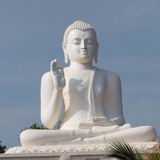
Anapanasati Mindfulness With Breathing
By Buddhadasa Bhikkhu
Part 1 of 2
PRACTICING FUNDAMENTAL TRUTHS
The next benefit is that we are able to practice in line with the principle of paticca-samuppada (dependent origination, conditioned arising). The theory of paticca-samuppada is complex and lengthy. For those of you who are not familiar with it, conditioned arising explains the causal origination of dukkha. A series of causes, each dependent on a previous cause, leads to suffering. The Lord Buddha taught many variations on this theme, but because of its great subtlety and profundity it is difficult to understand. Do study it. But once we come to its practical application, dependent origination is exquisitely simple. In practice, it all boils down to having sati in the moment of phassa (sense contact) and that is all. Phassa is the meeting of an internal sense organ, a corresponding external sense object, and the appropriate type of sense consciousness (vinnana). Merely having sati in the moment of phassa solves all the possible problems of paticca-samuppada completely. That is, before conditioned arising can develop have sati right there at contact. Do not let it be ignorant phassa. Then that contact will not lead to ignorant feeling and ignorant feeling will not lead to foolish craving (tanha). It all stops there. This is another advantage of training in Anapanasati. It makes sati sufficiently abundant and fast, qualified enough, to perform its duty in the moment of phassa and stop the stream of paticca-samuppada just then and there. This is an enormous benefit of practicing Anapanasati.
Another benefit is that we are able to practice according to the principle of the four ariya-sacca with ease and completeness. You all have heard and know about the four noble truths. The essence of this law is that dukkha is born out of ignorant desire (tanha). If there is tanha, there must be dukkha. When we are able to use sati to stop tanha and break it off, there is no dukkha. Through preventing ignorant sense experience (phassa), there is no ignorant feeling (vedana) and tanha is not stirred up. This is the best, most beneficial way to practice the four noble truths. Stop tanha through the speed and power of the sati developed by practicing Anapanasati in all four tetrads (body, feelings, mind and dhamma).
THE HEART OF THE TRIPLE GEM
A further benefit is that Anapanasati easily, completely, and perfectly brings us the Triple Gem (ti-ratana), the Three Refuges of Buddhism. This is because the essence or nucleus of the Buddha, The Dhamma, and the Sangha is in cleanliness-clarity-calm (purity- radiance-tranquility). The state of citta that is clean-clear-calm is the essence of Buddha-Dhamma-Sangha. Please be careful about these three words. The Lord Buddha is not some physical body. Rather, the state in the mind that is clean-clear-calm is the true Lord Buddha. In seeing the Dhamma, the Buddha is seen. The heart of the Dhamma is this cleanliness-clarity-calm itself. Then, the Sangha are those who through successful practice have clean-clear-calm minds. All three words are most important. The first person to realize perfect cleanliness-clarity-calm is called "the Buddha," that Truth realized is called "the Dhamma," and the people who can follow and practice accordingly are called "the Sangha." When we practice Anapanasati we make our citta clean-clear-calm, as we have explained in detail throughout these lectures. These qualities are the fruit of viraga, nirodha, and patinissagga (steps fourteen through sixteen). Through them there is cleanliness-clarity-calm, thereby there is easily the genuine Buddha-Dhamma-Sangha in our mind- hearts. This is another of Anapanasati's unsurpassed benefits.
BUDDHISM IN ITS ENTIRETY
Now, the next benefit is that in practicing Anapanasati we practice the most fundamental principle of Buddhism, namely, sila- samadhi-panna. These three factors are wholly present in the practitioner of Anapanasati. The unshakeable determination to practice is sila (virtue).
By Buddhadasa Bhikkhu
Part 1 of 2
PRACTICING FUNDAMENTAL TRUTHS
The next benefit is that we are able to practice in line with the principle of paticca-samuppada (dependent origination, conditioned arising). The theory of paticca-samuppada is complex and lengthy. For those of you who are not familiar with it, conditioned arising explains the causal origination of dukkha. A series of causes, each dependent on a previous cause, leads to suffering. The Lord Buddha taught many variations on this theme, but because of its great subtlety and profundity it is difficult to understand. Do study it. But once we come to its practical application, dependent origination is exquisitely simple. In practice, it all boils down to having sati in the moment of phassa (sense contact) and that is all. Phassa is the meeting of an internal sense organ, a corresponding external sense object, and the appropriate type of sense consciousness (vinnana). Merely having sati in the moment of phassa solves all the possible problems of paticca-samuppada completely. That is, before conditioned arising can develop have sati right there at contact. Do not let it be ignorant phassa. Then that contact will not lead to ignorant feeling and ignorant feeling will not lead to foolish craving (tanha). It all stops there. This is another advantage of training in Anapanasati. It makes sati sufficiently abundant and fast, qualified enough, to perform its duty in the moment of phassa and stop the stream of paticca-samuppada just then and there. This is an enormous benefit of practicing Anapanasati.
Another benefit is that we are able to practice according to the principle of the four ariya-sacca with ease and completeness. You all have heard and know about the four noble truths. The essence of this law is that dukkha is born out of ignorant desire (tanha). If there is tanha, there must be dukkha. When we are able to use sati to stop tanha and break it off, there is no dukkha. Through preventing ignorant sense experience (phassa), there is no ignorant feeling (vedana) and tanha is not stirred up. This is the best, most beneficial way to practice the four noble truths. Stop tanha through the speed and power of the sati developed by practicing Anapanasati in all four tetrads (body, feelings, mind and dhamma).
THE HEART OF THE TRIPLE GEM
A further benefit is that Anapanasati easily, completely, and perfectly brings us the Triple Gem (ti-ratana), the Three Refuges of Buddhism. This is because the essence or nucleus of the Buddha, The Dhamma, and the Sangha is in cleanliness-clarity-calm (purity- radiance-tranquility). The state of citta that is clean-clear-calm is the essence of Buddha-Dhamma-Sangha. Please be careful about these three words. The Lord Buddha is not some physical body. Rather, the state in the mind that is clean-clear-calm is the true Lord Buddha. In seeing the Dhamma, the Buddha is seen. The heart of the Dhamma is this cleanliness-clarity-calm itself. Then, the Sangha are those who through successful practice have clean-clear-calm minds. All three words are most important. The first person to realize perfect cleanliness-clarity-calm is called "the Buddha," that Truth realized is called "the Dhamma," and the people who can follow and practice accordingly are called "the Sangha." When we practice Anapanasati we make our citta clean-clear-calm, as we have explained in detail throughout these lectures. These qualities are the fruit of viraga, nirodha, and patinissagga (steps fourteen through sixteen). Through them there is cleanliness-clarity-calm, thereby there is easily the genuine Buddha-Dhamma-Sangha in our mind- hearts. This is another of Anapanasati's unsurpassed benefits.
BUDDHISM IN ITS ENTIRETY
Now, the next benefit is that in practicing Anapanasati we practice the most fundamental principle of Buddhism, namely, sila- samadhi-panna. These three factors are wholly present in the practitioner of Anapanasati. The unshakeable determination to practice is sila (virtue).
Telegram
Words of the Buddha
Daily teachings of Buddha Dharma
👍1🏆1
When the mind is set on correct action, that is sila altogether. In the intention necessary to practice every step of Anapanasati there is automatically a natural sila without us having to practice it in particular. Then, there will be samadhi (concentration) as well. Because of this intention, we practice until samadhi arises. Then panna (wisdom) develops, especially in the fourth tetrad which is the most perfect wisdom. In practicing Anapanasati correctly the most fundamental principle of Buddhism is fulfilled, it leads to sila-samadhi-panna in full measure. This is an enormous benefit: practicing Buddhism in its entirety.
When we speak concisely, we talk about sila-samadhi-panna. If we want to go into more complete detail, we talk about the seven bojjhanga (factors of awakening). There is a statement of the Buddha which asserts that fully practicing the sixteen steps of Anapanasati perfects the four satipatthana (foundations of mindfulness). Through the perfection of the four satipatthana (body, feeling, mind, and Dhamma, i.e., the objects of the four tetrads), the seven bojjhanga are perfected. Then full awakening is assured. The seven bojjhanga are the very factors which lead to the enlightenment of the arahant (a human being who is liberated from all dukkha). It would take hours to go into all the details. Now, we only have time to give the names of these factors for you to hear: sati, dhammavicaya (investigation of Dhamma), viriya (effort, energy), piti (contentment, satisfaction), passaddhi (tranquility), samadhi (concentration, collectedness), and upekkha (equanimity, even-mindedness). These seven factors are complete when Anapanasati is complete. When these seven factors are complete, perfect awakening is assured.
Although we do not have enough time now to explain further, please understand that the seven bojjhanga are a sure thing when Anapanasati is practiced completely. The recorded words of the Buddha state this clearly. You can verify its truth by yourself.
===
Part 1 of 2:
https://news.1rj.ru/str/dhammapadas/2301
Part 2 of 2:
https://news.1rj.ru/str/wordsofbuddha/3332
===
Words of the Buddha channel:
https://news.1rj.ru/str/wordsofbuddha
===
When we speak concisely, we talk about sila-samadhi-panna. If we want to go into more complete detail, we talk about the seven bojjhanga (factors of awakening). There is a statement of the Buddha which asserts that fully practicing the sixteen steps of Anapanasati perfects the four satipatthana (foundations of mindfulness). Through the perfection of the four satipatthana (body, feeling, mind, and Dhamma, i.e., the objects of the four tetrads), the seven bojjhanga are perfected. Then full awakening is assured. The seven bojjhanga are the very factors which lead to the enlightenment of the arahant (a human being who is liberated from all dukkha). It would take hours to go into all the details. Now, we only have time to give the names of these factors for you to hear: sati, dhammavicaya (investigation of Dhamma), viriya (effort, energy), piti (contentment, satisfaction), passaddhi (tranquility), samadhi (concentration, collectedness), and upekkha (equanimity, even-mindedness). These seven factors are complete when Anapanasati is complete. When these seven factors are complete, perfect awakening is assured.
Although we do not have enough time now to explain further, please understand that the seven bojjhanga are a sure thing when Anapanasati is practiced completely. The recorded words of the Buddha state this clearly. You can verify its truth by yourself.
===
Part 1 of 2:
https://news.1rj.ru/str/dhammapadas/2301
Part 2 of 2:
https://news.1rj.ru/str/wordsofbuddha/3332
===
Words of the Buddha channel:
https://news.1rj.ru/str/wordsofbuddha
===
Telegram
Words of the Buddha
Daily teachings of Buddha Dharma
👏1💯1
Forwarded from Words of the Buddha
“Monks, if while walking, a thought of sense desire or ill will or harmfulness arises in a monk, and if he allows it to stay and does not reject it, does not quickly abandon it, does not get rid of it, and does not bring it to an end, that monk— lacking in energy and unafraid of wrongdoing—is often and continually called lazy and weak in his effort.
Whether walking, standing, sitting, or lying down, a monk who has evil thoughts related to sense pleasures is following a wrong path. Infatuated with delusory things, he is not capable of achieving supreme enlightenment.
Whether walking, standing, sitting, or lying down, a monk who overcomes evil thoughts and delights in the stilling of thoughts is capable of achieving supreme enlightenment.
Partially excerpted from Itivuttaka 110 : Carasutta
Whether walking, standing, sitting, or lying down, a monk who has evil thoughts related to sense pleasures is following a wrong path. Infatuated with delusory things, he is not capable of achieving supreme enlightenment.
Whether walking, standing, sitting, or lying down, a monk who overcomes evil thoughts and delights in the stilling of thoughts is capable of achieving supreme enlightenment.
Partially excerpted from Itivuttaka 110 : Carasutta
👏1💯1
Forwarded from Words of the Buddha
Anapanasati Mindfulness With Breathing
By Buddhadasa Bhikkhu
Part 2 of 2
NIBBANA HERE AND NOW
Now, we come to the most positive benefit obtained through the practice of mindfulness with breathing, namely, we will have nibbana in this life, without needing to die. We mean nibbana here and now, the type where we do not need to die, the kind that has nothing to do with death. "Nibbana" means "coolness." The word 'nibbuto" also means "coolness." If it is only temporary coolness, not continual, and not yet perfect, we call it "nibbuto." Nevertheless, the flavor is the same as perfect nibbana. Nibbuto is like the sample a salesman shows of the product we actually buy. They must be alike. Here we have a sample of nibbana to taste for a little while. We call it temporary nibbana or samayika-nibbana.
Coolness also can be the nibbana that happens due to "that factor." In Pali it is called "that factor," which means something like "coincidental." For example, when there is sati on the breath, the citta is cool. Anapanasati is "that factor," the agent, the cause, that affects the coolness here. This is tadariga-nibbana, coincidental nibbana. This coolness occurs because when there is no defilement the citta is cool. When there is no fire, there is coolness. Here, Anapanasati gets rid of the fires, the defilements. Although it is only temporary, the fire goes away and there is coolness for a while. There is nibbana for a while, due to "that factor," that tool, namely Anapanasati. Although momentary, not yet perfect and perpetual, the flavor of nibbana is savored as a sample or taste. Anapanasati helps us to sample nibbana little by little, moment by moment, during this very life. And nothing has to die. Then, coolness's duration is lengthened, its extent is broadened, and the frequency is increased until there is perfect nibbana. This is the benefit which I consider most satisfying or most positive. If you can do it.
Make sure that you understand this word nibbana correctly. It means "cool" and has nothing to do with dying. If it is the kind of nibbana associated with death, such as the death of an arahant, we use another word, "parinibbana. Just "nibbana" without the prefix 'pari," simply means "cool," the absence of heat. Imagine that everything is going right for you: you have good health, economic security, a good family, good friends, and good surroundings. Then, this life of yours is cool according to the meaning of nibbana. It may not be perfect nibbana, because it must include a cool mind to be perfect, but it is cool just the same.
The word 'nibbana" means "cool." It even can be used regarding material things. A burning charcoal that gradually cools down until no longer hot is said to "nibbana." When soup is too hot to eat, wait for it to cool off, then we can say that the soup is nibbana enough to eat. It might be applied even to fierce and dangerous animals captured from the forest, then, tamed and trained until fully domesticated. They can be said to nibbana as well. In the Pali texts, this same word is used regarding material things, animals, and peo- ple. If something is cool rather than hot it is nibbana in one sense or another. And it need not die. We will receive the most satisfying sort of nibbang cool in body, cool in mind, cool in all respects through practicing Anapanasati
In short, we have a cool life here and now, namely, nibbana in the sense we have explained just now. In Pali, this is called 'nibbuto," meaning "one who is cooled" or "one who has nibbana." That state is called "nibbana." That kind of person is called "nibbuto.
THE LAST BREATH
There are many other benefits to the practice of Anapanasati that we could mention, but it would take hours, which is more than you listeners and we speakers can handle. Allow us, however, to mention one last item: we will know the last breath of our life. That is, we will know the breath in which we will die. This does not mean that we will choose the moment of death.
By Buddhadasa Bhikkhu
Part 2 of 2
NIBBANA HERE AND NOW
Now, we come to the most positive benefit obtained through the practice of mindfulness with breathing, namely, we will have nibbana in this life, without needing to die. We mean nibbana here and now, the type where we do not need to die, the kind that has nothing to do with death. "Nibbana" means "coolness." The word 'nibbuto" also means "coolness." If it is only temporary coolness, not continual, and not yet perfect, we call it "nibbuto." Nevertheless, the flavor is the same as perfect nibbana. Nibbuto is like the sample a salesman shows of the product we actually buy. They must be alike. Here we have a sample of nibbana to taste for a little while. We call it temporary nibbana or samayika-nibbana.
Coolness also can be the nibbana that happens due to "that factor." In Pali it is called "that factor," which means something like "coincidental." For example, when there is sati on the breath, the citta is cool. Anapanasati is "that factor," the agent, the cause, that affects the coolness here. This is tadariga-nibbana, coincidental nibbana. This coolness occurs because when there is no defilement the citta is cool. When there is no fire, there is coolness. Here, Anapanasati gets rid of the fires, the defilements. Although it is only temporary, the fire goes away and there is coolness for a while. There is nibbana for a while, due to "that factor," that tool, namely Anapanasati. Although momentary, not yet perfect and perpetual, the flavor of nibbana is savored as a sample or taste. Anapanasati helps us to sample nibbana little by little, moment by moment, during this very life. And nothing has to die. Then, coolness's duration is lengthened, its extent is broadened, and the frequency is increased until there is perfect nibbana. This is the benefit which I consider most satisfying or most positive. If you can do it.
Make sure that you understand this word nibbana correctly. It means "cool" and has nothing to do with dying. If it is the kind of nibbana associated with death, such as the death of an arahant, we use another word, "parinibbana. Just "nibbana" without the prefix 'pari," simply means "cool," the absence of heat. Imagine that everything is going right for you: you have good health, economic security, a good family, good friends, and good surroundings. Then, this life of yours is cool according to the meaning of nibbana. It may not be perfect nibbana, because it must include a cool mind to be perfect, but it is cool just the same.
The word 'nibbana" means "cool." It even can be used regarding material things. A burning charcoal that gradually cools down until no longer hot is said to "nibbana." When soup is too hot to eat, wait for it to cool off, then we can say that the soup is nibbana enough to eat. It might be applied even to fierce and dangerous animals captured from the forest, then, tamed and trained until fully domesticated. They can be said to nibbana as well. In the Pali texts, this same word is used regarding material things, animals, and peo- ple. If something is cool rather than hot it is nibbana in one sense or another. And it need not die. We will receive the most satisfying sort of nibbang cool in body, cool in mind, cool in all respects through practicing Anapanasati
In short, we have a cool life here and now, namely, nibbana in the sense we have explained just now. In Pali, this is called 'nibbuto," meaning "one who is cooled" or "one who has nibbana." That state is called "nibbana." That kind of person is called "nibbuto.
THE LAST BREATH
There are many other benefits to the practice of Anapanasati that we could mention, but it would take hours, which is more than you listeners and we speakers can handle. Allow us, however, to mention one last item: we will know the last breath of our life. That is, we will know the breath in which we will die. This does not mean that we will choose the moment of death.
Telegram
Dhammapada - Buddha Dharma Teachings
Daily teachings of the Dhammapada, beloved and favorite teachings of the Buddha
❤1🙏1
Forwarded from Words of the Buddha
It just means that through becoming well-versed in our practice of Anapanasati we become ex-
perts regarding the breath. We will know instantly whether we are going to die during this present breath or not. Then we can predict the final breath of our life. This is the special benefit which is knowing that last minute in which we will die.
The Lord Buddha himself declared that he realized Perfect Self-Awakening (anuttara sammasambodhi) through practicing Anapanasati. Consequently, we are pleased to recommend it to you, and to people everywhere, so that all human beings will know of it and be able to practice it. The Lord Buddha became a Buddha while practicing Anapanasati. Thus, he offered it to us as the best system of all to practice. He advised us all to use this practice for our own welfare, for the welfare of others, for the welfare of everyone. There is no better way to practice Dhamma than mindfulness with breathing. May you all give careful attention to it.
Our discussion of anapanasati-bhavana is sufficiently com- plete now. May we end the final lecture here.
===
Dhammapada, beloved and favorite teachings of the Buddha channel:
https://news.1rj.ru/str/dhammapadas
===
perts regarding the breath. We will know instantly whether we are going to die during this present breath or not. Then we can predict the final breath of our life. This is the special benefit which is knowing that last minute in which we will die.
The Lord Buddha himself declared that he realized Perfect Self-Awakening (anuttara sammasambodhi) through practicing Anapanasati. Consequently, we are pleased to recommend it to you, and to people everywhere, so that all human beings will know of it and be able to practice it. The Lord Buddha became a Buddha while practicing Anapanasati. Thus, he offered it to us as the best system of all to practice. He advised us all to use this practice for our own welfare, for the welfare of others, for the welfare of everyone. There is no better way to practice Dhamma than mindfulness with breathing. May you all give careful attention to it.
Our discussion of anapanasati-bhavana is sufficiently com- plete now. May we end the final lecture here.
===
Dhammapada, beloved and favorite teachings of the Buddha channel:
https://news.1rj.ru/str/dhammapadas
===
Telegram
Dhammapada - Buddha Dharma Teachings
Daily teachings of the Dhammapada, beloved and favorite teachings of the Buddha
👍1🏆1
Dhammapada Verse 391
Mahapajapatigotami Vatthu
Yassa kayena vacaya
manasa natthi dukkatam
samvutam tihi thanehi
tamaham brumi brahmanam.
Verse 391: Him I call a brahmana who does no evil in deed or word or thought, who is restrained in these three respects.
The Story of Theri Mahapajapati Gotami
While residing at the Jetavana monastery, the Buddha uttered Verse (391) of this book, with reference to Theri Mahapajapati Gotami.
Mahapajapati Gotami was the stepmother of Gotama Buddha. On the death of Queen, seven days after the birth of Prince Siddhattha, Mahapajapati Gotami became the chief queen of King Suddhodana. At that time, her own son Nanda was only five days old. She let her own son be fed by a wet-nurse, and herself fed Prince Siddhattha, the future Buddha. Thus, Mahapajapati Gotami was a great benefactor to Prince Siddhattha.
When Prince Siddhattha returned to Kapilavatthu after the attainment of Buddhahood, Mahapajapati Gotami went to see the Buddha and requested that women should also be allowed to enter the Buddhist Order as bhikkhunis; but the Buddha refused permission. Later, King Suddhodana died after attaining arahatship. Then, while the Buddha was sojourning at the Mahavana forest near Vesali, Mahapajapati, accompanied by five hundred ladies, came on foot from Kapilavatthu to Vasali. They had already shaven their heads and had put on the dyed robes. There, for a second time, Mahapajapati requested the Buddha to accept women in the Buddhist Order. The Venerable Ananda also interceded on her behalf. So, the Buddha complied, with the proviso that Mahapajapati abides by eight special conditions (garudhammas). Mahapajapati undertook to observe the garudhammas as required, and the Buddha admitted her into the Order. Thus, Mahapajapati was the first to be admitted to the Order of the Bhikkhunis. The other women were admitted to the Order after her by the bhikkhus as instructed by the Buddha.
In course of time, it came to the minds of some bhikkhunis that Mahapajapati Gotami had not been properly admitted as a bhikkhuni because she did not have a preceptor; therefore, Mahapajapati Gotami was not a true bhikkhuni. With this thought in their mind, they stopped doing sabbath (uposatha) ceremonies and vassa (pavarana) ceremonies with her. They went to the Buddha and posed the problem of Mahapajapati Gotami not having been properly admitted to the Order of bhikkhunis as she had no preceptor. To them the Buddha replied, "Why do you say so? I myself gave the eight garudhammas to Mahapajapati and she had learnt and practised the garudhammas as required by me. I myself am her preceptor and it is quite wrong for you to say that she has no preceptor. You should harbour no doubt whatsoever about an arahat."
Then the Buddha spoke in verse as follows:
Verse 391: Him I call a brahmana who does no evil in deed or word or thought, who is restrained in these three respects.
===
Words of the Buddha channel:
https://news.1rj.ru/str/wordsofbuddha
===
Mahapajapatigotami Vatthu
Yassa kayena vacaya
manasa natthi dukkatam
samvutam tihi thanehi
tamaham brumi brahmanam.
Verse 391: Him I call a brahmana who does no evil in deed or word or thought, who is restrained in these three respects.
The Story of Theri Mahapajapati Gotami
While residing at the Jetavana monastery, the Buddha uttered Verse (391) of this book, with reference to Theri Mahapajapati Gotami.
Mahapajapati Gotami was the stepmother of Gotama Buddha. On the death of Queen, seven days after the birth of Prince Siddhattha, Mahapajapati Gotami became the chief queen of King Suddhodana. At that time, her own son Nanda was only five days old. She let her own son be fed by a wet-nurse, and herself fed Prince Siddhattha, the future Buddha. Thus, Mahapajapati Gotami was a great benefactor to Prince Siddhattha.
When Prince Siddhattha returned to Kapilavatthu after the attainment of Buddhahood, Mahapajapati Gotami went to see the Buddha and requested that women should also be allowed to enter the Buddhist Order as bhikkhunis; but the Buddha refused permission. Later, King Suddhodana died after attaining arahatship. Then, while the Buddha was sojourning at the Mahavana forest near Vesali, Mahapajapati, accompanied by five hundred ladies, came on foot from Kapilavatthu to Vasali. They had already shaven their heads and had put on the dyed robes. There, for a second time, Mahapajapati requested the Buddha to accept women in the Buddhist Order. The Venerable Ananda also interceded on her behalf. So, the Buddha complied, with the proviso that Mahapajapati abides by eight special conditions (garudhammas). Mahapajapati undertook to observe the garudhammas as required, and the Buddha admitted her into the Order. Thus, Mahapajapati was the first to be admitted to the Order of the Bhikkhunis. The other women were admitted to the Order after her by the bhikkhus as instructed by the Buddha.
In course of time, it came to the minds of some bhikkhunis that Mahapajapati Gotami had not been properly admitted as a bhikkhuni because she did not have a preceptor; therefore, Mahapajapati Gotami was not a true bhikkhuni. With this thought in their mind, they stopped doing sabbath (uposatha) ceremonies and vassa (pavarana) ceremonies with her. They went to the Buddha and posed the problem of Mahapajapati Gotami not having been properly admitted to the Order of bhikkhunis as she had no preceptor. To them the Buddha replied, "Why do you say so? I myself gave the eight garudhammas to Mahapajapati and she had learnt and practised the garudhammas as required by me. I myself am her preceptor and it is quite wrong for you to say that she has no preceptor. You should harbour no doubt whatsoever about an arahat."
Then the Buddha spoke in verse as follows:
Verse 391: Him I call a brahmana who does no evil in deed or word or thought, who is restrained in these three respects.
===
Words of the Buddha channel:
https://news.1rj.ru/str/wordsofbuddha
===
Telegram
Words of the Buddha
Daily teachings of Buddha Dharma
👌1💯1
Forwarded from Words of the Buddha
Free Buddha Dharma ebook
Frames of Reference
By Ajaan Lee Dhammadharo
A practical explanation for meditators of the four frames of reference from the Satipaṭṭhāna Sutta.
Free download available:
https://www.dhammatalks.org/Archive/Writings/Ebooks/FramesOfReference200826.pdf
===
Frames of Reference
By Ajaan Lee Dhammadharo
A practical explanation for meditators of the four frames of reference from the Satipaṭṭhāna Sutta.
Free download available:
https://www.dhammatalks.org/Archive/Writings/Ebooks/FramesOfReference200826.pdf
===
👍3🆒1
Dhammapada Verse 392
Sariputtatthera Vatthu
Yamha dhammam vijaneyya
sammasambuddhadesitam
sakkaccam tam namasseyya
aggihuttamva brahmano.
Verse 392: If from somebody one should learn the Teaching of the Buddha, he should respectfully pay homage to that teacher, as a brahmin worships the sacrificial fire.
The Story of Thera Sariputta
While residing at the Jetavana monastery, the Buddha uttered Verse (392) of this book, with reference to the Venerable Sariputta.
The Venerable Sariputta was born of brahmin parents of Upatissa village; that was why he was named Upatissa. His mother was Sari. His very close friend was Kolita, another brahmin youth, son of Moggali. Both the youths were searching for the right doctrine, which would lead them to liberation from the round of rebirths, and both of them had a great desire to enter a religious Order. First, they went to Sancaya, but they were not satisfied with his teaching. Then they wandered all over Jambudipa looking for a teacher who would show them the way to the Deathless, but their search was fruitless. After some time, they parted company but with the understanding that the one who found the true dhamma first should inform the other.
About that time, the Buddha arrived at Rajagaha with a company of bhikkhus, including Thera Assaji, one of the group of the first Five Bhikkhus (Pancavaggis). While Thera Assaji was on an alms-round, Upatissa saw the thera and was very much impressed by his noble countenance. So Upatissa respectfully approached the thera and asked who his teacher was, what doctrine his teacher taught, and also briefly to explain the doctrine to him. Thera Assaji then told Upatissa about the arising of the Buddha and about his sojourn at the Veluvana monastery in Rajagaha. The thera also quoted a short stanza connected with the Four Noble Truths.
The verse runs thus:
Ye dhamma hetuppa bhava
tesam hetum tathagato aha
tesanca yo nirodho
evam vadi maha samano.
It means:
The Tathagata has declared the cause and also the cessation of all phenomena which arise from a cause. This is the doctrine held by the Great Samana.
When the verse was only half-way through, Upatissa attained Sotapatti Fruition.
As promised, Upatissa went to his friend Kolita to inform him that he had found the true dhamma. Then the two friends, accompanied by two hundred and fifty followers, went to the Buddha who was then at Rajagaha. When they arrived at the Veluvana monastery, they asked permission to enter the Buddhist Order, and both Upatissa and Kolita, together with their two hundred and fifty followers, were admitted as bhikkhus. Upatissa, son of Sari, and Kolita, son of Moggali, then came to be known as Sariputta and Moggallana. Soon after their admission to the Order, the Buddha expounded to them a dhamma and the two hundred and fifty bhikkhus attained arahatship; but Moggallana and Sariputta attained arahatship only at the end of seven days and fifteen days respectively. The reason for the delay in their attainment of arahatship was that they had made a wish for Chief Discipleship, which required much more striving to achieve perfection.
The Venerable Sariputta always remembered that he had been able to meet the Buddha and attain the Deathless through the Venerable Assaji. So, he always paid obeisance in the direction where his teacher was and he always went to bed with his head lying in the same direction. Other bhikkhus who were staying with him at the Jetavana monastery misinterpreted his actions and said to the Buddha, "Venerable Sir! The Venerable Sariputta still worships the various directions, viz., the East, the South, the West, the North, the Nadir and the Zenith, as he has done before as a brahmin youth; it seems as if he has not yet given up his old beliefs." The Buddha sent for the Venerable Sariputta and Sariputta explained to the Buddha that he was only paying obeisance to his teacher, the Venerable Assaji, and that he was not worshipping the various directions.
Sariputtatthera Vatthu
Yamha dhammam vijaneyya
sammasambuddhadesitam
sakkaccam tam namasseyya
aggihuttamva brahmano.
Verse 392: If from somebody one should learn the Teaching of the Buddha, he should respectfully pay homage to that teacher, as a brahmin worships the sacrificial fire.
The Story of Thera Sariputta
While residing at the Jetavana monastery, the Buddha uttered Verse (392) of this book, with reference to the Venerable Sariputta.
The Venerable Sariputta was born of brahmin parents of Upatissa village; that was why he was named Upatissa. His mother was Sari. His very close friend was Kolita, another brahmin youth, son of Moggali. Both the youths were searching for the right doctrine, which would lead them to liberation from the round of rebirths, and both of them had a great desire to enter a religious Order. First, they went to Sancaya, but they were not satisfied with his teaching. Then they wandered all over Jambudipa looking for a teacher who would show them the way to the Deathless, but their search was fruitless. After some time, they parted company but with the understanding that the one who found the true dhamma first should inform the other.
About that time, the Buddha arrived at Rajagaha with a company of bhikkhus, including Thera Assaji, one of the group of the first Five Bhikkhus (Pancavaggis). While Thera Assaji was on an alms-round, Upatissa saw the thera and was very much impressed by his noble countenance. So Upatissa respectfully approached the thera and asked who his teacher was, what doctrine his teacher taught, and also briefly to explain the doctrine to him. Thera Assaji then told Upatissa about the arising of the Buddha and about his sojourn at the Veluvana monastery in Rajagaha. The thera also quoted a short stanza connected with the Four Noble Truths.
The verse runs thus:
Ye dhamma hetuppa bhava
tesam hetum tathagato aha
tesanca yo nirodho
evam vadi maha samano.
It means:
The Tathagata has declared the cause and also the cessation of all phenomena which arise from a cause. This is the doctrine held by the Great Samana.
When the verse was only half-way through, Upatissa attained Sotapatti Fruition.
As promised, Upatissa went to his friend Kolita to inform him that he had found the true dhamma. Then the two friends, accompanied by two hundred and fifty followers, went to the Buddha who was then at Rajagaha. When they arrived at the Veluvana monastery, they asked permission to enter the Buddhist Order, and both Upatissa and Kolita, together with their two hundred and fifty followers, were admitted as bhikkhus. Upatissa, son of Sari, and Kolita, son of Moggali, then came to be known as Sariputta and Moggallana. Soon after their admission to the Order, the Buddha expounded to them a dhamma and the two hundred and fifty bhikkhus attained arahatship; but Moggallana and Sariputta attained arahatship only at the end of seven days and fifteen days respectively. The reason for the delay in their attainment of arahatship was that they had made a wish for Chief Discipleship, which required much more striving to achieve perfection.
The Venerable Sariputta always remembered that he had been able to meet the Buddha and attain the Deathless through the Venerable Assaji. So, he always paid obeisance in the direction where his teacher was and he always went to bed with his head lying in the same direction. Other bhikkhus who were staying with him at the Jetavana monastery misinterpreted his actions and said to the Buddha, "Venerable Sir! The Venerable Sariputta still worships the various directions, viz., the East, the South, the West, the North, the Nadir and the Zenith, as he has done before as a brahmin youth; it seems as if he has not yet given up his old beliefs." The Buddha sent for the Venerable Sariputta and Sariputta explained to the Buddha that he was only paying obeisance to his teacher, the Venerable Assaji, and that he was not worshipping the various directions.
Telegram
Dhammapada - Buddha Dharma Teachings
Daily teachings of the Dhammapada, beloved and favorite teachings of the Buddha
❤1👍1🏆1
The Buddha was satisfied with the explanation given by the Venerable Sariputta and said to the other bhikkhus, "Bhikkhus! The Venerable Sariputta was not worshipping the various directions; he was only paying obeisance to his teacher and benefactor, through whom he had attained the Deathless. It is quite right and proper for him to pay homage to such a teacher."
Then the Buddha spoke in verse as follows:
Verse 392: If from somebody one should learn the Teaching of the Buddha, he should respectfully pay homage to that teacher, as a brahmin worships the sacrificial fire.
===
Dhammapada, beloved and favorite teachings of the Buddha channel:
https://news.1rj.ru/str/dhammapadas
===
Then the Buddha spoke in verse as follows:
Verse 392: If from somebody one should learn the Teaching of the Buddha, he should respectfully pay homage to that teacher, as a brahmin worships the sacrificial fire.
===
Dhammapada, beloved and favorite teachings of the Buddha channel:
https://news.1rj.ru/str/dhammapadas
===
Telegram
Dhammapada - Buddha Dharma Teachings
Daily teachings of the Dhammapada, beloved and favorite teachings of the Buddha
👏1💯1
Forwarded from Buddha Dharma books
Free Buddha Dharma ebook
Basic Themes: Four Treatises on Buddhist Practice, by Phra Ajaan Lee Dhammadharo
Uniquely among the ajaans in the Thai Wilderness tradition Ajaan Lee composed systematic treatises on the practice. These are valuable documents, giving a wilderness perspective on basic Dhamma topics.
Free download here:
https://www.dhammatalks.org/Archive/Writings/Ebooks/BasicThemes_181215.pdf
===
Basic Themes: Four Treatises on Buddhist Practice, by Phra Ajaan Lee Dhammadharo
Uniquely among the ajaans in the Thai Wilderness tradition Ajaan Lee composed systematic treatises on the practice. These are valuable documents, giving a wilderness perspective on basic Dhamma topics.
Free download here:
https://www.dhammatalks.org/Archive/Writings/Ebooks/BasicThemes_181215.pdf
===
💯2👍1🥰1