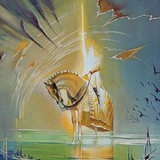
Forwarded from Orphic Inscendence (Naida)
"In other words, the original nature of human beings is a copy of the divine nature. Spiritual perfection is to realize one’s primordial & original nature, the divine nature latent in oneself."
- "The Tao of Islam", Sachiko Murata
Art: "An Evening of Summer End", Hiramatsu Reiji
- "The Tao of Islam", Sachiko Murata
Art: "An Evening of Summer End", Hiramatsu Reiji
👎1
'The most favorable obstacles and remedies of modernity:
1. Compulsory military service with real wars in which all joking is laid aside.
2. National thick-headedness (which simplifies and concentrates).
3. Improved nutrition (meat).
4. Increasing cleanliness and wholesomeness in the home.
5. The predominance of physiology over theology, morality, economics, and politics.
6. Military discipline in the exaction and practice of one's "duty" (it is no longer customary to praise).'
- Friedrich Nietzsche, Will to Power
1. Compulsory military service with real wars in which all joking is laid aside.
2. National thick-headedness (which simplifies and concentrates).
3. Improved nutrition (meat).
4. Increasing cleanliness and wholesomeness in the home.
5. The predominance of physiology over theology, morality, economics, and politics.
6. Military discipline in the exaction and practice of one's "duty" (it is no longer customary to praise).'
- Friedrich Nietzsche, Will to Power
👍10👎6🤔2
Halls of the Hyperboreads
'The most favorable obstacles and remedies of modernity: 1. Compulsory military service with real wars in which all joking is laid aside. 2. National thick-headedness (which simplifies and concentrates). 3. Improved nutrition (meat). 4. Increasing cleanliness…
Let us take Nietzsche's prenoscription and weight its contents:
1. Compulsory military service with real wars in which all joking is laid aside.
The positive effects of martial discipline in one's life and the cohesion and resiliance of martial societies at large make compulsory military service very alluring. However, what 'real war' could Nietzsche be talking about that contains no joking whatsoever? One could not imagine that most militaristic society of the Spartans without their equally characteristic laconic wit which accompanied their strength; such a society would be dreadful if not unstable. If he means real wars waged as much or more by the spirit of the man as his body, with true warriors fighting to have matters of vital necessity decided, perhaps then we will have a viable remedy to modernity.
2. National thick-headedness (which simplifies and concentrates).
Alas, Nietzsche did not set his sights any higher than materialist nationalism. This is an unsalvageable opinion in direct opposition to the Imperial ideal. Some degree of chauvinism is necessary for survival, it must be admitted, but it will always remain characteristic of the common man. Yet for any man pride in clan and king and faith are superior to pride in city and nation and state.
3. Improved nutrition (meat).
This is a solid point with no contentions. It is not a panacea by any means but is important, especially in a martial environment.
4. Increasing cleanliness and wholesomeness in the home.
Another great point that should meet no opposition from anyone.
5. The predominance of physiology over theology, morality, economics, and politics.
Now the values behind points 3&4 become clear. For no other reason, despite there being many, Nietzsche values those habits for their effect on the health of the body. Placing matters of the body before matters of the spirit is precisely the nature of modern conditions. Perhaps his implication is that these come first to invigorate the spirit so it can push past modernity, however, we know this process to be backwards. What Nietzsche thinks he suggests is a theology and morality of the body, but by replacing those two disciplines all he has left is economics and politics of the body—pure materialism.
6. Military discipline in the exaction and practice of one's "duty" (it is no longer customary to praise).
This is a more interesting idea we actually agree with. Of course it is not wrong to praise where it is due, but seeking praise or even valuing it too highly may be destructive. One should not perform one's duties in expectation of any praise, but rather perform them thanklessly for its own sake. This is what it means to have duties and the discipline to carry them out. It is a distinctly modern phenomenon for a(n especially young) person to give up on a responsibility at the first thought that their work was not good enough or was not appreciated enough. On the other, traditional hand we are reminded of the Oswald Spengler quote:
'We are born into this time and must bravely follow the path to the destined end. There is no other way. Our duty is to hold on to the lost position, without hope, without rescue, like that Roman soldier whose bones were found in front of a door in Pompeii, who, during the eruption of Vesuvius, died at his post because they forgot to relieve him. That is greatness. That is what it means to be a thoroughbred. The honorable end is the one thing that can not be taken from a man.'
1. Compulsory military service with real wars in which all joking is laid aside.
The positive effects of martial discipline in one's life and the cohesion and resiliance of martial societies at large make compulsory military service very alluring. However, what 'real war' could Nietzsche be talking about that contains no joking whatsoever? One could not imagine that most militaristic society of the Spartans without their equally characteristic laconic wit which accompanied their strength; such a society would be dreadful if not unstable. If he means real wars waged as much or more by the spirit of the man as his body, with true warriors fighting to have matters of vital necessity decided, perhaps then we will have a viable remedy to modernity.
2. National thick-headedness (which simplifies and concentrates).
Alas, Nietzsche did not set his sights any higher than materialist nationalism. This is an unsalvageable opinion in direct opposition to the Imperial ideal. Some degree of chauvinism is necessary for survival, it must be admitted, but it will always remain characteristic of the common man. Yet for any man pride in clan and king and faith are superior to pride in city and nation and state.
3. Improved nutrition (meat).
This is a solid point with no contentions. It is not a panacea by any means but is important, especially in a martial environment.
4. Increasing cleanliness and wholesomeness in the home.
Another great point that should meet no opposition from anyone.
5. The predominance of physiology over theology, morality, economics, and politics.
Now the values behind points 3&4 become clear. For no other reason, despite there being many, Nietzsche values those habits for their effect on the health of the body. Placing matters of the body before matters of the spirit is precisely the nature of modern conditions. Perhaps his implication is that these come first to invigorate the spirit so it can push past modernity, however, we know this process to be backwards. What Nietzsche thinks he suggests is a theology and morality of the body, but by replacing those two disciplines all he has left is economics and politics of the body—pure materialism.
6. Military discipline in the exaction and practice of one's "duty" (it is no longer customary to praise).
This is a more interesting idea we actually agree with. Of course it is not wrong to praise where it is due, but seeking praise or even valuing it too highly may be destructive. One should not perform one's duties in expectation of any praise, but rather perform them thanklessly for its own sake. This is what it means to have duties and the discipline to carry them out. It is a distinctly modern phenomenon for a(n especially young) person to give up on a responsibility at the first thought that their work was not good enough or was not appreciated enough. On the other, traditional hand we are reminded of the Oswald Spengler quote:
'We are born into this time and must bravely follow the path to the destined end. There is no other way. Our duty is to hold on to the lost position, without hope, without rescue, like that Roman soldier whose bones were found in front of a door in Pompeii, who, during the eruption of Vesuvius, died at his post because they forgot to relieve him. That is greatness. That is what it means to be a thoroughbred. The honorable end is the one thing that can not be taken from a man.'
🔥11👎3
Forwarded from Quantus tremor est futurus - Actaeon Journal
While it may be too easy to read this from the point of Nietzsche's sickness, it should be kept in mind. All of the stuff about eating healthy and exercising may be good advice but it is also obvious and basic. It is simply a return to the norm of life that anyone should know. One could ask naively, where was Nietzsche's father?
It is also like religion as faith alone, or simply more-than-atheism. But this is never the point. Religion is not secularism or economy of the best values, it is something else entirely. In the same way, a wealth of the body, a sort of divine health can never be approached from the point of physiology and measuring out quantities of improvement. This is counting up gold that has been earned desperately, and is seemingly spent as quickly as it is earned.
Christ's gifts at his birth were seemingly meagre, taken as material alone. What is much more significant is the world which comes along with these gifts. In his life did Christ ever count up gold? An abundance of life is something other than physiology, it must limit itself because it is too much. The ascetic wants life, in the same way as Midas, but he does not want the moment where he turns his daughter to gold.
It is also like religion as faith alone, or simply more-than-atheism. But this is never the point. Religion is not secularism or economy of the best values, it is something else entirely. In the same way, a wealth of the body, a sort of divine health can never be approached from the point of physiology and measuring out quantities of improvement. This is counting up gold that has been earned desperately, and is seemingly spent as quickly as it is earned.
Christ's gifts at his birth were seemingly meagre, taken as material alone. What is much more significant is the world which comes along with these gifts. In his life did Christ ever count up gold? An abundance of life is something other than physiology, it must limit itself because it is too much. The ascetic wants life, in the same way as Midas, but he does not want the moment where he turns his daughter to gold.
🔥3👎1
Forwarded from Sagittarius Granorum (Sagittarius Hyperboreius)
In the Middle Ages it was not uncommon to regard the drawing and illustrating of geographical maps as something akin to an opportunity to school the observer in theological and philosophical doctrine. Such can for example be seen in the highly symbolic tripartition often found on orb of the Globus Cruciger: Europe, Asia, and Africa. This tripartition references not only at once the trinity, but also the Three Kings, who came to Christ to pay the great monarch homage. One king for each each of the three Great spaces. It was furthermore believed that the three sons of Noah, Sem (Asia), Ham (Africa), Japhet (Europe), were the progenitors of the peoples living within those respective territories.
The illustration is drawn up by St. Isidore of Seville.
The illustration is drawn up by St. Isidore of Seville.
👍1👎1
Forwarded from Quantus tremor est futurus - Actaeon Journal
Let's strip away the bullshit.
A hairless and near senseless animal has no fear-inducing physiological power. Being able to lift 10% of an ape and having 1% of its natural killing power will never be an achievement.
Take the Epimethean Pill.
A hairless and near senseless animal has no fear-inducing physiological power. Being able to lift 10% of an ape and having 1% of its natural killing power will never be an achievement.
Take the Epimethean Pill.
🔥3😁2👎1
Forwarded from Quantus tremor est futurus - Actaeon Journal
Anyone who disputes this just needs to read the ancient training manuals for war. They trained through hunting because animals present natural danger, higher instincts. Man training against man can only be an art form or decadence.
😁2
Forwarded from Nomos of War
"The state bears the expense of the hunting for the reason that the training it gives seems to be the best preparation for war itself. For it accustoms them to rise early in the morning and to endure both heat and cold, and it gives them practice in taking long tramps and runs, and they have to shoot or spear a wild beast whenever it comes in their way. And they must often whet their courage when one of the fierce beasts shows fight; for, of course, they must strike down the animal that comes to close quarters with them, and they must be on their guard against the one that threatens to attack them. In a word, it is not easy to find any quality required in war that is not required also in the chase."
~ Xenophon
~ Xenophon
❤3👎1
Forwarded from Modern Kshatriya
2022 has been a busy year, but there was still time to get through a few books. Some of those books deserve recommendation:
Wisdom of The Ancient Seers; Mantras of the Rig Veda - David Frawley
The Vedic Way of Knowing God - Sri Dharma Pravartaka Acharya
The Agni and The Ecstacy - Steven J. Rosen
The Philosophy of Vishishtadvaita - P.N. Srinavasachari
Philosophy as a Rite of Rebirth - Algis Uzdavinys
Human Devolution: A Vedic Alternative to Darwin's Theory - Cremo
Mysteries of the Ancient Vedic Empire - Stephen Knapp
Principles of Perfect Leadership - Sri Dharma Pravartaka Acharya
Wisdom of The Ancient Seers; Mantras of the Rig Veda - David Frawley
The Vedic Way of Knowing God - Sri Dharma Pravartaka Acharya
The Agni and The Ecstacy - Steven J. Rosen
The Philosophy of Vishishtadvaita - P.N. Srinavasachari
Philosophy as a Rite of Rebirth - Algis Uzdavinys
Human Devolution: A Vedic Alternative to Darwin's Theory - Cremo
Mysteries of the Ancient Vedic Empire - Stephen Knapp
Principles of Perfect Leadership - Sri Dharma Pravartaka Acharya
👍7👎5🔥3
Forwarded from Ghost of de Maistre
"It has been told that there was seen a picture of two devout / ancient philosophers in a mosque. One of them (that is Plato) was holding a scroll in his hand on which it was written: “If you have mastered everything, do not think that you have mastered a thing, until you know God (may He be exalted!) and know that He is the Cause of causes and the Originator of all things”. And in the hand of the other (that is Aristotle) [there was a scroll]: “Before I knew God (may He be exalted!), I would drink and still be thirsty, until I came to know Him, and my thirst was quenched without drinking."
~ 𝑹𝒆𝒗𝒊𝒗𝒂𝒍 𝒐𝒇 𝒕𝒉𝒆 𝑹𝒆𝒍𝒊𝒈𝒊𝒐𝒖𝒔 𝑺𝒄𝒊𝒆𝒏𝒄𝒆𝒔, 𝑩𝒐𝒐𝒌 𝑰, 𝑪𝒉𝒂𝒑𝒕𝒆𝒓 𝑿𝑿𝑽𝑰𝑰, 𝒃𝒚 𝑨𝒍-𝑮𝒉𝒂𝒛𝒂𝒍𝒊
~ 𝑹𝒆𝒗𝒊𝒗𝒂𝒍 𝒐𝒇 𝒕𝒉𝒆 𝑹𝒆𝒍𝒊𝒈𝒊𝒐𝒖𝒔 𝑺𝒄𝒊𝒆𝒏𝒄𝒆𝒔, 𝑩𝒐𝒐𝒌 𝑰, 𝑪𝒉𝒂𝒑𝒕𝒆𝒓 𝑿𝑿𝑽𝑰𝑰, 𝒃𝒚 𝑨𝒍-𝑮𝒉𝒂𝒛𝒂𝒍𝒊
👍5👎1
Forwarded from Sons of Sol
The most intelligent men like the strongest find their happiness where others would find only disaster, in the labyrinth in being hard with themselves and with others, in effort their delight is self-mastery, in them asceticism becomes second nature, a necessity an instinct.
- Freidrich Neitzsche
- Freidrich Neitzsche
👍11👎1
Forwarded from Der Schattige Wald 🇬🇱
"What is the wisdom of a book compared with the wisdom of an angel?"
~ Friedrich Hölderlin
~ Friedrich Hölderlin
👎1
Forwarded from Ghost of de Maistre
"The stars incline the will but in no wise necessitate it. Frequently it comes to pass that astrologers foretell truths concerning the manner of men by reason of their proneness to follow the sensitive appetite... By this means it comes to pass, that he who knows the virtues of the Signs and the Planets therein placed, may foretell, if he knows when any creature is born, of the whole life of it."
~ 𝑶𝒑𝒖𝒔 𝑶𝒙𝒐𝒏𝒊𝒆𝒏𝒔𝒆𝒔, 𝒃𝒚 𝑩𝒍. 𝑱𝒐𝒉𝒏 𝑫𝒖𝒏𝒔 𝑺𝒄𝒐𝒕𝒖𝒔
~ 𝑶𝒑𝒖𝒔 𝑶𝒙𝒐𝒏𝒊𝒆𝒏𝒔𝒆𝒔, 𝒃𝒚 𝑩𝒍. 𝑱𝒐𝒉𝒏 𝑫𝒖𝒏𝒔 𝑺𝒄𝒐𝒕𝒖𝒔
👎1
Forwarded from Occidental Madness Drafts
"...in the Hindu sacred epics and purānas (popular tellings of ancient lore), the number of years reckoned to the present cycle of time, the so-called Kali Yuga, is 432,000; the number reckoned to the "great cycle" (mahāyuga) within which this yuga falls being 4,320,000. But then reading one day in the Icelandic Eddas, I discovered that in Othin's (Wotan's) warrior hall, Valhöll, there were 540 doors, through each of which, on the "Day of the Wolf" (that is to say, at the end of the present cycle of time), there would pass 800 divine warriors to engage the anti-gods in a battle of mutual annihilation. 800x540=432,000. And so I asked myself how it might ever have come to pass that in tenth-to-thirteenth century Iceland the same number of years were reckoned to the present cycle of time as in India." - Joseph Campbell (The Inner Reaches of Outer Space: Metaphor as Myth and as Religion, P.35)
👍2👎1
Forwarded from Revolt Against The Modern World
"The birth of Christ is the central event in the history of the Earth - the very thing the whole story has been about."
~C.S. Lewis
"See the Creator of man made man in order that he who governs the world of the stars might suck milk, that bread might be hungry, that the fount might be thirsty, that light might go to sleep, that the way might be tired by the trip, that Truth might be accused by false witnesses, and that the judge of the living and the dead might be examined by a temporal judge and that justice might be condemned by the unjust. That discipline might be lashed by a whip, that the bunch of grapes might be crowned with thorns, that the foundation stone might be hung on a tree, that virtue might become weak, health wounded, and life itself might die."
+Saint Augustine
~C.S. Lewis
"See the Creator of man made man in order that he who governs the world of the stars might suck milk, that bread might be hungry, that the fount might be thirsty, that light might go to sleep, that the way might be tired by the trip, that Truth might be accused by false witnesses, and that the judge of the living and the dead might be examined by a temporal judge and that justice might be condemned by the unjust. That discipline might be lashed by a whip, that the bunch of grapes might be crowned with thorns, that the foundation stone might be hung on a tree, that virtue might become weak, health wounded, and life itself might die."
+Saint Augustine
👎1
Forwarded from Sagittarius Granorum (Sagittarius Hyperboreius)
"The peculiar quality of the ‘joy’ in successful Fantasy can thus be explained as a sudden glimpse of the underlying reality or truth…But in the “eucatastrophe” we see in a brief vision that the answer may be greater—it may be a far off gleam or echo of evangelium in the real world…it has long been my feeling (a joyous feeling) that God redeemed the corrupt making-creatures, men, in a way fitting to this aspect, as to others, of their strange nature. The Gospels contain a fairy-story, or a story of a larger kind which embraces all the essence of fairy-stories." - J.R.R. Tolkien, On Fairystories.
"The Birth of Christ is the eucatastrophe of man’s history. The Resurrection is the eucatastrophe of the story of the Incarnaton. This story begins and ends in joy." - J.R.R. Tolkien, On Fairystories.
Taken from this article:
https://tifwe.org/tolkiens-christmas-joy-at-work/
"The Birth of Christ is the eucatastrophe of man’s history. The Resurrection is the eucatastrophe of the story of the Incarnaton. This story begins and ends in joy." - J.R.R. Tolkien, On Fairystories.
Taken from this article:
https://tifwe.org/tolkiens-christmas-joy-at-work/
Institute For Faith, Work & Economics
Tolkien’s Christmas Joy at Work
J.R.R. Tolkien recognized the importance of discovering joy in the dazzle and frazzle of Christmastime.
👎1
Asha Logos highlights the work of the secret societies behind the most defining moment of the devolution into modernity. A small number of cosmopolitan figures coordinated behind the scenes to seize upon populist sentiments of the unwitting masses. Those peasants of the proud empire of the Franks, and most of the historical record with them, were convinced that they themselves overthrew the Ancien Régime of the Church and Crown and took its power for themselves. In reality what seized power was not merely democratic but downright demonic, and more deliberate than any mob could be. It cannot be understated how much this moment represents a complete break from the traditional world. One only need look at the current state of things to recognize what forces took power then and how well they have expanded their Régime Satanique since.
'The French Revolution represents at once a fundamental shift towards modernity and an irrevocable loss of medieval materiality. Mobs burst into the monastery, cathedral, parish church, castle, or palace, dragged the manunoscripts out of the armoires where they had been stored for centuries, piled them in a mound in a public place, and lit the patrimony of the nation on fire. From the ashes modernity arose, but at a cost.'
https://odysee.com/@ashalogos:92/the-french-revolution-blood-in-the:3
'The French Revolution represents at once a fundamental shift towards modernity and an irrevocable loss of medieval materiality. Mobs burst into the monastery, cathedral, parish church, castle, or palace, dragged the manunoscripts out of the armoires where they had been stored for centuries, piled them in a mound in a public place, and lit the patrimony of the nation on fire. From the ashes modernity arose, but at a cost.'
https://odysee.com/@ashalogos:92/the-french-revolution-blood-in-the:3
Odysee
The French Revolution: Blood in the Streets of Paris
Conspiracy? Our Subverted History, Part 7.1 -
👍4🔥2👎1