"My father used to play with my brother and me in the yard. Mother would come out and say, ‘You’re tearing up the grass.’ ‘We’re not raising grass,’ Dad would reply. ‘We’re raising boys.’”
👍8
The Prophet said to one of his companions:
وإن لولدك عليك حقاً
“𝗬𝗼𝘂𝗿 𝘀𝗼𝗻 𝗵𝗮𝘀 𝗮 𝗿𝗶𝗴𝗵𝘁 𝘂𝗽𝗼𝗻 𝘆𝗼𝘂.”
[‘Sahih Muslim 1159c].
https://sunnah.com/muslim:1159c
But when you go to the mosque, 99% of the time, the elder preacher is complaining about bad children, rarely do they talk about bad parenting.
Most of the time, children clash with their parents because their parents lack basic parenting skills, they demand respect but don’t give the same respect and rights back to their children.
The blame gets shifted to the children: the children are always wrong, the parents are always right.
This mentality leads to conflict and broken homes.
وإن لولدك عليك حقاً
“𝗬𝗼𝘂𝗿 𝘀𝗼𝗻 𝗵𝗮𝘀 𝗮 𝗿𝗶𝗴𝗵𝘁 𝘂𝗽𝗼𝗻 𝘆𝗼𝘂.”
[‘Sahih Muslim 1159c].
https://sunnah.com/muslim:1159c
But when you go to the mosque, 99% of the time, the elder preacher is complaining about bad children, rarely do they talk about bad parenting.
Most of the time, children clash with their parents because their parents lack basic parenting skills, they demand respect but don’t give the same respect and rights back to their children.
The blame gets shifted to the children: the children are always wrong, the parents are always right.
This mentality leads to conflict and broken homes.
Sunnah
Sahih Muslim 1159c - The Book of Fasting - كتاب الصيام - Sunnah.com - Sayings and Teachings of Prophet Muhammad (صلى الله عليه…
Hadith of the Prophet Muhammad (saws) in English and Arabic
👍9
One of the most prevalent problem among muslims :
Examples of Toxic Behaviours from Parents :
- Forcing the child to study a certain degree.
- Forcing the child to marry from a certain race, tribe or social class.
- Emotionally manipulating the child to doing what they want.
- Verbally abusive towards the child
- Restricting their movement or interaction for no reason.
- Being unreasonably emotionally and financially dependent.
- Physically abusive towards the child.
- Passive aggressiveness.
- Not giving the child room to grow and discover themselves.
These behaviours are unfortunately quite common amongst Muslim families and may cause a rift between children and their parents.
Examples of Toxic Behaviours from Parents :
- Forcing the child to study a certain degree.
- Forcing the child to marry from a certain race, tribe or social class.
- Emotionally manipulating the child to doing what they want.
- Verbally abusive towards the child
- Restricting their movement or interaction for no reason.
- Being unreasonably emotionally and financially dependent.
- Physically abusive towards the child.
- Passive aggressiveness.
- Not giving the child room to grow and discover themselves.
These behaviours are unfortunately quite common amongst Muslim families and may cause a rift between children and their parents.
👍10
✒ The Right Of A Father
Prophet Muḥammad Ṣallallāhu-ʿAlaihi Wa Sallam said:
رضا الرب في رضا الوالد وسخط الرب في سخط الوالد
“The Pleasure of the Lord is in the pleasure of the father and the Anger of the Lord is in the anger of the father.”
● [مختصر صحيح الجامع الصغير برقم ٣٥٠٦ ، حسنه الألباني]
al-ʿAllāmah aṣ-Ṣanʿānee Raḥimahullāh said in its Sharḥ:
“This is because it is Allāh Who has Commanded that the father be honored and obeyed, so whoever holds onto the Command of Allāh then He's Pleased with him and whosoever opposes His Command then He's Angry with him!!”
● [التنوير شرح الجامع الصغير ٦/٢٥٧]
Prophet Muḥammad Ṣallallāhu-ʿAlaihi Wa Sallam said:
رضا الرب في رضا الوالد وسخط الرب في سخط الوالد
“The Pleasure of the Lord is in the pleasure of the father and the Anger of the Lord is in the anger of the father.”
● [مختصر صحيح الجامع الصغير برقم ٣٥٠٦ ، حسنه الألباني]
al-ʿAllāmah aṣ-Ṣanʿānee Raḥimahullāh said in its Sharḥ:
“This is because it is Allāh Who has Commanded that the father be honored and obeyed, so whoever holds onto the Command of Allāh then He's Pleased with him and whosoever opposes His Command then He's Angry with him!!”
● [التنوير شرح الجامع الصغير ٦/٢٥٧]
👍6
🗣️Brothers need to do better! Y’all marry us- treat us badly and make us single moms in the end! If you love your kids! Treat their mothers better! Ittaquillah! A broken woman cannot raise your cubs correctly! Quit breaking us!
👍15👎2
Strengthening The Family
The relationship between the children&their parents is a special one,strive to make it a relationship which is built upon love, compassion, knowledge & understanding.Give them memories which they will cherish for the rest of their lives so they can pass it on to future generations.
The relationship between the children&their parents is a special one,strive to make it a relationship which is built upon love, compassion, knowledge & understanding.Give them memories which they will cherish for the rest of their lives so they can pass it on to future generations.
👍3
HEALING BROKEN FATHERHOOD
God gave us the gift of family. But when a father’s heart is not turned toward his children, that gift becomes distorted.
His family suffers a loss that is difficult to overcome. For some, it is devastating.
And the pain often carries into the next generations….
https://homeschooladventure.com/blog/healing-broken-fatherhood/
God gave us the gift of family. But when a father’s heart is not turned toward his children, that gift becomes distorted.
His family suffers a loss that is difficult to overcome. For some, it is devastating.
And the pain often carries into the next generations….
https://homeschooladventure.com/blog/healing-broken-fatherhood/
👍4
Mothers: Producers of Heroes
“…Mothers play a great role in building a generation. The better a mother is at raising her children, the more successfully the Ummah is built and the more successful it is at producing heroes. You hardly ever see a great man except that a great woman is behind him who left some of her traits in his personality by way of the milk from which he was fed and the warm embrace in which he sought refuge.
Most men find it hard to remove these shining images from their minds that they retain of their mothers. These outstanding images that ran through his veins from a young age remain engraved in his mind, and he cannot help but remember them with veneration and pride. He recalls the simple, clear words that his mother left his spirit with, and these words grow to become milestones on his path and guiding lights on his quest.
He cannot help but place himself under the vast shade that his mother provided for him throughout the long course of his life, nurtured by pleasant emotions and mixed with the eternal days of his life. These realities grow in his spirit and become an inseparable part of his personality that he cannot let go of without letting go of his humanity.
This is why preserving this affection and repaying this kindness with kindness is an obligation in Islam that is directly partnered with Tawhid: {“…and your Lord ordained that you worship only Him, and that you treat your parents with excellence…”} [al-Isra’; 23] And disobedience to them is directly partnered with kufr.
Respect for mothers occupies a very high position on the ladder of Islam, and is very heavy in its scales. It is reported in the ‘Sahih’ that a man came to the Messenger of Allah (صلى الله عليه و سلم) and said: “O Messenger of Allah, who is most deserving of my kind treatment?” He replied: “Your mother.” The man asked: “Then who?” He replied: “Your mother.” The man asked again: “Then who?” He replied: “Your mother.” The man asked again: “Then who?” He replied: “Your father.”
I once said to Ibrahim al-Akhdar – the imam of the Haram in Makkah – “Why do you prevent your sweet voice from being heard by the Muslims who come from everywhere to hear it? How can you request to return to Madinah when some people say that hearing you recite the Qur’an is like hearing it descending fresh from the heavens?”
So, he replied: “My treasures in this world are my grandmother and mother, and I must fulfill my responsibilities to them and treat them well. Nobody can do this but me.”
I said: “Why don’t you bring your grandmother here?”
He said: “She refuses to leave Madinah out of fear that she might die outside of it, and her greatest wish is to be buried in the graveyard of al-Baqi’.”
And indeed, Ibrahim actually left the Haram in Makkah and went back to leading a small mosque in Madinah, sticking to the Paradise that is at the foot of his mother and grandmother…”
[‘Majallat al-Jihad’; #36, Rabi’ al-Awwal 1408]
“…Mothers play a great role in building a generation. The better a mother is at raising her children, the more successfully the Ummah is built and the more successful it is at producing heroes. You hardly ever see a great man except that a great woman is behind him who left some of her traits in his personality by way of the milk from which he was fed and the warm embrace in which he sought refuge.
Most men find it hard to remove these shining images from their minds that they retain of their mothers. These outstanding images that ran through his veins from a young age remain engraved in his mind, and he cannot help but remember them with veneration and pride. He recalls the simple, clear words that his mother left his spirit with, and these words grow to become milestones on his path and guiding lights on his quest.
He cannot help but place himself under the vast shade that his mother provided for him throughout the long course of his life, nurtured by pleasant emotions and mixed with the eternal days of his life. These realities grow in his spirit and become an inseparable part of his personality that he cannot let go of without letting go of his humanity.
This is why preserving this affection and repaying this kindness with kindness is an obligation in Islam that is directly partnered with Tawhid: {“…and your Lord ordained that you worship only Him, and that you treat your parents with excellence…”} [al-Isra’; 23] And disobedience to them is directly partnered with kufr.
Respect for mothers occupies a very high position on the ladder of Islam, and is very heavy in its scales. It is reported in the ‘Sahih’ that a man came to the Messenger of Allah (صلى الله عليه و سلم) and said: “O Messenger of Allah, who is most deserving of my kind treatment?” He replied: “Your mother.” The man asked: “Then who?” He replied: “Your mother.” The man asked again: “Then who?” He replied: “Your mother.” The man asked again: “Then who?” He replied: “Your father.”
I once said to Ibrahim al-Akhdar – the imam of the Haram in Makkah – “Why do you prevent your sweet voice from being heard by the Muslims who come from everywhere to hear it? How can you request to return to Madinah when some people say that hearing you recite the Qur’an is like hearing it descending fresh from the heavens?”
So, he replied: “My treasures in this world are my grandmother and mother, and I must fulfill my responsibilities to them and treat them well. Nobody can do this but me.”
I said: “Why don’t you bring your grandmother here?”
He said: “She refuses to leave Madinah out of fear that she might die outside of it, and her greatest wish is to be buried in the graveyard of al-Baqi’.”
And indeed, Ibrahim actually left the Haram in Makkah and went back to leading a small mosque in Madinah, sticking to the Paradise that is at the foot of his mother and grandmother…”
[‘Majallat al-Jihad’; #36, Rabi’ al-Awwal 1408]
👍3
#Your_response_matters.*
Every broken egg, a pair of eyes, and your response.
__________
A 5-year old loves to put eggs in the fridge. Once in a while, an egg breaks and she looks at you (her mommy) for a response.
A 6-year old is trying to set the dinner table, breaks a plate of your favorite dinner set, and then those two little eyes seek your sympathy.
A 7-year old is trying to help you get the grocery out of the car, something slips and there you see the honey and the glass pieces. The kid has already covered his cheeks with both his hands.
_______
Your response matters. My response matters. You see, all these things can be replaced, but our responses can never be. Every time you say, "#It's_OK,_carry on",
you boost the self esteem, helping them to grow as powerful individuals, less prone to depression, anxiety and self esteem issues. Every time you smack them, you instill a simple lesson "materialistic stuff is more worthy than their dignity".
Every broken egg, a pair of eyes, and your response.
__________
A 5-year old loves to put eggs in the fridge. Once in a while, an egg breaks and she looks at you (her mommy) for a response.
A 6-year old is trying to set the dinner table, breaks a plate of your favorite dinner set, and then those two little eyes seek your sympathy.
A 7-year old is trying to help you get the grocery out of the car, something slips and there you see the honey and the glass pieces. The kid has already covered his cheeks with both his hands.
_______
Your response matters. My response matters. You see, all these things can be replaced, but our responses can never be. Every time you say, "#It's_OK,_carry on",
you boost the self esteem, helping them to grow as powerful individuals, less prone to depression, anxiety and self esteem issues. Every time you smack them, you instill a simple lesson "materialistic stuff is more worthy than their dignity".
Sh. Ṣāliḥ al-Fawzān Hafiẓahullāh:
“No doubt children are a blessing BUT ONLY when they are upright, and their uprightness has a reason; WHICH IS CULTIVATION (Tarbiyah) BY THEIR FATHER...
For the father has a BIG ROLE in rectification or corruption of his children and he's RESPONSIBLE for them in front of Allāh!!”
● [http://www.alfawzan.af.org.sa/ar/node/15428]
“No doubt children are a blessing BUT ONLY when they are upright, and their uprightness has a reason; WHICH IS CULTIVATION (Tarbiyah) BY THEIR FATHER...
For the father has a BIG ROLE in rectification or corruption of his children and he's RESPONSIBLE for them in front of Allāh!!”
● [http://www.alfawzan.af.org.sa/ar/node/15428]
👍5
Forwarded from Muslim Health Tips
🎯 *Did you know?*⁉️
*Chordae Tendineae or in simple words "Heart Strings" which are essential for heart's mitral function, can break as a result of a trauma!*
*When a "heart break" or trauma happens it means the mitral regurgitation as a result of collapse of chordae tendineae's function. Subsequently, it can create instant or delayed effects on the heart including tachycardia, bradycardia or in worst cases cardiac arrest.*
⚠️ *So next time think a hundred times before breaking someone's heart!*‼️
*Chordae Tendineae or in simple words "Heart Strings" which are essential for heart's mitral function, can break as a result of a trauma!*
*When a "heart break" or trauma happens it means the mitral regurgitation as a result of collapse of chordae tendineae's function. Subsequently, it can create instant or delayed effects on the heart including tachycardia, bradycardia or in worst cases cardiac arrest.*
⚠️ *So next time think a hundred times before breaking someone's heart!*‼️
👍6
𝗥𝘂𝗹𝗶𝗻𝗴 𝗼𝗳 𝗮 𝗙𝗮𝘁𝗵𝗲𝗿 𝘄𝗵𝗼 𝗱𝗼𝗲𝘀𝗻'𝘁 𝗖𝗼𝗺𝗺𝗮𝗻𝗱 𝗵𝗶𝘀 𝗖𝗵𝗶𝗹𝗱𝗿𝗲𝗻 𝘁𝗼 𝗣𝗲𝗿𝗳𝗼𝗿𝗺 𝗦𝗮𝗹𝗮̄𝗵 (𝗽𝗿𝗮𝘆𝗲𝗿)
QUESTIONER:
"Verily, many fathers don't advise their sons to perform Ṣalāh. So, Is the father sinful?"
ANSWER:
Yes. The father who doesn't command his children to (perform) Ṣalāh is sinful, and likewise is their brother, paternal uncle, maternal uncle, mother; all of them are sinful if they neglect (this).
Enjoining the good and forbidding the evil is obligatory.
Therefore, It's mandatory upon them to enjoin good and forbid evil, and it's from the obligations of the believers.
He, Taʿāla [The Exalted] says:
“The believing men and women are Awliyā’ (supporters) of one another; they enjoin (on the people) Al-Ma‘rūf (i.e. Islāmic Monotheism and all that Islâm orders one to do), and forbid (people) from Al-Munkar (i.e. polytheism and disbelief of all kinds, and all that Islām has forbidden).” — Sūrah At-Tawbah, 71
And the Prophet ﷺ said, “Whoever sees Munkar among you, then let him change it with his hand, if he's unable to, then, with his tongue. If he's unable, then, with his heart.”
They're capable of speech, meaning, they're capable of condemning through speech. Therefore, the mother condemns, (likewise does) the father, elder brother, paternal uncle, maternal uncle, and others.
For indeed, this is from the ways of helping one another in righteousness and piety.
Allāh, Glorified be He, said, “Help you one another in Al-Birr and At-Taqwā (virtue, righteousness and piety).” — Sūrah Al-Māʾidah, 2
And He, Glorified be He, said, “By Al-‘Asr (the time). Verily, man is in loss, except those who believe (in Islāmic Monotheism) and do righteous good deeds, and recommend one another to the truth and recommend one another to patience.” — Sūrah Al-ʿAṣr, 1-3
It's a must to help one another in righteousness and piety.
There's no doubt that condemning the one who abandons the prayer is from the ways of helping one another in righteousness, piety and a daʿwah (calling) to Allāh, the Exalted.
[Shaykh Ibn Bāz (رحمه اللّٰه) | q/a translated vid, https://t(dot)me/SheikhIbnBaz]
QUESTIONER:
"Verily, many fathers don't advise their sons to perform Ṣalāh. So, Is the father sinful?"
ANSWER:
Yes. The father who doesn't command his children to (perform) Ṣalāh is sinful, and likewise is their brother, paternal uncle, maternal uncle, mother; all of them are sinful if they neglect (this).
Enjoining the good and forbidding the evil is obligatory.
Therefore, It's mandatory upon them to enjoin good and forbid evil, and it's from the obligations of the believers.
He, Taʿāla [The Exalted] says:
“The believing men and women are Awliyā’ (supporters) of one another; they enjoin (on the people) Al-Ma‘rūf (i.e. Islāmic Monotheism and all that Islâm orders one to do), and forbid (people) from Al-Munkar (i.e. polytheism and disbelief of all kinds, and all that Islām has forbidden).” — Sūrah At-Tawbah, 71
And the Prophet ﷺ said, “Whoever sees Munkar among you, then let him change it with his hand, if he's unable to, then, with his tongue. If he's unable, then, with his heart.”
They're capable of speech, meaning, they're capable of condemning through speech. Therefore, the mother condemns, (likewise does) the father, elder brother, paternal uncle, maternal uncle, and others.
For indeed, this is from the ways of helping one another in righteousness and piety.
Allāh, Glorified be He, said, “Help you one another in Al-Birr and At-Taqwā (virtue, righteousness and piety).” — Sūrah Al-Māʾidah, 2
And He, Glorified be He, said, “By Al-‘Asr (the time). Verily, man is in loss, except those who believe (in Islāmic Monotheism) and do righteous good deeds, and recommend one another to the truth and recommend one another to patience.” — Sūrah Al-ʿAṣr, 1-3
It's a must to help one another in righteousness and piety.
There's no doubt that condemning the one who abandons the prayer is from the ways of helping one another in righteousness, piety and a daʿwah (calling) to Allāh, the Exalted.
[Shaykh Ibn Bāz (رحمه اللّٰه) | q/a translated vid, https://t(dot)me/SheikhIbnBaz]
👍2
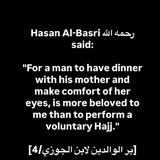
Imam Ibn Al-Jawzi رحمه الله on parent's rights:
وقوله: (وَبِالوَلِدَينِ إِحساناً) هو: البر والإكرام
قال ابن عباس: (لا تنفض ثوبك أمامهما فيصيبها الغبار) .
'𝘈𝘭𝘭𝘢𝘩 𝘒𝘢𝘳𝘦𝘦𝘮 𝘴𝘢𝘪𝘥: '𝘽𝙚 𝙜𝙤𝙤𝙙 𝙩𝙤 𝙮𝙤𝙪𝙧 𝙥𝙖𝙧𝙚𝙣𝙩𝙨.' [𝘘𝘶𝘳'𝘢𝘯 2:83].
𝘐𝘵 𝘮𝘦𝘢𝘯𝘴 𝘸𝘦 𝘴𝘩𝘰𝘶𝘭𝘥 𝘵𝘳𝘦𝘢𝘵 𝘵𝘩𝘦𝘮 𝘸𝘪𝘵𝘩 𝘩𝘰𝘯𝘰𝘶𝘳 𝘢𝘯𝘥 𝘬𝘪𝘯𝘥𝘯𝘦𝘴𝘴.
𝘐𝘣𝘯 𝘈𝘣𝘣𝘢𝘢𝘴 رضي الله عنه 𝘴𝘢𝘪𝘥: '𝘿𝙤 𝙣𝙤𝙩 𝙚𝙫𝙚𝙣 𝙨𝙝𝙖𝙠𝙚 𝙮𝙤𝙪𝙧 𝙘𝙡𝙤𝙩𝙝𝙚𝙨 𝙞𝙣 𝙛𝙧𝙤𝙣𝙩 𝙤𝙛 𝙩𝙝𝙚𝙢, 𝙨𝙤 𝙞𝙩𝙨 𝙙𝙪𝙨𝙩 𝙙𝙤𝙚𝙨 𝙣𝙤𝙩 𝙛𝙖𝙡𝙡 𝙤𝙣 𝙩𝙝𝙚𝙢.'
['Birr al-Walidayn', p. 1].
وقوله: (وَبِالوَلِدَينِ إِحساناً) هو: البر والإكرام
قال ابن عباس: (لا تنفض ثوبك أمامهما فيصيبها الغبار) .
'𝘈𝘭𝘭𝘢𝘩 𝘒𝘢𝘳𝘦𝘦𝘮 𝘴𝘢𝘪𝘥: '𝘽𝙚 𝙜𝙤𝙤𝙙 𝙩𝙤 𝙮𝙤𝙪𝙧 𝙥𝙖𝙧𝙚𝙣𝙩𝙨.' [𝘘𝘶𝘳'𝘢𝘯 2:83].
𝘐𝘵 𝘮𝘦𝘢𝘯𝘴 𝘸𝘦 𝘴𝘩𝘰𝘶𝘭𝘥 𝘵𝘳𝘦𝘢𝘵 𝘵𝘩𝘦𝘮 𝘸𝘪𝘵𝘩 𝘩𝘰𝘯𝘰𝘶𝘳 𝘢𝘯𝘥 𝘬𝘪𝘯𝘥𝘯𝘦𝘴𝘴.
𝘐𝘣𝘯 𝘈𝘣𝘣𝘢𝘢𝘴 رضي الله عنه 𝘴𝘢𝘪𝘥: '𝘿𝙤 𝙣𝙤𝙩 𝙚𝙫𝙚𝙣 𝙨𝙝𝙖𝙠𝙚 𝙮𝙤𝙪𝙧 𝙘𝙡𝙤𝙩𝙝𝙚𝙨 𝙞𝙣 𝙛𝙧𝙤𝙣𝙩 𝙤𝙛 𝙩𝙝𝙚𝙢, 𝙨𝙤 𝙞𝙩𝙨 𝙙𝙪𝙨𝙩 𝙙𝙤𝙚𝙨 𝙣𝙤𝙩 𝙛𝙖𝙡𝙡 𝙤𝙣 𝙩𝙝𝙚𝙢.'
['Birr al-Walidayn', p. 1].
👍15
The Braying Drunkard
Al-‘Awām b. Ḥawshab (148H) – Allāh have mercy on him – said:
I once came to an area in one part of which was a graveyard. After ‘aṣr, one of the graves split open and a man with the head of a donkey and the body of a human came up from it and brayed three times, after which the grave closed back up on him. I then saw an old woman weaving fleece or wool, and a woman said, “Do you see that old woman?” I said, “What about her?” She replied, “That is the mother of this [dead] man.” I asked, “What was his story?” She replied, “He used to drink wine, and whenever he would go out his mother would say, ‘O my son, fear Allāh; until when will you keep drinking wine?’ He would reply, ‘You bray like a donkey.'” The woman said, “He then died after ‘aṣr, so every day after ‘asr the grave opens up and he brays a few times, then the grave closes up on him again.”
Al-Hāfidh Abul-Qāsim Al-Aṣbahānī, Al-Targhīb wa Al-Tarhīb article 471.
Shaykh Nāṣir Al-Dīn Al-Albānī graded this narration ḥasan in his edition of Al-Mundhirī’s Al-Targhīb wa Al-Tarhīb. See Ṣaḥīḥ Al-Targhīb wa Al-Tarhīb ḥadīth 2517.
Al-Mundhirī quotes Al-Aṣbahānī as saying:
This [story] was narrated by Abul-‘Abbās Al-Aṣam in a dictation at Naysābūr, in the presence of great preservers [of traditions] and people of knowledge, and they did not reject it.
Al-‘Awām b. Ḥawshab (148H) – Allāh have mercy on him – said:
I once came to an area in one part of which was a graveyard. After ‘aṣr, one of the graves split open and a man with the head of a donkey and the body of a human came up from it and brayed three times, after which the grave closed back up on him. I then saw an old woman weaving fleece or wool, and a woman said, “Do you see that old woman?” I said, “What about her?” She replied, “That is the mother of this [dead] man.” I asked, “What was his story?” She replied, “He used to drink wine, and whenever he would go out his mother would say, ‘O my son, fear Allāh; until when will you keep drinking wine?’ He would reply, ‘You bray like a donkey.'” The woman said, “He then died after ‘aṣr, so every day after ‘asr the grave opens up and he brays a few times, then the grave closes up on him again.”
Al-Hāfidh Abul-Qāsim Al-Aṣbahānī, Al-Targhīb wa Al-Tarhīb article 471.
Shaykh Nāṣir Al-Dīn Al-Albānī graded this narration ḥasan in his edition of Al-Mundhirī’s Al-Targhīb wa Al-Tarhīb. See Ṣaḥīḥ Al-Targhīb wa Al-Tarhīb ḥadīth 2517.
Al-Mundhirī quotes Al-Aṣbahānī as saying:
This [story] was narrated by Abul-‘Abbās Al-Aṣam in a dictation at Naysābūr, in the presence of great preservers [of traditions] and people of knowledge, and they did not reject it.
👍7
Kids should be shown extreme gentleness and softness - build them up with love and mercy. However softness does not mean, a mother should avoid educating her child on right and wrong. Many children have extremely bad habits, and parents avoid calling them out. The truth is, most parents have very little control over their kids, rather their kids have the most control over their parents. Allowing your children to control you is not a form of love. Many parents give in to their kids unhealthy and harmful demands, just to silence them from throwing tantrums. The habits you instill within your children when they are young will be habits they hold when they are older - do not make it difficult for their adulthood. Their tarbiya is your responsibility. Let it not be, that someone asks them "what did your mother teach you?"
Be upright, stand your ground - and show softness.
Be upright, stand your ground - and show softness.
👍9
Parents Gain from Their Children's Good Deeds, with or without Their Children Intending That
For the most recently edited version of this translation, please see: wp.me/p4lHkd-12e
For the most recently edited version of this translation, please see: wp.me/p4lHkd-12e
👍2